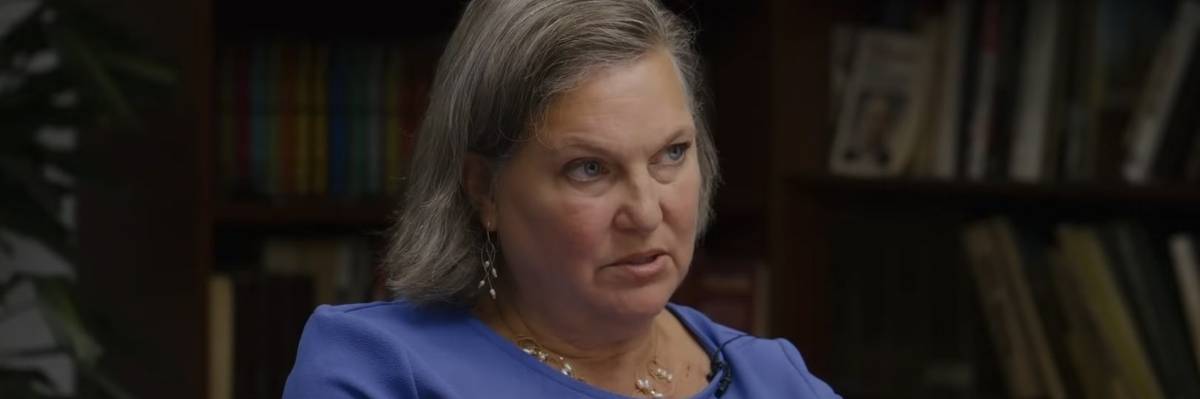
Victoria Nuland, former Under Secretary of State for Political Affairs, during an interview with journalist Mikhail Zygar.
Victoria Nuland Appears to Confirm Key Moment When Peace Deal Was Scuttled in Ukraine
Relitigating these details two years later cannot be dismissed as an exercise in political archeology. More than two years later, the war drags on with no end in sight.
Victoria Nuland, former Under Secretary of State for Political Affairs and one of the principal architects of the Biden administration’s Russia policy, has now opined on what is perhaps the foggiest episode in a war distinguished by a nearly impenetrable kind of diplomatic opacity: the April 2022 Istanbul peace talks between Russia and Ukraine.
Furthermore she acknowledges that there was a deal on the table and that Western powers didn’t like conditions that would have limited Ukraine's military arsenal, lending credence to the theory that Ukraine’s supporters had a hand in ultimately scuttling it.
To be sure, neither the topic nor the content of Nuland’s comments is new. She is but the latest in a cavalcade of high-profile insiders, including former Israeli Prime Minister Nafatli Bennett and Ukrainian politician Davyd Arakhamia, whose testimony has shed light on the external pressures possibly informing the Zelenskyy government’s fateful decision to pull the plug on Turkish-brokered talks surrounding a draft treaty that would have ended the Ukraine war.
But, if we are to arrive at something approximating a full and unprejudiced post-mortem, it remains a necessary even if ungrateful task to carefully catalog all of these accounts — especially one from as influential a Russia policy figure as Nuland.
“Relatively late in the game the Ukrainians began asking for advice on where this thing was going and it became clear to us, clear to the Brits, clear to others that (Russian President Vladimir) Putin's main condition was buried in an annex to this document that they were working on,” she said, referencing Russia’s stipulation for hard caps and other limits on military personnel and types of weaponry that Ukraine can possess.
Such concessions, she argued, should be rejected by Kyiv because they would leave Ukraine “basically neutered as a military force.” She intimated, unsurprisingly without indulging specifics, that these anxieties were expressed by Western officials: “People inside Ukraine and people outside Ukraine started asking questions about whether this was a good deal and it was at that point that it fell apart,” Nuland said.
Just who “outside Ukraine” posed these questions and precisely what effect did these pointed queries exercise on Ukrainian officials? The full story of that short-lived diplomatic interlude is unlikely to be unraveled until after the war, in no small part due to the obvious political sensitivities at play. But there is now what appears to be, even in the most conservative estimation, a large body of circumstantial evidence that Western actors, quite possibly hailing from the UK and other countries which were designated as “guarantors” of Ukraine’s security under the Istanbul draft treaty, expressed reservations about the Istanbul format.
The extent to which these Western reservations were decisive insofar as they constituted a hard veto over the peace talks is a trickier question. One can reasonably surmise that Ukraine would have found it difficult to ink a deal that did not command at least tacit support from the Western countries on which it overwhelmingly relies, but it is no less true that the talks were fraught and, though there were positive signs of a slow convergence between the Moscow and Kyiv on key issues, the two sides were a considerable ways off from fully harmonizing their positions when the deal was terminated.
Victoria Nuland's comments lend further credence to the proposition that a settlement between Russia and Ukraine was on the table in Istanbul, that the West played a role in shaping Ukrainian thinking on the desirability of pursuing negotiations, and that Western leaders apparently conveyed the view that it was a bad deal.
Relitigating these details two years later cannot be dismissed as an exercise in political archeology; the facts of what transpired in Istanbul are as relevant as ever in informing our thinking about endgame scenarios as the war roils into its third year.
We are at a crossroads
This country and this world are at a monumental crossroads. In a few short weeks, US voters will have an opportunity to beat back the forces of fascism and confront the billionaires who are rigging the economy, our media system, and our democracy, making it increasingly impossible for ordinary people to get by. We’re not just talking about the election. We’re talking about what must be done once these fascist elements are vanquished from power. We need a bolder set of solutions than what either major party has so far been willing to offer and a working-class movement ready to fight like hell for it. Trump didn't emerge from nowhere. The conditions that fueled MAGA authoritarianism were created by decades of radical neoliberal economic policies and a corrupt political system dominated by corporate interests. They slashed taxes on the super-rich, promising that the benefits would trickle down. They said giveaways to the corporate titans would make life more affordable for the rest of us. It was all bullshit. And when a bitter, betrayed populace searches for someone to blame, right-wing demagogues have little trouble finding scapegoats. People know when they're being lied to, but you won't hear any of this from the corporate media. Only independent journalism—powered and funded by people who believe in building a better world—can deliver truly trustworthy daily news. Our Fall Campaign is underway, and we need your help. To power our newsroom through the rest of the year, we need to raise $125,000 by midnight on October 31. So if you share our vision, please contribute whatever you can to sustain our work. |
Victoria Nuland, former Under Secretary of State for Political Affairs and one of the principal architects of the Biden administration’s Russia policy, has now opined on what is perhaps the foggiest episode in a war distinguished by a nearly impenetrable kind of diplomatic opacity: the April 2022 Istanbul peace talks between Russia and Ukraine.
Furthermore she acknowledges that there was a deal on the table and that Western powers didn’t like conditions that would have limited Ukraine's military arsenal, lending credence to the theory that Ukraine’s supporters had a hand in ultimately scuttling it.
To be sure, neither the topic nor the content of Nuland’s comments is new. She is but the latest in a cavalcade of high-profile insiders, including former Israeli Prime Minister Nafatli Bennett and Ukrainian politician Davyd Arakhamia, whose testimony has shed light on the external pressures possibly informing the Zelenskyy government’s fateful decision to pull the plug on Turkish-brokered talks surrounding a draft treaty that would have ended the Ukraine war.
But, if we are to arrive at something approximating a full and unprejudiced post-mortem, it remains a necessary even if ungrateful task to carefully catalog all of these accounts — especially one from as influential a Russia policy figure as Nuland.
“Relatively late in the game the Ukrainians began asking for advice on where this thing was going and it became clear to us, clear to the Brits, clear to others that (Russian President Vladimir) Putin's main condition was buried in an annex to this document that they were working on,” she said, referencing Russia’s stipulation for hard caps and other limits on military personnel and types of weaponry that Ukraine can possess.
Such concessions, she argued, should be rejected by Kyiv because they would leave Ukraine “basically neutered as a military force.” She intimated, unsurprisingly without indulging specifics, that these anxieties were expressed by Western officials: “People inside Ukraine and people outside Ukraine started asking questions about whether this was a good deal and it was at that point that it fell apart,” Nuland said.
Just who “outside Ukraine” posed these questions and precisely what effect did these pointed queries exercise on Ukrainian officials? The full story of that short-lived diplomatic interlude is unlikely to be unraveled until after the war, in no small part due to the obvious political sensitivities at play. But there is now what appears to be, even in the most conservative estimation, a large body of circumstantial evidence that Western actors, quite possibly hailing from the UK and other countries which were designated as “guarantors” of Ukraine’s security under the Istanbul draft treaty, expressed reservations about the Istanbul format.
The extent to which these Western reservations were decisive insofar as they constituted a hard veto over the peace talks is a trickier question. One can reasonably surmise that Ukraine would have found it difficult to ink a deal that did not command at least tacit support from the Western countries on which it overwhelmingly relies, but it is no less true that the talks were fraught and, though there were positive signs of a slow convergence between the Moscow and Kyiv on key issues, the two sides were a considerable ways off from fully harmonizing their positions when the deal was terminated.
Victoria Nuland's comments lend further credence to the proposition that a settlement between Russia and Ukraine was on the table in Istanbul, that the West played a role in shaping Ukrainian thinking on the desirability of pursuing negotiations, and that Western leaders apparently conveyed the view that it was a bad deal.
Relitigating these details two years later cannot be dismissed as an exercise in political archeology; the facts of what transpired in Istanbul are as relevant as ever in informing our thinking about endgame scenarios as the war roils into its third year.
- Exit of Victoria Nuland Presents Opportunity for Peace in Ukraine ›
- A Feminist Demand on International Women's Day: Fire Victoria Nuland ›
- The War in Ukraine Was Provoked—and Why That Matters to Achieve Peace ›
- Why Won't the US Help Negotiate a Peaceful End to the War in Ukraine? ›
- Opinion | The Key to Peace in Ukraine Remains What It Has Always Been | Common Dreams ›
- Opinion | If We Want Peace in Ukraine: What Now? | Common Dreams ›
Victoria Nuland, former Under Secretary of State for Political Affairs and one of the principal architects of the Biden administration’s Russia policy, has now opined on what is perhaps the foggiest episode in a war distinguished by a nearly impenetrable kind of diplomatic opacity: the April 2022 Istanbul peace talks between Russia and Ukraine.
Furthermore she acknowledges that there was a deal on the table and that Western powers didn’t like conditions that would have limited Ukraine's military arsenal, lending credence to the theory that Ukraine’s supporters had a hand in ultimately scuttling it.
To be sure, neither the topic nor the content of Nuland’s comments is new. She is but the latest in a cavalcade of high-profile insiders, including former Israeli Prime Minister Nafatli Bennett and Ukrainian politician Davyd Arakhamia, whose testimony has shed light on the external pressures possibly informing the Zelenskyy government’s fateful decision to pull the plug on Turkish-brokered talks surrounding a draft treaty that would have ended the Ukraine war.
But, if we are to arrive at something approximating a full and unprejudiced post-mortem, it remains a necessary even if ungrateful task to carefully catalog all of these accounts — especially one from as influential a Russia policy figure as Nuland.
“Relatively late in the game the Ukrainians began asking for advice on where this thing was going and it became clear to us, clear to the Brits, clear to others that (Russian President Vladimir) Putin's main condition was buried in an annex to this document that they were working on,” she said, referencing Russia’s stipulation for hard caps and other limits on military personnel and types of weaponry that Ukraine can possess.
Such concessions, she argued, should be rejected by Kyiv because they would leave Ukraine “basically neutered as a military force.” She intimated, unsurprisingly without indulging specifics, that these anxieties were expressed by Western officials: “People inside Ukraine and people outside Ukraine started asking questions about whether this was a good deal and it was at that point that it fell apart,” Nuland said.
Just who “outside Ukraine” posed these questions and precisely what effect did these pointed queries exercise on Ukrainian officials? The full story of that short-lived diplomatic interlude is unlikely to be unraveled until after the war, in no small part due to the obvious political sensitivities at play. But there is now what appears to be, even in the most conservative estimation, a large body of circumstantial evidence that Western actors, quite possibly hailing from the UK and other countries which were designated as “guarantors” of Ukraine’s security under the Istanbul draft treaty, expressed reservations about the Istanbul format.
The extent to which these Western reservations were decisive insofar as they constituted a hard veto over the peace talks is a trickier question. One can reasonably surmise that Ukraine would have found it difficult to ink a deal that did not command at least tacit support from the Western countries on which it overwhelmingly relies, but it is no less true that the talks were fraught and, though there were positive signs of a slow convergence between the Moscow and Kyiv on key issues, the two sides were a considerable ways off from fully harmonizing their positions when the deal was terminated.
Victoria Nuland's comments lend further credence to the proposition that a settlement between Russia and Ukraine was on the table in Istanbul, that the West played a role in shaping Ukrainian thinking on the desirability of pursuing negotiations, and that Western leaders apparently conveyed the view that it was a bad deal.
Relitigating these details two years later cannot be dismissed as an exercise in political archeology; the facts of what transpired in Istanbul are as relevant as ever in informing our thinking about endgame scenarios as the war roils into its third year.
- Exit of Victoria Nuland Presents Opportunity for Peace in Ukraine ›
- A Feminist Demand on International Women's Day: Fire Victoria Nuland ›
- The War in Ukraine Was Provoked—and Why That Matters to Achieve Peace ›
- Why Won't the US Help Negotiate a Peaceful End to the War in Ukraine? ›
- Opinion | The Key to Peace in Ukraine Remains What It Has Always Been | Common Dreams ›
- Opinion | If We Want Peace in Ukraine: What Now? | Common Dreams ›