SUBSCRIBE TO OUR FREE NEWSLETTER
Daily news & progressive opinion—funded by the people, not the corporations—delivered straight to your inbox.
5
#000000
#FFFFFF
To donate by check, phone, or other method, see our More Ways to Give page.
Daily news & progressive opinion—funded by the people, not the corporations—delivered straight to your inbox.
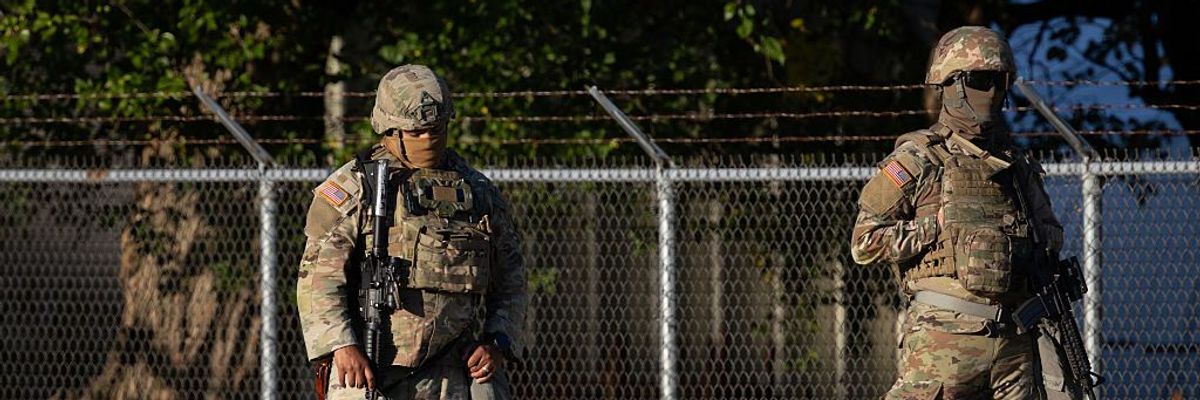
Members of the Texas National Guard stand guard at an Army Reserve training facility on October 7, 2025 in Elwood, Illinois.
"Trump is losing his grip on the dictatorial power he so covets," said one legal analyst.
The US Supreme Court on Tuesday dealt President Donald Trump a major loss by rejecting the administration's request to strike down a temporary restraining order that barred him from deploying the National Guard in Chicago.
In a 6-3 ruling that featured dissents from Justices Neil Gorsuch, Samuel Alito, and Clarence Thomas, the Supreme Court determined that the Trump administration had not met statutory requirements needed to justify deploying the National Guard in a state over the objections of its own government.
The court noted that the administration justified its Illinois deployment—pursued alongside a federal crackdown on undocumented immigrants in and around the state's largest city—by pointing to a law stating that the president may federalize the National Guard in the event that he is "unable with the regular forces to execute the laws of the United States."
However, the court found that the "regular forces" referenced in the statute refers to the US military, not civilian law enforcement officials. This is relevant because the president faces significant restrictions on his ability to deploy the military domestically under the Posse Comitatus Act.
"Because the statute requires an assessment of the military’s ability to execute the laws, it likely applies only where the military could legally execute the laws," the justices wrote. "Such circumstances are exceptional: Under the Posse Comitatus Act, the military is prohibited from 'execut[ing] the laws' 'except in cases and under circumstances expressly authorized by the Constitution or act of Congress.'"
The justices further said that the Trump administration so far "has failed to identify a source of authority that would allow the military to execute the laws in Illinois" and has not invoked any statute that would provide an exception to the Posse Comitatus Act.
In conclusion, the court wrote that the federal government "has not carried its burden to show" that the law "permits the president to federalize the guard in the exercise of inherent authority to protect federal personnel and property in Illinois."
Illinois Attorney General Kwame Raoul, who had sued the Trump administration over the deployment, cheered the ruling and said that "the extremely limited circumstances under which the federal government can call up the militia over a state's objection do not exist in Illinois."
Raoul added that he was "pleased that the streets of Illinois will remain free of armed National Guard members as our litigation continues in the courts."
Glenn Kirschner, a former federal prosecutor, celebrated the Supreme Court's ruling as a victory for the rule of law.
"Trump is losing his grip on the dictatorial power he so covets," Kirschner commented on X.
Aaron Reichlin-Melnick, a senior fellow at the American Immigration Council, said he was "genuinely shocked" by the court's ruling, and he credited an amicus brief written by Georgetown University Law Center professor Marty Lederman with swaying the court, as it centered the definition of "regular forces" in the statute as central to determining the legality of Trump's actions.
Lisa Gilbert, co-president of Public Citizen and co-chair of the Not Above the Law Coalition, hailed the court's ruling but warned that the danger posed by the Trump administration's authoritarian ambitions has not ended.
"With a lawful administration that understood the limits of executive power, this would be the end of the question," she said of the ruling. "Unfortunately, we are living under an authoritarian regime that persists in every possible effort to expand its power and override guardrails. With an administration that displays utter disregard for the Constitution, we must now watch diligently how it will respond to a decisive Supreme Court decision against its lawless power grab."
Dear Common Dreams reader, It’s been nearly 30 years since I co-founded Common Dreams with my late wife, Lina Newhouser. We had the radical notion that journalism should serve the public good, not corporate profits. It was clear to us from the outset what it would take to build such a project. No paid advertisements. No corporate sponsors. No millionaire publisher telling us what to think or do. Many people said we wouldn't last a year, but we proved those doubters wrong. Together with a tremendous team of journalists and dedicated staff, we built an independent media outlet free from the constraints of profits and corporate control. Our mission has always been simple: To inform. To inspire. To ignite change for the common good. Building Common Dreams was not easy. Our survival was never guaranteed. When you take on the most powerful forces—Wall Street greed, fossil fuel industry destruction, Big Tech lobbyists, and uber-rich oligarchs who have spent billions upon billions rigging the economy and democracy in their favor—the only bulwark you have is supporters who believe in your work. But here’s the urgent message from me today. It's never been this bad out there. And it's never been this hard to keep us going. At the very moment Common Dreams is most needed, the threats we face are intensifying. We need your support now more than ever. We don't accept corporate advertising and never will. We don't have a paywall because we don't think people should be blocked from critical news based on their ability to pay. Everything we do is funded by the donations of readers like you. When everyone does the little they can afford, we are strong. But if that support retreats or dries up, so do we. Will you donate now to make sure Common Dreams not only survives but thrives? —Craig Brown, Co-founder |
The US Supreme Court on Tuesday dealt President Donald Trump a major loss by rejecting the administration's request to strike down a temporary restraining order that barred him from deploying the National Guard in Chicago.
In a 6-3 ruling that featured dissents from Justices Neil Gorsuch, Samuel Alito, and Clarence Thomas, the Supreme Court determined that the Trump administration had not met statutory requirements needed to justify deploying the National Guard in a state over the objections of its own government.
The court noted that the administration justified its Illinois deployment—pursued alongside a federal crackdown on undocumented immigrants in and around the state's largest city—by pointing to a law stating that the president may federalize the National Guard in the event that he is "unable with the regular forces to execute the laws of the United States."
However, the court found that the "regular forces" referenced in the statute refers to the US military, not civilian law enforcement officials. This is relevant because the president faces significant restrictions on his ability to deploy the military domestically under the Posse Comitatus Act.
"Because the statute requires an assessment of the military’s ability to execute the laws, it likely applies only where the military could legally execute the laws," the justices wrote. "Such circumstances are exceptional: Under the Posse Comitatus Act, the military is prohibited from 'execut[ing] the laws' 'except in cases and under circumstances expressly authorized by the Constitution or act of Congress.'"
The justices further said that the Trump administration so far "has failed to identify a source of authority that would allow the military to execute the laws in Illinois" and has not invoked any statute that would provide an exception to the Posse Comitatus Act.
In conclusion, the court wrote that the federal government "has not carried its burden to show" that the law "permits the president to federalize the guard in the exercise of inherent authority to protect federal personnel and property in Illinois."
Illinois Attorney General Kwame Raoul, who had sued the Trump administration over the deployment, cheered the ruling and said that "the extremely limited circumstances under which the federal government can call up the militia over a state's objection do not exist in Illinois."
Raoul added that he was "pleased that the streets of Illinois will remain free of armed National Guard members as our litigation continues in the courts."
Glenn Kirschner, a former federal prosecutor, celebrated the Supreme Court's ruling as a victory for the rule of law.
"Trump is losing his grip on the dictatorial power he so covets," Kirschner commented on X.
Aaron Reichlin-Melnick, a senior fellow at the American Immigration Council, said he was "genuinely shocked" by the court's ruling, and he credited an amicus brief written by Georgetown University Law Center professor Marty Lederman with swaying the court, as it centered the definition of "regular forces" in the statute as central to determining the legality of Trump's actions.
Lisa Gilbert, co-president of Public Citizen and co-chair of the Not Above the Law Coalition, hailed the court's ruling but warned that the danger posed by the Trump administration's authoritarian ambitions has not ended.
"With a lawful administration that understood the limits of executive power, this would be the end of the question," she said of the ruling. "Unfortunately, we are living under an authoritarian regime that persists in every possible effort to expand its power and override guardrails. With an administration that displays utter disregard for the Constitution, we must now watch diligently how it will respond to a decisive Supreme Court decision against its lawless power grab."
The US Supreme Court on Tuesday dealt President Donald Trump a major loss by rejecting the administration's request to strike down a temporary restraining order that barred him from deploying the National Guard in Chicago.
In a 6-3 ruling that featured dissents from Justices Neil Gorsuch, Samuel Alito, and Clarence Thomas, the Supreme Court determined that the Trump administration had not met statutory requirements needed to justify deploying the National Guard in a state over the objections of its own government.
The court noted that the administration justified its Illinois deployment—pursued alongside a federal crackdown on undocumented immigrants in and around the state's largest city—by pointing to a law stating that the president may federalize the National Guard in the event that he is "unable with the regular forces to execute the laws of the United States."
However, the court found that the "regular forces" referenced in the statute refers to the US military, not civilian law enforcement officials. This is relevant because the president faces significant restrictions on his ability to deploy the military domestically under the Posse Comitatus Act.
"Because the statute requires an assessment of the military’s ability to execute the laws, it likely applies only where the military could legally execute the laws," the justices wrote. "Such circumstances are exceptional: Under the Posse Comitatus Act, the military is prohibited from 'execut[ing] the laws' 'except in cases and under circumstances expressly authorized by the Constitution or act of Congress.'"
The justices further said that the Trump administration so far "has failed to identify a source of authority that would allow the military to execute the laws in Illinois" and has not invoked any statute that would provide an exception to the Posse Comitatus Act.
In conclusion, the court wrote that the federal government "has not carried its burden to show" that the law "permits the president to federalize the guard in the exercise of inherent authority to protect federal personnel and property in Illinois."
Illinois Attorney General Kwame Raoul, who had sued the Trump administration over the deployment, cheered the ruling and said that "the extremely limited circumstances under which the federal government can call up the militia over a state's objection do not exist in Illinois."
Raoul added that he was "pleased that the streets of Illinois will remain free of armed National Guard members as our litigation continues in the courts."
Glenn Kirschner, a former federal prosecutor, celebrated the Supreme Court's ruling as a victory for the rule of law.
"Trump is losing his grip on the dictatorial power he so covets," Kirschner commented on X.
Aaron Reichlin-Melnick, a senior fellow at the American Immigration Council, said he was "genuinely shocked" by the court's ruling, and he credited an amicus brief written by Georgetown University Law Center professor Marty Lederman with swaying the court, as it centered the definition of "regular forces" in the statute as central to determining the legality of Trump's actions.
Lisa Gilbert, co-president of Public Citizen and co-chair of the Not Above the Law Coalition, hailed the court's ruling but warned that the danger posed by the Trump administration's authoritarian ambitions has not ended.
"With a lawful administration that understood the limits of executive power, this would be the end of the question," she said of the ruling. "Unfortunately, we are living under an authoritarian regime that persists in every possible effort to expand its power and override guardrails. With an administration that displays utter disregard for the Constitution, we must now watch diligently how it will respond to a decisive Supreme Court decision against its lawless power grab."