SUBSCRIBE TO OUR FREE NEWSLETTER
Daily news & progressive opinion—funded by the people, not the corporations—delivered straight to your inbox.
5
#000000
#FFFFFF
To donate by check, phone, or other method, see our More Ways to Give page.
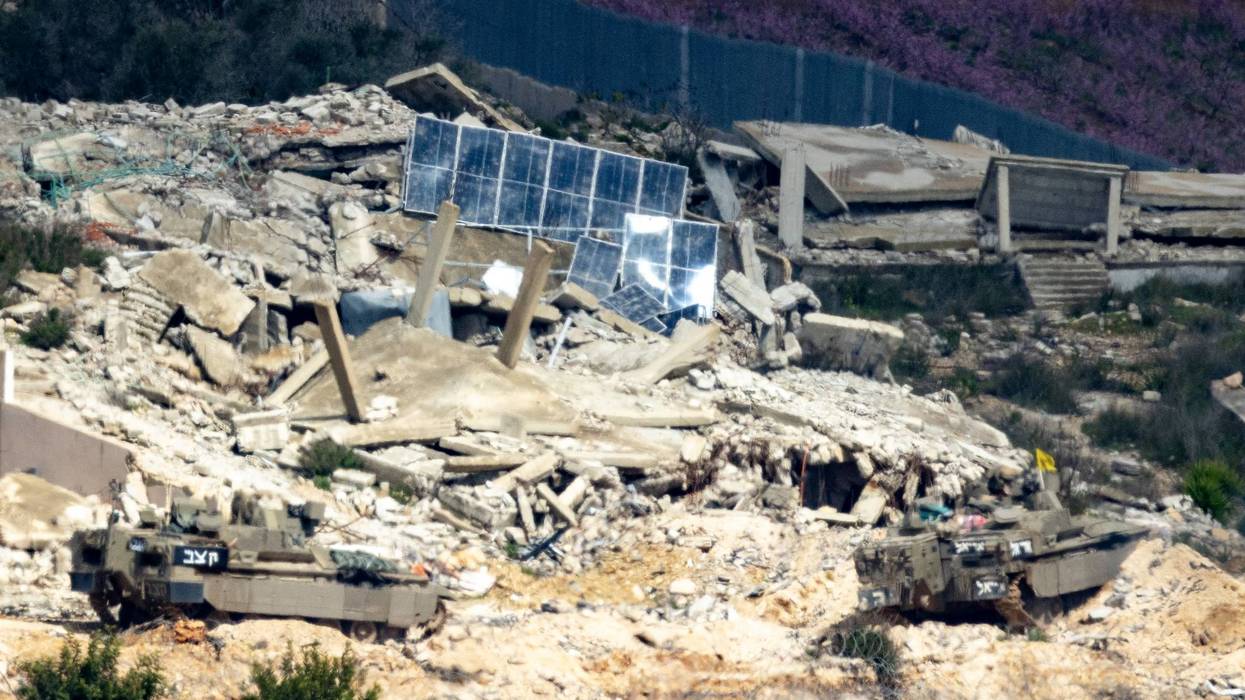
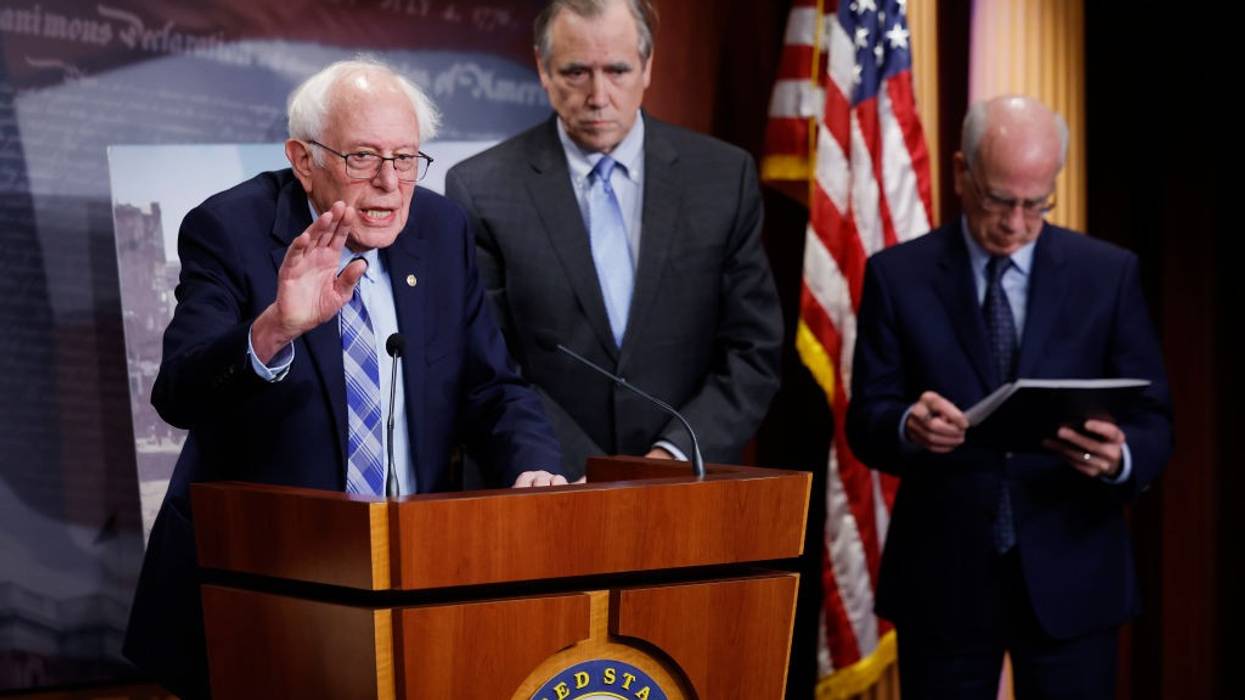
“Given the horrific destruction that Israel’s extremist government has wrought on Gaza, Iran, and Lebanon, the last thing in the world that American taxpayers need to do right now is to provide 22,000 new bombs to the [Benjamin] Netanyahu government,” Sanders said in a statement.
Van Hollen added that “Congress must use all the tools at our disposal to end Trump’s war, including stopping the transfer… of taxpayer-funded bombs to the Netanyahu government.”
All told, US taxpayers funded $17.8 billion in arms sales to Israel under President Joe Biden—$11.9 billion government-brokered and $5.9 billion commercial—81% of the $22 billion in sales from 2021-2024.
The senators are right to highlight US taxpayers’ role in these arms deals. That they’re reported as sales belies who’s actually paying for them. Americans, not Israelis, pay for the vast majority of US arms sales to Israel.
US arms sales to Israel aren’t really sales, at least not in the typical sense. Israel’s position as purchaser in these weapons deals isn’t synonymous with funder. This is made clear in the arms sales notifications themselves.
Consider the four most recent notified arms sales to Israel published in the Federal Register: $740 million for armored personnel carriers, $1.98 billion for tactical vehicles and accessories, $3.8 billion for attack helicopters and related weaponry, and $150 million for utility helicopters and parts. After “Prospective Purchaser,” all these notifications list Government of Israel. After “Funding Source,” all list Foreign Military Financing—or FMF, the US military aid program through which Israel receives at least $3.3 billion a year.
In practice, FMF functions as a gift card for Israel to spend on weapons. US taxpayers are stuck paying for the gift card. The only trace of Israeli funding in those $6.7 billion in arms sales is in the tactical vehicle deal, where National Funds follows FMF on the funding source line.
What about the pair of sales including 22,000 bombs, objected to by Sanders, et al.? Both deals are funded by FMF, or in other words, US taxpayers.
This is, of course, a small sample size. But four years of arms sales data tell the same story: Israel doesn’t pay for most of the weapons the US sells it—US taxpayers do.
This fact undermines the economic justification for these arms sales. By foreclosing any claims that they bring significant foreign investment into the US, the case for these sales collapses into the same flawed job creations argument that many hawks use to defend lavish government spending on the military.
The jobs argument is itself a tacit admission of a weak national security justification. A policy that truly concerned the nation’s very existence wouldn’t have to be sold in terms as banal as job creation. The security justification alone would be convincing enough.
Military spending is the least efficient way a government can create jobs. Using military aid to boost employment is like buying a plane ticket to watch a film: Yes, there’s an in-flight movie; no, that doesn’t justify the expense.
Even that analogy is generous. The relationship between military spending and jobs is not self-evident. In 1985, the US military budget was $295 billion—$746 billion in today’s dollars—and there were 3 million workers in the US arms industry. By 2021, the US military budget had increased by $132 billion in real terms—to $879 billion—while the number of arms industry workers had dropped to 1.1 million. Despite military spending increasing 18% above inflation, there was a 63% drop in arms industry employment.
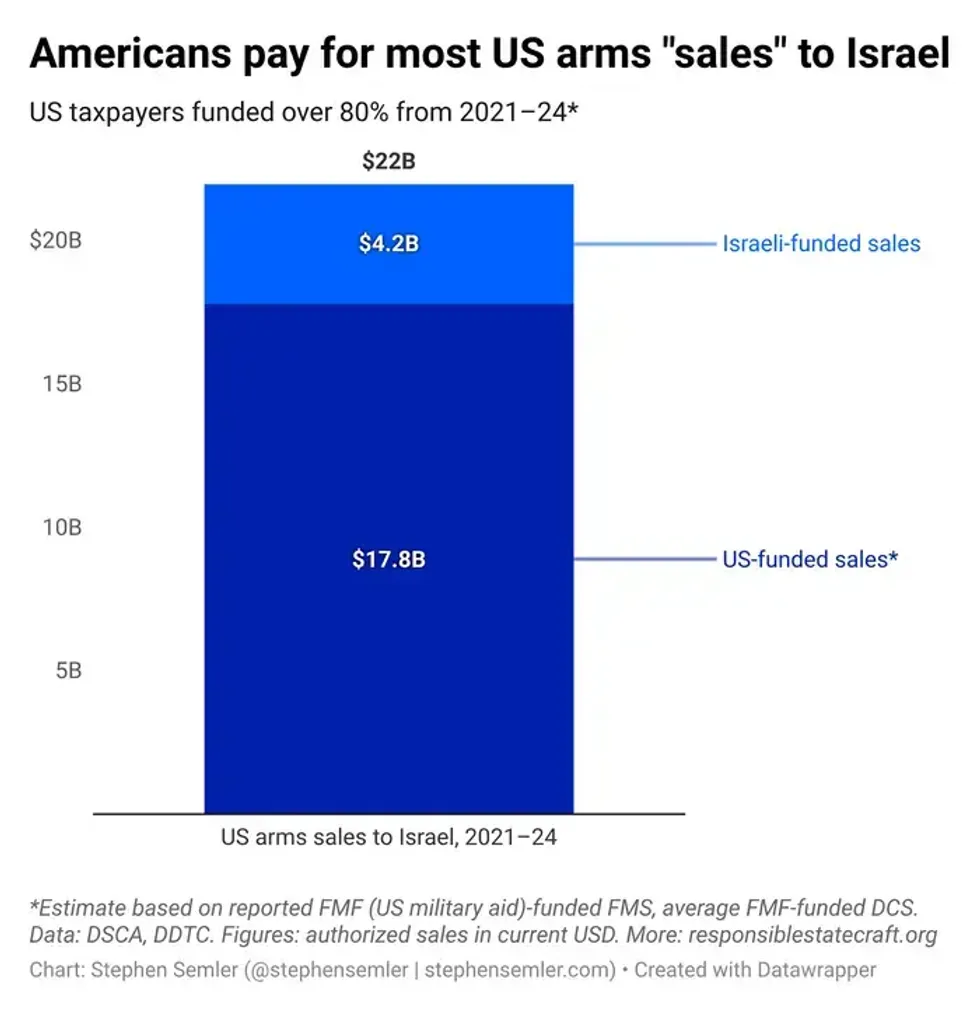
American arms sales are either US government brokered (“Foreign Military Sales”) or commercial (“Direct Commercial Sales”). I collected data on both via the Defense Security Cooperation Agency’s (DSCA) Historical Sales Books and the Directorate of Defense Trade Controls’ (DDTC) Section 655 Reports, respectively. Both yearly publications tally the value of authorized arms sales.
The Biden administration authorized $22 billion in arms sales to Israel, including more than $13.2 billion in US government-brokered sales and over $8.7 billion in commercial sales. According to the DSCA report, 90% of the government-brokered deals were funded with US military aid. The DDTC report doesn’t specify the funding source, but 68% is a reasonable estimate based on the average annual share of FMF funding that Israel reportedly spends on commercial sales.
All told, US taxpayers funded $17.8 billion in arms sales to Israel under President Joe Biden—$11.9 billion government-brokered and $5.9 billion commercial—81% of the $22 billion in sales from 2021-2024. That’s nearly $18 billion in subsidies disguised as sales.
US taxpayers deserve a refund, not more of the same from Trump.

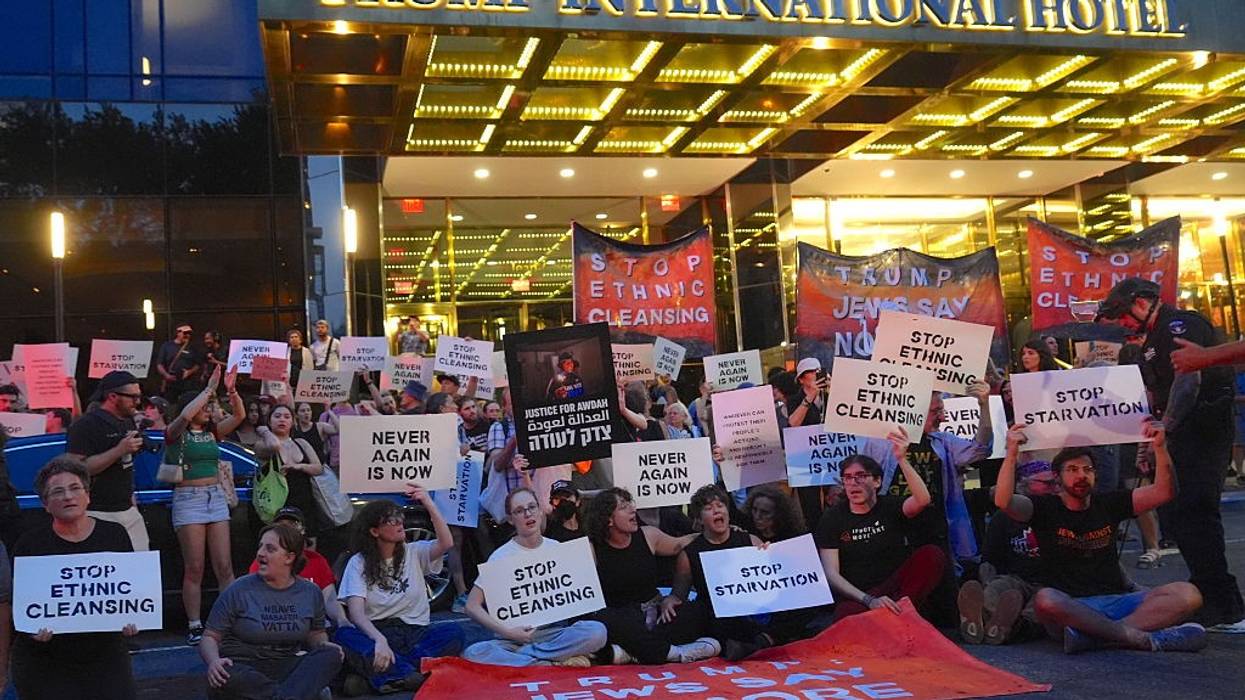
"The carnage the Israeli government is inflicting on the people of Gaza is unbearable. Palestinians in Gaza are suffering catastrophic levels of widespread starvation," IfNotNow wrote on social media. "Israeli troops have killed over 1,000 starving Palestinians lining up for scant aid at U.S.-backed sites. Haaretz reports that these 'food aid massacres' are a command decision. This is an atrocity of the gravest sort."
"Some Jewish communal leaders declare it a betrayal to Judaism to cry out against these injustices," the group added. "We consider it a betrayal to Judaism not to. For our collective sake. For the sake of those suffering. For the sake of each of our souls, we say NO MORE."
The demonstration, which started at Columbus Circle before moving closer to President Donald Trump's hotel, featured remarks from Jewish organizers, commentators, and political figures, including New York City Comptroller Brad Lander.
IfNotNow said that more than 40 were arrested at the demonstration, which the group called a product of "the broadest tent coalition in the Jewish community against the atrocities in Gaza in the last two years, representing the vast majority of U.S. Jews who are outraged by the actions of the Israeli government in Gaza."
 NYPD officers arrest activists protesting Israel's war on Gaza outside the Trump International Hotel in New York City. (Photo: Mostafa Bassim/Anadolu via Getty Images)
Monday's protest came days after 50 people were arrested at the Manhattan offices of U.S. Sens. Kirsten Gillibrand and Chuck Schumer during a demonstration against the lawmakers' continued support for arming the Israeli military. A day earlier, the two Democratic senators voted against a pair of resolutions led by Sen. Bernie Sanders (I-Vt.) that would have halted the Trump administration's sale of 1,000-pound bombs, assault rifles, and other weaponry to the Israeli government.
But a majority of Senate Democrats voted for the resolutions, a signal that lawmakers are beginning to respond as U.S. public support for Israel's war on Gaza continues to fall. A Gallup survey released last month found that just 32% of Americans—including a mere 8% of Democrats—support the assault, a new low.
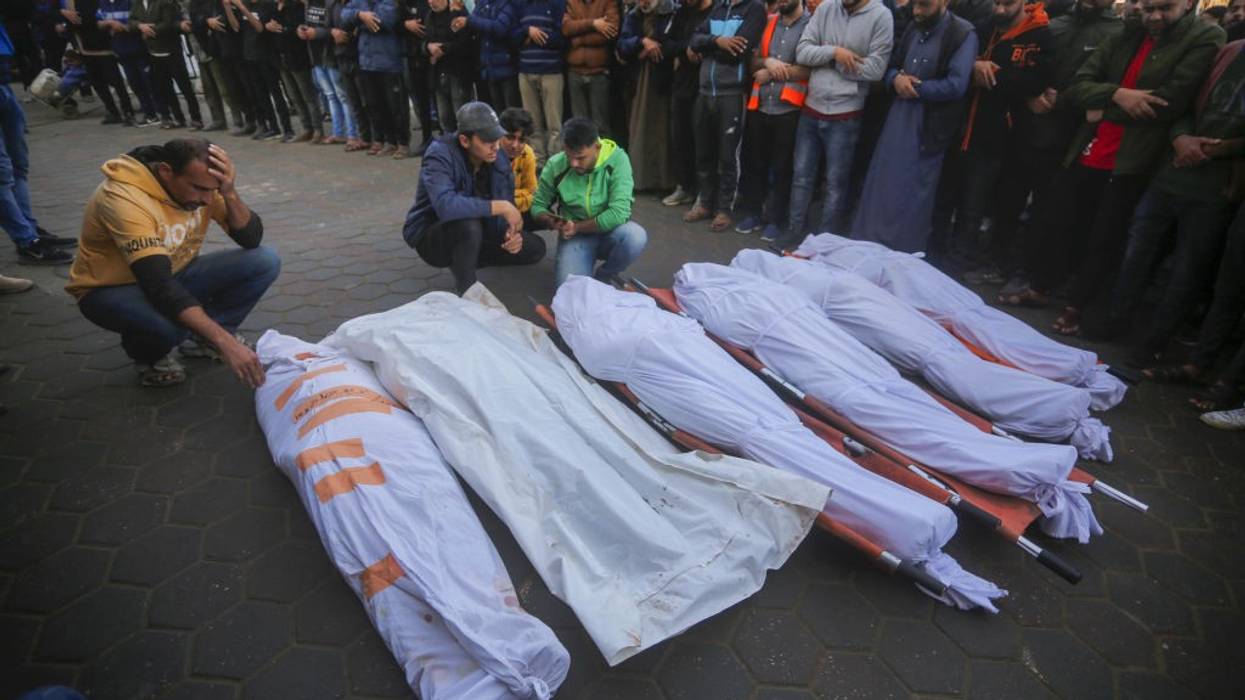
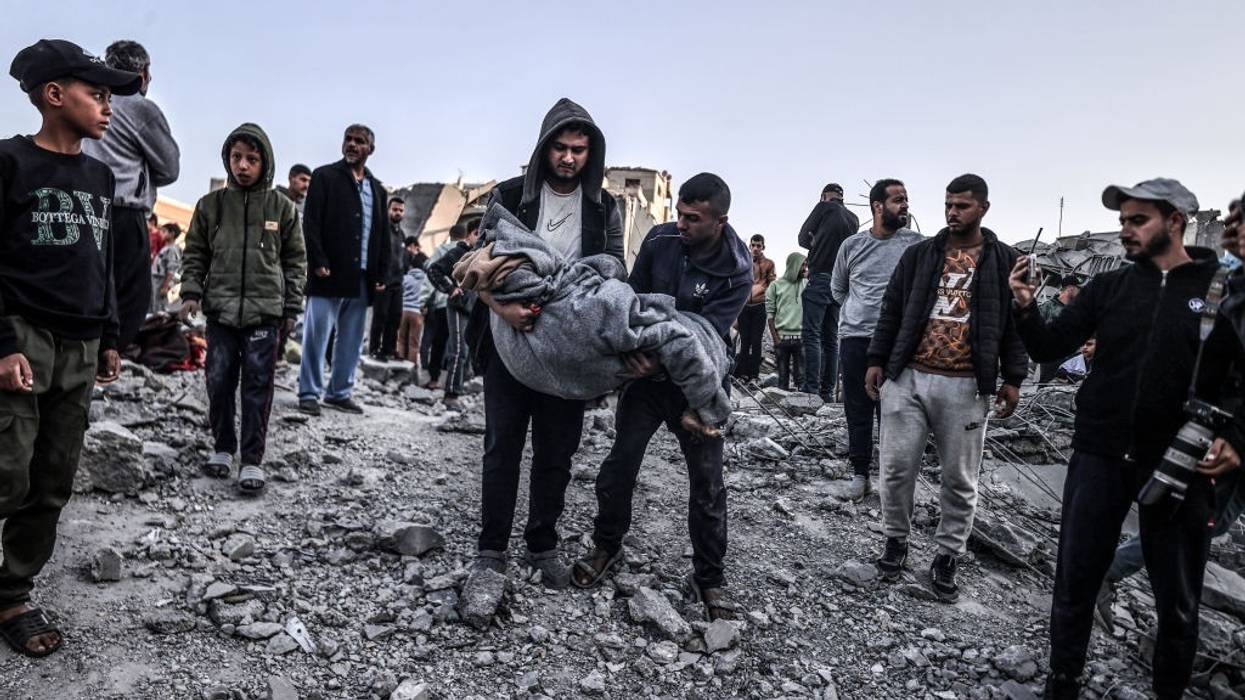
Meanwhile, the government of Israeli Prime Minister Benjamin Netanyahu is considering expanding its assault on an enclave that is already utterly devastated, with more than 90% of residential buildings damaged or destroyed, hundreds of thousands of people killed or injured, and famine conditions fueled by Israel's blockade spreading rapidly.
“We need to keep up the pressure and get more food and aid into Gaza NOW before more Palestinians die of starvation,” T'ruah, an organization of rabbis that took part in Monday's protest, said in a statement. "This event is a mass mobilization of American Jews who object to our government's continued support for the policy of starvation and refusal to leverage its immense power to compel the admission of humanitarian aid."
Reuters reported Monday that Netanyahu "will convene his security cabinet this week to decide on Israel's next steps in Gaza following the collapse of indirect cease-fire talks with Hamas, with one senior Israeli source suggesting more force could be an option."
"Last Saturday, during a visit to the country, U.S. Middle East envoy Steve Witkoff had said he was working with the Israeli government on a plan that would effectively end the war in Gaza," Reuters noted. "But Israeli officials have also floated ideas including expanding the military offensive in Gaza and annexing parts of the shattered enclave."

The State Department formally notified Congress of the proposed sale late last week, and reports indicate that the latest weapons package Joint Direct Attack Munitions (JDAMs), missiles for attack helicopters, and 500-pound bombs.
The new sale adds to the tens of billions of dollars worth of arms and other military assistance the U.S. has provided Israel since its large-scale assault on the Gaza Strip began in the wake of the Hamas-led October 7, 2023 attack. In at least two cases, the Biden administration bypassed Congress to deliver the weapons to Israel.
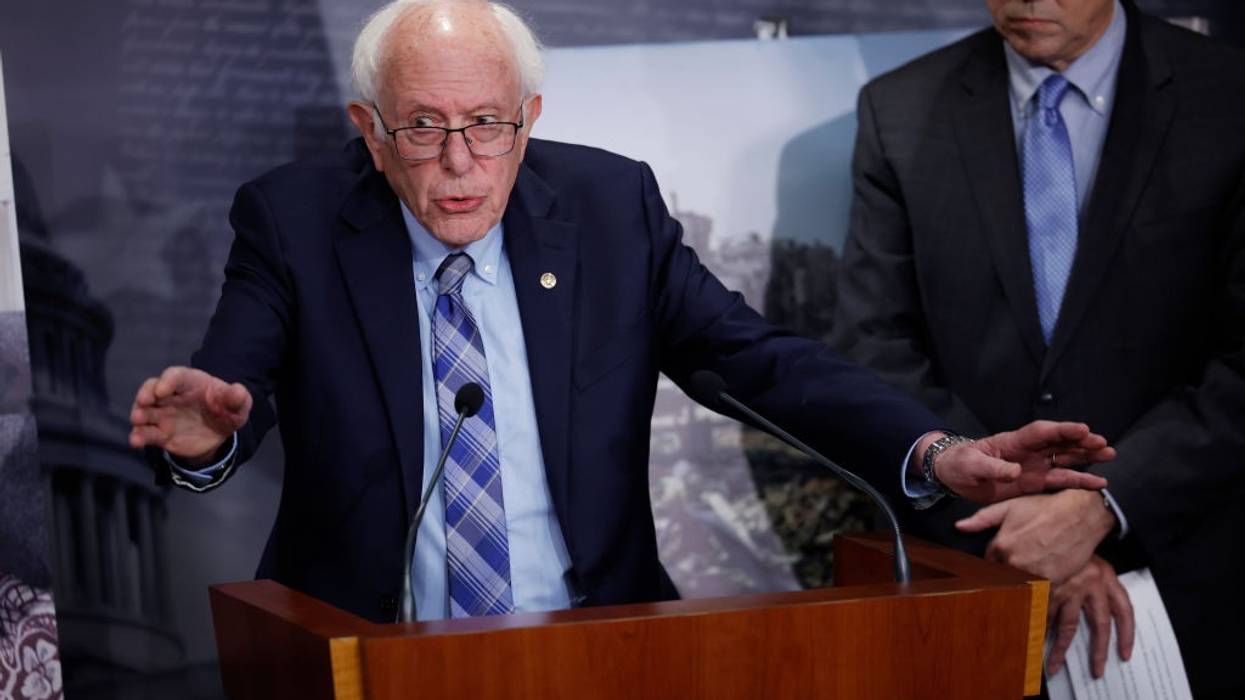
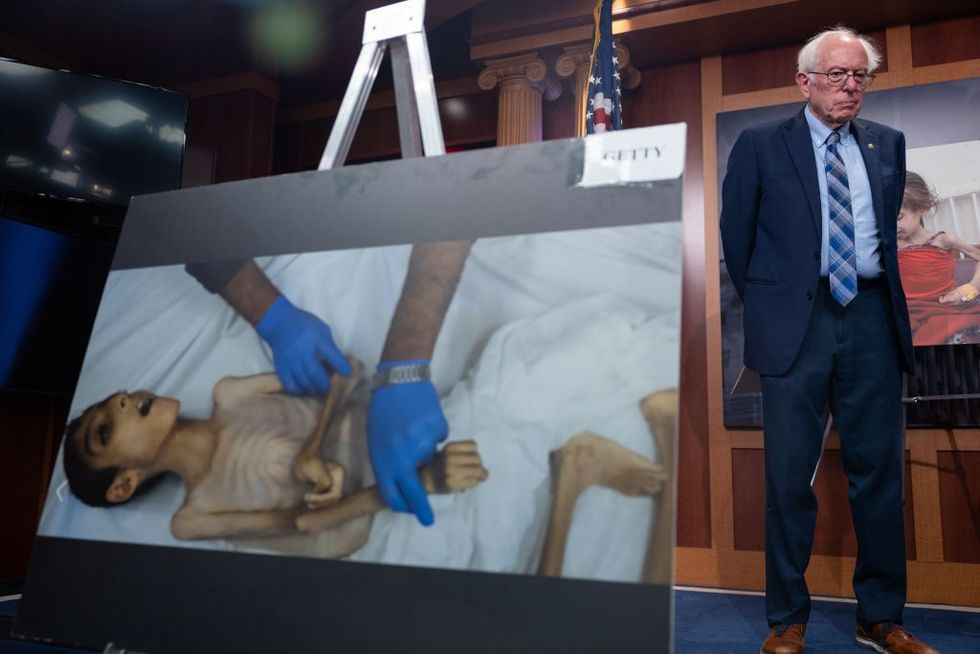 Sen. Bernie Sanders (I-Vt.) is seen at a press conference on his effort to block U.S. arms sales to Israel on November 19, 2024. (Photo: Nathan Posner/Anadolu via Getty Images)
Sanders is one of the few members of Congress who has vocally opposed continued offensive weapons sales to Israel and attempted to block the transactions, arguing that they violate U.S. laws prohibiting arms transfers to countries blocking American humanitarian aid.
Late last year, the U.S. Senate rejected a Sanders-led effort to thwart a sale of JDAMs, tank rounds, and other weaponry.
The newly proposed $8 billion weapons sale comes just days before U.S. President Joe Biden is set to leave office, which Haaretz correspondent Ben Samuels called "a fitting end to four years of policy that seemed to please no one and antagonize anyone unhappy with the status quo."
"The proposed arms sale is yet another wrinkle after a series of missed opportunities to press the Israeli government as hostages remain captive and Gaza's humanitarian crisis worsens," Samuels wrote.
In a statement on Monday, a top United Nations humanitarian relief official said that "despite our determination to deliver food, water, and medicine to survivors, our efforts to save lives are at breaking point."
Tom Fletcher, the U.N.'s under-secretary-general for humanitarian affairs and emergency relief coordinator, pointed to several recent Israeli attacks on aid operations in Gaza, including a strike "at a known food distribution point where a partner of the World Food Program was operating" and an attack on a clearly marked WFP convoy.
"These incidents are part of a dangerous pattern of sabotage and deliberate disruption," said Fletcher. "Israeli forces are unable or unwilling to ensure the safety of our convoys. Statements by Israeli authorities vilify our aid workers even as the military attacks them. Community volunteers who accompany our convoys are being targeted."
"I call on U.N. member states to insist that all civilians, and all humanitarian operations, are protected," Fletcher added. "This should not need to be said."
The group's investigators visited the Hasbaya Village Club Resort, the target of the strike, and found no evidence that the compound was being used for military activity, undercutting Israel's initial claim that it hit a building from which "terrorists were operating."
HRW also said it reviewed information indicating that Israel's military "knew or should have known" that journalists were staying in the compound. Journalists who were at the compound when Israel's strike hit said the Israeli military did not issue a warning ahead of the attack.
"All the indications show that this would have been a deliberate targeting of journalists: a war crime."
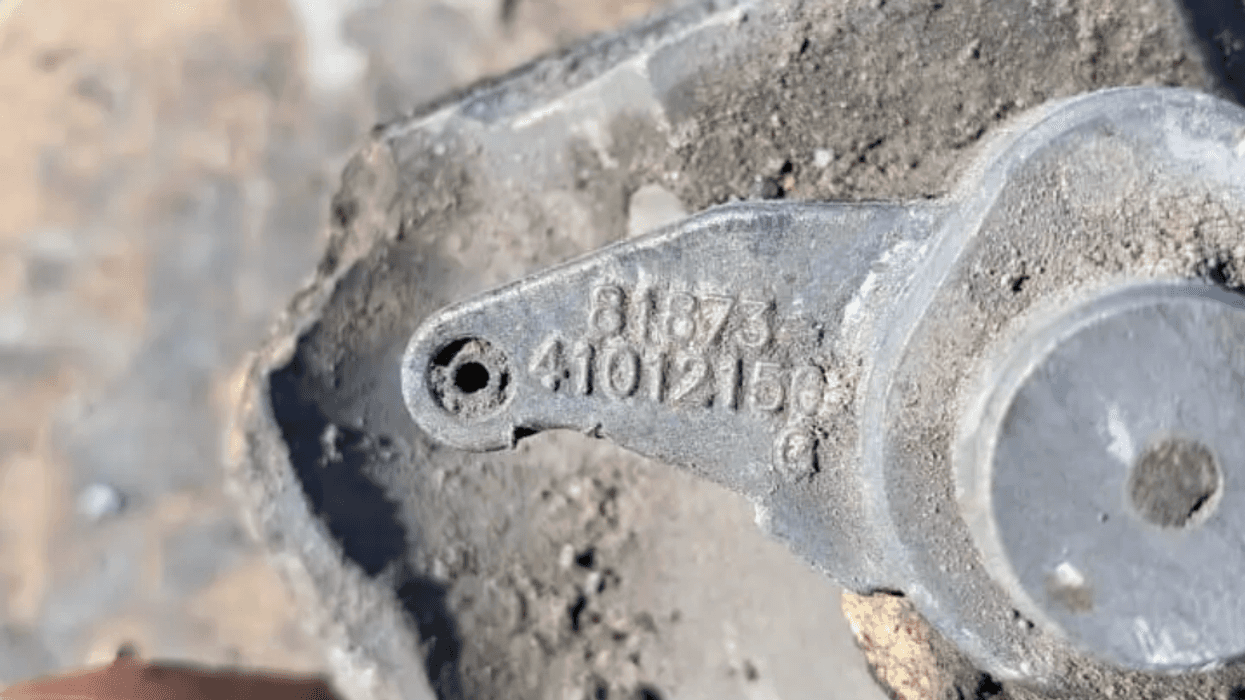
The airstrike killed at least three journalists and injured several others. Remnants from the scene of the strike collected by the targeted resort's owner were "consistent" with Joint Direct Attack Munitions (JDAMs) that the U.S. has provided to the Israeli military.
One fragment, according to HRW "bore a numerical code identifying it as having been manufactured by Woodard, a U.S. company that makes components for guidance systems on munitions." Boeing, a major U.S. military contractor, assembles and sells JDAMs, which are attached to bombs with the stated goal of making airstrikes more precise.
Other remnants HRW reviewed were consistent with materials from a 500-pound bomb equipped with a JDAM.
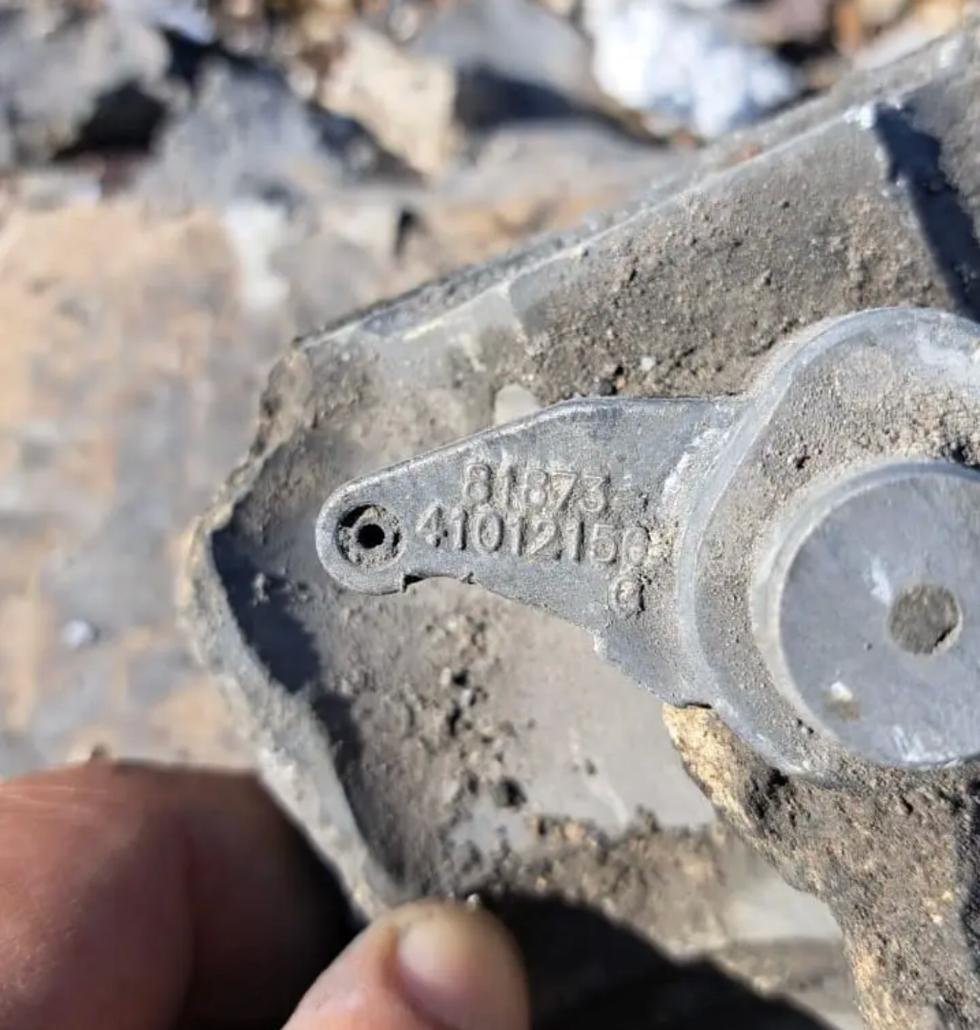 A bomb remnant retrieved following Israel's October 25, 2024 attack. (Photo: Anoir Ghaida via Human Rights Watch)
Richard Weir, a senior researcher at HRW, said in a statement Monday that "Israel's use of U.S. arms to unlawfully attack and kill journalists away from any military target is a terrible mark on the United States as well as Israel."
"The Israeli military's previous deadly attacks on journalists without any consequences give little hope for accountability in this or future violations against the media," said Weir. "As evidence mounts of Israel's unlawful use of U.S. weapons, including in apparent war crimes, U.S. officials need to decide whether they will uphold U.S. and international law by halting arms sales to Israel or risk being found legally complicit in serious violations."
The Guardian conducted a separate investigation of the Israeli strike and reached conclusions mirroring HRW's, reporting Monday that "Israel used a U.S. munition to target and kill three journalists and wound three."
"On 25 October at 3:19 am, an Israeli jet shot two bombs at a chalet hosting three journalists—cameraman Ghassan Najjar and technician Mohammad Reda from pro-Hezbollah outlet al-Mayadeen, as well as cameraman Wissam Qassem from the Hezbollah-affiliated outlet al-Manar," the newspaper observed. "All three were killed in their sleep in the attack which also wounded three other journalists from different outlets staying nearby. There was no fighting in the area before or at the time of the strike."
Nadim Houry, a human rights lawyer and executive director of the Arab Reform Initiative, told The Guardian that "all the indications show that this would have been a deliberate targeting of journalists: a war crime."
"This was clearly delineated as a place where journalists were staying," Houry said.
The findings were published just days after the U.S. Senate voted down an effort led by Sen. Bernie Sanders (I-Vt.) to block new sales of American weaponry to Israel. One of the resolutions put forth by Sanders would have blocked the imminent transfer of over $260 million worth of JDAMs to Israel's military.
In a fact sheet, Sanders' office pointed to six examples in which Israel's military used JDAMs in deadly attacks on civilians in Gaza and Lebanon, including children.
"The United States is complicit in these atrocities," Sanders said in a floor speech ahead of last week's vote. "That complicity must end."