

SUBSCRIBE TO OUR FREE NEWSLETTER
Daily news & progressive opinion—funded by the people, not the corporations—delivered straight to your inbox.
5
#000000
#FFFFFF
To donate by check, phone, or other method, see our More Ways to Give page.
Daily news & progressive opinion—funded by the people, not the corporations—delivered straight to your inbox.

A group of Democratic lawmakers pushed President Donald Trump on whether he would veto legislation that cuts Social Security.
A group of Democratic US senators warned Monday that congressional Republicans and President Donald Trump could be gearing up for a push for raise the retirement age as part of a broader—and deeply unpopular—effort to slash Social Security benefits after the 2026 midterm elections.
Sens. Elizabeth Warren (D-Mass.), Tammy Duckworth (D-Ill.), and Richard Blumenthal (D-Conn.) wrote in a letter to Trump that they have "renewed concerns" that his administration is "considering raising the retirement age, cutting the earned benefits of millions of Americans," despite the president's repeated vows to shield the program.
"Republicans have a history of attempting to increase the retirement age, privatize Social Security, or otherwise cut Social Security benefits, and some congressional Republicans have called to raise the retirement age or means-test benefits," the lawmakers wrote, emphasizing that GOP lawmakers "are not alone."
"In an interview this past fall, [Social Security Administration] Commissioner Frank Bisignano said—and later attempted to retract after public outcry—that your administration was considering this idea," the Democratic senators wrote of raising the retirement age, which would cut Social Security benefits across the board.
The nonpartisan Congressional Budget Office analysis of a 2024 Republican proposal to raise Social Security's full retirement age found that doing so would cut benefits by an average of 13% for people born after 1971.
The Democratic senators sent their letter to Trump days after Social Security's trustees said in their annual report that the program will be unable to pay out full benefits by the end of 2032—a quarter earlier than projected last year—unless Congress takes action. The finding was seen as evidence of the damage inflicted by Trump's policies, including his tariffs and tax cuts for the rich.
Ahead of the trustees report's release, House Speaker Mike Johnson declared that Social Security needs to be "adjusted and fixed" and said Republicans would release their plan "next year," without specifying what the proposal would entail.
Mike Johnson admits Republicans will cut Medicaid, Medicare, and Social Security next year pic.twitter.com/bgyAb4ppyw
— FactPost (@factpostnews) June 8, 2026
In their letter to Trump on Monday, the trio of Democratic senators demanded to know if the president is aware of "Republican plans to cut Medicare, Medicaid, or Social Security benefits" and whether he would veto GOP legislation that slashes those programs.
"Raising the retirement age—or otherwise cutting benefits—only worsens the looming retirement income crisis," the lawmakers wrote. "Doing so hurts older Americans, cutting monthly benefits and forcing millions into poverty."
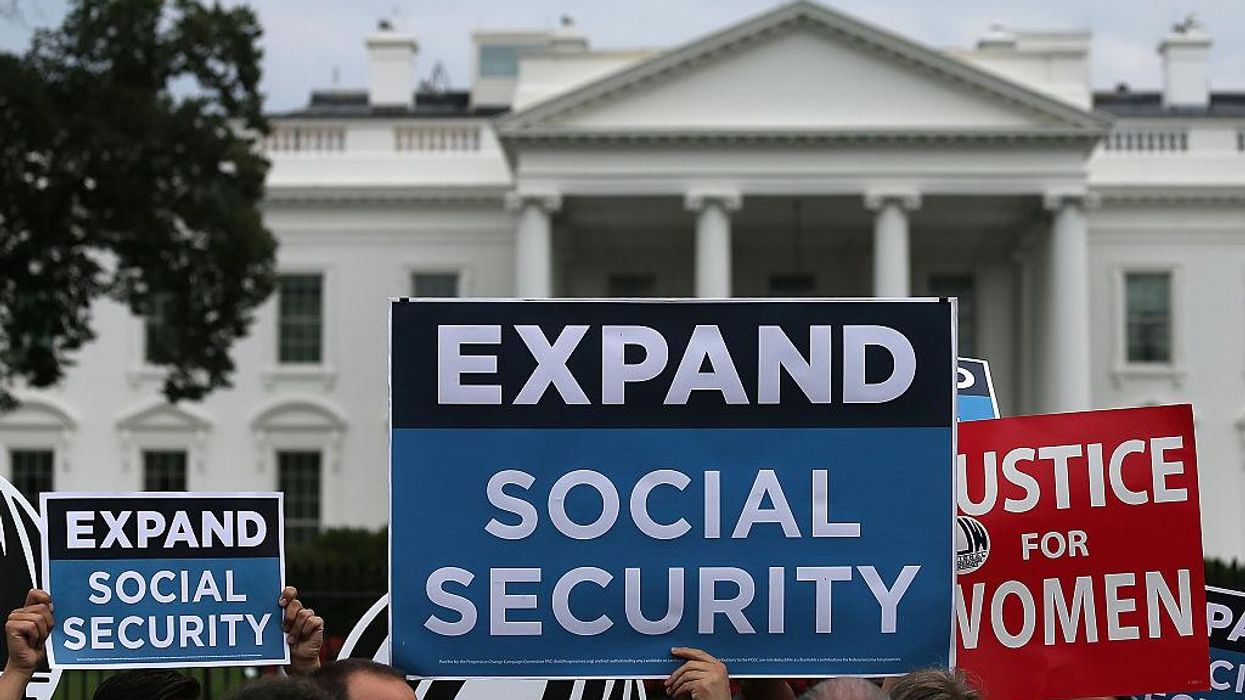
In this election year, voters should honor this milestone by supporting the party that is working to expand, not cut, their earned benefits.
On August 14, 1935, President Franklin D. Roosevelt signed Social Security into law. Eighty-nine years later, our Social Security system is at a crossroads. Even as we rightfully celebrate the widespread, enduring popularity and success of Social Security, it is imperative we recognize the threat aimed at our earned benefits by Republican politicians.
If the Trump-Vance ticket prevails this November, former U.S. President Donald Trump will continue his long track record of trying to cut and dismantle Social Security. Don’t be fooled by his rhetoric to the contrary. When Trump was president, he proposed cuts to Social Security in every one of his budgets.
When Trump couldn’t get the cuts enacted, he employed the old tactic of “starve the beast.” Figuring that tax cuts are easier to enact than benefit cuts, he sought to hold a Covid-19 relief package hostage to Congress agreeing to cut Social Security’s dedicated revenue. When that failed, he grabbed the questionable power to go after its dedicated revenue unilaterally—something without precedent. Because Trump was limited to executive action, he was able to only defer the revenue, but he made clear that he would not just defer the revenue, but eliminate it, if he were reelected. Insufficient dedicated revenue leads to automatic cuts. Conveniently, automatic cuts means there is no one to clearly be held accountable.
Republican politicians are ignoring the will of their own voters in favor of protecting their wealthy donors.
If Trump wins again, he will be even worse. Imagine Donald Trump as president, paired with a Republican Congress dominated by Speaker Mike Johnson’s (R-La.) vision of a fiscal commission to cut Social Security behind closed doors and the Republican Study Committee’s plans to cut Social Security by $1.5 trillion over just the next decade and trillions more after that (including raising the retirement age). That would be a nightmare scenario for Social Security and the millions of Americans and their families who rely on their earned Social Security benefits.
And it is just as important to recognize the immense opportunity that is available to make Social Security even better going forward.
As a Senator, Vice President Kamala Harris cosponsored legislation protecting and expanding Social Security. And her fantastic running mate, Minnesota Gov. Tim Walz, shares her commitment to Social Security. When he was in Congress he too cosponsored legislation to protect and expand Social Security.
He understands, from first-hand experience, just how important Social Security is. Here’s what he said in 2010:
As a young man watching my father die of a lengthy illness and a nine-year-old brother at home and a stay-at-home mother watching Social Security survivor benefits be there to allow my little brother to go on and go to college and my mother to go back in the workforce. Many people will say and they are absolutely right, “Pull yourself up by the bootstraps.” They were right of that. We just didn’t have any boots. They were loaned to us by Social Security. And for that we have paid that back ten times over. Our family is stronger, our community is stronger, our country is stronger.
Both Vice President Harris and Gov. Walz recognize that Social Security is the most secure, efficient, and important source of retirement income for the vast majority of Americans. But its benefits are inadequately low.
With the disappearance of traditional private-sector retirement plans, our nation is facing a retirement income crisis. Too many Americans fear that they must work until they die, because they will not be able to retire without a drastic decline in their standard of living. The solution is to expand Social Security.
Both Vice President Harris and Governor Walz understand this reality, and will fight to expand Social Security. They want to require multimillionaires and billionaires to start paying their fair share.
In stark contrast, Trump and his Republican allies in Congress support cutting Social Security and ultimately ending the program as we know it. This is laid out in the budget proposal from the Republican Study Committee (RSC), a group that counts about 80% of House Republicans as members. And rather than require the wealthy to pay more, they want to give huge tax breaks to the uber-wealthy. Republican politicians are ignoring the will of their own voters in favor of protecting their wealthy donors.
In this election year, voters should celebrate Social Security’s 89th birthday by supporting the party that is working to expand, not cut, their earned benefits.

If benefits were suddenly slashed, not only would members of Congress lose re-election, they likely wouldn’t be able to appear in public without being screamed at and chased down the street!
Every year, Social Security’s Board of Trustees issues a report detailing Social Security’s long-term financial outlook. This year’s report, like all its predecessors, shows that Social Security’s future is a question of values and choices, not affordability. It is a reminder that Congress must take action on Social Security sometime in the next 11 years — and our country’s two major political parties have very different visions for our Social Security system.
Democrats want to protect and expand Social Security, and pay for it by requiring millionaires and billionaires to contribute more of their fair share. Republicans want to slash Social Security’s already modest benefits, while giving massive tax handouts to the ultra-wealthy.
These competing visions should be front and center in voters’ minds because the trustees report projects that Congress must take action to prevent Social Security’s benefits from being automatically reduced by 17 percent in 2035.
There is no question that Congress will act. Around one in five Americans receive monthly Social Security benefits. That is one in three households. If benefits were suddenly slashed, not only would members of Congress lose re-election, they likely wouldn’t be able to appear in public without being screamed at and chased down the street!
The real question isn’t whether Congress will act, but what action it will take. We know what Democrats will do if they control Congress and the White House, because their position is open and transparent. It is clearly spelled out in legislation that has been introduced in Congress, in President Biden’s budget which states plainly that he supports those legislative efforts, and in the 2020 Democratic Platform.
These proposals have broad support within the Democratic Party, from progressives to moderates. They are also bipartisan in the way that matters — overwhelming support from Democratic, Republican, and independent voters.
Republicans are less open about their position, but a recent budget released by the Republican Study Committee (RSC), a group that comprises about 80 percent of House Republicans (including every member of Republican leadership), reveals the truth. It slashes Social Security benefits by $1.5 trillion in just the next 10 years. The budget’s cuts include raising the retirement age and decimating middle class benefits. The very same budget also includes trillions in tax cuts for the wealthy and giant corporations!
The RSC budget, while cloaked in vague and intentionally misleading language, is still more honest than usual. Generally, Republicans don’t openly endorse Social Security cuts, because they know how unpopular they are even with their own voters. Instead, they talk in Orwellian language about “saving” or “strengthening” Social Security. They want Americans to think that we can no longer afford Social Security, despite the ridiculousness of that claim, in the hope that their constituents will be grateful — not furious — when they receive at least some of their earned benefits.
Donald Trump, the presumptive Republican presidential nominee, was uncharacteristically honest when he recently said, “There is a lot you can do… in terms of cutting” Social Security. Knowing how unpopular cuts are, Trump generally denies he wants to cut benefits. When he was president, though, he included Social Security cuts in every one of his budgets. And prior to running for president, he called for raising the retirement age and privatizing Social Security while labeling it a Ponzi scheme. He has also advocated cutting Social Security’s dedicated funding. This could lead to even deeper benefit cuts down the road, but Trump knows cutting taxes is more popular than cutting benefits.
Trump and his fellow Republicans recognize the unpopularity of their positions. That’s why many of them seek to lure Democrats to join them (hold hands and jump, as they often phrase it) in cutting benefits behind closed doors so that they can share the blame or, even better, confuse voters into blaming Democrats.
Fortunately, the vast majority of Democrats are not taking the bait. But the danger is there. Every so often, Congress must pass legislation to prevent the nation from defaulting on its debts. If the United States ever did default, it would trigger a world-wide economic catastrophe.
The last time Congress voted to avoid default, Republicans tried to hold Social Security hostage, demanding benefit cuts in return for their votes. Fortunately, President Biden called their bluff and then-Speaker Kevin McCarthy folded – infuriating many of his House colleagues.
The next Congress will need to vote to raise the debt ceiling again. And to avert another attempt to take Social Security hostage, it matters who controls the House, Senate, and White House.
If Democrats retake the House of Representatives, Hakeem Jeffries will be speaker. Jeffries will ensure that the House passes a bill to raise the debt ceiling with no cuts to Social Security or any other vital benefits. And President Biden will unquestionably sign it. Indeed, he has promised to protect Social Security against cuts.
Moreover, Jeffries is a cosponsor of legislation to protect and expand Social Security. As Speaker, Jeffries will certainly bring that legislation up for a vote. When that happens, Republican members of Congress will be in a bind. They won’t want to require their billionaire donors to pay more, they won’t want to vote against Social Security, and they won’t want to offer their own alternative.
If the American people are clear on where their members stand and vote accordingly, Congress will enact legislation to protect and expand Social Security well before 2035. Once that happens, the annual trustees report will reveal that Social Security can pay all earned benefits for the foreseeable future.
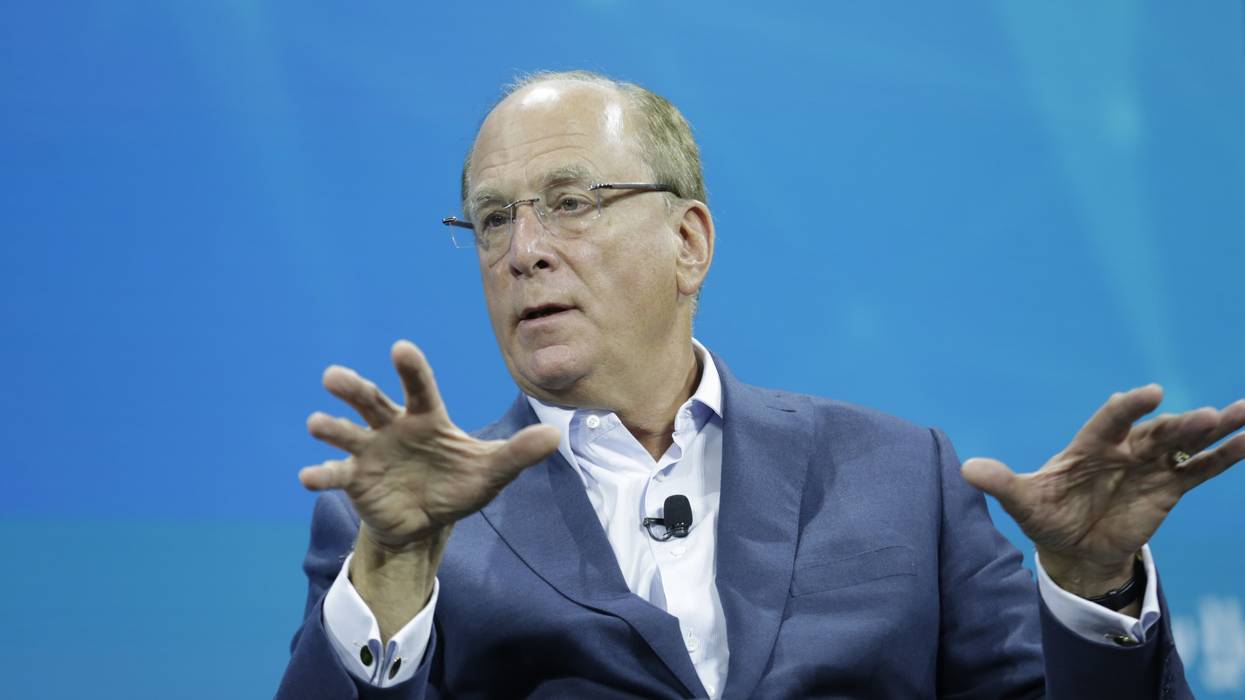
"I love how rich people are treated as sources of great wisdom when they obviously don't know their ass from their elbow," said one economist.
Larry Fink, the billionaire CEO of the world's largest asset management firm, wrote in his annual letter to investors on Tuesday that it is "a bit crazy" that 65 is viewed as a sensible retirement age in the United States, drawing swift backlash from Social Security defenders and policy analysts.
Dean Baker, senior economist at the Center for Economic and Policy Research, replied that the CEO of BlackRock apparently doesn't know the U.S. already raised the full retirement age for Social Security to 67 under a law passed during the Reagan administration—a change that inflicted benefit cuts across the board.
"I love how rich people are treated as sources of great wisdom when they obviously don't know their ass from their elbow," Baker wrote on social media.
While Fink, who is 71, wrote that "no one should have to work longer than they want to," he argued that "our conception of retirement" must change, pointing specifically to the Netherlands' decision to gradually raise its retirement age and tie it to life expectancy. (Fink does not mention that life expectancy in the U.S. has been trending downward in recent years.)
"When people are regularly living past 90, what should the average retirement age be?" Fink wrote. "How do we encourage more people who wish to work longer, with carrots rather than sticks?"
Alex Lawson, executive director of the progressive advocacy group Social Security Works, told Common Dreams in response to the BlackRock CEO's letter that "Larry Fink is the definition of an out-of-touch billionaire."
"He is welcome to work as long as he wants to, but that doesn't mean that everyone else—including people who do demanding physical labor—should work until they die," said Lawson.
"Half of Americans age 65 and older are living on less than $30,000 per year. This is absurd. Congress must expand Social Security."
Roughly half of older Americans have no retirement savings, a fact that Fink acknowledged in his letter.
While progressive lawmakers such as Sen. Bernie Sanders (I-Vt.) have called on policymakers to expand Social Security benefits by forcing rich people like Fink to contribute more to the program, the BlackRock CEO argued that the private sector and federal government should team up to "ensure that future generations can live out their final years with dignity."
"What should that national effort do? I don't have all the answers," Fink added. "But what I do have is some data and the beginnings of a few ideas from BlackRock’s work. Because our core business is retirement."
Fink's letter comes days after the Republican Study Committee—a panel comprised of around 80% of the House GOP caucus—released a budget proposal calling for "modest adjustments to the retirement age for future retirees to account for increases in life expectancy" in a purported bid to "secure Social Security solvency for decades to come."
But progressives argue that rather than slashing benefits for new retirees to shore up the program, Congress should lift the payroll tax cap that allows the ultra-rich to pay the same amount into Social Security as someone who makes $168,600 a year.
Fink, for example, has a base salary of around $1.5 million. With the current payroll tax cap in place, Fink stopped paying into Social Security less than a month and a half into 2024.
"In the U.S. today, 12 million seniors are dealing with food insecurity," Sanders wrote on social media Tuesday. "Half of Americans age 65 and older are living on less than $30,000 per year. This is absurd. Congress must expand Social Security."
Biden wants to save Social Security by having the super-rich — who have become far richer over the past several decades — pay more Social Security taxes. Let's be clear about what's at stake in this election.
During a typically rambling and incoherent interview last week, Trump admitted he would cut Social Security and Medicare if reelected. “There is a lot you can do in terms of entitlements, in terms of cutting and in terms of also the theft and the bad management of entitlements.”
Trump has tried to walk back the remarks, saying that when he used the word “cutting” he didn’t actually mean “cutting,” and that Social Security has a lot of waste. (In fact, Social Security is well managed, and theft or fraud is rare.)
But there’s no question Trump and his Republican allies want to cut Social Security and Medicare.
Here’s why. At the heart of their economic agenda — at least the portion they’re sharing with their super-wealthy backers — is another giant tax cut for the super-wealthy and big corporations.
The problem is that this tax cut would cause the federal budget deficit to explode — as did their last tax cut for the wealthy — unless Social Security and Medicare are cut. (Remember that as president, Trump repeatedly included cuts to Social Security and Medicare in his official budget proposals.)
This is why Trumpers have been ramping up calls for cuts in Social Security (or raising the age of eligibility, which is the same thing).
Last week, Daily Wire founder and professional bloviator Ben Shapiro — oblivious to the fact that millions of Americans do hard work that takes a toll on their bodies — urged that the retirement age be raised. “No one in the United States should be retiring at 65 years old. Frankly, I think retirement itself is a stupid idea unless you have some sort of health problem.” Turning Points USA founder Charlie Kirk echoed Shapiro: “I’m not a fan of retirement. I don’t think retirement is biblical.”
I want to be clear with you about Social Security. (I was once a trustee of the Social Security Trust Fund, so I know about this issue.)
Even without another Trump Republican tax cut for the rich, America still faces a pending problem financing Social Security. (Medicare is less problematic because the rise in health care costs has slowed, probably due to the Affordable Care Act.)
That’s because the American population is aging, with a rising ratio of retirees receiving Social Security benefits to workers paying into Social Security.
The Congressional Budget Office expects that over the next 20 years, spending on Social Security and Medicare will rise by about 3 percentage points of GDP.
In their annual report, the trustees of the Social Security Trust Fund said that Social Security will be able to pay full benefits for another decade but thereafter faces a significant funding shortfall. Unless something changes, after 2034 it will be able to pay only about 80 percent of scheduled benefits.
But this pending problem in no way requires cuts to Social Security benefits or increases in the retirement age.
In sharp contrast to Trump, Biden correctly asserts in his new budget that Social Security (and Medicare) can remain solvent by raising taxes on high incomes rather than by cutting benefits.
The problem isn’t that the giant baby-boom generation is sucking up too many Social Security benefits. The Social Security trustees anticipated the boom in boomer retirements. This is why Social Security was amended back in 1983, to gradually increase the age for collecting full retirement benefits from 65 to 67. That change is helping finance the retirements of boomers (like me).
So what did the trustees fail to anticipate in 1983 when they raised the retirement age for collecting full benefits? Answer: the degree of income inequality in 21st century America.
Put simply, a big part of the American working population is earning less than the Social Security trustees (including me) anticipated decades ago — and therefore paying less in Social Security payroll tax.
Had the pay of American workers kept up with what had been the trend decades ago — and kept up with their own increasing productivity — their Social Security payroll tax payments would have been enough to keep the program flush.
At the same time, a much larger chunk of the nation’s total income is going to the top than was expected decades ago.
Here’s the thing: Income subject to the payroll tax is capped. Not a single dollar of earnings in excess of the cap is subject to Social Security payroll taxes. This year’s cap is $168,600.
Which means, for example, that Jeff Bezos finished paying all his Social Security payroll taxes due this year at around 7 minutes into January 1.
The Social Security cap is adjusted every year for inflation, but the adjustment is tiny compared to what’s happened to incomes at the top.
As the rich have become far richer, more and more of the total income earned by Americans has become concentrated at the top. Therefore, more and more total income escapes the Social Security payroll tax.
The obvious solution to Social Security’s funding shortfall, therefore, is to lift the cap on income subject to the Social Security payroll tax, so the super-rich pay more in Social Security taxes.
To make sure it’s the super-rich — and not the upper-middle class — who pay, it makes sense to eliminate the cap altogether on earnings in excess of, say, $400,000.
As it happens, Biden’s plan does exactly this.
So there you have it: Trump and his regressive mouthpieces want to cut Social Security so they can give another giant tax cut to the super-rich.
Biden wants to save Social Security by having the super-rich — who have become far richer over the past several decades — pay more Social Security taxes.
The contrast couldn’t be more obvious or more important. Please help get the word out.

"It is the people who have the power in Switzerland," one union leader said.
In a move that pensioners rights group Avivo called "a historic victory for retirees," Swiss voters on Sunday voted to boost their pension by one-month's payment.
At the same time, voters rejected a measure to raise the retirement age from 65 to 66. The vote marks the first time in Switzerland's history that its people have voted directly to increase their own benefits, and one expert said the break with the past could be a response to the government bailout of Credit Suisse in 2023.
"Many think that the entrepreneurs and managers have broken the unwritten Swiss social contract: That managers are modest with bonuses and debauchery and the people are modest with social demands," Michael Hermann, who leads the Sotomo poll, told newspaper SonntagsZeitung. "People have been angry for a long time about the behavior of corporations, managers, tax evaders. So you often hear now: 'If they help themselves, then we also want something for us.'"
" Democracy is alive and kicking in Switzerland."
The pension plan measure will see pensioners receive a 13th payment every November, as is already the case for Swiss paychecks, as BBC News explained. Currently, pensioners are paid between $1,393 and $2,760 a month, which many argue is not enough given Switzerland's high cost of living. Zurich tied with Singapore as the most expensive city in the world, according to a November report by the Economic Intelligence Unit.
"I'm retired now and so obviously I would like a bit more," 65-year-old Zurich voter Mery told Reuters. "It should allow me to give a little something to my grandchildren."
The extra payments will start in 2026.
The measure needed both a majority of voters and a majority of cantons to pass, which it secured with 58.24% of voters and 16 out of 26 cantons, according to Le Monde.
The increase was backed by left parties and the Swiss Trade Union Federation and opposed by business interests and the center-right government and parliament, who argued it would be difficult to pay for. This makes the yes vote especially surprising, as historically Swiss voters have not acted against government advice on financial matters. For example, they rejected previous proposals to shorten the work week and increase the number of vacation days.
"Democracy is alive and kicking in Switzerland," said Interior Minister Elisabeth Baume-Schneider.
Lukas Golder of polling firm gfs.bern, reports Reuters, told SRF that the vote was "a huge milestone from a union perspective."
Head of the Swiss Trade Union Federation Pierre-Yves Maillard, told RTS that the vote sent "a wonderful message to all those who have worked hard all of their lives" and proved that "it is the people who have the power in Switzerland," according to Le Monde.
The proposal to raise the retirement age by one year and tie it to life-expectancy was rejected by 74.72% of voters. Turnout for the election was high for a Swiss plebiscite, at more than 58%.
The election comes amid a push to raise the retirement age in other countries. France's Emmanuel Macron faced massive protests when he upped that country's retirement age from 62 to 64.
U.S. Republican presidential candidate Nikki Haley has called for raising the retirement age for workers who are now in their 20s.
"They should plan on their retirement age being increased, yes," Haley said of younger workers during a January 10 debate.

Instead of forcing aging employees to delay retirement, lawmakers should ensure that workers have "access to jobs that pay fair wages and provide solid benefits during their prime working years," argues a new report.
Right-wing lawmakers' preferred method for dealing with the United States' looming retirement crisis—telling older workers to keep toiling until they've saved enough to stop—is "not a viable solution," says a report published Wednesday.
"Millions of people are entering their retirement years with insufficient savings to cover basic expenses and medical bills," the new analysis from the Economic Policy Institute (EPI) notes. "In response, some policymakers have proposed that older Americans could delay retirement to increase their savings."
But this ostensible fix "overlooks the large group of older Americans who work in difficult conditions—ranging from the physically demanding to the outright dangerous," EPI points out. "If older Americans endure difficult conditions that often force earlier exits from the workplace, proposals to delay retirement make little sense."
"Americans should... be fighting for more leisure."
Rather than forcing aging employees to postpone retirement, lawmakers should implement full-employment macroeconomic policies to ensure that workers have "access to jobs that pay fair wages and provide solid benefits during their prime working years," says the report, calling the latter approach "a more effective way to close the retirement savings gap."
To make sure "older workers can afford to retire when they need to," EPI also urges policymakers to bolster "support for workers with caregiving responsibilities, expand Social Security coverage and benefits," and improve "conditions for all workers through collective bargaining, stronger labor standards, and more effective health and safety protections."
Those who portray working longer as a legitimate solution for people who cannot afford to retire assume that "as workers age and gain more work experience, they are able to transition into jobs that are less physically demanding, less onerous, and less hazardous—making it possible to extend their working lives," the report notes. But as it goes on to show, "many workers in fact see little or no improvement in working conditions as they age."
Based on her analysis of data from the American Working Conditions Survey conducted by the RAND Corporation in 2015 and 2018, EPI researcher and report author Monique Morrissey found that:
Making matters worse, these tough jobs that roughly half of the nation's workers between the ages of 50 and 70 put up with don't pay enough to make retirement a possibility.
"Quantifying the large share of older workers with difficult jobs serves as a reality check for policymakers and researchers who view later retirement as an easy way for workers to close retirement income gaps," the report states.
"It misguided and unrealistic to expect older workers with onerous or hazardous jobs to keep working into advanced old age," the report continues. "A better way to close the retirement income gap is to support workers' ability to be fully employed during their prime working years and ensure that all jobs come with benefits that lead to a secure retirement."
On Wednesday afternoon, Morrissey was joined by U.S. Rep. Don Beyer (D-Va.) and Siavash Radpour, associate research director of the ReLab at the New School's Schwartz Center for Economic Policy Analysis, for a discussion moderated by Schwartz Center director and economic professor Teresa Ghilarducci.
Beyer brought up legislation he introduced last year that would establish an Older Workers Bureau in the U.S. Department of Labor aimed at improving aging employees' working conditions through targeted research.
Radpour, meanwhile, stressed that the nation's lack of retirement security results in lower job quality for all employees, which in turn decreases workers' ability to fight for a better future.
Workers need more leverage to negotiate for higher pay and better conditions, Radpour emphasized. But due to inadequate retirement funding, many aging employees have no choice but to keep toiling away at low-paying, onerous jobs. The inability of many workers to retire comfortably currently empowers employers, but reversing the present situation would have an inverse effect.
Notably, the Protecting the Right to Organize (PRO) Act, which seeks to push U.S. labor law in a more worker-friendly direction and increase workers' collective bargaining power, has languished in Congress for the past several years.
In February, progressive U.S. Sens. Bernie Sanders (I-Vt.) and Elizabeth Warren (D-Mass.) unveiled the Social Security Expansion Act, which would increase benefits by at least $200 per month and prolong the program's solvency for decades by finally requiring wealthy Americans to pay their fair share. The bill, which is overwhelmingly popular among voters of all persuasions, stands in stark contrast to Republican lawmakers' proposals to slash Social Security benefits and postpone eligibility.
Morrissey, for her part, observed that the lack of affordable healthcare—a widespread problem thanks to the for-profit model that plagues the U.S.—also hurts the nation's entire workforce, especially older employees who may be passed over for jobs by employers looking to avoid higher insurance costs.
On Wednesday, Sanders, joined by U.S. Reps. Pramila Jayapal (D-Wash.) and Debbie Dingell (D-Mich.) in the House, introduced the Medicare for All Act of 2023, which would guarantee universal healthcare without copays, deductibles, or high out-of-pocket costs. Its sponsors argue the bill would not only save lives but also empower the U.S. working class as a whole.
When asked during the roundtable about French workers' fight to protect their world-class pension system, Morrissey thanked them and said that "Americans should also be fighting for more leisure."

"This forced passage with the use of Article 49.3 must be met with a response in line with this show of contempt toward the people," declared one union leader as MPs introduced no-confidence motions.
Protests in Paris and across France have ramped up since President Emmanuel Macron's government on Thursday used a controversial constitutional measure to force through a pension reform plan without a National Assembly vote.
Fears that the Senate-approved measure—which would raise the retirement age from 62 to 64—did not have enough support to pass the lower house of Parliament led to a Council of Ministers meeting, during which Macron reportedly said that "my political interest would have been to submit to a vote… But I consider that the financial, economic risks are too great at this stage."
"This reform is outrageous, punishing women and the working class, and denying the hardship of those who have the toughest jobs."
After the meeting, French Prime Minister Élisabeth Borne announced the decision to go with the "nuclear option," invoking Article 49.3 of the French Constitution—a calculated risk considering the potential for a resulting motion of no-confidence.
Members of Parliament opposed to the overhaul filed a pair of no-confidence motions on Friday, and votes are expected on Monday. Although unlikely, given the current makeup of the legislature, passing such a motion would not only reject the looming pension law but also oust Macron's prime minister and Cabinet, and likely lead to early elections in France.
As Deutsche Welle reported:
"The vote on this motion will allow us to get out on top of a deep political crisis," said the head of the so-called LIOT group Bertrand Pancher, whose motion was co-signed by members of the broad left-wing NUPES coalition.
The far-right National Rally (RN) filed a second motion, but that was expected to get less backing. RN lawmaker Laure Lavalette however said her party would vote for "all" no-confidence motions filed. "What counts is scuppering this unfair reform bill," she said.
Leaders of the Les Republicains (LR) are not sponsoring any such motions. Reuters explained that individuals in the conservative party "have said they could break ranks, but the no-confidence bill would require all of the other opposition lawmakers and half of LR's 61 lawmakers to go through, which is a tall order."
Still, Green MP Julien Bayou said, "it's maybe the first time that a motion of no-confidence may overthrow the government."
Meanwhile, protests against the pension proposal—which have been happening throughout the year—continue in the streets, with some drawing comparisons to France's "Yellow Vests" movement sparked by fuel prices and economic conditions in 2018.
Not long after Borne's Article 49.3 announcement on Thursday, "protesters began to converge on the sprawling Place de la Concorde in central Paris, a mere bridge away from the heavily guarded National Assembly," according to France 24.
As the news outlet detailed:
There were the usual suspects, like leftist firebrand Jean-Luc Mélenchon, thundering against a reform he said had "no legitimacy—neither in Parliament, nor in the street." Unionists were also out in strength, hailing a moral victory even as they denounced Macron's "violation of democracy."
Many more were ordinary protesters who had flocked to the Concorde after class or work. One brandished a giant fork made of cardboard as the crowd chanted "Macron démission" (Macron resign). Another spray-painted an ominous message on a metal barrier—"The shadow of the guillotine is nearing"—in the exact spot where Louis XVI was executed 230 years ago.
Police used tear gas to disperse the Concorde crowd. Interior Minister Gérald Darmanin told RTL radio 310 people were arrested nationwide—258 of them in Paris. He said, "The opposition is legitimate, the protests are legitimate, but wreaking havoc is not."
Anna Neiva Cardante is a 23-year-old student whose parents, a bricklayer and a cleaner, "are among those who stand to lose most."
"A vote in the National Assembly was the government’s only chance of securing a measure of legitimacy for its reform," Neiva Cardante told France 24 as police cleared the crowd Thursday. "Now it has a full-blown crisis on its hands."
"This reform is outrageous," she added, "punishing women and the working class, and denying the hardship of those who have the toughest jobs."
Across the French capital early Friday, "traffic, garbage collection, and university campuses in the city were disrupted, as unions threatened open-ended strikes," DW noted. "Elsewhere in the country, striking sanitation workers blocked a waste collection plant that is home to Europe's largest incinerator to underline their determination."
"Article 49.3 constitutes a triple defeat for the executive: popular, political, and moral," declared Laurent Escure, secretary general of the labor union UNSA. "It opens up a new stage for the protests."
Philippe Martinez of the CGT union asserted that "this forced passage with the use of Article 49.3 must be met with a response in line with this show of contempt toward the people."

"What the government is doing makes people sick of politics. It should improve people's lives, not destroy them," said Rachel Keke, a leftist in France's National Assembly.
Amid protests against French President Emmanuel Macron's unpopular plan to overhaul the country's pension system, his government on Thursday chose the "nuclear option," opting to use a constitutional procedure to force through reforms, including raising the retirement age from 62 to 64, without a vote in the lower house of Parliament.
While the proposal passed the Senate, the upper chamber of Parliament, 193-114 Thursday morning, "reports indicated that the ruling party, which lost its overall majority in elections last year, was a handful of votes short" in the National Assembly, which led to an emergency Council of Ministers meeting about triggering Article 49.3,
Le Monde explained.
After announcing the government was invoking executive privilege, French Prime Minister Élisabeth Borne "faced scenes of anger and unrest in the National Assembly," reported Politico. "Far-left lawmakers belonging to the France Unbowed party booed and chanted the national hymn the Marseillaise as far-right National Rally MPs shouted 'Resign! Resign!'"
Using the controversial procedure to push through the plan is risky for Macron—founder of the Renaissance party—because it allows members of Parliament "to submit motions of no-confidence within 24 hours," Politico added. "While the government has survived motions of no-confidence in recent months, the stakes are much higher this time around. If a majority of MPs vote in favor of a motion, Borne's government would be forced to resign."
While multiple opposition groups in Parliament may respond with no-confidence motions, Marine Le Pen's far-right National Rally party has already pledged to do so.
"It's a total failure for the government," Le Pen told reporters of the Article 49.3 decision, calling for Borne's resignation. "From the beginning, the government fooled itself into thinking it had a majority."
Socialist Party chief Olivier Faure also criticized the approach, saying that "when a president has no majority in the country, no majority in the National Assembly, he must withdraw his bill."
Fabien Roussel, head of the French Communist Party, declared that "this government is not worthy of our Fifth Republic, of French democracy. Until the very end, Parliament has been ridiculed, humiliated."
MP Rachel Keke of the leftist party La France Insoumise stressed that "what the government is doing makes people sick of politics. It should improve people's lives, not destroy them."
Former French presidential candidate and MP Jean-Luc Mélenchon, who launched La France Insoumise, tweeted: "It is a spectacular failure and a collapse of the presidential minority. United unions call for continued action. This is what we are going to focus on."
French trade unions have led national demonstrations and strikes against the overhaul since January. While protesters were oscillating "between rage and resignation" earlier this week, they filled the streets of Paris on Thursday, and "the leader of the CFDT labor union, Laurent Berger, announced there would be new protest dates," according to Le Monde.
The General Confederation of Labor (CGT) said in a statement that "this reform is unfair, unjustified, and unjustifiable, this is what millions of people have been asserting forcefully for weeks in the demonstrations, with the strike, and in all the initiatives. These massive mobilizations are supported by a very large majority of the population and almost all workers."
"The only response from the government and employers is repression: requisitions, police interventions on workplace occupations, arrests, intimidation, questioning of the right to strike," the confederation added. "We won't let it happen! What the CGT denounced as unfair yesterday is even more so today! This can only encourage us to step up mobilizations and strikes, the fight continues!"

Life expectancy in the U.S. fell during the same period that a Reagan-era law raised the retirement age by two years.
In 1983, just before signing legislation that cut Social Security benefits, then-President Ronald Reagandeclared that "we're entering an age when average Americans will live longer and live more productive lives."
But Reagan's assumption of ever-rising life expectancy in the U.S. turned out to be false, according to a new analysis, a fact with painful consequences for those who saw their Social Security benefits pared back thanks to the 1983 law's gradual increase of the full retirement age—the age at which one is eligible for unreduced Social Security payments.
As Conor Smyth wrote Monday for the People's Policy Project, a left-wing think tank, the Social Security Amendments of 1983 hiked the full retirement age "from 65 in 2000 to 67 at the end of 2022."
"What this actually meant was not that the age at which people could retire and start drawing Social Security benefits changed—that remained at 62," Smyth explained. "Instead, by raising what's called the full retirement age (FRA) by two years, the law effectively cut benefit levels across the board, regardless of the age that any particular individual began claiming Social Security benefits. The result is that those retiring at 62 today face a 50% greater penalty for retiring before the change than they would have before 2000."
The 1983 law was an outgrowth of a special presidential commission headed by Alan Greenspan, a right-wing economist who would go on to serve as chair of the Federal Reserve for nearly two decades.
Smyth noted that before final passage of the measure—which cleared the House and Senate with bipartisan support, including from then-Sen. Joe Biden—"a popular argument for raising the retirement age was that life expectancy had increased, so people should work for longer."
"The presumption was that the increase in life expectancy since Social Security's implementation would continue as the retirement age rose. But, in reality, something peculiar happened," Smyth wrote. "Over the same period during which the 1983 law forced the retirement age up from 65 to 67, life expectancy in the U.S. actually declined. In 2000, U.S. life expectancy was 76.8 years. According to data released last December, life expectancy in 2021 was 76.4 years. This was the second consecutive year of significant life expectancy decline."
"That's a drop of 0.4 years over a time span when the FRA rose by nearly two years," Smyth observed. "So not only have Americans seen their benefits cut by an increase in the FRA, they now also face a particularly morbid version of a benefit cut in the form of shorter lives."
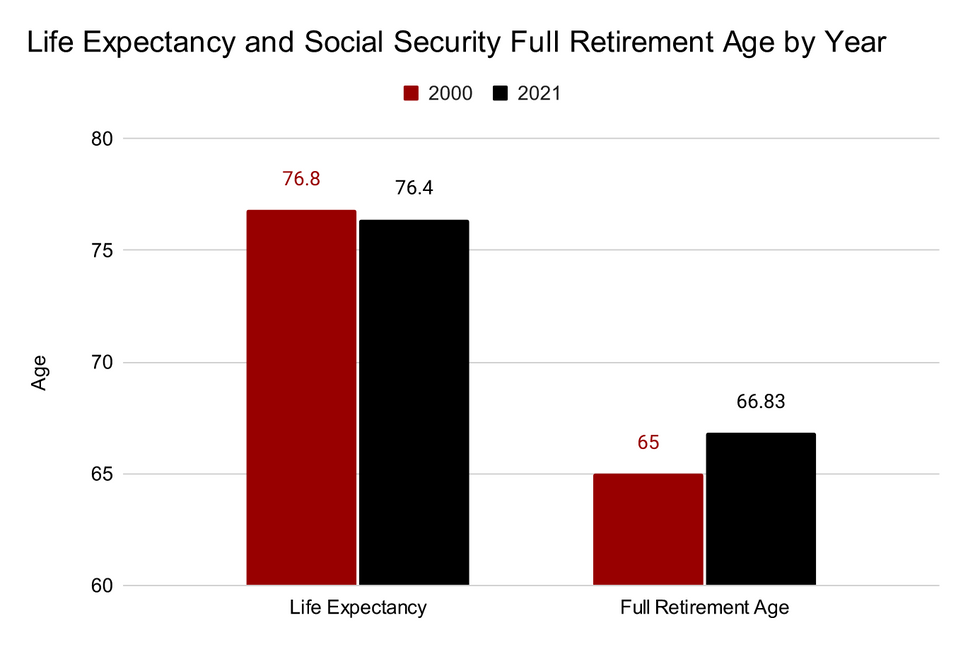 (Image: People's Policy Project)
The new analysis comes as some congressional Republicans are openly advocating further increases in the retirement age, with one GOP lawmaker recently declaring that people "actually want to work longer."
In a policy agenda released last year, the House Republican Study Committee (RSC) echoed Reagan-era arguments in favor of raising the full retirement age to 70—a change that would cut Social Security benefits across the board at a time when many retirees are struggling to afford basic necessities.
The RSC agenda states that Republican legislation known as the Social Security Reform Act would "continue the gradual increase of the normal retirement age that current law has set in motion at a rate of three months per year until it is increased by three years for those reaching age 62 in 2040, 18 years from now."
"This adjustment," the document claims, "would begin to realign the Social Security full retirement age to account for increases in life expectancy since the program's creation."
President Biden and congressional Democrats have pledged to reject any proposed cuts to Social Security, which Republicans have threatened to pursue in exchange for a deal to raise the debt ceiling.
In addition to urging Biden and Democratic lawmakers to stand firm against Social Security cuts, advocates are calling on the president to embrace a Social Security expansion plan such as the one recently proposed by Sens. Bernie Sanders of Vermont and Elizabeth Warren of Massachusetts, which would fund benefit increases by raising the payroll tax cap so that wealthier Americans contribute a more equal share to the program.
"President Biden campaigned on a promise to expand Social Security's modest benefits, while dedicating more revenue to it. Most Democratic senators and members of the House support that as well. Yet the mainstream media fails to take those proposals seriously," Nancy Altman, president of the advocacy group Social Security Works, wrote in an op-ed for Common Dreams last week.
"If the Biden administration championed an expansion plan, unveiled at a White House event with major stakeholders in attendance," Altman added, "that could not be ignored."