

SUBSCRIBE TO OUR FREE NEWSLETTER
Daily news & progressive opinion—funded by the people, not the corporations—delivered straight to your inbox.
5
#000000
#FFFFFF
To donate by check, phone, or other method, see our More Ways to Give page.
Daily news & progressive opinion—funded by the people, not the corporations—delivered straight to your inbox.
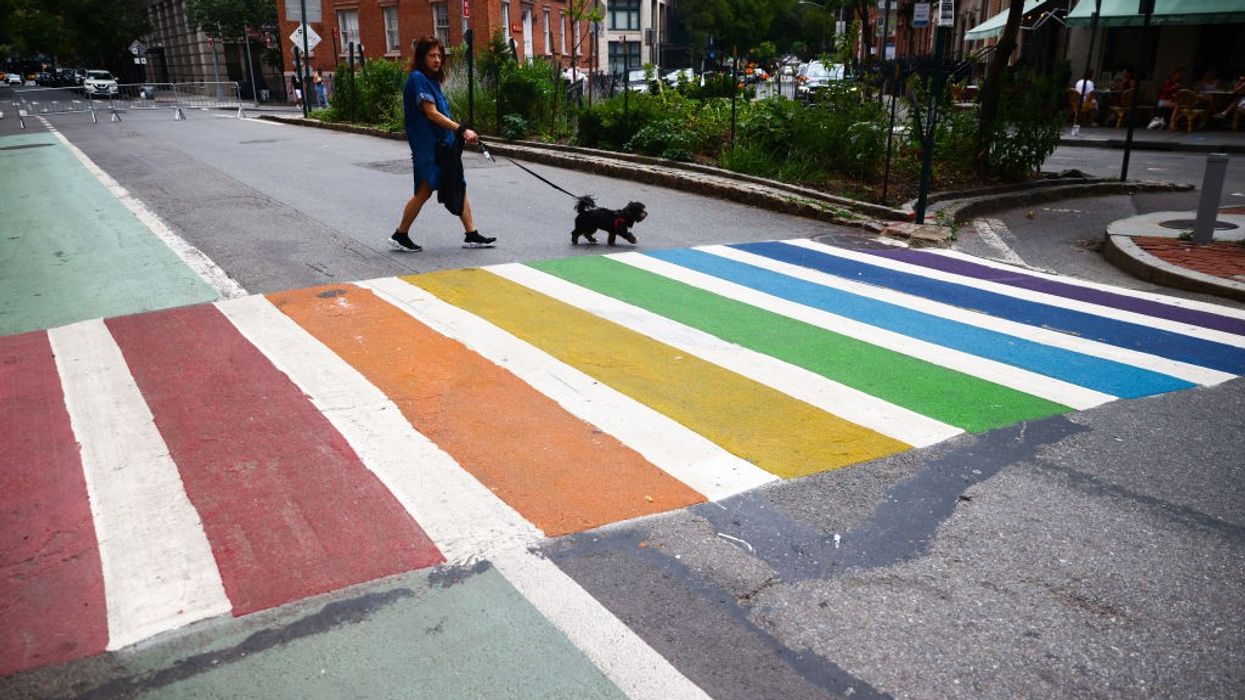
"Removing that crosswalk was a mean-spirited attempt to demoralize the LGBTQ+ community and an insult to the 49 people who lost their lives," said Democratic Florida state Sen. Lori Berman.
Republican Florida Gov. Ron DeSantis, following a directive from US President Donald Trump's administration, painted over a rainbow crosswalk in Orlando that for years had served as a memorial to the victims of the 2016 massacre at Pulse, a local LGBTQ+ nightclub.
As reported by local news station WESH, the removal of the rainbow display came in response to a directive from Transportation Secretary Sean Duffy, who sent a notice to governors last month that crosswalks should be free of potential distractions for drivers such as political messages.
The removal of the memorial was immediately denounced by Orlando Mayor Buddy Dyer, who slammed the move as "cruel."
"We are devastated to learn that overnight the state painted over the Pulse Memorial crosswalk on Orange Avenue," he said. "This callous action of hastily removing part of a memorial to what was at the time our nation's largest mass shooting, without any supporting safety data, or discussion, is a cruel political act."
Democratic Florida state Sen. Lori Berman offered a similarly scathing statement about the removal of the crosswalk, which she pointed out was originally approved by the administration of former Republican Gov. Rick Scott, who is now serving as one of Florida's US senators.
"The rainbow crosswalk at Pulse was a tribute, not a political statement—and a tribute authorized by a Republican administration, at that," she said. "It was specifically designed to enhance pedestrian safety for people paying their respects. Removing that crosswalk was a mean-spirited attempt to demoralize the LGBTQ+ community and an insult to the 49 people who lost their lives there nearly a decade ago."
DeSantis defended the crosswalk's removal, claiming the rainbow signified that Florida's roads had been "commandeered for political purposes."
However, within hours of the rainbow crosswalk's removal, local residents took matters into their own hands and painted it back, resulting in cheers from onlookers and appreciative honks from passing drivers.
Orlando recolors the Pulse Memorial Sidewalk Rainbow after DeSantis paved over it. We are Orlando Strong and no one can ever erase the LGBTQIA+ Community 🏳️⚧️🏳️🌈 pic.twitter.com/NLS7pOz1xQ
— 🍒Jeremy Rodriguez🍒 (@jeremy_rodrigue) August 21, 2025
The memorial paid tribute to the 49 people who were killed on June 12, 2016, when a 29-year-old man named Omar Mateen barged into the club and began opening fire on patrons.
During the massacre, Mateen placed a call to 911 in which he said that he had pledged his allegiance to the terrorist organization Islamic State. He later told a law enforcement negotiator that his killing spree was being done in reaction to American military intervention in Iraq and Syria.
Shortly after this, Mateen was killed in a shootout with local police.
We may never know the crucial determining factor or combination of factors responsible for Omar Mateen's ghastly slaughter of 49 people and the wounding of 53 others at Orlando's Pulse nightclub. Mainstream media pundits quickly cited LGBT bigotry, lax gun laws, failed FBI background checks, an infatuation with violence, deeply closeted homosexuality, and "self-radicalization."
We may never know the crucial determining factor or combination of factors responsible for Omar Mateen's ghastly slaughter of 49 people and the wounding of 53 others at Orlando's Pulse nightclub. Mainstream media pundits quickly cited LGBT bigotry, lax gun laws, failed FBI background checks, an infatuation with violence, deeply closeted homosexuality, and "self-radicalization."
But as more evidence accumulates, it's plausible that Mateen's unspeakable act was yet another grotesque version of the chickens coming home to roost. While the time and location of future attacks remain uncertain, there's no doubt that more jihadist-type chickens are en route to the henhouse. This raises the question that has remained outside polite conversation since September 11, 2001: What might lead someone like Mateen to carry out these hideous assaults on innocent U.S. citizens? Critical inquiry is not about making excuses for terrorism. Refusing to look at the causes of terrorism is inexcusable.
Years ago, Mateen spoke about becoming a martyr and watched Islamic State terrorism and propaganda videos. Classmates recall that when the second jumbo jet slammed into the Trade Center's south tower, the 14-year-old Mateen "started jumping up and down, cheering on the terrorists."
During one of his 911 calls from Pulse, he referred to the Tsarnaev brothers, the Boston Marathon bombers, as his "homeboys." In another, he claimed to be "acting in the name of God" and pledged his allegiance to ISIS leader Abu Bakr al-Bagdadi. And just before being killed by police, Mateen posted a Facebook message stating, "You kill innocent women and children by doing [U.S.] airstrikes. . . now taste the Islamic state vengeance."
Patience Carter, one of the hostages, heard Mateen say his attack was "to get America to stop bombing his country," a reference to his parents being from Afghanistan. In another conversation with a 911 operator, he demanded that the U.S. stop attacking Iraq and Syria and said, "That's why I'm out here right now."
Terrorism is only one consequence (the refugee crisis is another) that continues to reverberate in the wake of U.S. imperialist interventions, occupation, and unabated drone strike killings in Afghanistan, Yemen, Pakistan, and the Horn of Africa, and Washington's one-sided support for Israel's apartheid-like suppression of Palestinians.
As peace activist and author David Swanson notes, there is an immediate step the U.S. could take: "Stop bombing people around the world." Of course, this is the last thing that ISIS wants because the more bombs that fall, the "easier it is to motivate more killers." U.S. violence inevitably begets more violence and more sanctuaries for terrorists in the Middle East and South Asia.
To date, the U.S. has left citizens of these countries with four futile choices: (1) Remain in failed states destroyed by U.S. bombs. (2) Live under U.S.-sponsored brutal dictatorships with no prospects for change. (3) Become refugees. (4) Support or join ISIS-type organizations.
Because U.S. allies like Turkey, Pakistan, the Gulf monarchies, and, especially, Saudi Arabia are directly and indirectly in league with the terrorists, the decision has been made that this deplorable situation is preferable for U.S. "national security." The dominant interests in this country need to keep fear alive to justify any means of safeguarding their empire.
The Islamic State would not exist but for prior U.S. policy, including fateful decisions by Barack Obama and Hillary Clinton. ISIS is a death cult, and negotiating with them is impossible. Muslims must see an alternative to the dismal options listed above, an alternative that addresses their justifiable grievances. Recall Islamist Mohamed Morsi was democratically elected as president of Egypt in 2011, only to be overthrown and imprisoned by the U.S.-backed military. Only by supporting efforts to join Islam and democracy, currently exemplified by Tunisia and Indonesia, will this be possible. At this late date, it may not succeed, but there's no other sane alternative.
As the sun set over New York on June 12, hundreds of Muslims gathered together in Hudson River Park to break their Ramadan fast.
Iftar, the evening Ramadan meal, is often a joyous celebration of faith and family. But the mood that Sunday was solemn: That morning, news had broken of the ghastly massacre of LGBTQ revelers at Pulse nightclub in Orlando.
A lone Muslim had allegedly perpetrated the attack. Here by the Hudson, over 200 knelt in prayer.
"We're praying for those who were lost," one woman explained in a video circulated by the Huffington Post, her voice breaking. "As Muslims, we're united in our outrage over this senseless act of violence."
Meanwhile, an Orlando imam condemned terrorism as un-Islamic and affirmed his belief that "Islam teaches peace." The Florida chapter of a national Muslim group called on members to donate blood for the victims. And statements of sympathy tumbled forth from American Muslims in what CBS News called "an avalanche."
"Today, we stand in solidarity with the LGBTQ community," said the group Muslim Advocates. "Your grief is our grief. Your outrage is our outrage."
Unfortunately, none of those touching gestures deterred Donald Trump from warning darkly that "radical Islam is coming to our shores."
In a falsehood-riddled speech following the Orlando massacre, the presumptive GOP nominee blamed the shooting on immigration and "political correctness."
As Muslims all over America sent their sympathies to Orlando, Trump mocked his Democratic rival's insistence that "Muslims are peaceful and tolerant people." He accused Muslims of causing "death and destruction" by covering up terrorism in their midst (though it was later revealed that a Muslim member of Mateen's community had reported him as suspicious).
Then, in perhaps the most ominous part of the address, Trump claimed that Democrats will "take away Americans' guns and then admit the very people who want to slaughter us."
Muslim immigrants are the problem, he seems to be saying. And guns are the solution.
If you ask me, I'd feel much safer with the crowd at Hudson River Park than anywhere near a rally of armed Trump supporters. But here's the creepier part: For all his blathering that "we have to get smart" about "radical Islam," Trump is stupidly playing right into ISIS's hands.
Like Trump himself, the group benefits immensely from anything that drives a wedge between Muslims and the societies they live in.
ISIS said as much itself -- in plain English -- in a publication detailing its plan to "destroy the gray zone" between infidels and believers. Since most Muslims seem to like living in the liberal societies of Europe and North America, ISIS propagandists have written that the only way to drive up recruitment is to make Muslims feel unwelcome there.
No wonder ISIS recruiters are now featuring Donald Trump in advertisements.
It's not because they're afraid of him -- it's because few people are working harder to make Muslims feel unwelcome than he is. Civil rights groups report that Trump's rise has paralleled a shocking increase in hate crimes against Muslims in this country.
That's an outrage. And it's thoroughly self-defeating.
In fact, the United States has arguably the most prosperous, well-integrated Muslim population in the Western world. Even as ISIS has scored a few recruiting successes among the much more marginalized Muslim communities of Europe -- though even there, the group falls way outside the mainstream -- it's flat-lined here.
Scenes like the iftar gathering in New York, in other words, are the rule, not the exception. They're a touching rejoinder to the toxic politics of division and a far more accurate reflection of our Muslim neighbors than anything peddled by Trump.
And, not least, they're a much better asset in the fight against terrorism than any bullet or bomb -- or any demagogue who urges his followers to reach for their guns at the first sign of trouble.
As the debate and the raw emotion of June 12 subsides and the discussion moves into a second week, I find myself still reeling. I am not among those grieving the personal loss. My family and friends in Orlando are safe and the depth of my gratitude reflects this haunting and pronounced awareness that it might not have been so. That life must not be taken for granted. The grim reality that the news that shook mothers and fathers and brothers and sisters from their sleep last Sunday could have been mine. I feel this from far away from Orlando, and it is not lost on me that I write this waiting to retrieve a dear friend from the Brussels airport, where yet another tragedy, just months ago, shook so many.
As I consider the grief of those in Orlando, what shakes me the most is the moment those doubtlessly beautiful and brilliant lives were taken. My mind keeps drifting to the last moments for those murdered -- ordering drinks or texting their mothers from bathroom stalls -- and the thought that keeps haunting me is that it was just after "last call." The night was almost over.
The paradox is unrelenting, and it's the moment of their death that compounds my empathy and grief. I know what it feels like to be free on the dance floor at 3:00 a.m., working it out, happy, with friends, lovers and potential lovers. So many of us know that feeling -- that joy, that relative bliss and the vulnerability that comes with it. It is human. I imagine and remember the reprieve from work, from the 9-5, 11-3, or 6 until closing shift, a break from the other complications of life. I also know, as many LGBTQ people know, the sweet feeling of release from having performed our best drag all day to conform to the expectations of the dominant culture. The freedom found in some dark and crowded place where we can shake defiantly, kiss passionately and grind on the dance floor with abandon. The taunts, ridicule, and all manner of violence held at bay by the beats that feel as much within us as round us.
These spaces and moments are not perfect, but in this beautiful and sweet moment we are fully in our bodies, free in our love and desire. The more we've suffered and endured, the more the space is needed. I've always thought the song "God is a DJ" got it right, and the thought of that sacred moment interrupted by evil exacting such an unimaginable pain leaves me breathless. To the 49 souls whose lives have been lost, to the 53 injured and those who escaped, I will never again be able to dance without thinking of you.
When I've danced before, like many of us, I feel the weight of the gay clubs raided, bombed, the people beaten by police, forced to the ground while assaulted with billy clubs and police dogs. I have danced with the awareness that for the freedom we've gained and could express in Orlando, others in many other parts of our world cannot move their bodies so freely, cannot press their bodies against the bodies of those we desire without risking grave consequence. Perhaps that's what makes it all the more painful, the feeling of progress halted in one horrible instant. We had come to not expect such concentrated horror in places like Orlando.
For this reason and many, the shock of the country is understandable, and it is not at all mitigated by the fact that atrocities have happened before or persist elsewhere in similar or greater magnitude. No parent anywhere should have to feel what these parents must now feel. Yet, many have, do and will. As the war planes ready, and the soldiers prepare to be deployed, to think that the actions of this murderer will be cited as justification for the deaths of thousands is simply too much to bear. Perhaps one of the symptoms of the creeping inhumanity of our culture is our inability to mourn.
That grief drives us to action is not wrong, but for it to drive us to fear is dangerous. It is so dangerous because we are so very ill informed; we in the U.S. public are ignorant and some of this ignorance is willed. Thus, it goes that the horrible acts of a demented man serve to confirm the shortsighted convictions of ignorant people. Hypocrisy reigns, as they wrap themselves in rainbow flags to mourn lives they deemed unworthy of rights like hospital visitation.
Then comes the picking apart of the dead, perpetrator and victims. The New York Times publishes headlines like "Gays and Latinos, 2 Cultures Once at Odds," that speak of stitching together. The article eloquently chronicles the pain and homophobia of generations past. Yet this is the way the majority always tells the story, as if to be gay is to surrender your claim to Latino, as if being gay could make anyone any less Boricua, as if any of us with more complex identities could separate these insoluble aspects of our being. There is no Latino community without its LGBTQ members anymore than black or African American could exist without James Baldwin or Bayard Rustin, Alice Walker or Angela Davis. I don't wish to dishonor the victims by pointing out the violence of this reduction. Rather, I find it illustrative of a persistent problem that contributes to the creation of more victims.
Reporters, commentators and the like speak of "separate communities" reducing millions of people -- and in the case of Islam, 1.6 billion people -- to such a simplified caricature that, were the consequences not so frighteningly real in our time, it would be immediately taken as absurd. They say things like "Muslims are responsible," or "Muslims don't like gays," accepting a logic so faulty it's hard to understand how it could be said seriously. They render the Muslim gay, lesbian and trans people who have been among my friends in the United States and Europe invisible. These friends who I have, whom I've loved, also dance, arms extended, shoulders twisting. They also know the freedom of Pulse. It is true that they have struggled within their communities, as many of us have. Yet their struggle is made more difficult, not less, by bigotry and discrimination, bombs and military occupations directed at them. The W.E.B. Du Bois's phrases "What does it feel like to be a problem?" and "double consciousness" serve both LGBTQ people globally and Muslim-identified people living in Europe and the United States well. Du Bois wrote those words in 1903. Why haven't we learned?
It's all too much to deal with really. As I sit and write, my friend, Zoharah Simmons, who happens to be Muslim and feminist -- and a 50-year veteran of the Black Freedom Struggle -- arrives at Brussels Luchthaven. Following up on a conversation about nonviolence from our first event with young Belgians, our second event will be about the role of love and education in organizing for a more peaceful and just world. The airport is repaired, one does not notice the traces of the carnage that was here just three months ago. There is a part of me that wishes that I could just go from here to find a club and dance and forget it all. I'm sure I'll be able to again some day, but right now, my DJ is bowled over and weeping.
In a failure reminiscent of previous attempts to tighten gun laws following a mass shooting, the U.S. Senate on Monday night roundly rejected four measures to enact stricter gun control laws in the wake of last week's massacre in Orlando, Florida.
"Democrats and Republicans had put forth competing amendments to both strengthen background checks and prevent suspected terrorists from purchasing firearms," the Guardian reported. "But all four bills fell short of the 60 votes needed to clear a procedural hurdle in the Senate, in a near replica of a vote held in December when a pair of shooters killed 14 people and wounded 22 more in San Bernardino, California."
Sen. Elizabeth Warren (D.-Mass.) decried the vote in a Tweet:
The much-publicized Democratic-led filibuster in the Senate last week, which pushed for measures that critics derided as "not going far enough," resulted in an agreement to vote on new gun control legislation.
The Hill reports that many were pessimistic about the proposals' chances of success from the start:
All four measures--two dealt with background checks and two sought to prevent people on terrorist watchlists from buying guns--were expected to fail.
All four required 60 votes to move forward, and Republicans and Democrats offered dueling amendments on both issues. The National Rifle Association opposed the two Democratic measures.
The climactic vote was on a measure sponsored by Sen. Dianne Feinstein (D-Calif.) that would have prohibited people on terrorist watchlists from buying guns or explosives. It failed 47-53.
Before the vote, Sen. Bernie Sanders (I-Vt.) characterized the vote as a "no-brainer."
"Frankly, these Democratic amendments are no-brainers," Sanders wrote. "It is incomprehensible to me, and I believe to the vast majority of Americans, as to why Republicans would oppose them."
None of the measures were the ban on assault weapons sales that "so many are calling for," as Common Dreams reported.
Hillary Clinton released a statement that simply read, "Enough," and then proceeded to list the names of the 49 victims of the Orlando shooting, the Hill reported.
"Sen. Feinstein's and Sen. Murphy's proposals are commonsense," Sanders added. "In light of the terrible tragedies that have taken place in Orlando and other cities, it's not very hard to understand that terrorists or potential terrorists, criminals, and the dangerously mentally ill should not have access to guns. We have got to do everything we can to stop guns from falling into the hands of people who should not have them."
"What am I going to tell 49 grieving families?" asked Florida Sen. Bill Nelson after the measures were voted down, according to the Guardian. "What am I going to tell the families of those who are still in the hospital fighting for their lives?"
After coming under fierce criticism for its decision to publish redacted transcripts of the Orlando shooter's 911 calls, the U.S. Department of Justice (DOJ) late Monday released the full transcript, which names the terrorist organizations Omar Mateen claimed allegiance to.
"Unfortunately, the unreleased portions of the transcript [...] have caused an unnecessary distraction from the hard work that the FBI and our law enforcement partners have been doing to investigate this heinous crime," the DOJ and the Federal Bureau of Investigation (FBI) said in a joint press statement. "As much of this information had been previously reported, we have re-issued the complete transcript to include these references to provide the highest level of transparency possible under the circumstances."
The censored transcript read, in part:
OM: Praise be to God, and prayers as well as peace be upon the prophet of God [in Arabic]. I let you know, I'm in Orlando and I did the shootings.
OD: What's your name?
OM: My name is I pledge of allegiance to [omitted].
OD: Ok, What's your name?
OM: I pledge allegiance to [omitted] may God protect him [in Arabic], on behalf of [omitted].
The government claimed that it had censored the transcript out of sensitivity to the families and surviving victims of the June 12 attack on a Florida LGBTQ bar - the Pulse Nightclub - and also because it "did not want to provide the killer or terrorist organizations with a publicity platform for hateful propaganda."
However, the initial refusal to name the Islamic State or its leader, Abu Bakr al-Baghdadi, was criticized as being another form of "propaganda."
What's more, the Obama administration has refused to release the audio record of the calls--which, as The Intercept's Robert Mackey notes, "only seemed to encourage speculation online, and in the political arena, that the investigators might be concealing something."
Indeed, Mackey points out, there are already discrepancies between what's been stated about Mateen:
[B]ased on a previous description of Mateen's 911 calls given by FBI Director James Comey last week, it appears that the federal investigators continued to withhold details of a second conversation Mateen had with the 911 operator, which was not referred to at all in the government's timeline. "He made 911 calls from the club, during the attack," Comey said last week. "He called and he hung up. He called again and spoke briefly with the dispatcher, and then he hung up, and then the dispatcher called him back again and they spoke briefly. There were three total calls."
Also missing from the transcript and summary of the conversations was any mention of the fact that, as Comey also said last week, Mateen had expressed solidarity with the Tsarnaev brothers, who carried out the Boston Marathon bombings in 2013, and Moner Mohammad Abusalha, a Floridian who carried out a suicide bombing in Syria in 2014 on behalf of al Qaeda's representatives there, the Nusra Front. The FBI's Boston office revealed that Mateen had referred to the Tsarnaev brothers as his "homeboys" during one of the 911 calls, despite a lack of evidence that he had ever been in contact with them.
House Speaker Paul Ryan and other conservatives were quick to jump on the censorship as an indication that the Obama administration is trying to downplay the role of Islamist extremism in the attacks--inflaming arguments over the motive behind the hate crime.
Number of people killed in the June 12 massacre at Pulse, an LGBT dance club in Orlando, Florida, by a man who reportedly expressed animus toward LGBT people and who may have been a gay or bisexual person himself: 49
Number of people injured in the shooting, which took place on the club's Latin-themed night and whose victims were overwhelmingly Latino: more than 50
Rank of LGBT people among various minority groups most likely to be the targets of a hate crime, with transgender women of color at greatest risk: 1
Number of hate crimes reported nationally in 2014 that targeted people based on sexual orientation or gender identity, a figure that's likely an underestimate as it's based on local, non-mandatory reporting: 1,100
Number of anti-LGBT bills introduced in state legislatures last year, sparking rhetoric that demonizes LGBT people, portrays them as predators, and accuses them of threatening other people's civil rights: 125
Number of anti-LGBT bills introduced this year: about 200
Of the 12 states The Advocate recently named most anti-LGBT because of legislation introduced, number that are in the South: 7
Months before tweeting his condolences to the Orlando shooting victims' families that North Carolina Gov. Pat McCrory (R) signed into law House Bill 2, the state's controversial anti-LGBT "bathroom law" passed to nullify a transgender anti-discrimination ordinance in Charlotte along with all local anti-discrimination and minimum-wage ordinances across the state: less than 3
Days following the Orlando shooting that the North Carolina Values Coalition -- a group that opposes expanding LGBT rights and whose executive director led the 2012 effort to pass a state constitutional amendment banning same-sex marriage that was later overturned by the U.S. Supreme Court -- joined with dozens of Latino ministers for a press conference to defend House Bill 2: 2
Date on which McCrory attended a prayer rally organized by a far-right Christian group and allowed its leader to lay hands on him while saying the U.S. is a "lost country" that "deserves judgment" for, among other things, "homosexuals praying at the inauguration" of President Obama: 9/26/2015
Date on which McCrory issued an executive order to protect state workers from discrimination but which excluded protections for LGBT people: 6/30/2014
Months before tweeting that flags at state buildings would fly at half-mast in memory of the Orlando shooting victims that Tennessee Gov. Bill Haslam (R) signed into law a bill allowing therapists to discriminate against gay clients: almost 2
Years before former Arkansas Gov. Mike Huckabee (R) tweeted his condolences to the Orlando victims and their families that he called homosexuality "an aberrant, unnatural and sinful lifestyle": 14
Month in which Republican presidential candidate Donald Trump -- who blamed the Orlando massacre on "radical Islam" and called for banning Muslims from entering the U.S. even though the shooter was born in New York City -- appointed as his "liaison for Christian policy" Frank Amedia, who has called AIDS a "disease that comes because of unnatural sex": 5/2016
When the Republican National Committee released its initial statement on the Orlando massacre, number of sentences that vaguely acknowledged the violence was committed against a group of people because of their "orientation": 1
When the statement was revised a day later, number of sentences that acknowledged why the club's patrons were targeted: 0
Number of days after the Orlando massacre that U.S. House Republicans blocked a vote on an amendment reintroduced in the tragedy's wake that would have prohibited federal contractors from discriminating against LGBT workers, despite the sponsor's argument that allowing the vote would have demonstrated solidarity with the LGBT community: 2
Number of states that have anti-discrimination laws in place protecting LGBT people in the workplace: 18
Number of those states that are in the South: 0
Every nation has its recognizable rituals, its routines that make national character stand out more distinctly than anything else. Brazil has soccer or Rio's carnivals. Saudi Arabia has the Hajj around Mecca. Spain has Valencia's tomato-throwing day or the running of the bulls in Pamplona. Ireland has St. Patrick's Day and India has Diwali, its five-day festival of light.
We have mass shootings.
As in any undisciplined and carefree nation, our national ritual doesn't happen on set days, but it happens more often than any other nation's famous rituals. It's at once more surprising, like a flash mob, and more reliable: you can bet your lifesavings it'll happen sooner than later, assuming you're not in the line of fire.
By some measures it happens almost every day. By more conservative measures it happens about once a month: going by the obliteration of four or more people at a time, there's been some 200 mass murders since 2006, not at all a bad count for monthly regularity, though as yet there's no magazine or cable-TV station devoted to the custom.
Like all major multi-day rituals, this one has its predictable set pieces, its prescribed liturgy. All participants usually know how to play their part, and they play it very well. We've all had a lot of practice. Victims of course get killed, maimed, disfigured, or debilitated for life. Mountains of flowers grow and bloom as if irrigated by the grounds where blood flowed, like the red poppies of Flanders. Candles burn the length of a wick that usually measures the distance to the next massacre. The president makes a speech, filling in the blanks of the same speech recycled for dates, place names and maybe number of dead.
There's the obligatory debate on whether it's traditional murder, hate crime or terrorism, a modern-day replica of the middle age's scholastic disputations over the length of a saint's beard or a heretic's propensity to burn more crisply than a Catholic. If it's terrorism, for example, it justifies a new crusade, which has very little to distinguish it from the old crusades except that it also applies at home, where Muslims would be somehow banned and an inquisition dusted off.
It's also the perfect foil for the country's gun-raving maniacs locked and loaded on NRA dogma: The latest mass murder that would have been impossible without easier access to guns than to Xanax is chalked up to a war for civilization, a weak president, political correctness, big government, liberals, the media-anything but guns. There's an inescapable parallel with the Black Plague, which was blamed on Jews, foreigners, gypsies, bad air, bad wine, god's wrath-on anything but flea-ridden rodents.
We have mass shootings.
Guns are our plague's rodents, sanctified even when they're the only instrument of mass-murder. The bigger the guns the bigger the halo. The same assault weapons made for soldiers and mercenaries are worshipped like relics from the cross. The only problem at the scene of the murders, to hear the NRA's dirty Harrys rationalize it, is the absence of more people with more guns. "From 2001 to 2010, 119,246 Americans were murdered with guns, 18 times all American combat deaths in the wars in Iraq and Afghanistan," writes Gen. Stanley McChrystal, a former commander of U.S. and international forces in Afghanistan. That's about 40 nine-elevens. McChrystal calls that "a national crisis." The NRA sees it as a fundraising opportunity. It sees it as a reason to besiege legislatures until they pass more permissive gun-toting vigilantism concealed as laws. Lawmakers who go through the motions of proposing more gun control are vilified as apostates, queers or traitors. No regulations change. Nor does the broken record. But gun sales, like those mounds of flowers, soar.
Then there's the dissection of the shooter. Whatever his background-right-wing zealot, Muslim zealot, black-hater, Jew-hater, gay-hater, self-hater, postman-the shooter is demonized. The shooter, that most common of American creatures motivated by one of so many choices in the gallery of American grudges, is termed a mental case, an aberration, a character on the fringe of fringes who in no way represents anything recognizable. Then he's added to the massive database of recognizable mass killers.
If the attacker happens to be Muslim, there's also the pathetic reaction of American Muslim leaders who immediately condemn the act and declare themselves more patriotic than Betsy Ross's dog, as Methodist, Presbyterian, Catholic or Baptist leaders would never have to do if the mass murderer were, as he more often is, Methodist, Presbyterian, Catholic or Baptist.
As for the rest of us, we scream, we cry, we mourn, we fear for our children's safety, we tinker with our Facebook profile or write recycled columns as pathetic as those Muslim leaders' pronouncements. And so it goes until the next mass killing, the next display of national character, as predictable as Thanksgiving, Christmas and July 4th. It doesn't make you proud to be an American, necessarily. It shouldn't. But it unmistakably makes you feel like one. In that, we're unbeatable.
"That could have been me."
Those are the words that play repeatedly in my mind as I see the continued coverage of the tragedy at Pulse Nightclub in Orlando. For young Black and Latino gay, bisexual, and same-gender loving men like me, the club is our place to gather as a community, and last Sunday, its sanctity was violated with the same violence we experience by unapologetically living our lives outside its doors.
The club is our safe space. It is there that we can escape the very real danger that LGBT Black and Latino folks face for being who we are around our families and in our neighborhoods. The club gives us space away from the violence that persists in our heteronormative culture, and on Sunday morning, that safety, as illusory as it might have been, vanished with the lives of 49 young queer Black and Latino people and the injuries of 53 others.
The fact that this tragedy was at a gay club, on a night that appreciated a predominantly Latino community matters. It matters because, in those moments, behind those walls, we are able to dance and love without being afraid of physical violence and verbal abuse. We are able to be who we are for those few hours, before returning to our daily lives that force us to edit ourselves for survival.
We must remember and uplift the stories of those affected because our stories are not often told: stories of brilliance, creativity, and perseverance in the face of daily adversity. Stories that ended much too soon, due to violence and hate fueled by the rhetoric many have endured because of who they are and whom they love.
Where I live, there are very few places where I can feel affirmed in the intersections of my queerness and Blackness -- spaces that offer the opportunity to hold both identities, without choosing one over the other are few and far between. Coming out at 16, I had the privilege of finding an LGBT serving youth center, a place where I found a community and a support system that many young people desire but cannot find.
We are able to be who we are for those few hours, before returning to our daily lives that force us to edit ourselves for survival.
When I turned 18, I entered my first club, joined by other LGBT young people who stayed there from 10 p.m. to 2 a.m., because they did not have an affirming home to go to for the night. When the club ended, they walked around until either school started or their service agency reopened in the morning.
Moving to New York, I find that despite the many events that happen for LGBT people of color, I can always count on the club as a consistent space to be myself. There I can dance and socialize without the fear of being harmed. For my gender-nonconforming peers, there they can be who they are without apology.
In this Pride month, as we mourn those we lost, we must remain mindful that the spectrum of violence that affects LGBT Black and Latino people remains. Some will try to understand the motives of the shooter, but we must not let the lives of those harmed be overshadowed. We must march louder, love harder, and rebuild those spaces that allow us to be ourselves while continuing to make every space a safe one.