

SUBSCRIBE TO OUR FREE NEWSLETTER
Daily news & progressive opinion—funded by the people, not the corporations—delivered straight to your inbox.
5
#000000
#FFFFFF
To donate by check, phone, or other method, see our More Ways to Give page.
Daily news & progressive opinion—funded by the people, not the corporations—delivered straight to your inbox.
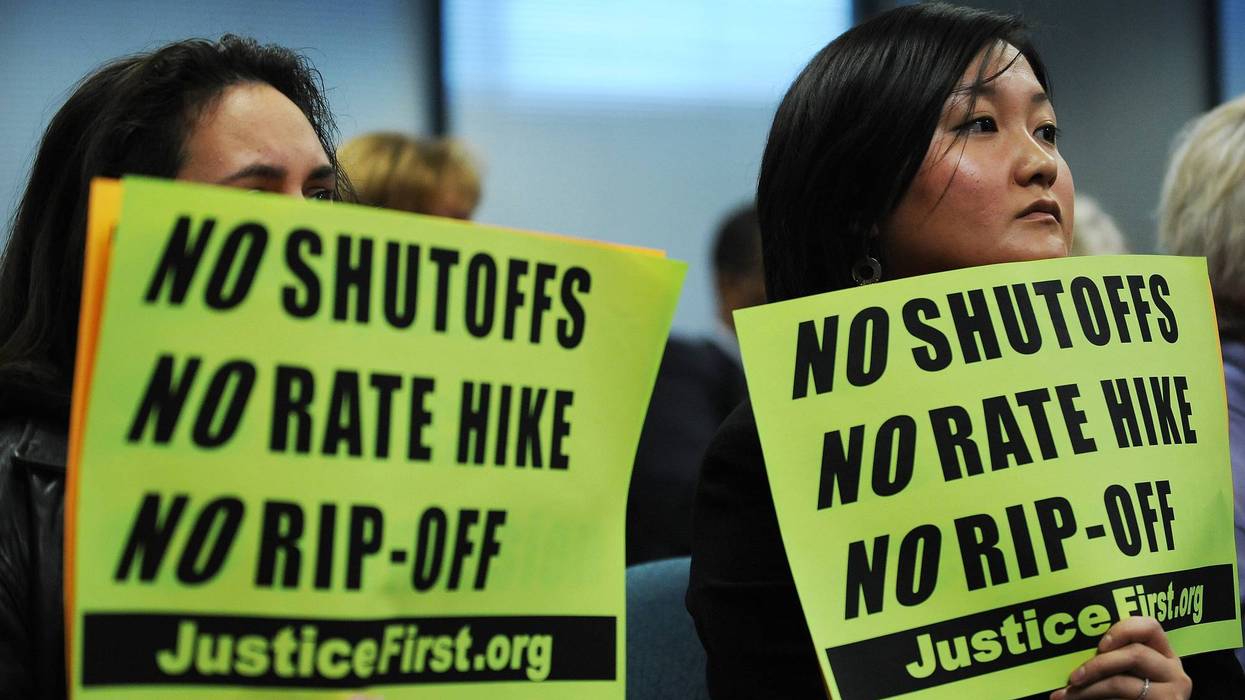
Public ownership of power has worked for decades in thousands of towns and cities and is being actively pursued in the District and other communities across the country.
Affordability will remain a top issue in 2026, continuing to draw political attention and likely defining this year’s midterm election races. Among the principal contributors to the cost-of-living crisis are power bills. For millions, the cost of keeping the lights, heating, and cooling on feels like “a second rent,” a problem that the explosive growth in the development and use of AI and associated data center capacity appears poised to aggravate.
The nation’s capital is no exception. A quarter of residents in the District of Columbia are unable to pay their power bill and in debt to the city’s private electricity company Pepco, which prioritizes short-term profits over affordable service. In 2024, the utility sent disconnection notices to 187,000 customers, threatening to shut off their electricity if they did not pay their arrears in full and forcing them to choose between, for instance, keeping their home safe and comfortable and food fresh or making their car payment.
Thankfully, we have a proven alternative–public ownership of power–that has worked for decades in thousands of towns and cities and is being actively pursued in the District and other communities across the country.
Alongside rent, home prices, dining, and entertainment, our electric bills have shot upwards. The only difference? Our power rates are comprehensively regulated. To protect against the monopoly power of Pepco, we have the Public Service Commission (PSC): a three-person board that reviews Pepco’s costs when the company wants to raise rates. Officially, the PSC acts as our watchdog to protect consumers from being billed thousands of dollars each month and to ensure the lights stay on in an environmentally sustainable way. In reality, it’s a depressingly familiar story of corporate capture of government.
We Power DC, a local campaign for energy democracy, has a simple demand: replacing Pepco with an electric utility that belongs to the people of the District.
In just the past few years, Pepco has jacked up rates while slow rolling climate action and energy efficiency. According to a 2023 PSC report, Pepco obtained only 16% of its power supply from renewable energy sources, while it thwarted the adoption of rooftop solar across the city. In response to this bad behavior, the PSC rewarded Pepco: approving a $147.2 million dollar rate increase in 2021 and a $123 million dollar rate hike in 2023. These dollars flow out of the District and into the coffers of Pepco and its holding company owner, Exelon of Chicago.
Despite a wide-ranging outcry from the community, industry experts, and even landlords, the PSC in November 2024 largely approved Pepco’s latest proposed rate increase. Commissioner Richard Beverly wrote a blistering dissent in which he said the other two commissioners were essentially approving the case “because Pepco said so.”
The effects of the rate increase were immediate and expected. Following a cold winter, the additional 5% bump on bills slammed DC residents, with some customers seeing their bills double or triple. Public anger forced Pepco to suspend shutoffs for the first few months of 2025—but both bill collection and the rate increase stayed in place.
Meanwhile, Exelon flaunted the rate hike in DC as a major success, all the while an impending recession looms across the city and the country at large. Even in bleak times, the pursuit of profits by Pepco (and utilities like it) is relentless.
Unfortunately, the District is not an outlier: Regulators across the country rubber-stamp requested rate increases, despite the lack of economic logic. State regulatory agencies liberally reward utility shareholders even though they assume little risk by parking their money in a safe and stable industry.
Fortunately, there is an alternative for all of us. In towns and cities across the country, utilities are not controlled by shareholders—instead, they are governed by the communities that they serve and run on a not-for-profit basis. Public power is a proven model that altogether supplies electricity to about 55 million Americans in around 2,000 towns and cities across red and blue states, including Los Angeles, Nashville, and Seattle. On average, publicly owned utilities provide electricity that is cheaper and more reliable than their shareholder-controlled counterparts. Public power is not foreign or experimental but firmly established in the United States.
Affordable power is not the only argument in favor of public ownership. The urgency of the climate crisis means that we cannot rely solely on cajoling private utilities to remake our power grid. Despite the declining costs and rapid growth of wind and solar over the past 15 years, decarbonization of the American power sector is not happening quickly enough.
Furthermore, for the next few years, the responsibility of cleaning up the power sector will largely fall to state and local governments. Congress’ gutting of the Inflation Reduction Act in the One Big Beautiful Bill means that federal tax credits for wind and solar will soon dry up. Instead of trying to bribe the private sector to invest, we should take control of the climate transition through direct public investment. New York did exactly this in 2023 when it enacted the Build Public Renewables Act (BPRA) and empowered the state-owned New York Power Authority to build large-scale renewable projects and lead a just transition to a clean electric sector.
Inspired by the successful movement behind BPRA and determined to end the unbearable burden of power bills for hundreds of thousands of residents, We Power DC, a local campaign for energy democracy, has a simple demand: replacing Pepco with an electric utility that belongs to the people of the District. A utility governed by us could provide reliable service at lower rates; provide high-quality union jobs; and be a leader, not a laggard, in the fight against climate change. On top of its grassroots organizing, We Power published a report describing in detail how DC would benefit from a publicly owned utility, and how we can get there. While the road to public power can be long, the report outlines key intermediate steps that DC should pursue, including commissioning a study on municipalization of Pepco, taking control of grid planning, and building and operating community solar projects.
We Power is accompanied by fights for public power in places as far flung as Ann Arbor, Michigan; Clearwater, Florida; and Tucson. Last month, a financial feasibility study found that power customers in New York’s Hudson Valley would save money right away by converting their private utility to a locally controlled public power authority. At a moment in which climate action and our political institutions are under full-frontal assault at the national level, We Power is one of many fights to build democratic and sustainable utilities.
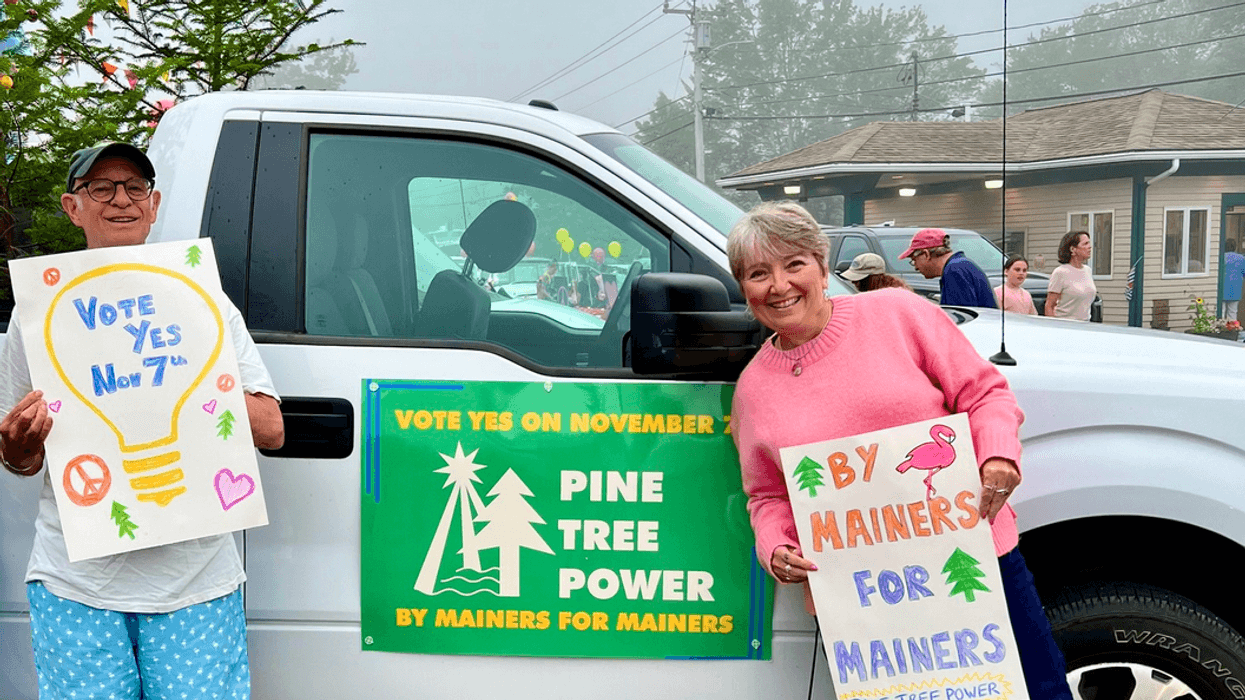
"Mainers have a rare chance to take control of an important part of their daily lives," said Sen. Bernie Sanders in his endorsement of Pine Tree Power. "Mainers can have cheaper, more reliable power—and help fight climate change at the same time."
As Election Day nears, climate and economic justice advocates in Maine and across the country are calling on voters in the New England state to approve an historic referendum that would initiate a public takeover of Maine's two for-profit utilities—a move which public power experts say could bring about a sea change in public utility ownership and lower rates for consumers while building resistance to fossil fuel infrastructure.
The "Yes on Question 3" campaign aims to create a new nonprofit company called Pine Tree Power, which would purchase Central Maine Power (CMP) and Versant. The two companies currently provide power to 96% of Maine customers. The new company would be run by a board of directors elected by Maine voters, which advocates say would make the utility far more accountable to consumers than the investor-owned utilities have been.
Proponents have pointed to local utility takeovers which have resulted in lower rates for consumers, such as the case of the Long Island Power Authority. The publicly owned authority reduced electricity rates by 20% for customers, according to the American Public Power Association (APPA).
The grassroots Pine Tree Power campaign notes that consumer-owned utilities (COUs) are not a radical new idea in Maine, as 10 COUs serve 98 towns across the state. When one of the COUs attempted to expand and provide more customers in Kennebunk with lower rates and more reliable service, CMP halted the effort, leading one resident to say they were being "held hostage by the country's worst power company."
"Whether we're new or lifelong Mainers, we know that our state is defined by folks who work hard for one another," reads Pine Tree Power's website. "Medical workers and mill workers, farmers and firefighters, loggers, and lobstermen, we all work together to power Maine. That's why we deserve a power company that works just as hard for us."
"But ever since our utilities were sold to the highest bidder, our communities have been falling victim to the tyranny of faraway corporations," it continues, noting that CMP's parent company is owned by a Spanish firm while the primary shareholder of Versant's parent company is the city of Calgary, Canada.
The U.S. Energy Information Administration says that average electricity prices across New England are some of the highest in the nation, rivaling only Alaska and Hawaii, with costs rising from 24.6 cents per kilowatt hour in June 2022 to 28.3 cents per kilowatt hour this past June. Meanwhile, Maine's electric utilities get low marks for reliability, with the state ranked 49th in the country according to a 2022 analysis by the Citizens Utility Board in Illinois.
Pine Tree Power says the new public utility would save ratepayers $9 billion over three decades—lowering rates by an average of $367 per household annually—while a 2020 study commissioned by the Maine Public Utilities Commission said rates would likely increase in the short term after the purchase of CMP and Versant, but come down over the long term due to tax savings.
As the APPA told the Rhode Island Current last month, 18 new local public power utilities have been formed in the U.S. over the past two decades, and "their rates are typically lower and their electric service is more reliable."
But companies like CMP and Versant, whose profits and rates have soared in recent years while service has declined, are able to pour their vast resources into their own campaigns "to discourage communities from looking at their options," Ursula Schryver of APPA told the Current. The utilities have raised more than $27 million to oppose the Yes on Question 3 initiative.
"They'll typically say it's going to be expensive, take years, and cost a lot of money," said Schryver, the group's vice president for strategic member engagement. "They're going to have PR campaigns [and] push legal challenges to drag it out and make it as expensive and as long and scary as possible."
Pine Tree Power noted on social media in July that the grassroots campaign has garnered small donations from more than 1,000 people, 90% of whom live in Maine.
In addition to spending tens of millions of dollars to defeat Pine Tree Power, the for-profit utilities are backing a separate referendum in November that, if passed, would stall the creation of the publicly owned company by requiring Mainers to vote on borrowing more than $1 billion in most cases.
Maine Affordable Energy, a group funded by CMP, claims the purchase of the two utilities would cost Mainers $13.5 billion, while utility lawyer Peter Murray estimated in the Portland Press Herald last month that the true acquisition price would likely be about half that amount, based on the investor-owned companies' Federal Energy Regulatory Commission filings.
One of the proposal's latest endorsements came from the Natural Resources Council of Maine (NRCM) on Wednesday, with the group writing in a position paper that in addition to saving Mainers money, the "transparency and local accountability" that a public utility would provide would be "crucial to an equitable, affordable clean energy transition."
"Sometimes it's only government that can get the job done," said NRCM. "Take for example Efficiency Maine Trust (EMT), an independent quasi-government agency formalized in 2009 for not dissimilar reasons to the Pine Tree Power proposal, to correct for the disincentive utilities have to invest in energy efficiency. EMT, now with an annual budget of $100 million, implements energy efficiency and alternative energy programs across Maine, invests in businesses and workforce capacity, and has become a widely trusted resource for information to inform personal and business investment decisions. Just imagine what EMT could accomplish if it were working with cooperative utilities."
The group added that low-cost financing available to COUs could help speed "an equitable clean energy transition" that includes "low- and moderate-income households and other underserved Mainers."
"Access to lower-cost financing can free up resources to build robust programs designed to overcome the social and financial barriers to energy efficiency upgrades, weatherization, heat pumps, zero-emission vehicles, solar, and battery storage, to ensure that vulnerable and marginalized people also enjoy the ways that clean energy makes our homes safer and more comfortable, affordable, and valuable," said NRCM.
The Pine Tree Power campaign has also been endorsed by 350.org, U.S. Sen. Bernie Sanders (I-Vt.), Sierra Club Maine, the Maine Organic Farmers and Gardeners Association (MOFGA), and the Maine State Nurses Association (MSNA).
MSNA argued in its endorsement that "access to clean, reliable energy is undeniably a public health concern," with power loss linked to higher mortality rates among elderly people, while MOFGA said "true sustainability will only be possible with a power company that puts the needs of our local communities above the profits of foreign CEOs."
"Power belongs in the hands of the people, not greedy corporations," said Sanders in July. "Mainers have a rare chance to take control of an important part of their daily lives. Instead of a private power system that last year sent $187 million in profits out of the country, Mainers can have cheaper, more reliable power—and help fight climate change at the same time."
While CMP has lobbied against renewable energy legislation, proponents of Pine Tree Power, including 350.org, say the publicly owned utility "is a direct way of targeting the fossil fuel industry."
"Returning power to the people and looking for big fights is where we can best show solutions and also resist the fossil fuel infrastructure," Candice Fortin, a campaigner with the group, told The Progressive in August.

Picking Hawaiian Electric up before or out of bankruptcy and converting it to a public good will insure the state with reliable, citizen-centered electricity for years to come while guaranteeing minimal disruption for employees.
Following the tragic—and perhaps criminal—fires in Lahaina, the state of Hawaii should purchase Hawaiian Electric, the sole provider of electric power to the state, and run it as a publicly owned utility. Here’s why.
When it comes to electric utilities, there are basically only two types of companies: private and public. The main difference between the two is one of incentives.
Private companies, owned by shareholders, have a singular primary goal: to make money. Every action they take must be scrutinized in the light of their impact on profits, because if profits aren’t maintained at a level acceptable to the shareholders, the senior level of management is looking at being replaced by people who will prioritize profits.
People served by publicly owned power companies pay less for electricity, get better service, and have fewer outages.
Public companies, owned by the governments representing the people they serve or run as co-ops and owned by the consumers themselves, also have a singular primary goal: serve the people as well as possible. Every action they take is scrutinized by the people and the government to make sure that people are getting the services they need, in the way they need, at a price they can afford.
Private for-profit electricity utilities not only cost their customers more and generally provide poorer service, but they also have such a long history of ripping people off to increase profits that every state in the union has had to create a regulatory agency to control their worst impulses.
This “public management” to oversee the private company’s management adds another layer of cost, on top of the profits extracted as dividends paid to shareholders, paid by the customers being burdened by privately owned power companies.
Hawaiian Electric is a private, shareholder-owned for-profit corporation, much like California’s PG&E. And, if investigations turn up further evidence of what’s already being reported in the media—that the Lahaina fires were possibly caused by the power company’s failure to turn off the power when the winds hit gale force—they’ll be as responsible for the deaths there as PG&E was for deaths from multiple wildfires in California. Those deaths cost PG&E billions.
This is part of why the company’s shares right now are in the tank, trading around $13 after years of bouncing between $30 and $40.
The market is anticipating lawsuits like the ones that bankrupted PG&E (a half-dozen have already been filed against Hawaiian Power, including a class action), driving down the share price, making now a perfect time for the state to buy out the company. Wells Fargo says they believe the stock will settle around $8 a share making it an amazing bargain.
In fact, the company filed a brief this week with the U.S. Securities and Exchange Commission (SEC), which regulates private companies, revealing that they are looking into bankruptcy.
People served by publicly owned power companies pay less for electricity, get better service, and have fewer outages. Serving over 49 million (1 in 7) Americans, including large cities like Austin, Nashville, Los Angeles, and Seattle as well as over 2,000 communities across the country, public power companies return an average of 20% more to their communities than do private power companies.
Customers of privately owned power companies suffer an average of 150 minutes of lost power per year; for customers of publicly owned power companies it’s only 62 minutes per year. Being responsive to their communities’ concerns, in 2019 fully 40% of all power generated by publicly owned companies came from renewable resources.
This only makes sense. While the management of a private company is always looking for ways to cut costs to satisfy shareholder demands for higher dividends, the management of publicly owned companies spend their time every day looking for ways to better serve their customers.
Not only that, private corporations can get away with behaviors that are imprisonable crimes when committed by government employees. These “now legal” breaches of the public trust include self-dealing, handing off cash to family members, paying off politicians, and harassing or firing whistleblowers.
As In the Public Interest notes:
[P]rivate providers are generally not subject to conflict‐of‐interest laws, nepotism statutes or ordinances, ethics codes or whistleblower protection for their employees, or restrictions on political involvement.
Back in 2015, when Hawaiian Electric announced it was in negotiations to be purchased by a big Florida power corporation, citizens of Hawaii got together and launched a series of plans and petitions to flip the company to public ownership. These plans ranged from the state taking over the entire company to breaking it up into smaller parts that were owned by the governments of each island or major city.
Forty legislators and county council members met at the state Capitol to request the legislature consider taking over Hawaiian Electric and turning it public. They were led by former Energy Committee Chair Chris Lee.
The group formed on Oahu was called KULOLO (Keep Our Utility Locally Owned and Locally Operated), named after a well-known fudge-like Hawaiian desert made from taro and coconut. City Council Chair Ernie Martin put forth the resolution to the city for a feasibility study.
On the Big Island, citizens and legislators formed the Hawaii Island Energy Cooperative. Its members included some well-known names from the area: Richard Ha of Hamakua Farms, state Sen. Russell Ruderman, and Department of Hawaiian Home Lands Commissioner Wallace Ishibashi. They went so far as to hire a big PR firm (Hastings and Pleadwell) to sell the idea to citizens.
Maui Mayor Alan Arakawa was serious, too: he awarded $70,000 to the consulting firm Guernsey for a study of the viability of transitioning that city’s power to a municipally owned utility.
But then the deal fell through and the conversation about taking over the company went silent.
Now it’s back.
A sense of crisis around Hawaiian Electric is already in the air. Just a few days ago, State Senator Angus McKelvey (D-Maui) told the Honolulu State Advertiser:
The consequences [of the fire] are beyond measure. I hope that this will be the mother of all wake-up calls. People need to have comfort that this won’t happen ever again.
The senator, who’s been in the legislature for 18 years, added that the privately owned power company has repeatedly resisted calls from him and other legislators to spend money to harden their power systems by burying cables where they can’t cause fires:
“They fight it tooth and nail,” he told the Advertiser. “There’s zero excuse in my mind why power lines in Lahaina shouldn’t be underground now. No amount of money should be a reason not to do it.”
Disaster workers are still searching for bodies in Lahaina, but, with over 100 dead and counting, the fire already represents the worst American wildfire death toll in over a century.
Hawaiian Electric not only provides an essential service (which shouldn’t be exploited for profits), but also employs about 3,800 people across the islands.
Picking it up before or out of bankruptcy and converting it to a public good will insure the state with reliable, citizen-centered electricity for years to come while guaranteeing minimal disruption for those employees (other than the senior executives with their fat paychecks, like the CEO, who makes $3.8 million a year, who will probably need to be replaced).
Back when Enron was collapsing, our local utility here in Portland, Oregon, was one of their affiliates and on the block for sale. The city scraped together the asking price and a small premium to sweeten the pot, but the company refused to sell to a municipality or state, wanting to keep the utility in for-profit hands. It’s now called Portland General Electric (PGE).
Portlanders got screwed (I’ve personally experienced multiple days of power outages almost every year since) and we didn’t even get a T-shirt out of the deal.
During our last power outage, a month or two ago, PGE came out and strung a temporary high-voltage power line, attaching it to trees (!), to keep our neighborhood lit; we’re now bracing for the winter winds.
PGE, after all, has to come up with the $6.2 million in annual compensation its CEO gets, not to mention the other high-paid senior executives and the $158 million in dividends it paid to its stockholders last year. Fixing my neighborhood naturally competes with that priority.
Which is why Hawaii needs to move on this quick, before other for-profit utilities get into the act as happened here in Oregon. The corporate raiders will soon be circling, even as Lahaina buries its dead.

"A better world is possible," said campaigners who pushed for the passage of the Build Public Renewables Act. "And we are building it."
Climate campaigners in New York were credited on Tuesday with pushing Democratic Gov. Kathy Hochul and the state Legislature to include in the state budget "historic" provisions that will build publicly owned renewable energy and end the use of fossil fuels in new buildings—without a loophole allowing municipalities to opt out of the requirement.
The budget, hammered out in recent days in talks between the governor and the leaders of the Legislature as advocates refused to back down from their demands for far-reaching climate measures within the deal, includes the Build Public Renewables Act (BPRA), which was secured "through four years of organizing across the state by thousands of [Democratic Socialists of America members], the Public Power NY coalition, and more," said the NYC-DSA Ecosocialist Working Group.
"This text is the biggest Green New Deal win in U.S. history," said the group. "A better world is possible. And we are building it."
The BPRA will enable the New York Power Authority (NYPA), the state's publicly owned power provider, to assess each year whether New York is expected to meet its targets of achieving 70% renewable energy by 2030 and 100% by 2040. If not, the agency will step in to build enough renewable energy to fill in the gap.
The law is set to create tens of thousands of green jobs and "shut down some of the state's most polluting oil and gas plants—which are concentrated in working-class, Black, and brown communities—by 2030, replacing them with pollution-free renewable power," according to Public Power NY, a statewide grassroots movement.
Campaigners were outraged last year when the Democratic-led state Legislature refused to vote on the law before ending the legislative session early. Several New York Democrats in the U.S. House, including Reps. Alexandria Ocasio-Cortez and Jamaal Bowman, wrote to Hochul in March to demand the passage of the law.
Public Power NY noted that proposed reforms to the governance of the NYPA, which would have made the authority more accountable to New Yorkers, were not included in the final deal. Justin Driscoll, a former Republican donor who has opposed the BPRA, is currently Hochul's hand-picked interim CEO of the agency, and the coalition said it will "mobilize the powerful movement that passed this bill to oppose his nomination."
"NYPA needs leadership that understands the potential of public power and will use NYPA's resources and capacity to ensure that affordable energy gets to New Yorkers who need it most and that New York meets its climate goals," said Public Power NY.
Despite the absence of the proposed reforms in the budget, author and advocate Naomi Klein called the deal a "big win" for campaigners who have spent years pushing for public power in New York.
The budget also includes the All-Electric Building Act, a first-in-the-nation state law that will ban the use of fossil fuels in new buildings, starting in 2026 for structures with fewer than seven stories and 2029 for taller buildings.
Campaigners with Food & Water Watch (FWW), Earthjustice, NYPIRG, and New York Communities for Change successfully pushed Hochul and state lawmakers to exclude a "poison pill" provision which would have allowed local governments to opt out of the new requirements, enabling the entire state to take a "historic step" toward ending the use of oil and gas to heat and power buildings.
Once enacted, the measure will save households between $904 and $3,000 per year, according to an analysis by think tank Win Climate, but advocates noted that the law will go into effect two years after they had demanded—the result of a multimillion-dollar lobbying campaign by oil and gas giants, critics said.
"New Yorkers are resisting fossil fuels everywhere they pop up, from the power plants that pollute our air to the pipelines that put our communities in harm's way. Now buildings can be a part of that solution," said Alex Beauchamp, northeast region director at FWW. "Unfortunately, we're still moving too slowly, and Gov. Hochul is to blame. Instead of fighting for the swift transition off fossil fuels that the climate crisis demands, the governor caved at the eleventh hour, giving the fossil fuel industry another year of delay to profit at our expense. We won't stop fighting until we end our devastating addiction to fossil fuels."
Certain commercial buildings also won't have to comply until 2029, a carve-out that will benefit "large warehouses and box stores operated by the likes of Amazon" and will "reduce the bill's positive impact and further defer to corporate lobbyists," said FWW.
Rachel Rivera, a Brownsville, Brooklyn resident and New York Communities for Change member whose home was devastated by Hurricane Sandy in 2012, said the budget deal led her to have "mixed emotions."
"This policy is a political compromise between what's needed for the people and the death-dealing fossil fuel industry, the people who hurt my family so badly," said Rivera. "On the one hand, New York, my home, will be the first state to end fossil fuels in new buildings by law. That's huge because my community needs to save money, breathe clean air, and get good jobs in clean energy, not die in an extreme weather crisis, as members of my family have. Sadly, this great new law will go into effect years later than it should."
"New York is far behind what's needed for climate justice," she added. "I want to thank our bill sponsors, and all the movement leaders who fight for what's right."
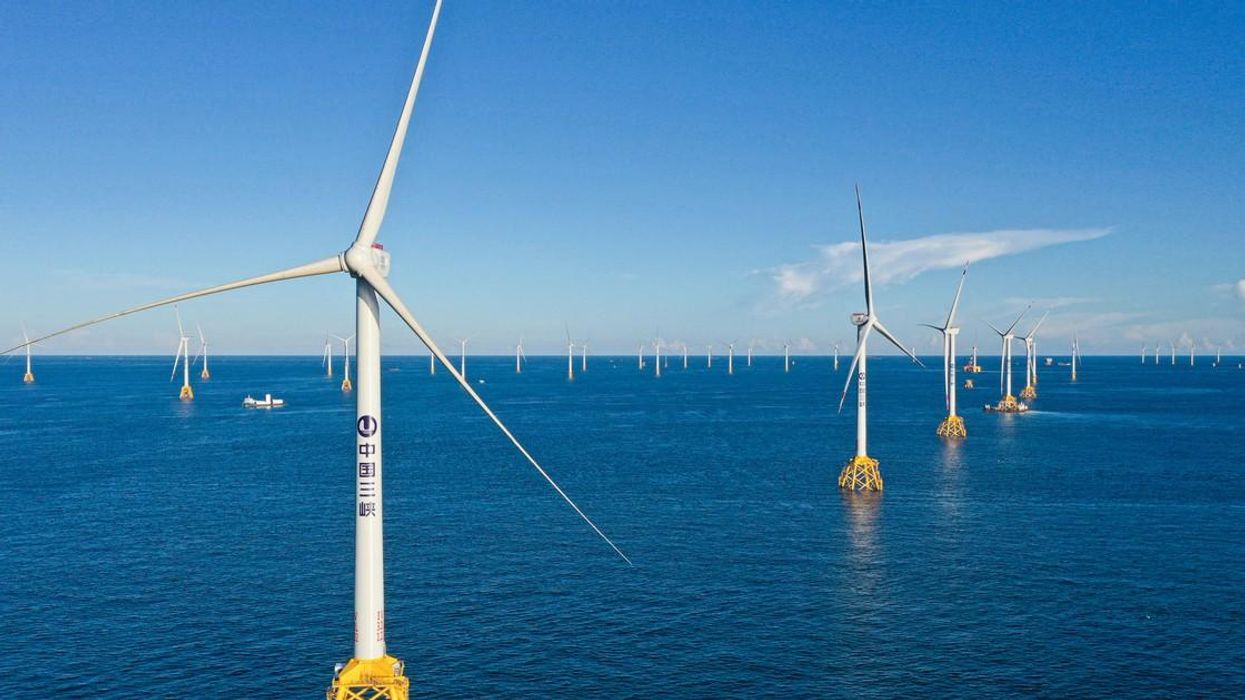
The blades of the wind turbines on the mountain range opposite my window are turning especially energetically today. Last night's storm has abated but high winds continue, contributing extra kilowatts to the electricity grid at precisely zero additional cost (or marginal cost, in the language of the economists). But the people struggling to make ends meet during a dreadful cost-of-living crisis must pay for these kilowatts as if they were produced by the most expensive liquefied natural gas transported to Greece's shores from Texas. This absurdity, which prevails well beyond Greece and Europe, must end.
We need a large-scale Manhattan Project-like investment in the green technologies of the future (such as green hydrogen and large-scale offshore floating windfarms).
The absurdity stems from the delusion that states can simulate a competitive, and thus efficient, electricity market. Because only one electricity cable enters our homes or businesses, leaving matters to the market would lead to a perfect monopoly - an outcome that nobody wants. But governments decided that they could simulate a competitive market to replace the public utilities that used to generate and distribute power. They can't.
The European Union's power sector is a good example of what market fundamentalism has done to electricity networks the world over. The EU obliged its member states to split the electricity grid from the power-generating stations and privatize the power stations to create new firms, which would compete with one another to provide electricity to a new company owning the grid. This company, in turn, would lease its cables to another host of companies that would buy the electricity wholesale and compete among themselves for the retail business of homes and firms. Competition among producers would minimize the wholesale price, while competition among retailers would ensure that final consumers benefit from low prices and high-quality service.
Alas, none of this could be made to work in theory, let alone in practice.
The simulated market faced contradictory imperatives: to ensure a minimum amount of electricity within the grid at every point in time, and to channel investment into green energy. The solution proposed by market fundamentalists was twofold: create another market for permissions to emit greenhouse gases, and introduce marginal-cost pricing, which meant that the wholesale price of every kilowatt should equal that of the costliest kilowatt.
The emission-permit market was meant to motivate electricity producers to shift to less polluting fuels. Unlike a fixed tax, the cost of emitting a ton of carbon dioxide would be determined by the market. In theory, the more industry relied on terrible fuels like lignite, the larger the demand for the EU-issued emission permits. This would drive up their price, strengthening the incentive to switch to natural gas and, ultimately, to renewables.
Marginal-cost pricing was intended to ensure the minimum level of electricity supply, by preventing low-cost producers from undercutting higher-cost power companies. The prices would give low-cost producers enough profits and reasons to invest in cheaper, less polluting energy sources.
To see what the regulators had in mind, consider a hydroelectric power station and a lignite-fired one. The fixed cost of building the hydroelectric station is large but the marginal cost is zero: once water turns its turbine, the next kilowatt the station produces costs nothing. In contrast, the lignite-fired power station is much cheaper to build, but the marginal cost is positive, reflecting the fixed amount of costly lignite per kilowatt produced.
By fixing the price of every kilowatt produced hydroelectrically to be no less than the marginal cost of producing a kilowatt using lignite, the EU wanted to reward the hydroelectric company with a fat profit, which, regulators hoped, would be invested in additional renewable-energy capacity. Meanwhile, the lignite-fueled power station would have next to no profits (as the price would just about cover its marginal costs) and a growing bill for the permits it needed to buy in order to pollute.
But reality was less forgiving than the theory. As the pandemic wreaked havoc on global supply chains, the price of natural gas rose, before trebling after Russia invaded Ukraine. Suddenly, the most polluting fuel (lignite) was not the most expensive, motivating more long-term investment in fossil fuels and infrastructure for LNG. Marginal-cost pricing helped power companies extract huge rents from outraged retail consumers, who realized they were paying much more than the average cost of electricity. Not surprisingly, publics, seeing no benefits - to them or to the environment - from the blades rotating above their heads and spoiling their scenery, turned against wind turbines.
The rise in natural gas prices has exposed the endemic failures that occur when a simulated market is grafted onto a natural monopoly. We have seen it all: How easily producers could collude in fixing the wholesale price. How their obscene profits, especially from renewables, turned citizens against the green transition. How the simulated market regime impeded common procurement that would have alleviated poorer countries' energy costs. How the retail electricity market became a casino with companies speculating on future electricity prices, profiting during the good times, and demanding state bailouts when their bets turn bad.
It's time to wind down simulated electricity markets. What we need, instead, are public energy networks in which electricity prices represent average costs plus a small mark-up. We need a carbon tax, whose proceeds must compensate poorer citizens. We need a large-scale Manhattan Project-like investment in the green technologies of the future (such as green hydrogen and large-scale offshore floating windfarms). And, lastly, we need municipally-owned local networks of existing renewables (solar, wind, and batteries) that turn communities into owners, managers, and beneficiaries of the power they need.