
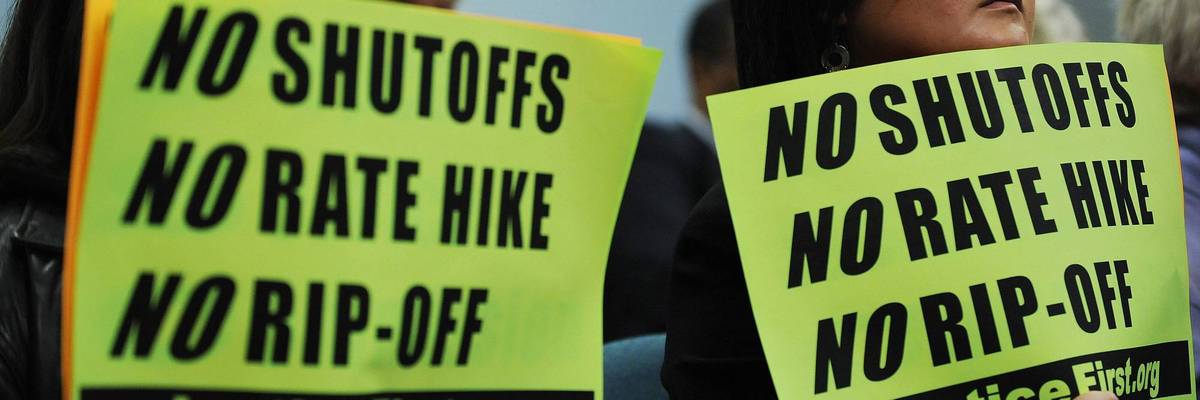
A group of protesters display anti-Pepco placards as District of Columbia Public Service Commission Chairman Betty Ann Kane speaks during a hearing on Pepco's 44.5 million US dollars rate hike at the commission's headquarters in Washington, DC, on March 2, 2010.
Power Bills Are Bankrupting DC Residents—but There's a Path to Affordability for All
Public ownership of power has worked for decades in thousands of towns and cities and is being actively pursued in the District and other communities across the country.
Affordability will remain a top issue in 2026, continuing to draw political attention and likely defining this year’s midterm election races. Among the principal contributors to the cost-of-living crisis are power bills. For millions, the cost of keeping the lights, heating, and cooling on feels like “a second rent,” a problem that the explosive growth in the development and use of AI and associated data center capacity appears poised to aggravate.
The nation’s capital is no exception. A quarter of residents in the District of Columbia are unable to pay their power bill and in debt to the city’s private electricity company Pepco, which prioritizes short-term profits over affordable service. In 2024, the utility sent disconnection notices to 187,000 customers, threatening to shut off their electricity if they did not pay their arrears in full and forcing them to choose between, for instance, keeping their home safe and comfortable and food fresh or making their car payment.
Thankfully, we have a proven alternative–public ownership of power–that has worked for decades in thousands of towns and cities and is being actively pursued in the District and other communities across the country.
Alongside rent, home prices, dining, and entertainment, our electric bills have shot upwards. The only difference? Our power rates are comprehensively regulated. To protect against the monopoly power of Pepco, we have the Public Service Commission (PSC): a three-person board that reviews Pepco’s costs when the company wants to raise rates. Officially, the PSC acts as our watchdog to protect consumers from being billed thousands of dollars each month and to ensure the lights stay on in an environmentally sustainable way. In reality, it’s a depressingly familiar story of corporate capture of government.
We Power DC, a local campaign for energy democracy, has a simple demand: replacing Pepco with an electric utility that belongs to the people of the District.
In just the past few years, Pepco has jacked up rates while slow rolling climate action and energy efficiency. According to a 2023 PSC report, Pepco obtained only 16% of its power supply from renewable energy sources, while it thwarted the adoption of rooftop solar across the city. In response to this bad behavior, the PSC rewarded Pepco: approving a $147.2 million dollar rate increase in 2021 and a $123 million dollar rate hike in 2023. These dollars flow out of the District and into the coffers of Pepco and its holding company owner, Exelon of Chicago.
Despite a wide-ranging outcry from the community, industry experts, and even landlords, the PSC in November 2024 largely approved Pepco’s latest proposed rate increase. Commissioner Richard Beverly wrote a blistering dissent in which he said the other two commissioners were essentially approving the case “because Pepco said so.”
The effects of the rate increase were immediate and expected. Following a cold winter, the additional 5% bump on bills slammed DC residents, with some customers seeing their bills double or triple. Public anger forced Pepco to suspend shutoffs for the first few months of 2025—but both bill collection and the rate increase stayed in place.
Meanwhile, Exelon flaunted the rate hike in DC as a major success, all the while an impending recession looms across the city and the country at large. Even in bleak times, the pursuit of profits by Pepco (and utilities like it) is relentless.
Unfortunately, the District is not an outlier: Regulators across the country rubber-stamp requested rate increases, despite the lack of economic logic. State regulatory agencies liberally reward utility shareholders even though they assume little risk by parking their money in a safe and stable industry.
Fortunately, there is an alternative for all of us. In towns and cities across the country, utilities are not controlled by shareholders—instead, they are governed by the communities that they serve and run on a not-for-profit basis. Public power is a proven model that altogether supplies electricity to about 55 million Americans in around 2,000 towns and cities across red and blue states, including Los Angeles, Nashville, and Seattle. On average, publicly owned utilities provide electricity that is cheaper and more reliable than their shareholder-controlled counterparts. Public power is not foreign or experimental but firmly established in the United States.
Affordable power is not the only argument in favor of public ownership. The urgency of the climate crisis means that we cannot rely solely on cajoling private utilities to remake our power grid. Despite the declining costs and rapid growth of wind and solar over the past 15 years, decarbonization of the American power sector is not happening quickly enough.
Furthermore, for the next few years, the responsibility of cleaning up the power sector will largely fall to state and local governments. Congress’ gutting of the Inflation Reduction Act in the One Big Beautiful Bill means that federal tax credits for wind and solar will soon dry up. Instead of trying to bribe the private sector to invest, we should take control of the climate transition through direct public investment. New York did exactly this in 2023 when it enacted the Build Public Renewables Act (BPRA) and empowered the state-owned New York Power Authority to build large-scale renewable projects and lead a just transition to a clean electric sector.
Inspired by the successful movement behind BPRA and determined to end the unbearable burden of power bills for hundreds of thousands of residents, We Power DC, a local campaign for energy democracy, has a simple demand: replacing Pepco with an electric utility that belongs to the people of the District. A utility governed by us could provide reliable service at lower rates; provide high-quality union jobs; and be a leader, not a laggard, in the fight against climate change. On top of its grassroots organizing, We Power published a report describing in detail how DC would benefit from a publicly owned utility, and how we can get there. While the road to public power can be long, the report outlines key intermediate steps that DC should pursue, including commissioning a study on municipalization of Pepco, taking control of grid planning, and building and operating community solar projects.
We Power is accompanied by fights for public power in places as far flung as Ann Arbor, Michigan; Clearwater, Florida; and Tucson. Last month, a financial feasibility study found that power customers in New York’s Hudson Valley would save money right away by converting their private utility to a locally controlled public power authority. At a moment in which climate action and our political institutions are under full-frontal assault at the national level, We Power is one of many fights to build democratic and sustainable utilities.
We are at a crossroads
This country and this world are at a monumental crossroads. In a few short weeks, US voters will have an opportunity to beat back the forces of fascism and confront the billionaires who are rigging the economy, our media system, and our democracy, making it increasingly impossible for ordinary people to get by. We’re not just talking about the election. We’re talking about what must be done once these fascist elements are vanquished from power. We need a bolder set of solutions than what either major party has so far been willing to offer and a working-class movement ready to fight like hell for it. Trump didn't emerge from nowhere. The conditions that fueled MAGA authoritarianism were created by decades of radical neoliberal economic policies and a corrupt political system dominated by corporate interests. They slashed taxes on the super-rich, promising that the benefits would trickle down. They said giveaways to the corporate titans would make life more affordable for the rest of us. It was all bullshit. And when a bitter, betrayed populace searches for someone to blame, right-wing demagogues have little trouble finding scapegoats. People know when they're being lied to, but you won't hear any of this from the corporate media. Only independent journalism—powered and funded by people who believe in building a better world—can deliver truly trustworthy daily news. Our Fall Campaign is underway, and we need your help. To power our newsroom through the rest of the year, we need to raise $125,000 by midnight on October 31. So if you share our vision, please contribute whatever you can to sustain our work. |
Affordability will remain a top issue in 2026, continuing to draw political attention and likely defining this year’s midterm election races. Among the principal contributors to the cost-of-living crisis are power bills. For millions, the cost of keeping the lights, heating, and cooling on feels like “a second rent,” a problem that the explosive growth in the development and use of AI and associated data center capacity appears poised to aggravate.
The nation’s capital is no exception. A quarter of residents in the District of Columbia are unable to pay their power bill and in debt to the city’s private electricity company Pepco, which prioritizes short-term profits over affordable service. In 2024, the utility sent disconnection notices to 187,000 customers, threatening to shut off their electricity if they did not pay their arrears in full and forcing them to choose between, for instance, keeping their home safe and comfortable and food fresh or making their car payment.
Thankfully, we have a proven alternative–public ownership of power–that has worked for decades in thousands of towns and cities and is being actively pursued in the District and other communities across the country.
Alongside rent, home prices, dining, and entertainment, our electric bills have shot upwards. The only difference? Our power rates are comprehensively regulated. To protect against the monopoly power of Pepco, we have the Public Service Commission (PSC): a three-person board that reviews Pepco’s costs when the company wants to raise rates. Officially, the PSC acts as our watchdog to protect consumers from being billed thousands of dollars each month and to ensure the lights stay on in an environmentally sustainable way. In reality, it’s a depressingly familiar story of corporate capture of government.
We Power DC, a local campaign for energy democracy, has a simple demand: replacing Pepco with an electric utility that belongs to the people of the District.
In just the past few years, Pepco has jacked up rates while slow rolling climate action and energy efficiency. According to a 2023 PSC report, Pepco obtained only 16% of its power supply from renewable energy sources, while it thwarted the adoption of rooftop solar across the city. In response to this bad behavior, the PSC rewarded Pepco: approving a $147.2 million dollar rate increase in 2021 and a $123 million dollar rate hike in 2023. These dollars flow out of the District and into the coffers of Pepco and its holding company owner, Exelon of Chicago.
Despite a wide-ranging outcry from the community, industry experts, and even landlords, the PSC in November 2024 largely approved Pepco’s latest proposed rate increase. Commissioner Richard Beverly wrote a blistering dissent in which he said the other two commissioners were essentially approving the case “because Pepco said so.”
The effects of the rate increase were immediate and expected. Following a cold winter, the additional 5% bump on bills slammed DC residents, with some customers seeing their bills double or triple. Public anger forced Pepco to suspend shutoffs for the first few months of 2025—but both bill collection and the rate increase stayed in place.
Meanwhile, Exelon flaunted the rate hike in DC as a major success, all the while an impending recession looms across the city and the country at large. Even in bleak times, the pursuit of profits by Pepco (and utilities like it) is relentless.
Unfortunately, the District is not an outlier: Regulators across the country rubber-stamp requested rate increases, despite the lack of economic logic. State regulatory agencies liberally reward utility shareholders even though they assume little risk by parking their money in a safe and stable industry.
Fortunately, there is an alternative for all of us. In towns and cities across the country, utilities are not controlled by shareholders—instead, they are governed by the communities that they serve and run on a not-for-profit basis. Public power is a proven model that altogether supplies electricity to about 55 million Americans in around 2,000 towns and cities across red and blue states, including Los Angeles, Nashville, and Seattle. On average, publicly owned utilities provide electricity that is cheaper and more reliable than their shareholder-controlled counterparts. Public power is not foreign or experimental but firmly established in the United States.
Affordable power is not the only argument in favor of public ownership. The urgency of the climate crisis means that we cannot rely solely on cajoling private utilities to remake our power grid. Despite the declining costs and rapid growth of wind and solar over the past 15 years, decarbonization of the American power sector is not happening quickly enough.
Furthermore, for the next few years, the responsibility of cleaning up the power sector will largely fall to state and local governments. Congress’ gutting of the Inflation Reduction Act in the One Big Beautiful Bill means that federal tax credits for wind and solar will soon dry up. Instead of trying to bribe the private sector to invest, we should take control of the climate transition through direct public investment. New York did exactly this in 2023 when it enacted the Build Public Renewables Act (BPRA) and empowered the state-owned New York Power Authority to build large-scale renewable projects and lead a just transition to a clean electric sector.
Inspired by the successful movement behind BPRA and determined to end the unbearable burden of power bills for hundreds of thousands of residents, We Power DC, a local campaign for energy democracy, has a simple demand: replacing Pepco with an electric utility that belongs to the people of the District. A utility governed by us could provide reliable service at lower rates; provide high-quality union jobs; and be a leader, not a laggard, in the fight against climate change. On top of its grassroots organizing, We Power published a report describing in detail how DC would benefit from a publicly owned utility, and how we can get there. While the road to public power can be long, the report outlines key intermediate steps that DC should pursue, including commissioning a study on municipalization of Pepco, taking control of grid planning, and building and operating community solar projects.
We Power is accompanied by fights for public power in places as far flung as Ann Arbor, Michigan; Clearwater, Florida; and Tucson. Last month, a financial feasibility study found that power customers in New York’s Hudson Valley would save money right away by converting their private utility to a locally controlled public power authority. At a moment in which climate action and our political institutions are under full-frontal assault at the national level, We Power is one of many fights to build democratic and sustainable utilities.
- Trump's Surging LNG Exports Cost US Consumers $12 Billion in Just 9 Months ›
- How to Make Sure People and the Planet Don’t Pay for the Data Center Buildout ›
- What's Driving the Electricity Price Hike and What Can We Do About It? ›
- Analysis Shows Electric Bills Have Spiked 13% in Trump’s First Year—And His Own Policies Are to Blame ›
- 'Radical and Reckless': House Passes LNG Bill to Jack Up Climate Pollution and Energy Prices ›
- Led by Sanders, Senate Democrats Demand Trump EPA Restore Solar Funding as Energy Prices Soar ›
Affordability will remain a top issue in 2026, continuing to draw political attention and likely defining this year’s midterm election races. Among the principal contributors to the cost-of-living crisis are power bills. For millions, the cost of keeping the lights, heating, and cooling on feels like “a second rent,” a problem that the explosive growth in the development and use of AI and associated data center capacity appears poised to aggravate.
The nation’s capital is no exception. A quarter of residents in the District of Columbia are unable to pay their power bill and in debt to the city’s private electricity company Pepco, which prioritizes short-term profits over affordable service. In 2024, the utility sent disconnection notices to 187,000 customers, threatening to shut off their electricity if they did not pay their arrears in full and forcing them to choose between, for instance, keeping their home safe and comfortable and food fresh or making their car payment.
Thankfully, we have a proven alternative–public ownership of power–that has worked for decades in thousands of towns and cities and is being actively pursued in the District and other communities across the country.
Alongside rent, home prices, dining, and entertainment, our electric bills have shot upwards. The only difference? Our power rates are comprehensively regulated. To protect against the monopoly power of Pepco, we have the Public Service Commission (PSC): a three-person board that reviews Pepco’s costs when the company wants to raise rates. Officially, the PSC acts as our watchdog to protect consumers from being billed thousands of dollars each month and to ensure the lights stay on in an environmentally sustainable way. In reality, it’s a depressingly familiar story of corporate capture of government.
We Power DC, a local campaign for energy democracy, has a simple demand: replacing Pepco with an electric utility that belongs to the people of the District.
In just the past few years, Pepco has jacked up rates while slow rolling climate action and energy efficiency. According to a 2023 PSC report, Pepco obtained only 16% of its power supply from renewable energy sources, while it thwarted the adoption of rooftop solar across the city. In response to this bad behavior, the PSC rewarded Pepco: approving a $147.2 million dollar rate increase in 2021 and a $123 million dollar rate hike in 2023. These dollars flow out of the District and into the coffers of Pepco and its holding company owner, Exelon of Chicago.
Despite a wide-ranging outcry from the community, industry experts, and even landlords, the PSC in November 2024 largely approved Pepco’s latest proposed rate increase. Commissioner Richard Beverly wrote a blistering dissent in which he said the other two commissioners were essentially approving the case “because Pepco said so.”
The effects of the rate increase were immediate and expected. Following a cold winter, the additional 5% bump on bills slammed DC residents, with some customers seeing their bills double or triple. Public anger forced Pepco to suspend shutoffs for the first few months of 2025—but both bill collection and the rate increase stayed in place.
Meanwhile, Exelon flaunted the rate hike in DC as a major success, all the while an impending recession looms across the city and the country at large. Even in bleak times, the pursuit of profits by Pepco (and utilities like it) is relentless.
Unfortunately, the District is not an outlier: Regulators across the country rubber-stamp requested rate increases, despite the lack of economic logic. State regulatory agencies liberally reward utility shareholders even though they assume little risk by parking their money in a safe and stable industry.
Fortunately, there is an alternative for all of us. In towns and cities across the country, utilities are not controlled by shareholders—instead, they are governed by the communities that they serve and run on a not-for-profit basis. Public power is a proven model that altogether supplies electricity to about 55 million Americans in around 2,000 towns and cities across red and blue states, including Los Angeles, Nashville, and Seattle. On average, publicly owned utilities provide electricity that is cheaper and more reliable than their shareholder-controlled counterparts. Public power is not foreign or experimental but firmly established in the United States.
Affordable power is not the only argument in favor of public ownership. The urgency of the climate crisis means that we cannot rely solely on cajoling private utilities to remake our power grid. Despite the declining costs and rapid growth of wind and solar over the past 15 years, decarbonization of the American power sector is not happening quickly enough.
Furthermore, for the next few years, the responsibility of cleaning up the power sector will largely fall to state and local governments. Congress’ gutting of the Inflation Reduction Act in the One Big Beautiful Bill means that federal tax credits for wind and solar will soon dry up. Instead of trying to bribe the private sector to invest, we should take control of the climate transition through direct public investment. New York did exactly this in 2023 when it enacted the Build Public Renewables Act (BPRA) and empowered the state-owned New York Power Authority to build large-scale renewable projects and lead a just transition to a clean electric sector.
Inspired by the successful movement behind BPRA and determined to end the unbearable burden of power bills for hundreds of thousands of residents, We Power DC, a local campaign for energy democracy, has a simple demand: replacing Pepco with an electric utility that belongs to the people of the District. A utility governed by us could provide reliable service at lower rates; provide high-quality union jobs; and be a leader, not a laggard, in the fight against climate change. On top of its grassroots organizing, We Power published a report describing in detail how DC would benefit from a publicly owned utility, and how we can get there. While the road to public power can be long, the report outlines key intermediate steps that DC should pursue, including commissioning a study on municipalization of Pepco, taking control of grid planning, and building and operating community solar projects.
We Power is accompanied by fights for public power in places as far flung as Ann Arbor, Michigan; Clearwater, Florida; and Tucson. Last month, a financial feasibility study found that power customers in New York’s Hudson Valley would save money right away by converting their private utility to a locally controlled public power authority. At a moment in which climate action and our political institutions are under full-frontal assault at the national level, We Power is one of many fights to build democratic and sustainable utilities.
- Trump's Surging LNG Exports Cost US Consumers $12 Billion in Just 9 Months ›
- How to Make Sure People and the Planet Don’t Pay for the Data Center Buildout ›
- What's Driving the Electricity Price Hike and What Can We Do About It? ›
- Analysis Shows Electric Bills Have Spiked 13% in Trump’s First Year—And His Own Policies Are to Blame ›
- 'Radical and Reckless': House Passes LNG Bill to Jack Up Climate Pollution and Energy Prices ›
- Led by Sanders, Senate Democrats Demand Trump EPA Restore Solar Funding as Energy Prices Soar ›