

SUBSCRIBE TO OUR FREE NEWSLETTER
Daily news & progressive opinion—funded by the people, not the corporations—delivered straight to your inbox.
5
#000000
#FFFFFF
To donate by check, phone, or other method, see our More Ways to Give page.
Daily news & progressive opinion—funded by the people, not the corporations—delivered straight to your inbox.

“I really believe the situation is very dangerous,” said one Russian politics expert during a week in which the two countries exchanged strikes.
Voices on both sides of the war between Russia and Ukraine have issued ominous statements during a week when the two countries traded escalatory missile strikes.
Russia launched a strike on the Ukrainian city of Dnipro using an experimental, hypersonic missile Thursday, according to Russian President Vladimir Putin. The attack followed Ukrainian strikes on Russian territory using western-made, long-range missiles.
"This is an escalation," said Tatiana Stanovaya, a senior fellow at the Carnegie Russia Eurasia Center told The New York Times. "I really believe the situation is very dangerous."
Moscow's missile was fired using a conventional warhead but "it could be refitted to certainly carry ... different types of conventional or nuclear warheads," Pentagon spokesperson Sabrina Singh said. Singh also described it as an "intermediate range ballistic missile."
Initial reports from Ukrainian officials said that the strike was an intercontinental ballistic missile, in contrast to Putin's characterization of the missile. According to the Financial Times, officials from Ukraine, Russia, NATO, and the U.S. have offered different exact classifications for the weapon.
Putin, in a televised address, made clear that the move was in response to Ukraine's use of western-made weapons to strike deeper into Russia.
The Ukrainian government had long sought the permission of western governments to use weapons like American-made Army Tactical Missile Systems, or ATACMS, and U.K.-produced Storm Shadow missiles. The U.S. began supplying the Lockheed Martin-produced ATACMS earlier this year, according to Defense One, but imposed restrictions on their use due to the escalatory implications of Ukraine using them to strike targets far inside Russian territory.
Ukraine launched strikes using both of those weapons this week following a policy shift from the Biden administration allowing their use, which at least one foreign policy expert cautioned was a "needlessly escalatory step."
"From that moment, as we have repeatedly underscored, a regional conflict in Ukraine previously provoked by the West has acquired elements of a global character," Putin said in his address, according to Reuters.
The comments come days after Putin also codified a change to the country's nuclear doctrine that lowered the threshold for potential nuclear weapons use.
Meanwhile, on the Ukrainian side, the country's former military commander Valery Zaluzhny offered a bleak prognosis of the war earlier this week, saying that he "believe[s] that in 2024 we can absolutely believe that the Third World War has begun."
The comments were in reference to the fact that Russia is enlisting the help of outside allies, such as North Korea, in its military effort.
Elsewhere, foreign policy experts cautioned against escalatory spiral.
Anatol Lieven, the director of the Eurasia Program at the Quincy Institute for Responsible Statecraft, offered an argument against what he sees as the underlying rationale of allowing Ukraine to attack Russia with U.S. and U.K.-supplied long range missiles.
"The official argument for the ATACMS and Storms Shadows decision is to put Ukraine in a stronger position before peace talks are initiated by Trump," he wrote in a piece published Thursday. "This is a dangerous gamble, because the missiles (which are guided to their targets by U.S. personnel) risk infuriating Russia without giving really critical help to Ukraine."
U.S. intelligence analysts have also warned that granting Ukraine the ability to use U.S., French and U.K.-supplied long-range missiles could prompt forceful retaliation by Russia; additionally, analysts cautioned that the missiles would likely not fundamentally change the course of the war.
In a similar vein to Lieven, Matt Duss, the executive vice president of the Center for International Policy and Robert Farley, an assistant professor at the University of Kentucky, argued in the pages of Foreign Policy this week that U.S. policymakers should pursue a negotiated peace for Ukraine, in part because "Ukraine does not have a path to a straightforward victory."
"If Trump makes good on his promise to end the war, supporters of Ukraine must be clear about the principles at stake and be careful not to let maximalist aims foreclose a durable negotiated settlement. We say this with the knowledge of what conceding Ukrainian territory to permanent Russian control could mean, and has already meant, for Ukrainians in those territories," they wrote.
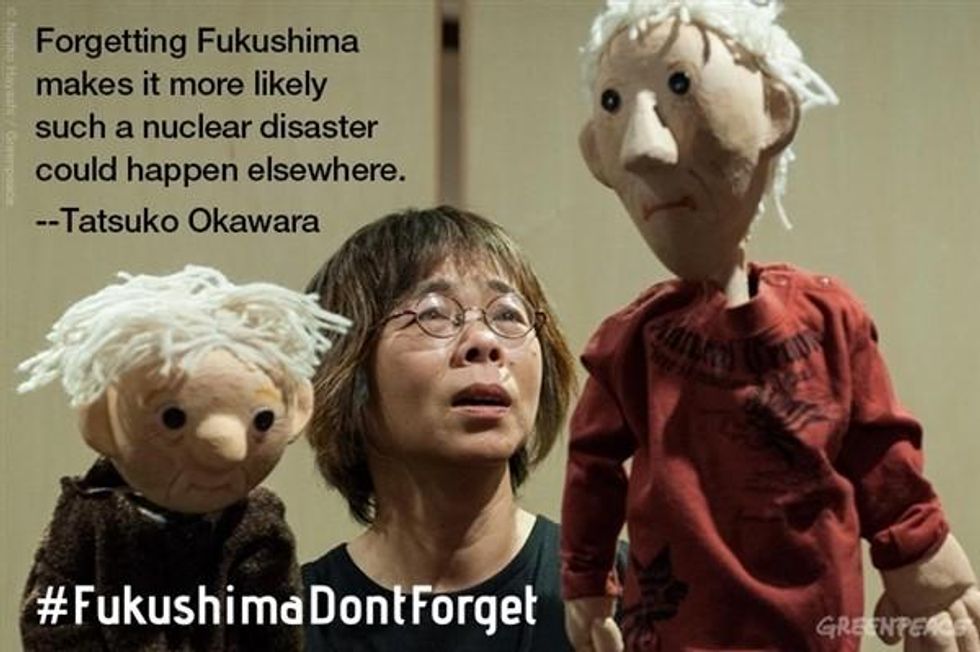
"Forgetting Fukushima makes it more likely that such a nuclear disaster could happen elsewhere," said Mrs Tatsuko Okawara, one of the hundreds of thousands of victims of the Fukushima accident that began on 11 March 2011.
Though she is right, the world still seems to forget.
The nuclear industry is trying its hardest to make us forget by downplaying the impacts of the accident, ignoring the fact that the Fukushima reactors are still not under control and claiming that lessons have been learned. Nothing is further from the truth.
So business continues as usual and in many countries the same mistakes are being made that played a role in Fukushima. These are systemic failures linked to the nuclear sector, such as a lack of independent regulators, no accountability, putting profits before the protection of people, insufficient emergency planning and the continued belief in a nuclear safety paradigm that has been proven wrong.
A truly independent nuclear regulator is a rarity as most are closely connected to the sector that they should control. And at the same time, decisions are made on the basis of politics and economics, rather than people and their safety.
Fukushima 2014: Don't Forget (English subtitles)Three years after the Fukushima Daiichi nuclear catastrophe, the Japanese government insists everything is under control. But the ...
The nuclear industry still benefits from a liability system that shields them from carrying responsibility for the risks and damages they create. Big companies harvest large profits, while the moment things go wrong, it is the society and people who need to deal with the losses and damages. Those who are paying for Fukushima are the many thousands of citizens who lost their livelihoods; whose communities and families have been broken up; whose children cannot play outside because radiation levels are too high. The people who are paying are the Japanese people whose tax money is being used to deal with the crippled Fukushima reactors and clean up of the contaminated areas.
We were led to believe that the probability of a severe nuclear accident like Chernobyl was virtually insignificant. But looking at the real world, the evidence shows the frequency of reactor meltdowns is approximately once in every decade. Still, the nuclear sector uses the same probability assessments and procedures that were proven entirely wrong. Regulators continue to hesitate to properly act to reduce reactor risks, because stricter regulations would make the nuclear industry unprofitable.
The world is still running more than 400 inherently dangerous nuclear reactors and continues to build dozens more. Millions of people are at risk because, as Fukushima has shown, the radioactive contamination does not stop at a distance of 10 or 20 kilometres, which is the border of the officially designated evacuation zones. And still, nobody is prepared to handle a large-scale nuclear accident when people may need to be evacuated even hundred kilometres away from the nuclear power plant.
Nuclear energy is not a necessary evil, because affordable, safer and cleaner energy solutions exist. They are only a matter of political choice.
That's why we must not forget Fukushima. We must listen to those who suffer from the accident. We must remember, learn and act to build a better world.
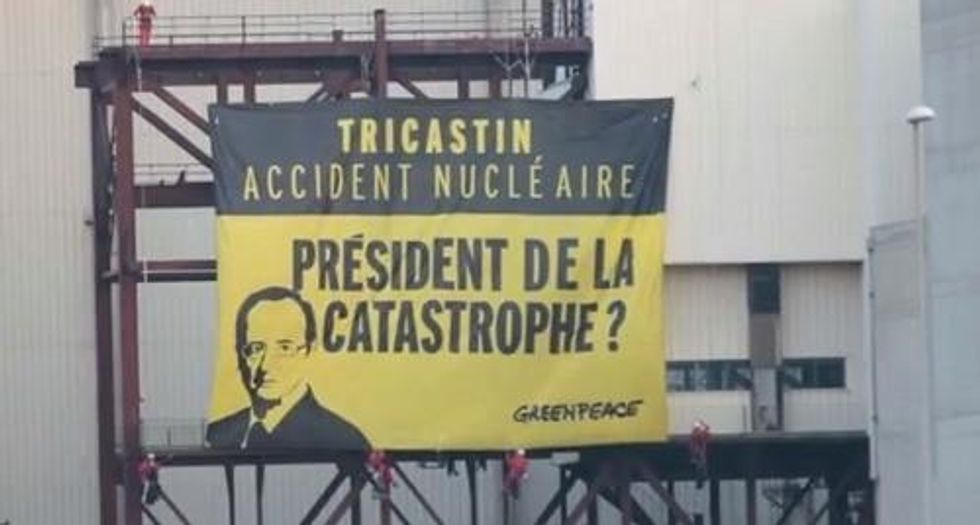
Ready to pay the price of a nuclear accident?
This is the question left for the president of "the most nuclear-dependent country on earth" by dozens of Greenpeace activists who broke into and occupied what they say is one of France's most dangerous nuclear power plants.
In the pre-dawn action on Monday, the activists climbed fences at the Tricastin nuclear power plant run by Electricite de France (EDF) where they unfurled banners and projected "Tricastin Nuclear Accident" and showed an image of President Francois Hollande's face next to the words "President of the Catastrophe?" and "Ready to Pay the Price?"
"With this action, Greenpeace is asking Francois Hollande to close the Tricastin plant, which is among the five most dangerous in France," Yannick Rousselet of Greenpeace France said in a statement.
Heads of the plant and the Ministry of the Interior dismissed the action as a publicity stunt and said the activists didn't reach sensitive areas, France 24 reports. But Rousselet told Reuters, "If being physically able to touch the reactors is not being in a sensitive place, I don't know what is."
"People with bad intentions could have posed a threat to the reactor's safety," said Rousselet.
BBC News adds:
Jean-Vincent Place, a prominent Green politician and French senator, told Europe 1 radio the Greenpeace action "shows that getting inside one of these extremely dangerous plants is a bit like passing through a sieve".
At the Tricastin plant:
In July 2008, an accident at a treatment centre next to the plant saw liquid containing untreated uranium overflow out of a faulty tank during a draining operation. The same month around 100 staff at Tricastin's nuclear reactor number four were contaminated by radioactive particles that escaped from a pipe. EDF, which runs the site, described the contamination as "slight".
AP reports that by midday, all but two of the nearly 30 activists had been arrested.
Salledepressefr has video:
L'action de Greenpeace dans la centrale nucléaire du Tricastin (version intégrale)Images d'illustration de la projection sur le réacteur et de l'installation de la banderole dans la centrale nucléaire du Tricastin par ...
Jim Lehrer missed an opportunity last night to help clarify for people watching the debate what is in dispute between Democrats like Barack Obama and Republicans like John McCain about U.S. policy towards Iran. For the record, this is what McCain adviser and former U.S. Secretary of State Henry Kissinger said about U.S. policy towards Iran, according to the transcript on CNN's website:
This was at an event with five former U.S. Secretaries of State, three Republicans (Kissinger, Powell, and Baker) and two Democrats (Christopher and Albright.) All five agreed that the U.S. should negotiate with Iran, without preconditions.
What "without preconditions" means in this context is quite straightforward and well-known. The current policy of the Bush Administration has been that the United States will not enter into substantive talks with Iran unless Iran first agrees to suspend the enrichment of uranium. The five former U.S. Secretaries of State agreed that this was a mistake, and that the United States should drop this precondition for the beginning of talks.
Our former Ambassador to the United Nations Thomas Pickering, who has spent much of his adult life being paid by the United States government to be an expert on diplomacy, put it this way in an interview earlier this year:
"Certainly, there's been a lot of suspicion of Iran, I join in being concerned about Iran's nuclear program, I don't dismiss that at all, it's serious. But I think asking for a price to open talks is not a feasible way to get the conversation going, and it was not the posture of the United States when it opened talks with North Korea...my own feeling is that with Iran we should start talks with Iran without preconditions."
It's John McCain's position - the neoconservative position - that is the outlier. And besides electioneering, there's only one plausible, logical explanation for the McCain-neoconservative position: they don't want an agreement between the United States and Iran. What they fear is not that talks would be useless, but that they might be productive.
After all, as everybody knows, if the U.S. seriously pursued talks and the talks failed, it would be a huge propaganda victory for the United States. "See," the United States could say. "We tried."
What the neoconservatives are afraid of is that there might actually be an agreement, and that an agreement would acknowledge and accept Iran's status and interests in the region. Then the neocons would have to give up their fantasies of "regime change" in Iran and "roll back" of Iranian influence.
The neoconservatives are married to the precondition of suspension of enrichment because they believe it is a deal-breaker for the Iranian side. There is an overwhelming consensus of Iranian public opinion that Iran has and must exercise the right to its own nuclear energy program. This consensus includes every political faction with significant influence in the country's politics. So, if your real goal is to prevent any agreement between the United States and Iran, insisting that Iran abandon its nuclear program (which is how Iranians interpret the U.S. demand) as a precondition for talks is an excellent policy.
There is a proposal on the floor that would meet U.S. concerns about the future capacity of Iran to use nuclear technology for a weapons program while satisfying the demand of Iranian public opinion for an Iranian nuclear energy program. That is Ambassador Pickering's proposal for multilateral enrichment in Iran, with full transparency and vigorous inspections. This week in New York Iranian officials restated Iran's willingness to negotiate on such a proposal.
That is what is in dispute. Do we want four more years - or even eight more years - of confrontation with Iran in a McCain-Palin Administration pursuing the neoconservative policies of the early Bush Administration, or do we want to seriously pursue negotiations that could lead to an agreement that would help stabilize the whole Middle East, significantly facilitating U.S. withdrawal from Iraq and promoting stability in Afghanistan and Pakistan.
Amb. Pickering on Iran Talks and Multinational EnrichmentFormer Ambassador Thomas Pickering calls for talks without preconditions and advocates a plan for a multinational uranium ...