

SUBSCRIBE TO OUR FREE NEWSLETTER
Daily news & progressive opinion—funded by the people, not the corporations—delivered straight to your inbox.
5
#000000
#FFFFFF
To donate by check, phone, or other method, see our More Ways to Give page.
Daily news & progressive opinion—funded by the people, not the corporations—delivered straight to your inbox.
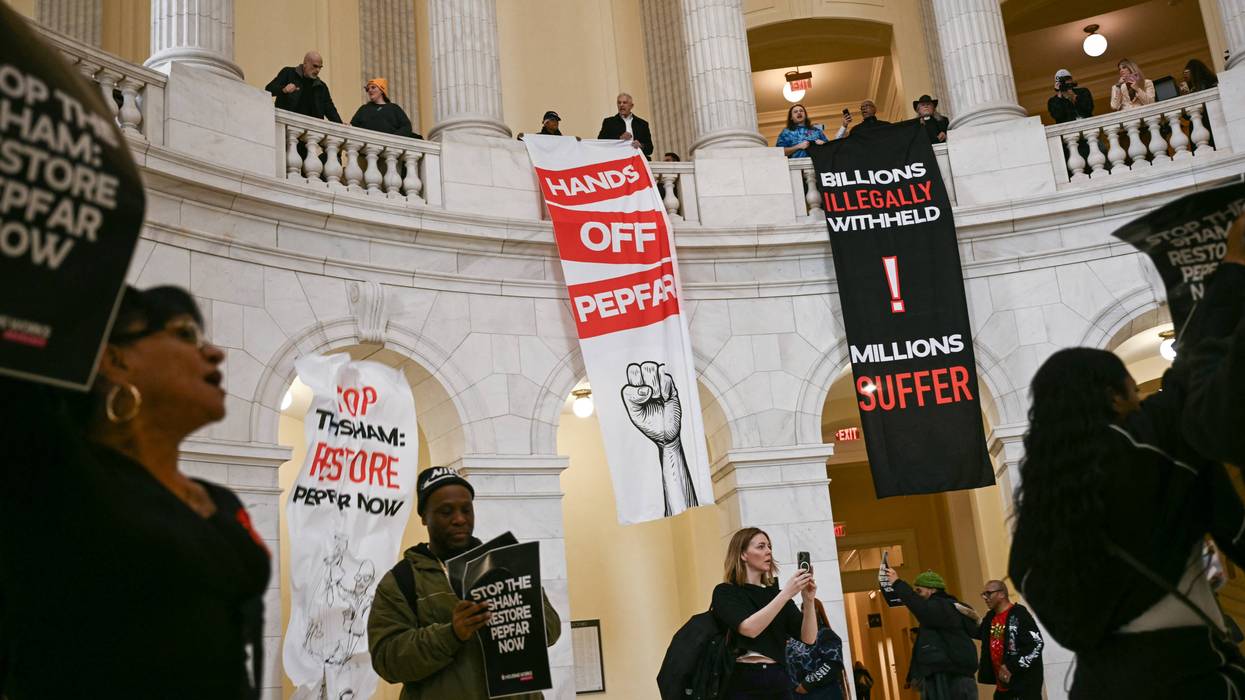
"The State Department is threatening Zambia with an embargo on essential medicines in order to plunder its minerals," said one HIV prevention advocate.
The US State Department is threatening to strip HIV/AIDS and other disease prevention funds for more than a million people in the African nation of Zambia in a bid to extort the country for greater access to its mineral wealth.
The New York Times reported Monday on the draft of a memo prepared for Secretary of State Marco Rubio, which states that "we will only secure our priorities by demonstrating willingness to publicly take support away from Zambia on a massive scale."
The Trump administration is considering whether to "significantly cut assistance" from the President’s Emergency Plan for AIDS Relief (PEPFAR), which provides daily HIV treatment to around 1.3 million Zambians and other funds for tuberculosis and malaria medications that save tens of thousands of lives each year.
At the time that PEPFAR was created, under the administration of President George W. Bush, HIV was killing around 90,000 people per year in Zambia. That number had been reduced to 16,000 in 2024, according to data from the Joint United Nations Program on HIV/AIDS (UNAIDS).
"Things are not okay," said Justin Wolfers, an economics professor at the University of Michigan and a Brookings Institution fellow.
Threats to cut PEPFAR are part of a broader push by the Trump administration to wield desperately needed foreign medical aid as a tool of coercion against impoverished nations, whose health systems have been thrown into turmoil by the Trump administration's massive cuts to the US Agency for International Development (USAID) last year.
According to the Times, 24 African nations have signed memoranda of understanding (MOU) under the Trump administration's so-called "America First Global Health Strategy" in order to unlock some US funding that has been cut.
Many of the deals require nations to increase their own health spending in order to restore just a fraction of what the US previously provided:
"According to an analysis by the nonprofit Partners in Health, health funding under the agreements would drop by 69% to Rwanda, 61% to Madagascar, 42% to Liberia, and 34% to Eswatini, where a quarter of adults live with HIV," the Times reported in January.
Meanwhile, the deals have come with other, often ideological, strings attached. Kenya's memorandum requires it to provide data guaranteeing that no funding is being used for abortion care, and to direct funds to certain Christian faith-based providers, even though they refuse services like HIV care to LGBTQ+ people.
Nigeria's agreement likewise requires more than $200 million to over 900 Christian faith-based healthcare facilities across the country and emphasizes protecting Christian victims of violence from the Islamist group Boko Haram, even though the majority of the group's victims are Muslim.
Some countries have rejected the deals, calling them one-sided and exploitative. Last month, Zimbabwe walked away from a deal that would have provided $367 million over five years because it required the country to give the US unfettered access to citizens' health data and biological samples.
The deal offered to Zambia is similar to those offered to other countries in that it requires the government to commit $340 million in health spending in exchange for $1 billion from the US over five years, less than half of what it received under previous US administrations. It also demands that Zambia provide citizens' health data to the US for 10 years, longer than the deals agreed to by other nations.
But the deal also stipulates that, to receive any funding, Zambia must provide US corporations with easier access to the nation's vast mineral wealth.
Zambia has some of the world's largest reserves of minerals such as copper, lithium, and cobalt, which are essential to green energy technology. The Trump administration says the country has given China greater access to its mines than it has given to the US.
Zambia would also be required to share mining databases with US experts and renegotiate a massive 2024 contract with the Millennium Challenge Corporation, a US-based foreign assistance agency, to reduce mining regulations.
After the terms of the deal leaked to The Guardian last month, Asia Russell, director of the HIV advocacy organisation Health GAP, derided it as a proposal for the "shameless exploitation" of Zambia.
In February, Zambia rejected the deal, with a spokesperson for the Ministry of Health saying it "did not align with the position and interests of Zambia."
Now the Trump administration is using HIV treatment funding in an effort to force its leaders back to the table and make an example of them for other countries that may seek to go their own way.
The memo describes threats to AIDS funding as a way to demonstrate the "use of sticks" to other countries with which it seeks to negotiate.
If Zambia refuses to sign, it says, “sharp public cuts to American foreign assistance would significantly demonstrate to aid-receiving countries the seriousness of our interest in collaboration and our insistence on tangible benefits under our America First foreign policy."
Zambia has already been stripped of more than half its annual PEPFAR funding from the US since the Trump administration returned to power last year through a combination of foreign aid freezes, rescissions, and budget cuts that stripped billions from the program.
A survey of 76 HIV clinics across 32 mostly African countries that received PEPFAR funds, conducted by the International Epidemiology Databases to Evaluate AIDS (IeDEA) consortium, found that, as a result of cuts, many experienced disruptions to testing and treatment, including drug shortages and staff layoffs.
Citing modeling studies, the researchers estimated that funding disruptions to PEPFAR just last year "resulted in more than 120,000 deaths by November 2025, including more than 13,000 child deaths."
Another study by Imperial College London predicted that just the three-month disruption at the beginning of President Donald Trump's second term would result in more than 37,400 excess deaths by 2060.
In a statement posted to social media on Monday, Republicans on the House Foreign Affairs Committee defended the threats to cut PEPFAR, saying that "Just like every other country, Zambia is free to walk away from these negotiations." The Republicans said it was "ridiculous to assume the United States should fund entire health systems for countries that turn around and give priority access to critical supply chains to China."
Russell said that "the State Department is threatening Zambia with an embargo on essential medicines in order to plunder its minerals."
While she said "Zambia’s MOU text is the first we know of that explicitly ties exploitation of mineral wealth," she noted that similar "exploitative conditions" are reportedly part of other nations' memoranda as well, but that information is scarce because they have been "negotiated in secret" and texts have not been made public.
Julius Kachidza, the chair of Zambia’s Civil Society Self-Coordinating Mechanism, said that yet another massive cut in US government funding “would be apocalyptic. It could be quite a disaster, especially to me. And the majority of people living with HIV in Zambia.”
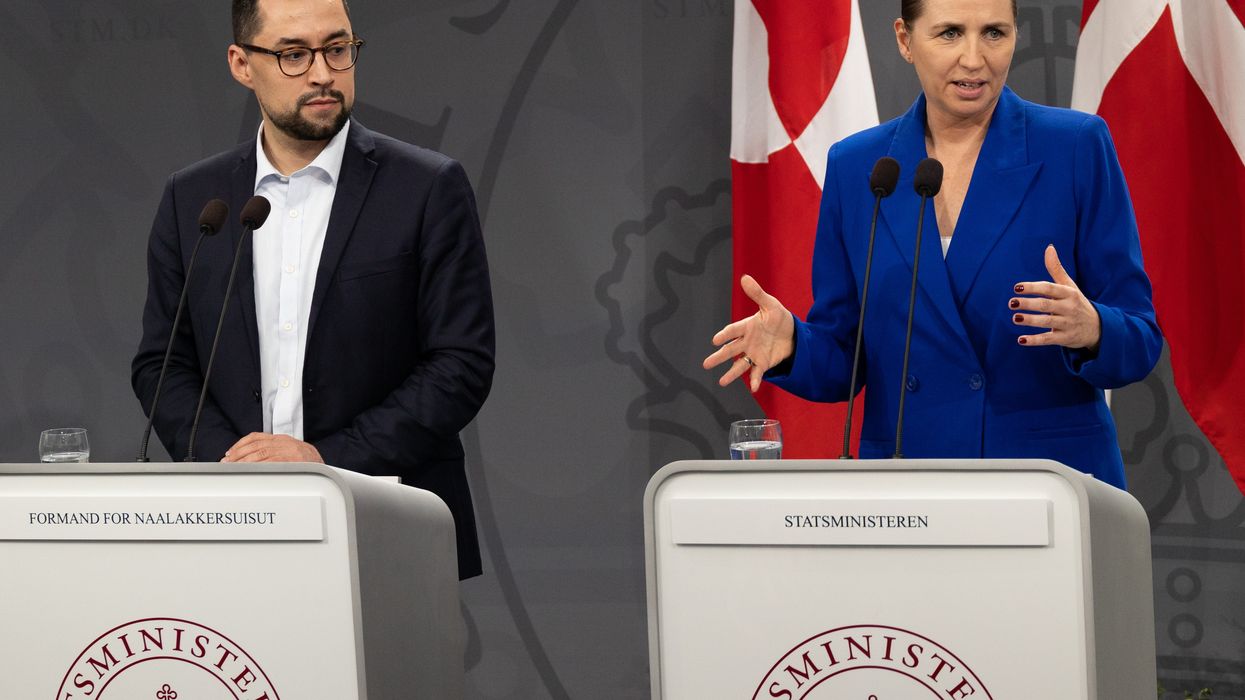
"Trump shouldn't have Greenland. Greenland is Greenland," said Denmark's foreign minister.
Greenlanders have spoken: An overwhelming majority of them do not want to leave the Kingdom of Denmark to instead become a part of the United States.
Denmark's Berlingske and Greenland's Sermitsiaq reported Tuesday that a poll conducted for the newspapers by the research firm Verian found that a whopping 85% of Greenlanders are opposed to joining the U.S., an idea that U.S. President Donald has aggressively pushed in recent weeks.
Trump has also claimed that the people of Greenland want to be a part of the U.S. "I think the people want to be with us," Trump said last week, according to the BBC.
Only 6% of Greenlanders said they want to leave the Danish Realm in favor of the U.S., and 9% are undecided, according to Berlingske. The poll, which recorded the responses of 497 Greenlandic citizens aged 18 and over, found that 45% of Greenlanders said they perceive Trump's interest in Greenland as a threat.
"Trump shouldn't have Greenland. Greenland is Greenland," said Lars Løkke Rasmussen, Denmark's foreign minister, on Tuesday, according to the Financial Times.
Since taking back the White House in November, Trump has publicly mused about not only seizing Greenland, but also retaking the Panama Canal and making Canada the 51st state.
In early January, he refused to rule out using military force to take over the canal and Greenland. "It might be that you'll have to do something. The Panama Canal is vital to our country," Trump said at a press conference. "We need Greenland for national security purposes."
Speaking on Fox News a day later, Trump's appointee for national security adviser, former Rep. Mike Waltz (R-Fla.), said that Trump's ambitions over Greenland have to do with geopolitical competition and natural resources. Greenland, the largest noncontinental island and a territory of Denmark, is mineral rich. The Arctic island is increasingly an arena of competition between China, the U.S., and Russia as ice melts and opens up new trade routes, according to the Financial Times.
During his first term, Trump directed his aides to examine whether the United States could purchase Greenland, which is home to the U.S. Space Force's Pituffik Space Base.
Last week, the Financial Times also reported on a phone call between Danish Prime Minister Mette Frederiksen and Trump, during which Trump insisted that he's serious about taking over Greenland.
"He was very firm. It was a cold shower. Before, it was hard to take it seriously. But I do think it is serious, and potentially very dangerous," said one European official who was briefed on the call and quoted anonymously by the Financial Times.
Even before the findings of the poll were reported on, Greenlanders had shown little enthusiasm for Trump's plan. "Greenland is ours. We are not for sale and will never be for sale. We must not lose our long struggle for freedom," the leftist Greenlandic Prime Minister Múte Egede said in December.
Egede has said that he wants independence from Denmark for Greenland.
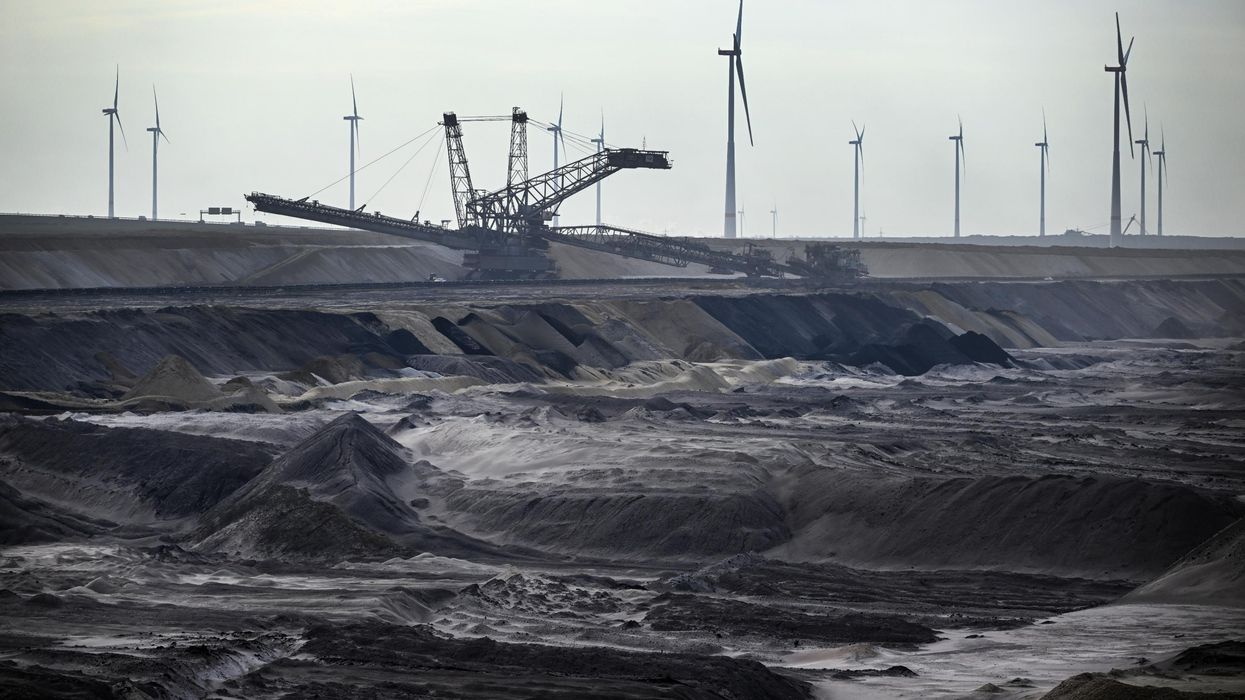
Wealthy nations are responsible for most of the consumption of natural resources, according to a new United Nations report.
The world could be extracting 60% more natural resources by 2060 if current trends continue, a new United Nations report finds.
The extraction of natural resources is having calamitous effects on the climate and the environment, the report states, and demand for such resources is only rising. These natural resources range from fossil fuels to the minerals and metals used in renewable energy.
"Extraction and processing of material resources... account for over 55% of greenhouse gas emissions and 40% of particulate matter health-related impacts," says the report by the U.N. Environment Program's International Resource Panel (IRP).
The report focuses on the large amounts of resources consumed by the world's richest and largest nations, and it recommends these nations reduce their projected consumption by a third. This would reduce projected greenhouse gas emissions by 80%, benefit the environment, and improve human health.
.@UNEPIRP Global Resources Outlook launched at #UNEA6 shows rich countries use 6x more resources & have 10x the climate impact than low-income ones.
Resource extraction tripled in 50 years, set to increase 60% by 2060, challenging environmental goals.https://t.co/R3fTjcosGJ pic.twitter.com/BfO0LO2sQo
— UN Environment Programme (@UNEP) March 1, 2024
Accomplishing this goal would require making significant changes in transportation, infrastructure, food consumption, and more. That may seem lofty, but the report states this can be accomplished without sacrificing economic growth. The economy simply needs to be grown in a more sustainable fashion.
"Weak, partial, fragmented, or slow policies will not work. This can only be possible with far-reaching and truly systemic shifts in energy, food, mobility, and the built environment implemented at an unprecedented scale and speed," the report says.
The U.N. has been warning about the overconsumption of natural resources for years, and it seems the situation has only gotten more dire over time. While many wealthy nations have made progress in terms of increasing renewable energy use, less attention has been paid to the sustainable use of natural resources.
"We should not accept that meeting human needs must be resource-intensive, and we must stop stimulating extraction-based economic success. With decisive action by politicians and the private sector, a decent life for all is possible without costing the earth," said Janez Potočnik, co-chair of the IRP.
More than 50 humanitarian and environmental groups from around the world called on Friday for an independent international investigation into the assassination of Honduran Indigenous rights activist Berta Caceres, who was murdered in her sleep at 1 am on Thursday by two unknown assailants.
"Mrs. Caceres' case is the most high-profile killing within a growing trend in the murder, violence, and intimidation of people defending their indigenous land rights in Honduras," wrote the groups in their letter to the Honduran president.
"We know that in Honduras, it is very easy to pay people to commit murders," Zuniga Caceres said of her mother's death to teleSUR. "But we know that those behind this are other powerful people with money and a whole apparatus that allows them to commit these crimes."
The Guardian reported that Caceres was a prominent leader in the Indigenous movement in Honduras against one of Central America's most significant hydropower projects, four enormous dams known as "Agua Zarca" in the Gualcarque river basin. The Indigenous group Caceres founded, the Civil Council for Popular and Indigenous Organizations of Honduras (COPINH), has successfully prevented the project from moving forward.
Caceres was awarded the prestigious Goldman Environmental Prize last year for her activism.
"Berta Caceres devoted her life to protecting natural resources, public spaces, land rights, rivers from the privatization process that's underway and that gained speed after the 2009 military coup," said Karen Spring, the Honduras-based coordinator of the social justice network Honduras Solidarity Group, in an interview with Free Speech Radio News on Thursday. "She spent her life defending land and supporting communities, mostly indigenous communities all over the country."
As a result of her activism, Caceres had received death threats and feared for her life, the Los Angeles Times reported, and the Inter-American Commission on Human Rights (IACHR), a prominent human rights organization, had last year formally called on the Honduran government to put protections in place for Caceres, according to the Guardian. The UN has condemned the Honduran government for failing to protect her, and activists have accused the government of having a hand in her death.

In its most recent report (pdf) released in December, IACHR warned of the violence and threats to their lives that activists such as Caceres suffer under in Honduras. The group blamed "the increased presence of organized crime and drug traffickers, the recruitment of children and adolescents, and an inadequate judicial response that fuels impunity, corruption, and high levels of poverty and inequality. In addition, according to the information received, part of that insecurity comes from the National Police, the Military Police, and the Army, through their illegitimate use of force, in some cases in complicity with organized crime."
Student protesters took to the streets in Tegucigalpa on Thursday to mourn the widely beloved environmentalist's death, the Guardian reported, and the Honduran government, in power since a U.S.-backed coup in 2009, responded with riot police.
The Honduran government confirmed that one suspect had been arrested in a statement to teleSUR on Friday. There were reportedly two assassins involved in Caceres' death. But the Caceres family is demanding "an independent, international investigation [into her death] not led by the Honduran government," teleSUR reported.
"Honduras has the world's highest murder rate," noted School of the Americas Watch, a group that seeks to close the infamous U.S. Army School of the Americas, in a statement on Thursday. "Honduran human rights organizations report there have been over 10,000 human rights violations by state security forces, and impunity is the norm--most murders go unpunished. The Associated Press has repeatedly exposed ties between the Honduran police and death squads, while U.S. military training and aid for the Honduran security forces continues."
The environmental group International Rivers demanded Thursday that "the U.S government, in particular, end its support for the Honduran military through loans and training at the School of the Americas," drawing attention to the United States' significant responsibility for the oppressive regime in Honduras today, in order "to honor Berta Caceres' lifelong struggle and her ultimate sacrifice for rivers and rights."
Democracy Now! remembered Caceres in the following segment on Thursday:
Sparking outcry from environmentalist and Indigenous groups, Justin Trudeau took a pro-oil stance and argued for more controversial pipelines to carry Canada's dirty tar sands oil to coastal ports in comments at a sustainability conference in Vancouver on Wednesday.
"We want the low-carbon economy that continues to provide good jobs and great opportunities for all Canadians," said Canada's Liberal prime minister, as Elizabeth McSheffrey reported in the National Observer. "To get there, we need to make smart strategic investments in clean growth and new infrastructure, but we must also continue to generate wealth from our abundant natural resources to fund this transition to a low-carbon economy."
However, Green party leader Elizabeth May said at the same conference, "If you have an economic strategy for the oilsands that are premised on high volumes of export on the low-value product, you both ship jobs off-shore and drive up greenhouse gases. Those are inconsistent aims."
The Global Series 16 conference centers on sustainability and business, describing itself as "North America's Largest Environmental Business Summit." All of Canada's premiers are attending the talks on sustainability and business from March 2-3.
In contrast to the prime minister's attempt to make an economic argument for pipelines, social justice group the Council of Canadians noted that "the average renewable energy investment creates four times as many jobs as the same investment in the fossil fuel economy," as the group called for more renewable energy jobs on Thursday.
The prime minister's statements were made only months after he declared, "Canada is back, my good friends," to delegates at the COP21 climate conference in Paris in November. This signaled what activists hoped would be a transition to a more sustainable Canada as he signed the historic commitment to keep global warming below 1.5 degrees Celsius.
Trudeau's party's campaign was built on the Liberals' opposition to his pro-oil predecessor, Stephen Harper, who heartily supported the nation's controversial tar sands industry that critics saw as primarily responsible for the country's failure to uphold the terms of previous climate change agreements.
During his campaign, Trudeau emphasized his condemnation of the Northern Gateway pipeline, which would have transported tar sands oil to the B.C. coast. However, activists still lobbied Trudeau to take a stricter position on pipelines after his party ousted Harper's Conservatives in October, as the young prime minister's stance was unclear.
Trudeau did announce harsher environmental reviews for the projects in December. Still, his promises appeared to lack teeth when a federal audit uncovered "systematic failures" within the country's National Energy Board that conducts the pipeline approval process.
The prime minister's talk in Vancouver this week marked a shift from the grand promises made in Paris: "The choice between pipelines and wind turbines is a false one," Trudeau argued, according to the Vancouver Sun. "We need both to reach our goal."
After his talk, the National Observer reported, Trudeau refused to answer reporters' questions about the growth in tar sands mining that would inevitably be fueled by the construction of new pipelines.
A Ricochet editorial charged Thursday:
The prime minister is wrong. Hard choices must be made, between the interests of fossil fuel corporations and the possibility of a decent collective future for Canadians and people all over the world.
First Nations also criticized Trudeau on Wednesday. According to the Aboriginal Peoples Television Network (APTN), Aboriginal leaders stormed out of a climate meeting with the prime minister after it "fell to shambles. " Athabasca Chipewyan First Nation Chief Allan Adam lamented that "the meeting didn't include any talks of taking care of mother earth," APTN reported, and "instead, the focus was placed on economic development and transitioning to a green economy."
On Thursday, the prime minister will meet with Canada's premiers to create a national climate plan. A 350.org campaign manager argued that Canada can achieve a 100% renewable energy economy that honors Indigenous rights, but "only if the government listens to people, not pipeline companies and big polluters."
A warming climate is exacerbating global inequality by pushing critical natural resources, such as fish stocks, away from impoverished equatorial regions and making them more exploitable by the wealthy, according to a study released on Wednesday.
While the gap between the rich and poor in the U.S. and worldwide has expanded at a mind-boggling pace in recent decades, the new study, designed by scientists at Princeton, Rutgers, Yale, and Arizona State, shows that the frightening speed with which the globe is warming will only compound the economic trend.
The study looked specifically at fish to better understand the phenomenon.
"We tend to think of climate change as just a problem of physics and biology," Malin Pinsky, professor of ecology and evolution at Rutgers, explained to Rutgers Today. "But people react to climate change as well, and at the moment, we don't understand the impacts of human behavior on natural resources affected by climate change."
To examine those impacts, Pinsky told the newspaper that "[w]hat we find is that natural resources like fish are being pushed around by climate change and that changes who gets access to them."
The study, published in the journal Nature Climate Change, looked at what the authors call "inclusive wealth," or the "sum of a community's capital assets."
Rutgers Today reports that the researchers examined natural resources such as fish and forests, a community's infrastructure—buildings, roads, factories—and its population's education level and health.
The newspaper wrote:
Pinsky reports that the stronger and more conservation-oriented a community's natural resource management, the higher the value it places on its natural resources, whether those resources are increasing or diminishing. If wealthier communities and countries are more likely to have strong resource management, these wealthy groups are more likely to benefit, thus exacerbating inequality.
The study used data collected by Pinsky in his studies of fish migration and applied a mathematical formula created by Yale University economist Eli Fenichel to illustrate the connection between the migration of natural resources and the migration of wealth. The scientists created two fictitious fishery-dependent communities, Northport and Southport, and used Fenichel's formula to examine future interactions between them and their fish stocks.
The findings also echo the changes and depletion reported by commercial and Indigenous fisheries worldwide.
The researchers observed that "a changing climate can reallocate natural capital, change the value of all forms of capital, and lead to mass redistribution of wealth."
The Paris Climate Talks were a top-down collaboration in the global political sphere, producing a hopeful treaty to reduce carbon emissions. At this moment of global alliances, what is a bottom-up approach that rejoins humans and natural systems? Our anthropocentric mindset that devalues all other life forms, the Cartesian influence that reduces all life to functional objects or resources in the service of human goals and activities- this is the central delusion that propels us towards ecological destruction. A parallel track to the political one and equally important is reflection and deep questioning to gain a more realistic perspective of the human role in the natural world. A shift away from anthropocentrism requires a re-doing of worldview; and how we view the world speaks volumes about how we view ourselves and the intersections of Self and Other.
"Resilience" and "sustainability" are central terms and meta-narratives for imagining and creating a lighter, less destructive human footprint in the arenas of agriculture, urban planning, and elsewhere. These meta-narratives or frames help re-educate us to thinking of systems, longevity, diversity in systems, adaptability, and to ending the fallacy of endless natural resources. Yet more-than-humans are still viewed as "resources". These terms don't dispel that fallacy. We need another meta-narrative for creating a shared world with other species, in which others are valued and have inherent worth. To go even further, this new narrative can highlight the view of the Self as a collective, in which others are within us. Post-humanism is a movement within academia that imagines the world beyond anthropocentrism, but these ideas seldom make it to broader audiences or discussions.
Different cultural worldviews contribute to mutual thriving across species, or mutual destruction. In India and parts of Africa, sacred groves are protected due to religious significance and remain areas of high biodiversity and old-growth trees. Many indigenous groups view other species as kin, and as having their own cultures. Humans and other species live in a multi-cultural world, and each deserves respect, and especially the species we choose to eat.
What sort of mindset, perspective, worldview equalizes humans and natural systems and emphasizes interconnectedness, such that both can thrive? What mindset recognizes relationships across species, instead of viewing sociality only in the human realm? And what is the appropriate language here? Conservation biologists talk of "coexistence" with elephants, wolves, other large mammals whose lives sit on the brink of extinction due to habitat loss, poaching, unwillingness to share landscapes. Is "coexistence" a term that works for re-imagining, re-building relationships to other species? The words we choose at this moment are essential.
"Coexistence" emphasizes the concept of living in parallel lines, tolerating the presence of the other. This isn't representative of the inherent interconnectedness within systems. Millions of bacteria inhabit us in mutually beneficial arrangements that are more intertwined than "coexisting." Half of the oxygen humans breath comes from marine phytoplankton; this is not a parallel living arrangement. Even species that don't rely on one another for air share commonalities that connect them. Our lives are bound in a mutuality.
A mindset that emphasizes similarities of form or function across humans and non-humans is one possibility. Brazilian anthropologist Eduardo Viveiros de Castro describes an Amerindian worldview in which animals and plants were all once human and still have a human essence but now wear a cloak of a different kind. He applies this worldview within the discipline of anthropology for an inclusive multi-species approach. Another anthropologist, Tim Ingold, in Scotland, writes about "correspondence," which is an intermingling of sentience among species. Anthropologist Bruno Latour's Actor Network Theory brings non-humans into analysis of systems as actors, agents. The field of political ecology begins to view non-humans in an equal position to humans as agents. Ecologist Ricardo Rozzi proposes we move beyond Aldo Leopold's Land Ethic, to bio-culturalism, which "couples human habits, habitats and communities of co-inhabitatants", or non-humans on the landscape. Rozzi explains that "ethics" comes from ethos, which originally meant "the adobe of an animal." Our notions of ethics were originally tied to our connections to other species and their habitual ways.
The term "cohabitation" connotes sharing landscapes, sharing home, which is closer to representing interconnectedness. Cohabitation intermixes logos, mythos, and ethics, storying landscapes and seascapes again with meanings, metaphors, narratives of shared histories, shared places. Cohabitation is especially controversial when applied to large carnivores like wolves and leopards. Ecologist Sunetro Ghosal, who studies large cat conservation in India, explores cohabitation. Scientists view leopards as dependent on them to create conservation plans and understand their behavior, which may contribute less to cohabitation, to sharing landscapes than some of the tribal peoples' views in which leopards are sacred members of their community. They know how to prevent attacks and even know individual leopards and their past experiences, which sometimes explain the reason for a violent episode. The leopards are people, of a sort.
Building relationships to other species, to natural systems is central to this inner way forward. Jane Goodall and many others in her field present how important it is to become like the ones they study, to enlist their mimicry and empathy, and become the Other in a sense. The Other is also within us, as German philosopher Peter Sloterdijk explains in an alternate view of subjectivity. Our own subjectivity involves having the Other within us. In other words, we are not bounded selves but are who we are through our relationships, interactions, and holding others within us. These ideas and ways of being need more of a spotlight and more discussion. This is a way forward, re-establishing humans as a positive force on this planet instead of destroying all life forms in our wake.
Let's study places in the world where humans successfully cohabitate with other species. Cohabitation should be studied in academic institutions, supported with grants by large institutions, and should become a narrative we discuss and perhaps engage with. It's more radical than coexistence or sustainability, but why not elevate values in this learning curve. Science tends to avoid values, but you can't learn how to live with others without valuing them.
Without drastic efforts to reduce deforestation, rising greenhouse gases, and unsustainable global agriculture, the planet will lose its tropical forests—a crucial element in the fight against irreversible climate change—in just 35 years.
Absent aggressive conservation policies, the world will lose 2.9 million square kilometers of its tropical forests by 2050, according to a new working paper published Monday by Center for Global Development (CGD) environmental expert Jonah Busch and research assistant Jens Engelmann. That's a chunk the size of India, or one-third of U.S. land mass.
If the world continues to take a "business-as-usual" approach to agriculture, logging, and other such forces, tropical deforestation will account for more than one-sixth of the remaining carbon emitted if the world is to limit global warming to 2 degrees Celsius.
The carbon emissions that would occur during that process would add up to 169 billion tons--the equivalent of running 44,000 typical coal plants per year, Be, 2016-2050 (pdf)., that the carbon emissions from that process would total 169 billion tons, the equivalent of running 44,000 typical coal plants per year.
According to a separate study published earlier this year by NASA, tropical forests absorb carbon dioxide at a far higher rate than previously thought, making them an invaluable resource in curbing global warming.
That's the bad news. The good news, Busch writes, is that there are many solutions available.
"Avoiding dangerous climate change while expanding economic prosperity is perhaps the defining challenge of the 21st century," Busch writes. "Achieving both goals requires reducing greenhouse gas emissions where doing so has the lowest unit cost."
Carbon pricing is one example. The researchers found that applying a global fee of $20 per ton of carbon dioxide between 2016 and 2050 would keep 41 gigatons of emissions from being discharged.
Another option is to follow Brazil's model of targeting greenhouse gases, which involves "satellite monitoring, law enforcement, new protected areas and indigenous territories, restrictions on rural credit, and moratoriums on unsustainable soy and cattle production," Busch writes. "Due to these restrictive measures, Amazon deforestation fell by nearly 80 percent since 2004 even while Brazil's soy and cattle production increased."
CGD's study comes as another report from the University of Leeds, published Friday in Science, warns of a devastating future for forests, which will exist only in a "simplified" state by 2100 if climate change is not aggressively addressed.
"Earth has lost 100 million hectares of tropical forest over the last 30 years, mostly to agricultural developments," lead researcher Dr. Simon Lewis said last week. "Few people think about how intertwined with tropical forests we all are."
Lewis, a forest expert and professor at the University of Leeds and University College London, found that a new and more dangerous phase of human environmental impact threatens to deteriorate much of the world's remaining tropical forests until they exist in a fragmented, "living dead" state. That fate can only be avoided by shifting to low-carbon energy or embracing policies that promote "development without destruction."
"Unfortunately, most of the benefits from logging, mining, and intensive agriculture flow away from local people," Lewis wrote in an article accompanying the report. "Giving forest-dwellers long-term collective legal rights over their land would mean benefits flow to them."
As world leaders prepare for the upcoming climate conference in Paris and the growing call to prevent full-scale destruction of natural resources continues to build, 2015 is becoming "a big year for climate," Busch writes.
As of Thursday, August 13, humans have officially exhausted the planet's yearly supply of natural resources. For the rest of 2015, the earth will run an "ecological deficit"--accumulating carbon dioxide in the atmosphere and depleting the planet for future generations.
This is the disturbing estimate of the Global Footprint Network (GFN), which calculates the planet's "overshoot day" annually. The troubling milestone occurred less than eight months into 2015 and six days earlier than last year's, a symptom of what the organization warns is a "looming catastrophe."
"We have a metabolism problem," Mathis Wackernagel, president of GFN, told Common Dreams. "In the end, the biggest knowledge gap we have is whether physical reality matters or not. Most of our planning assumes resource reality is a minor issue."
"Earth Overshoot Day" is calculated by dividing the planet's biocapacity—defined by the group as "the ability of an ecosystem to regenerate biological resources and absorb wastes generated by humans"—by humanity's overall ecological footprint and multiplying this ratio by 365.
According to the group, in the 1970s, the earth passed a "critical threshold" where human consumption began outpacing the planet's ability to restore itself. Today, humanity's "demand for renewable ecological resources and the services they provide is now equivalent to that of more than 1.5 Earths."
"In planetary terms, the costs of our ecological overspending are becoming more evident by the day," GFN warned. "Climate change--a result of greenhouse gases being emitted faster than forests and oceans can absorb them--is the most obvious and arguably pressing result. But there are others--shrinking forests, species loss, fisheries collapse, higher commodity prices, and civil unrest, to name a few."
Others have pointed out that the world does not contribute to planetary depletion equally. For example, a report released earlier this year by Oil Change International finds that wealthy countries are driving the global expansion of coal extraction and power generation. Meanwhile, poor people and nations across the world are impacted the most by the ongoing effects of climate change. Social movements and countries from the Global South have argued that rich countries owe a "climate debt"--to be paid in the form of reparations.