SUBSCRIBE TO OUR FREE NEWSLETTER
Daily news & progressive opinion—funded by the people, not the corporations—delivered straight to your inbox.
5
#000000
#FFFFFF
To donate by check, phone, or other method, see our More Ways to Give page.
Daily news & progressive opinion—funded by the people, not the corporations—delivered straight to your inbox.
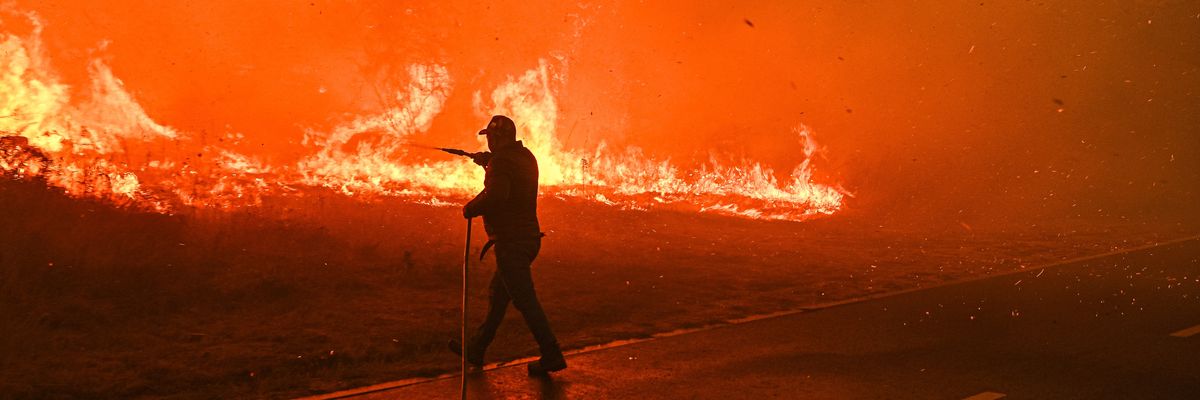
A resident tries to fight a wildfire burning on September 17, 2024 in Marco de Canaveses, Portugal.
A new report contained "the bleakest news possible, especially with a climate denier U.S. president in office for the next four years," said one climate scientist.
A day after U.S. voters elected climate-denying Republican Donald Trump in the presidential race, soon ushering in an administration that is sure to expand fossil fuel drilling, the European Union's Earth observation agency announced that 2024 is "virtually certain" to be the hottest year on record and to hit a worrying temperature milestone.
The year is expected to be the first on record in which the temperature is more than 1.5°C hotter than before the Industrial Revolution, according to the Copernicus Climate Change Service (C3S). The Paris climate agreement of 2015 urged countries to curb greenhouse gas emissions with the goal of limiting planetary heating to 1.5°C by the end of the century.
Over the past 12 months, said C3S, global temperatures were 1.6°C warmer than the yearly average from 1850-1900.
"The average temperature anomaly for the rest of 2024 would have to drop to almost zero for 2024 to not be the warmest year," said C3S.
Last month was the second-hottest October ever recorded, with temperatures 1.65°C higher than preindustrial levels. It was the 15th month in the past 16 to be hotter than 1.5°C over preindustrial temperatures.
While a single year above the 1.5°C mark does not necessarily indicate that the Paris climate goal is out of reach, C3S director Carlo Buontempo said the planet has "never had to cope with a climate as warm as the current one."
"This inevitably pushes our ability to respond to extreme events—and adapt to a warmer world—to the absolute limit," he told The Guardian.
Climate scientist Bill McGuire called the Copernicus report "the bleakest news possible, especially with a climate denier U.S. president in office for the next four years."
Trump has pledged to expand fossil fuel extraction and do away with climate regulations introduced by the Biden administration, telling oil executives he would do so if they contributed $1 billion to his campaign in what was described as a quid pro quo.
The C3S—which based its analysis on billions of measurements from satellites, ships, aircraft, and weather stations—noted in its report that October saw numerous extreme weather events tied to the warming planet. Heavy rains led to severe flash flooding in Spain, killing more than 200 people. Above average precipitation was also seen in Norway, France, China, southern Brazil, and parts of Australia, while Florida faced Hurricane Milton just two weeks after Hurricane Helene killed more than 230 people.
The World Meteorological Organization last week announced that carbon dioxide concentrations in the atmosphere are accumulating faster than at any other time in human history, rising more than 10% in the last two decades.
"The most effective solution to address the climate challenges is a global commitment on emissions," Buontempo told The Guardian.
BBC journalist Navin Singh Khadka said on the news network that if the 1.5°C breach continues "in the long term, then we are warned there will be catastrophic consequences."
"In the meantime we're told this could be a temporary overshoot because of factors like El Niño, for instance, but even then... the [Intergovernmental Panel on Climate Change] report has warned us that there might be some irreversible impacts," said Khadka. "What are those irreversible impacts? Can we live with them? That's the question now."
Dear Common Dreams reader, It’s been nearly 30 years since I co-founded Common Dreams with my late wife, Lina Newhouser. We had the radical notion that journalism should serve the public good, not corporate profits. It was clear to us from the outset what it would take to build such a project. No paid advertisements. No corporate sponsors. No millionaire publisher telling us what to think or do. Many people said we wouldn't last a year, but we proved those doubters wrong. Together with a tremendous team of journalists and dedicated staff, we built an independent media outlet free from the constraints of profits and corporate control. Our mission has always been simple: To inform. To inspire. To ignite change for the common good. Building Common Dreams was not easy. Our survival was never guaranteed. When you take on the most powerful forces—Wall Street greed, fossil fuel industry destruction, Big Tech lobbyists, and uber-rich oligarchs who have spent billions upon billions rigging the economy and democracy in their favor—the only bulwark you have is supporters who believe in your work. But here’s the urgent message from me today. It's never been this bad out there. And it's never been this hard to keep us going. At the very moment Common Dreams is most needed, the threats we face are intensifying. We need your support now more than ever. We don't accept corporate advertising and never will. We don't have a paywall because we don't think people should be blocked from critical news based on their ability to pay. Everything we do is funded by the donations of readers like you. When everyone does the little they can afford, we are strong. But if that support retreats or dries up, so do we. Will you donate now to make sure Common Dreams not only survives but thrives? —Craig Brown, Co-founder |
A day after U.S. voters elected climate-denying Republican Donald Trump in the presidential race, soon ushering in an administration that is sure to expand fossil fuel drilling, the European Union's Earth observation agency announced that 2024 is "virtually certain" to be the hottest year on record and to hit a worrying temperature milestone.
The year is expected to be the first on record in which the temperature is more than 1.5°C hotter than before the Industrial Revolution, according to the Copernicus Climate Change Service (C3S). The Paris climate agreement of 2015 urged countries to curb greenhouse gas emissions with the goal of limiting planetary heating to 1.5°C by the end of the century.
Over the past 12 months, said C3S, global temperatures were 1.6°C warmer than the yearly average from 1850-1900.
"The average temperature anomaly for the rest of 2024 would have to drop to almost zero for 2024 to not be the warmest year," said C3S.
Last month was the second-hottest October ever recorded, with temperatures 1.65°C higher than preindustrial levels. It was the 15th month in the past 16 to be hotter than 1.5°C over preindustrial temperatures.
While a single year above the 1.5°C mark does not necessarily indicate that the Paris climate goal is out of reach, C3S director Carlo Buontempo said the planet has "never had to cope with a climate as warm as the current one."
"This inevitably pushes our ability to respond to extreme events—and adapt to a warmer world—to the absolute limit," he told The Guardian.
Climate scientist Bill McGuire called the Copernicus report "the bleakest news possible, especially with a climate denier U.S. president in office for the next four years."
Trump has pledged to expand fossil fuel extraction and do away with climate regulations introduced by the Biden administration, telling oil executives he would do so if they contributed $1 billion to his campaign in what was described as a quid pro quo.
The C3S—which based its analysis on billions of measurements from satellites, ships, aircraft, and weather stations—noted in its report that October saw numerous extreme weather events tied to the warming planet. Heavy rains led to severe flash flooding in Spain, killing more than 200 people. Above average precipitation was also seen in Norway, France, China, southern Brazil, and parts of Australia, while Florida faced Hurricane Milton just two weeks after Hurricane Helene killed more than 230 people.
The World Meteorological Organization last week announced that carbon dioxide concentrations in the atmosphere are accumulating faster than at any other time in human history, rising more than 10% in the last two decades.
"The most effective solution to address the climate challenges is a global commitment on emissions," Buontempo told The Guardian.
BBC journalist Navin Singh Khadka said on the news network that if the 1.5°C breach continues "in the long term, then we are warned there will be catastrophic consequences."
"In the meantime we're told this could be a temporary overshoot because of factors like El Niño, for instance, but even then... the [Intergovernmental Panel on Climate Change] report has warned us that there might be some irreversible impacts," said Khadka. "What are those irreversible impacts? Can we live with them? That's the question now."
A day after U.S. voters elected climate-denying Republican Donald Trump in the presidential race, soon ushering in an administration that is sure to expand fossil fuel drilling, the European Union's Earth observation agency announced that 2024 is "virtually certain" to be the hottest year on record and to hit a worrying temperature milestone.
The year is expected to be the first on record in which the temperature is more than 1.5°C hotter than before the Industrial Revolution, according to the Copernicus Climate Change Service (C3S). The Paris climate agreement of 2015 urged countries to curb greenhouse gas emissions with the goal of limiting planetary heating to 1.5°C by the end of the century.
Over the past 12 months, said C3S, global temperatures were 1.6°C warmer than the yearly average from 1850-1900.
"The average temperature anomaly for the rest of 2024 would have to drop to almost zero for 2024 to not be the warmest year," said C3S.
Last month was the second-hottest October ever recorded, with temperatures 1.65°C higher than preindustrial levels. It was the 15th month in the past 16 to be hotter than 1.5°C over preindustrial temperatures.
While a single year above the 1.5°C mark does not necessarily indicate that the Paris climate goal is out of reach, C3S director Carlo Buontempo said the planet has "never had to cope with a climate as warm as the current one."
"This inevitably pushes our ability to respond to extreme events—and adapt to a warmer world—to the absolute limit," he told The Guardian.
Climate scientist Bill McGuire called the Copernicus report "the bleakest news possible, especially with a climate denier U.S. president in office for the next four years."
Trump has pledged to expand fossil fuel extraction and do away with climate regulations introduced by the Biden administration, telling oil executives he would do so if they contributed $1 billion to his campaign in what was described as a quid pro quo.
The C3S—which based its analysis on billions of measurements from satellites, ships, aircraft, and weather stations—noted in its report that October saw numerous extreme weather events tied to the warming planet. Heavy rains led to severe flash flooding in Spain, killing more than 200 people. Above average precipitation was also seen in Norway, France, China, southern Brazil, and parts of Australia, while Florida faced Hurricane Milton just two weeks after Hurricane Helene killed more than 230 people.
The World Meteorological Organization last week announced that carbon dioxide concentrations in the atmosphere are accumulating faster than at any other time in human history, rising more than 10% in the last two decades.
"The most effective solution to address the climate challenges is a global commitment on emissions," Buontempo told The Guardian.
BBC journalist Navin Singh Khadka said on the news network that if the 1.5°C breach continues "in the long term, then we are warned there will be catastrophic consequences."
"In the meantime we're told this could be a temporary overshoot because of factors like El Niño, for instance, but even then... the [Intergovernmental Panel on Climate Change] report has warned us that there might be some irreversible impacts," said Khadka. "What are those irreversible impacts? Can we live with them? That's the question now."