

SUBSCRIBE TO OUR FREE NEWSLETTER
Daily news & progressive opinion—funded by the people, not the corporations—delivered straight to your inbox.
5
#000000
#FFFFFF
To donate by check, phone, or other method, see our More Ways to Give page.
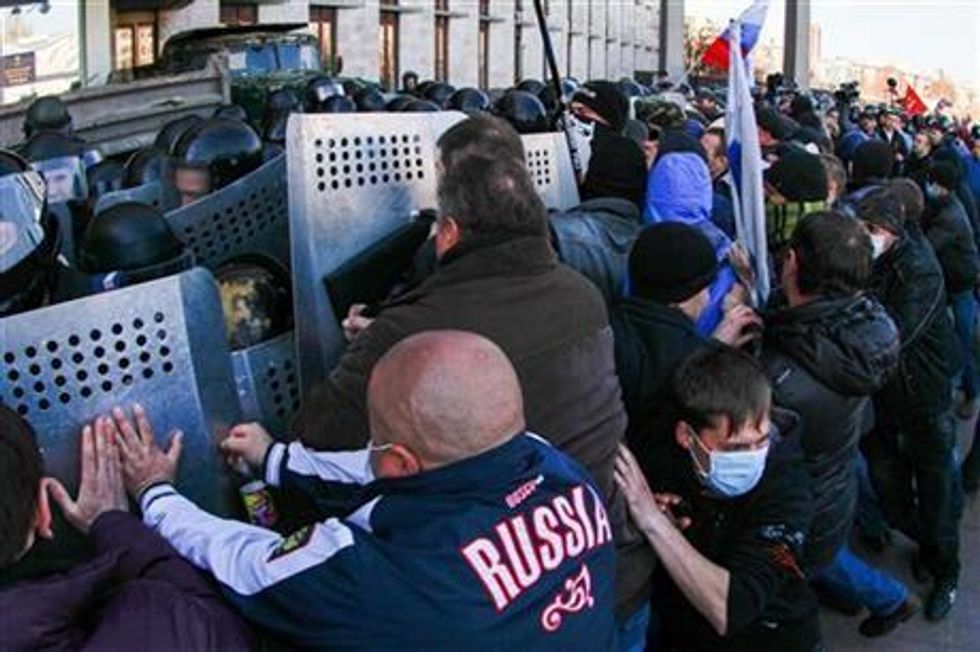
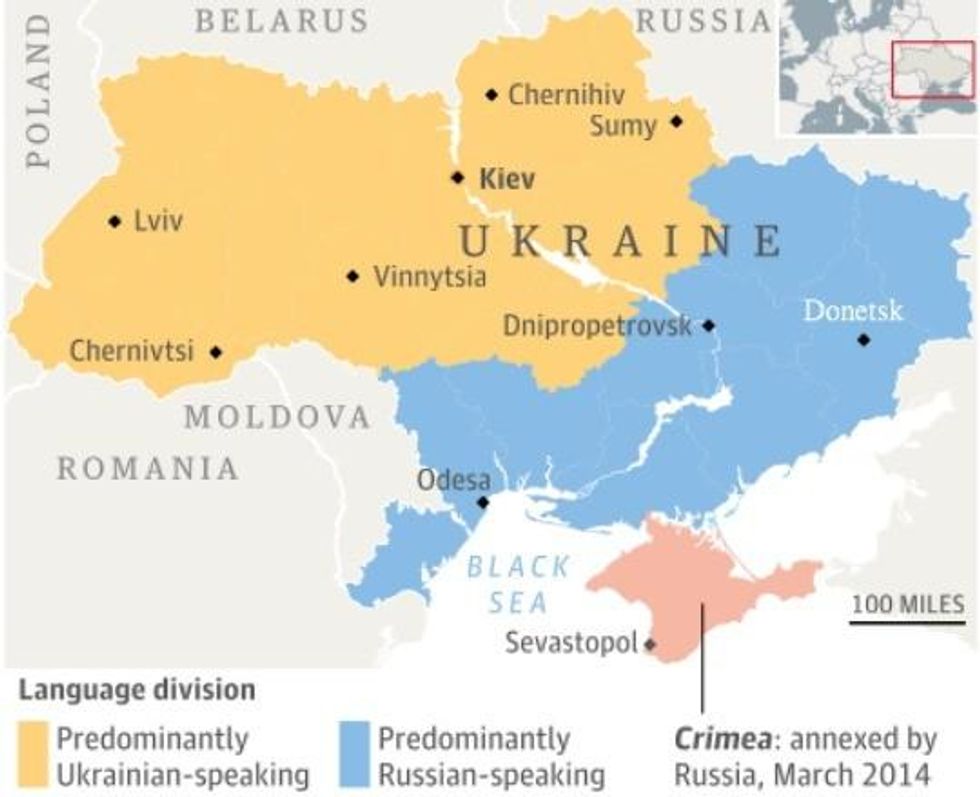
Pro-Russian citizens in the eastern cities of Ukraine are rising up against the government in Kiev, storming government buildings, raising the Russian flag, and calling for referendum votes to proclaim their independence. In their eyes, the recently established government based in the western capital city is not legitimate and now, like Crimea, they wish to exercise their right to break free of Ukraine and rejoin the Russian confederacy.
On Sunday night, protesters stormed buildings in three key cities--Kharkiv, Luhansk and Donetsk, clashing with security forces but ultimately gaining access to buildings and refusing to leave.
After taking control in Donetsk, with several thousand people occupying the main administrative building, the group released a video declaring their independence. "Seeking to create a popular, legitimate, sovereign state, I proclaim the creation for the sovereign state of the People's Republic of Donetsk," the spokesperson said, as the watching crowd reportedly cheered.
The unidentified man called for assistance from Moscow, saying, "Without your support, without the support of Russia, it will be hard for us to resist the Kiev junta on our own."
From Kiev, the interim Prime Minister Arseny Yatseniuk on Monday morning blamed the upheaval on Russian interference.
"The plan is to destabilize the situation, the plan is for foreign troops to cross the border and seize the country's territory, which we will not allow," Yatseniuk said.
According to Reuters:
The protesters appeared to be responding in part to Yanukovich, who fled to Russia after he was ousted and who on March 28 issued a public call for each of Ukraine's regions to hold a referendum on its status inside the country.
Separately, Ukraine's defense ministry said a Russian marine had shot and killed a Ukrainian naval officer in Crimea on Sunday night.
The 33-year-old officer, who was preparing to leave Crimea, was shot twice in officers' quarters in the locality of Novofedorovka. It was not clear why the Russian marine had opened fire.
Yatseniuk said that though much of the unrest had died down in eastern Ukraine in the past month there remained about 1,500 "radicals" in each region who spoke with "clear Russian accents" and whose activity was being coordinated through foreign intelligence services.
But he said Ukrainian authorities had drawn up a plan to handle the crisis.
"We have a clear action plan," he said, adding that senior officials would head to the towns concerned.
Meanwhile, news from Crimea on Sunday revealed that a Ukrainian military officer had been shot and killed by a Russian soldier. And though the incident appeared to result from a drunken brawl, observers on all sides have warned that it could be just such an incident of violence that could quickly escalate tensions between Kiev, Moscow, and the western powers that have continued to cast the situation in Ukraine in "Cold War" terms.
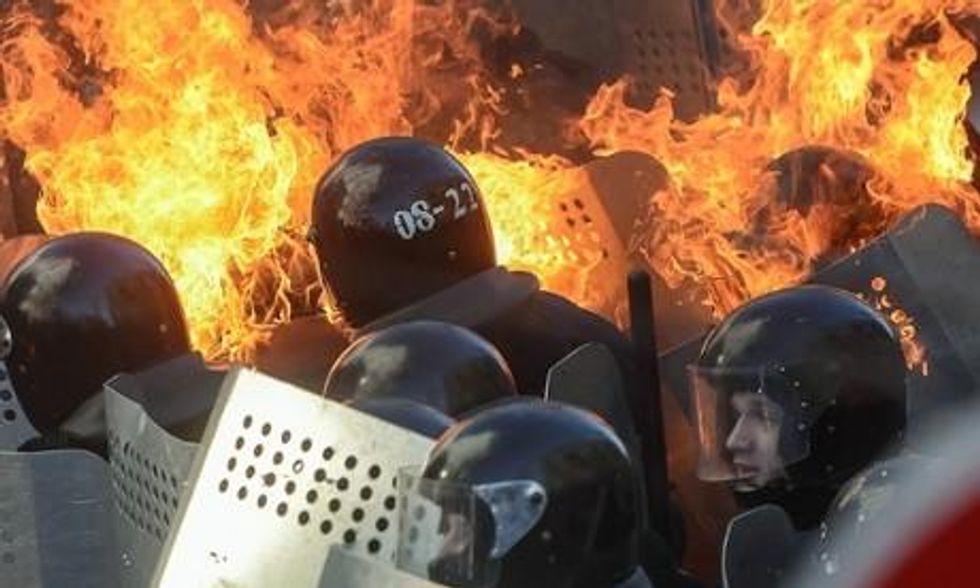
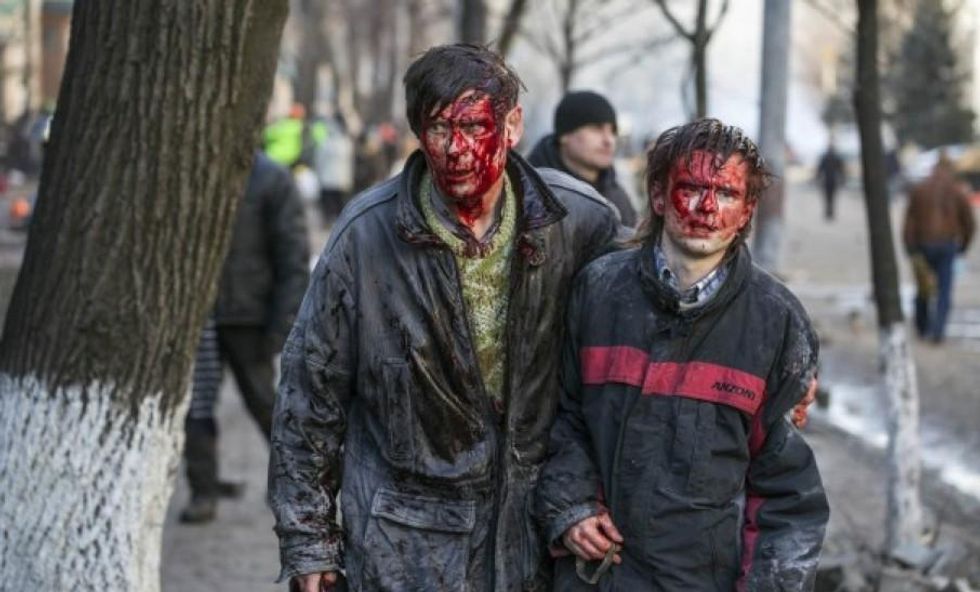
Clashes between anti-government protesters and state security forces exploded in Kiev on Tuesday with at least nine people reported killed as night fell in the Ukrainian capital amid fresh fears that a political stalemate has now escalated into chaotic mayhem with an unknown trajectory.
USA Today reports:
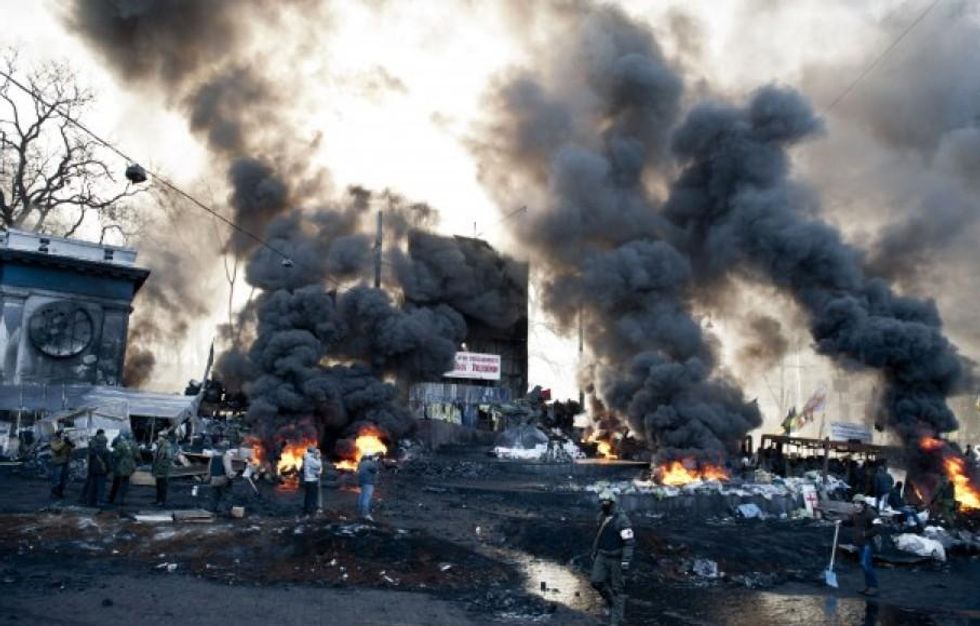
Government troops fired stun grenades and gunshots at thousands of marchers, killing at least nine people, said opposition lawmaker Lesya Orobets. The pop of grenades could be heard and clouds of tear gas and smoke from burning cars and trucks filled the streets.
"This is crazy, it's like a real war - they are going to kill each other," said protester Liudmila Mazur, 50, as she watched about 100 protesters attack a police barricade that blocked the way to parliament.
"I don't know if there is another way now as the government understands only force. When we were protesting peacefully, they didn't hear us. I just hope people won't get hurt," Mazur said.
The Associated Press posted this video from the afternoon clashes:
Raw: Deadly Clashes in Ukraine, Deadline Sethttps://smarturl.it/AssociatedPress Thousands of angry anti-government demonstrators clashed with police outside Ukraine's ...
According to the New York Times:
In the course of wild day of parries and thrusts by the protesters and the police, the authorities in Kiev reported nine people killed, including two police officers. It was the bloodiest day of violence since President Yanukovych spurned a trade deal with Europe in November and set of protests that began peacefully but have since involved occasional spasms of deadly violence.
The push into Independence Square by anti-riot forces spread chaos and fire across the protest zone, with tents ablaze as police advanced through clouds of smoke and tear-gas. Protesters sang the national anthem against the din of percussion grenades, fireworks and what, on occasion, sounded like gunfire.
And the Guardian, which was offering live coverage throughout the day, reported that in addition to those killed, more than 100 people have been seriously injured in the violence.
Photos:
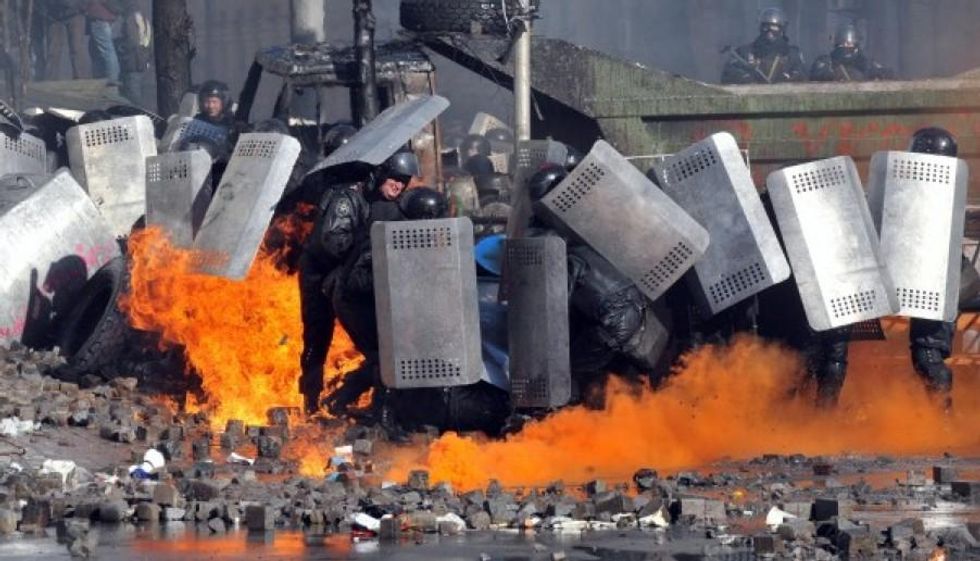
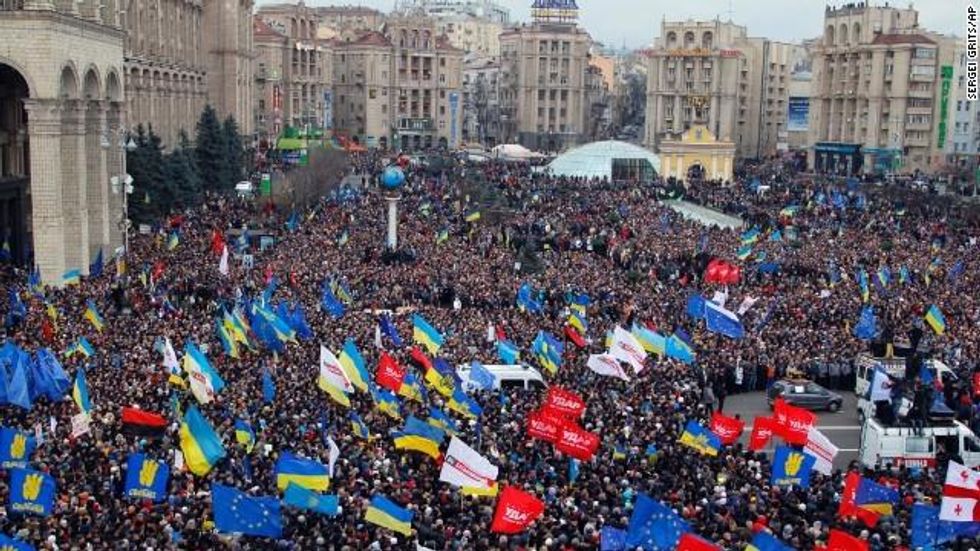
The hundreds of thousands of street demonstrators who took to the streets across Ukraine on Sunday showed no signs of letting up as their calls for 'revolution' against the government of President Viktor Yanukovych were matched with strategic seizures of ground in the nation's capital of Kiev on Monday.
Kiev's Independent Square, according to reports, is now under the full control of the protesters who have set up barricades protecting the central gathering area. Meanwhile, key government offices came under occupation overnight with protesters setting up a makeshift headquarters inside city hall and government workers have been barred from entering their workplaces.
As the Guardian reports:
On Monday morning, as Kiev began its working week, tension was high as both ordinary people and opposition leaders were left guessing how events might unfold. Hundreds of protesters took up positions blocking entrances to government buildings to stop officials from getting to work, while others blocked off whole streets. Many of the people who spent the night in the two government buildings that were seized by protesters insisted they would not leave until the government falls.
In the western city of Lviv, stronghold of pro-European forces, the regional authorities announced a general strike on Monday.
The key political opposition to Yanukovych, such as the jailed former prime minister Yulia Tymoshenko and the heavyweight boxer Vitali Klitschko, have called on their supporters to refrain from violence but not to go home.
"This government is clearly over," said Vladimir Luchishin, 60, from Donetsk, who was sleeping at city hall, having arrived on Sunday. "If they try to fight back with force, it will only make things worse for them."
Police have retreated from most of the centre of Kiev but cordons of riot police remained in position, guarding the Presidential Administration - the scene of violent clashes on Sunday in which more than 100 police were injured. On Monday morning, the interior ministry said a total of 150 riot police and other officials had been injured, while 165 protesters had been injured, 109 of which required some kind of hospital treatment.
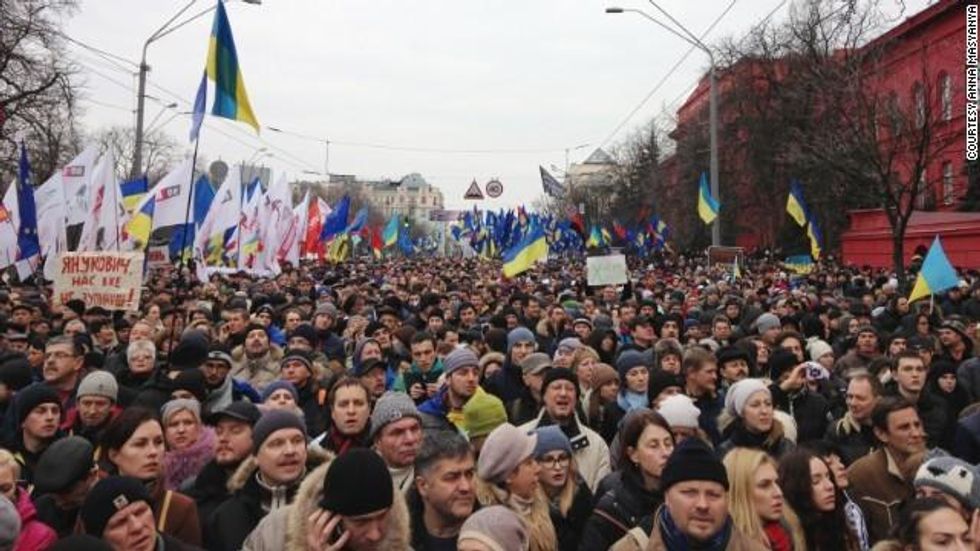
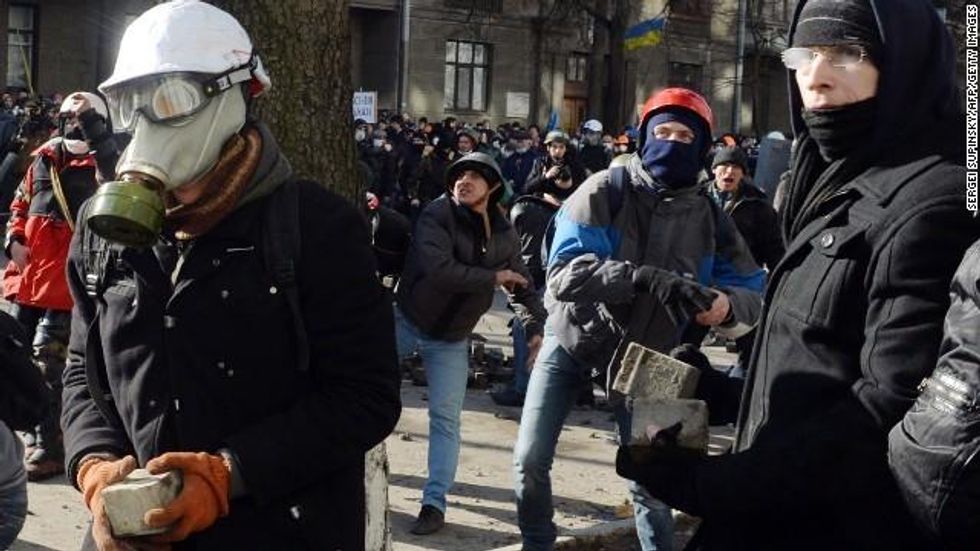
The calls for 'revolution' have mostly remained peaceful, with the majority of the large crowd speaking out against the violence that has occurred at the margins of their protests as ultra-rightwing nationalists have used the occasion of the protests to attack police, using petrol bombs, rocks, and other weapons in an effort to incite a violent response. Some peaceful anti-government protesters on Sunday put themselves between the violent, masked provocateurs and a line of riot police who had taken up a defensive position.
"We should not be provoked. There are a lot of provocateurs. We can change the power in a civilized way. Our rally in Kiev today is a peaceful protest only," said heavyweight boxer Vitali Klitchko--a member of parliament, one of the most famous people in Ukraine and a supporter of the revolution--told people during a speech in the square on Sunday.
Klitchko is only one of many of Ukrainian lawmakers siding with the protesters and as negotiations continue behind closed doors on the government response, the life of the protest movement is making progress of its own.
As the New York Times reports:
Inna Bohoslovska, a member of Parliament who has quit Mr. Yanukovich's Party of Regions in support of the demonstrators, called on Monday for the government to resign. Demonstrators also continued to occupy City Hall in Kiev, where windows had been smashed and walls covered with graffiti. Under a sign for the Kiev City Council, someone had painted in black: "Revolution Headquarters."
After a huge rally on Sunday -- a crowd estimated at a million or more that observers said exceeded even the largest gatherings of the Orange Revolution nine years ago -- the demonstrators overnight blocked city streets, using Christmas decorations and police barricades intended to stop the protest.
The result was an oddly festive, fir-trimmed encampment at the heart of the Ukrainian capital. Protest leaders, sensing that momentum had turned to their advantage, continued to add infrastructure to their operation, bringing in television monitors and erecting a small tent city that included first-aid stations and canteens.
Having occupied the nearby Trade Unions building on Sunday, they seized control of a giant screen mounted on its facade, and replaced the advertising it had carried -- first with images of the yellow-starred European Union flag, and by Monday morning with a live video feed of speakers on the protest stage outside.