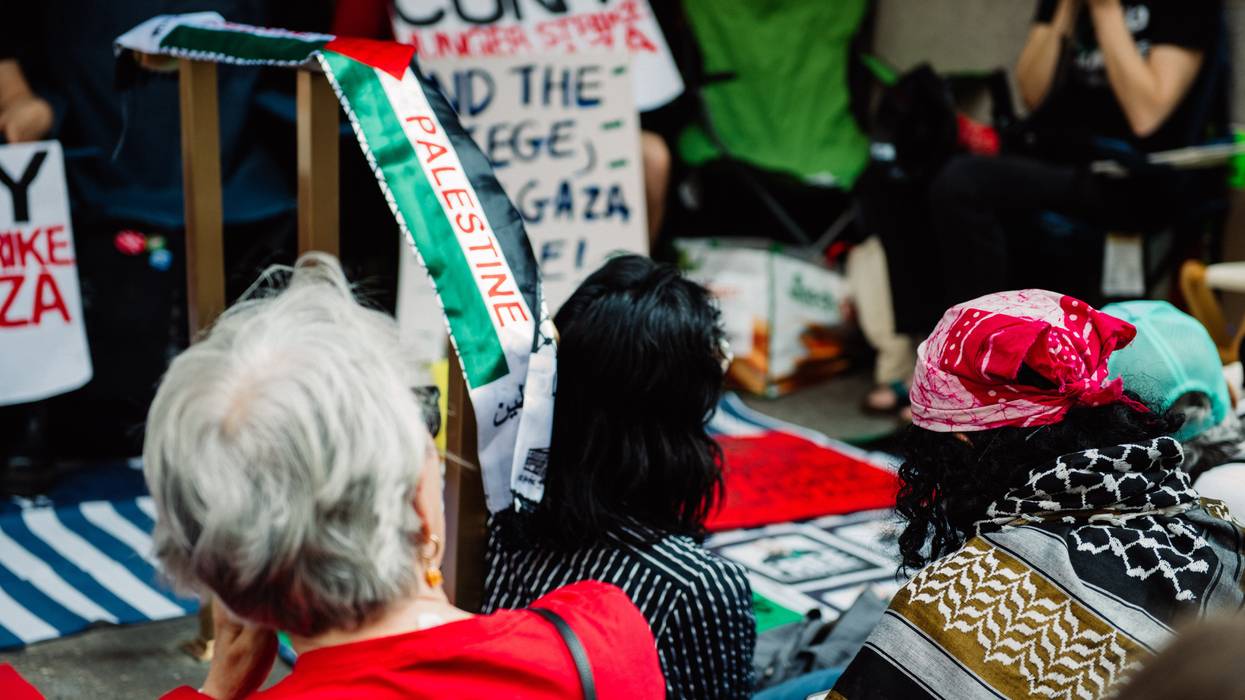
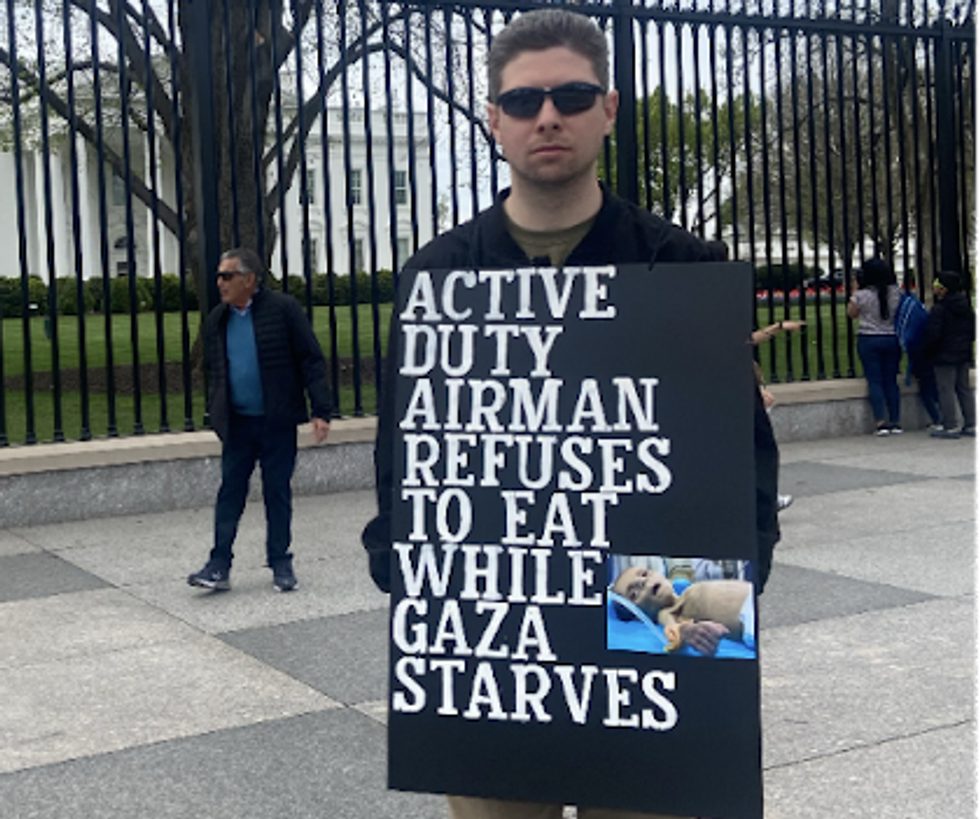
Hunger strikers and supporters were out on the steps of the Graduate Center [GC] today from 12-6:00 pm ET. We are devastated by the news out of Gaza but strengthened by the beautiful solidarity that has gathered around the steps. Not only did many, many GC faculty, staff, and students stop by to join the strike or camp out for the day, but we received a lot of support from passersby (including a group of high school juniors who stopped by to talk and donated to Gaza), and our fundraiser reached $3,486 in less than 24 hours.
UPDATES FROM GAZA
The news out of Gaza this week is devastating. Over the past 10 days, the intensifying Israeli onslaught has displaced 180,000 people. As people of conscience around the world reel at news of the massacre of Dr. Alaa al-Najjar's nine children, Israel continues to murder Palestinians as they attempt to receive life-saving aid, killing Mohammad Imad Abdel-Hadi, Khalil Ashraf Mousa, and Ashraf Anwar Khalil Mousa and injuring over 46 people on May 27, the day we began our hunger strike. Since the beginning of the genocide Israel haskilled over 400 people waiting for aid in Gaza. In the first few hours of today, 36 Palestinians were killed by intensified Israeli bombing, including eight killed in an attack on the home of Gaza journalist Osama al-Arbid in the northern strip. This comes just two days after israel's massacre at Fahmi al-Jarjawi school in Gaza City, killing 36 people including children and seriously injuring many more. An injury in the Gaza Strip can be a death sentence, as 22 out of Gaza's 38 hospitals are out of service, the Health Ministry has said, with those still operating facing a "catastrophic" shortage of supplies. There is an urgent (and deadly) shortage of oxygen, particularly in intensive care units, operating rooms, pediatric nurseries, and emergency departments. Meanwhile, Israeli warplanes have also bombed Yemen's Sanaa airport for the second time this month, and one person was injured in an Israeli drone strike targeting a vehicle in the town of Abbasiya in southern Lebanon. The U.S. is not only complicit in these crimes—it is funding, materially supporting, and politically enabling them. On May 27, the day we began our hunger strike, the U.S. sent its 800th planeload of weapons to Israel since October 7. CUNY must divest NOW!
Day Three
Day three of our strike saw an outpouring of solidarity. After some harassment by Zionists while setting up this morning, we had a day full of support. The fundraiser for Gaza has now reached $7,000. We are heartened by this incredible show of solidarity from our community. In the course of the day, two passersby—separately—stopped to tell us that they had participated in prison hunger strikes and wished us well; both had achieved their demands. Their solidarity meant a lot to us, but is also a stark reminder of how deeply affected our community is by mass incarceration. Later on, a driver jumped out of their car across 5th Avenue while stopped at a red light to get our fundraiser flyer; another person leapt out of their car and delivered a ton of water bottles to us. Hunger strikers are tired, but in good spirits and very buoyed by the solidarity. No word from the chancellor yet, though the vice chancellor was present at yesterday's strike.
Again and again, we have been humbled by the amount of support shown to the strike from passersby in Midtown Manhattan, in the belly of the beast under the shadow of the Empire State Building.
UPDATES FROM GAZA
The Gaza Media Office has adjusted the death toll of Palestinian journalists killed by Israel to 221 to include the assassination of Moataz Rajab, a cameraman and editor for Al-Quds al-Youm TV channel. Rajab and others were targeted in an Israeli airstrike in Gaza City on Wednesday, May 28, the 600th day of the U.S.-Israeli genocide. Facing unabated starvation, desperate Palestinians broke into the World Food Program's warehouse in Deir al-Balah in central Gaza where the Israeli Occupation Forces (IOF) shot and killed two people. In the panic caused by Israeli gunfire, two others were crushed and dozens injured. At least 23 people were killed on Thursday in a series of Israeli airstrikes on residential buildings in the al-Bureij refugee camp in central Gaza, on the same day that the Israeli government fast-tracked the establishment of 22 new settlements (the largest one-time approval) on occupied Palestinian land in the West Bank.
Day Four
The fourth day of our hunger strike was marked by connections across labor efforts, movement strategies, and political struggles. Fellow hunger strikers from Veterans for Peace stopped by and extended their solidarity. They have undertaken a 40-day "Fast for Gaza" outside of the U.S. Mission to the United Nations demanding "full humanitarian aid" in to Gaza and "no more weapons to Israel." Brooklyn College comrades held a campus organizing strategy meeting on the steps of the GC and invited supporters from other campuses who were on site. In a rally at the strike, the PSC-CUNY's rank-and-file "Fight to Win" caucus ratcheted up the energy, tapping speakers from Columbia and United Federation of Teachers. The literal "shaking off" we did throughout the "Learning with Intifadas" teach-in left strikers and supporters properly invigorated. The fundraiser for Gaza has now reached $9,745. We are truly overwhelmed by the material support that our community has extended. Hunger strikers were grateful for the sun today, and their health was tended to by healthcare worker comrades who visited and checked their vitals. Still radio silence from the CUNY chancellor who we've been bombarding with calls and emails demanding that CUNY DIVEST!
UPDATES FROM GAZA
As we reach day 602 of the genocide, U.N. spokesperson Jens Laerke stated that Gaza is the "hungriest place on Earth." Laerke stated that 100% of the 2.3 million Palestinians trapped by the siege of Gaza now face imminent "catastrophic hunger." The only aid not blocked by Israel from entering Gaza is coming from the so-called "Gaza Humanitarian Foundation" (GHF), a neo-imperialist capitalist venture sponsored by theUnited States and Israel. But this supposed "aid" is increasingly being referred to as a death trap, with more and more Palestinians routinely attacked and killed while seeking aid from GHF distribution points: Today 20 people were shot by Israeli soldiers while they tried to collect supplies at the Netzarim Corridor GHF aid point. Throughout Gaza, 30 Palestinians have been killed since the start of the day with attacks in Deir el-Balah, northern Jabalia, and eastern Khan Younis. Over the last two weeks 200,000 people have been displaced into a constantly shrinking "safe zone." Roughly 80% of the land in Gaza is under an evacuation order, pushing 2.1 million people into an area of approximately 73 square kilometers. In Jerusalem, Sanaa Salameh Daqqa was arrested near to Bab al-Amoud, following calls by Israeli National Security Minister Itamar Ben-Gvir to deport her. Daqqa is a translator and the widow of Walid Daqqa, a revolutionary Palestinian leader who was affiliated with the Popular Front for the Liberation of Palestine, and who was martyred in an Israeli prison in April 2024. The Palestinian Prisoners Club are claiming that Sanaa Daqqa is being targeted as part of a campaign of revenge against Walid Daqqa's family. But resistance remains strong in Gaza. The Qassam Brigades, which currently number 40,000 fighters, the same as in October 2023, have undertaken seven operations against the IOF this week. Elsewhere, Ireland has become the first Western state to officially declare that Israel is committing genocide in Gaza. While this an important step in challenging Israel's fallacious claim that it uses violence legitimately, this announcement comes far too late and with little material action yet tied to it.
Day Five
The fifth day of our hunger strike saw our community in support of Palestine continue to grow on the steps, with the strikers remaining steadfast in their demand that CUNY DIVEST NOW. Meanwhile, in just five days, we have reached our first goal of $10,000, which will be distributed to over a dozen families in Gaza. In fact, the fundraiser for Gaza has reached $11,734! We've now doubled our goal to $20,000, which will allow us to extend more direct material support to Palestinians as Israel continues to prohibit the entry of food and medical supplies, as prices skyrocket, and as indiscriminate israeli bombing escalates. Today, we had our first Letter Writing to Prisoners session and wrote to Rodney Hinton Jr. Nurse Mina came by to check on the strikers accompanied by her partner, her therapy dog, and her 7-year-old daughter who handed out stickers and made our day. Strikers are resolute but headed into the more difficult days of striking, so she'll keep an eye on them. Later in the day, a comrade who teaches high school gave a brilliant teach-in, "Un-Erasing Palestine in K-12 Education." Together we poured over and critiqued the K-12 curriculum around Palestine and a practice Regents exam. We agreed upon the necessity of teachers taking it upon themselves to teach Palestine (and Western imperialism) honestly and factually in their classrooms, despite the career risks this may pose. We were joined by a big contingent of folks fasting under the demand that the U.S. stop arming Israel, including legendary longtime organizer and writer Sam Husseini. Throughout the strike other brilliant movement elders such as Laurie Arbeiter, organizer and sailor on the first Freedom Flotilla to Gaza, and Former SEEK counselor and participant in the 1969 CCNY takeover Fran Giteles have stopped in to spend time talking with us and share stories. Still radio silence from the CUNY chancellor who we've been bombarding with calls and emails demanding that CUNY DIVEST!
UPDATES FROM GAZA
Today, Hamas submitted a response to the U.S.-backed Israeli cease-fire proposal. They have offered to release 10 Israeli captives alongside the bodies of 18 deceased Israelis, in return for the release of an unspecified number of Palestinian prisoners. Hamas is calling for a permanent cease-fire; the U.S. and Israel have rebuked this proposal and are currently offering a temporary cease-fire for 60 days only, at which point we can assume they will renew their campaign of genocide and extermination. In the course of the day, the IOF murdered at least 60 Palestinians across Gaza. In the past 48 hours, the IOF has bombed 60 homes in northern Gaza and has issued an evacuation order for all residents of Khan Younis, Bani Suheila, and Abasan, while the Qassam Brigade continues to resist the IOF. On May 27 Qassam Brigades engaged in combat with Israeli soldiers in the al-Atatra area of Beit Lahiya (northern Gaza). The armed wing of the Palestinian Islamic Jihad, al-Quds Brigade, also released a statement detailing an attack it undertook against the IOF in Shujayea neighborhood in Gaza City. Elsewhere, in another imperial heartland, fans of Paris Saint-Germain football club raised a large banner reading "Stop Genocide in Gaza" at the Allianz Stadium in Munich during the Champions League final. Germany is the second largest supplier of arms to Israel, accounting for roughly 30% of its arsenal. Middle East Monitor reported that on the day we began our strike (May 27) Israel received its 940th shipment of arms from the United States since 7 October 2023. And, in Italy, the Emilia-Romagna region has formally cut ties with Israel.
Day Six
Today was marked by much warmth and support from passersby, which buoyed the spirits of strikers and on-the-ground supporters. Again and again, we have been humbled by the amount of support shown to the strike from passersby in Midtown Manhattan, in the belly of the beast under the shadow of the Empire State Building. All over the world, support for Palestine is growing. The fundraiser for Gaza has now reached $13,114! Countless people extended cash donations today, including a taxi driver who leapt out of his car and dashed over to greet us! Strikers are depleted and exhausted on their SIXTH day of NO FOOD, yet still firm in their demand that CUNY DIVEST NOW. Earlier today, strikers were successfully able to have a video call with a comrade on the ground in the al-Mawasi area of Khan Younis; together, we watched the sun set over the Mediterranean. Later, The Red Snare joined us for an enlivening protest drumming workshop that drew in many neighbors (including children!). We were told that our collective drum beating and chanting was heard throughout the Graduate Center library. Closing out our day of political education, the "Eviction as Censorship: Housing Rights for Student Organizers" teach-in yielded some productive and engaging conversations on the housing precarities faced by movement workers and organizers, as participants shared and collectively strategized around their own immediate housing realities. Still not a peep from the CUNY chancellor who we've been bombarding with calls and emails, demanding that CUNY DIVEST!
To contact the CUNY chancellor and amplify our demand for divestment call 646–664–9100 or email felo@cuny.edu.
UPDATES FROM GAZA
Today, we received news that Dr. Hamdi al-Najjar, husband of Dr. Alaa Al-Najjar, has died of his injuries. This comes after the death of 9 of the couples' 10 children in an israeli attack on their home. The death toll in Gaza today has risen to 54, following a series of Israeli attacks throughout the strip. Thirty-one of those reported dead were murdered while waiting for food near two of the Gaza Humanitarian Aid Foundation supply points in Rafah and close to the Netzarim Corridor. Elham al-Qudra described the murder of her brother-in-law: "He went to get food for his children. His children were dying of hunger. He said, 'I want to go.' He left his three children behind and died. Three little children. One of them is still breastfeeding. He's nine months old." In the north of Gaza, Israel blew up Nouri al-Kaabi Dialysis Hospital, the only site in Gaza still able to provide lifesaving treatment for patients with kidney issues. In al-Mawasi, Khan Younis—a designated humanitarian zone—three people were killed during sustained bombing; one of the victims was a disabled child. In July 2024, at least 90 Palestinians were murdered in the same immediate area by Israeli airstrikes. Meanwhile, despite the cease-fire signed in November, Israel continues to bomb Lebanese territory. Today, it killed two people in the Bint Jbeil district of southern Lebanon. And in the Occupied West Bank, Israeli settlers, under military protection, assaulted and badly injured two brothers near Ramallah, Ghassan and Imad Mohammed Issa Abduljabir. Elsewhere, Yemen's Ansar Allah launched another rocket toward Ben Gurion airport; although it was intercepted, it grounded flights entering and leaving the airport. A spokesperson for Ansar Allah stated, "Our operations will not stop until the war on our brothers in Gaza stops and the complete siege on them is lifted." Yemen has been one of the few Arab states that has remained steadfast in its support of Palestinians since October 2023.
Day Seven
It's been seven days since we launched our hunger strike, and the energy outside the Graduate Center was infectious. Today was filled to the brim with public programming and visits from longtime organizers and movement workers. The fundraiser for Gaza has now reached $14,704. One passerby donated $500 in cash to the campaign! Others came to sit with us and listen in to the teach-ins. The support for Palestine on the street has been huge and visceral. For our public programming, port workers from Elizabeth, New Jersey shared updates on their "Don't Move Zim" campaign and their ongoing efforts to block Israeli shipping and weapons transportation in and out of the port. A CUNY professor gave a teach-in on Frantz Fanon's concept of decolonization and it was great to take some of Fanon's bigger questions and think through them together in a comradely space. At the end of the day, Chandra Mohanty and Angela Y. Davis came through and gave encouragement to the hunger strikers, echoing our solidarity with all those enduring genocide in Gaza. STILL no word from the CUNY chancellor as our hunger strikers go their seventh day WITHOUT FOOD. We have ONE DEMAND: that CUNY DIVEST!
UPDATES FROM GAZA
At least 51 Palestinians have been murdered and 503 injured across Gaza by Israeli forces in the last 24 hours. Most of those killed were in northern Gaza, including six children who died after their home was bombed in Jabalia. Since Israel broke the cease-fire agreement on March 18, 2025, it has murdered 4,201 Palestinians. In Beit Lahiya, IOF soldiers stormed the Indonesian Hospital, forcing 55 critically ill patients, including a child in intensive care, to flee or be evacuated from the facility. Given previous targeting of the site, there are fears from patients and doctors that the Israelis may soon destroy the hospital. Since the U.S.-backed GHF commenced its work last week, at least 75 Palestinians have been murdered at aid sites. Doctors Without Borders have called GHF's operations "dehumanizing, dangerous, and severely ineffective." Mohammed Abu Deqqa described the massacre on Sunday at a GHF aid site in Rafah: "At first, we thought they were [firing] warning shots. But it didn't take long before the shooting intensified. I began to see people lying on the ground, covered in blood. That was around 5:30 am. People started running, but many couldn't escape. The bullets were chasing people even as they tried to flee." UNRWA's acting director Sam Rose described the dehumanization of GHF points as treating Palestinians like "herded animals in pens." Two days ago, the Qassam Brigades undertook an attack on IOF soldiers east of the town of al-Qarara, in southern Gaza; on the same day, they also targeted the IOF military site in Ein al-Thalatha, launching three short-range missiles.
Day Eight
Today was as heartening as it was challenging. Recent media coverage has spread the word about our hunger strike, which has amplified our support for Palestine but also resulted in greater exposure to Zionist groups who came out to the strike today, harassing strikers and supporters. Luckily, there was a large crowd gathered at the strike when Zionists showed up and by forming a protective circle around the strikers while chanting, "In our thousands in our millions, we are all Palestinian!" we eventually drove them away. The day was also filled with rich conversations and movement collaboration across each teach-in and public programming events. Comrades from Pal-Awda joined us and extended updates on their Stolen Land campaign, a large-scale effort to disrupt the illegal sale of occupied Palestinian land to settlers here in New York City. Later, during a teach-in on "Tracing the Debt Economy of Higher Ed," a member of Vietnam Veterans Against the War shared his outrage over what's happening in Gaza and how it reminds him of the atrocities perpetrated by the American war machine in Southeast Asia. The fundraiser for Gaza has now reached $16,484! The hunger strikers are physically struggling: lightheadedness, weakness, and exhaustion have really set in, but the ongoing waves of support have been crucial to maintaining their energy and resolve. STILL silence from the CUNY chancellor who we've been bombarding with calls and emails demanding divestment as our hunger strikers go their eighth day WITHOUT FOOD! CUNY DIVEST NOW!
UPDATES FROM GAZA
For the third day in a row, IOF soldiers have killed Palestinians waiting to receive aid at GHF aid points: At least 27 people were killed and 90 injured at the Rafah site. Hind Khoudary, a journalist for Al Jazeera, reported, "The Israeli forces just opened fire randomly, shooting Palestinians… using quadcopters and live ammunition." Seven Palestinians were killed while sheltering in a camp in the Port of Gaza, as well as three in Deir el-Balah and four near Khan Younis. Across the West Bank, the IOF and settlers have attacked Palestinians in Beit Ummar, north of Hebron, and destroyed olive trees in Kafr Malek, east of Ramallah. Soldiers have also raided archaeological sites in Qarawat Bani Hassan and leveled land in Deir Jarir, close to Ramallah. Matthew Miller, U.S. State Department spokesperson under former President Joe Biden, admitted today that Israel is, "without a doubt," committing war crimes in Gaza—after spending years denying any wrongdoing in Gaza and justifying the continued shipping of U.S. arms to the apartheid state. We did not need Miller's admission to recognize the duplicity and lies of the U.S. administration, which has spent almost two years funding, arming, and politically supporting the genocide in broad daylight. Yemen's Ansar Allah has promised further escalation if Israel does not end its genocide and occupation of Palestine. They made this announcement following another rocket attack on Israel. Yahya Saree, spokesperson for Ansar Allah, stated that Israel will only get "more missiles and drones" from Yemen, "in rejection of the crime of genocide." Throughout the genocide Yemen has been one of the few countries to enact their obligations under international law by blocking shipping in the Red Sea in defense of the Palestinian people. The newly-formed Mohammed Deif Brigade based in Syria has likewise promised further attacks, firing two rockets at Israeli targets today, even as Israel continues its colonial campaign in Syria, having just launched rockets from fighter jets over southern Syria and bombing other sites in the Deraa countryside.
The CUNY Hunger Strike for Gaza paused on June 11 due to concern for the health of strikers after 16 days of no food and a decision to collectively reorient our efforts toward direct action campaigns targeting weapons manufacturing in NYC. For two-and-a-half weeks, the strike created a vibrant pro-Palestine space in the heart of empire, with an effusion of political education and community building. Relationships and connections forged at the strike continue to nurture collaboration between CUNY organizers and local campaigns throughout the city, including Veterans for Peace 40 day fast demanding a full arms embargo on Israel, the campaign to demilitarize Brooklyn Navy Yard, and Pal-awda New York's campaign to stop the sale of stolen Palestinian land here in NYC. Two separate fundraisers associated with the strike raised over $31,000, which has been sent directly to people surviving on the ground in Gaza.
We continue to demand that the CUNY administration DIVEST IMMEDIATELY from its complicity in Israeli-U.S. genocide. As the genocide across Palestine escalates, the U.S. joined Israel to launch a bloodthirsty war on Iran, and domestic attacks on pro-Palestine activists continue we DEMAND that our university divest. We join millions of people around the world—from the crew of the Madleen to the Sumud convoy to those preparing to set sail from Malaysia to those flooding the streets of every major city in every nation—rising up in a tsunami of humanity for Gaza and insisting that Zionism will fall and that Palestine will be free, within our lifetime.
As Chancellor Matos is scheduled to appear before the house committee on antisemitism this month, CUNY students and faculty continue to be persecuted for their support for Palestine and CUNY continues to refuse to disclose its investments in Israel and in weapons and tech manufacturers participating in Israeli war crimes (which we know total at least $8.5 million and likely much more). To contact the CUNY chancellor and amplify our demand for divestment call 646–664–9100 or email felo@cuny.edu.