

5
#000000
#FFFFFF
To donate by check, phone, or other method, see our More Ways to Give page.
Daily news & progressive opinion—funded by the people, not the corporations—delivered straight to your inbox.

"The governor's choice to opt out of the federal school voucher program will strengthen democracy and provide a stronger future for Illinois communities and children," said one advocate.
Public school advocates praised Illinois Gov. JB Pritzker on Tuesday for joining some fellow Democratic state leaders in rejecting President Donald Trump's optional "Federal Scholarship Tax Credit program," which critics call a harmful voucher scheme.
"At a time when public school education needs investments more than ever, we should not siphon money from public schools for private education—especially as the Trump administration's policies decimate education," said Pritzker, who frequently clashes with the Republican president and is one of several Democrats considered a possible 2028 candidate for the White House.
"We have a responsibility to do right by all of our students," added Pritzker, who just won a third term. "Taxpayer funding should not subsidize donations to private schools that could discriminate based on religion, sexual orientation, or other characteristics."
Established by Trump and congressional Republicans' One Big Beautiful Bill Act, the program will allow eligible taxpayers to claim an annual credit of up to $1,700, or $3,400 for married couples filing jointly, for contributions to "scholarship granting organizations." It's widely seen as an effort to funnel funds into private school tuition, but money could also go toward "academic tutoring, special needs services, books, supplies, computers and other equipment, and other qualifying expenses."
Governors have until January 1 to opt in to the program. Democrats have made mixed decisions, and some are still deciding.
Pritzker's state includes the third-largest district in the country: Chicago Public Schools. Stacy Davis Gates, president of both the Chicago Teachers Union and Illinois Federation of Teachers, said Tuesday that "public dollars belong in public schools."
"Trump's voucher scheme was built to pull money out of public education with zero oversight and zero educational benefit for students," Davis Gates stressed. "Illinois' 1.8 million public school students deserve better, and today they got it. Gov. Pritzker did the right thing in rejecting Trump's voucher program."
"And to be clear, saying no to vouchers is the floor, not the ceiling," she continued. "Our schools are $7 billion short of what the law mandates for our students. Keeping vouchers out stops our schools from losing more. Fully funding them is how we make them whole."
The union leader also highlighted that "on Wednesday, December 2, educators from across Illinois will be back at the Capitol to ask lawmakers and the governor to make a down payment on their past-due balance this veto session."
Karl Goeke, president of the Illinois Education Association (IEA), the state's largest union for K-12 teachers outside of Chicago, similarly welcomed the governor's rejection of Trump's program in a Tuesday statement.
"Public money belongs in public schools, end of story," said Goeke. "Illinois' 1.6 million public school students, their parents and educators across Illinois counted on Gov. Pritzker to reject vouchers and protect public education, and he did. We are thrilled and thankful."
While Trump's Department of Education, GOP state lawmakers, and Pritzker's failed Republican challenger, Darren Bailey, lashed out on social media, Illinois State Superintendent of Education Tony Sanders applauded the decision, as did leaders at Illinois Families for Public Schools, the Partnership for Equity and Education Rights Illinois, and the Learning Disabilities Association of Illinois.
"School voucher programs do not provide students with disabilities with the educational legal protections they are guaranteed under federal law," explained Karen Tamley, president and CEO of Access Living. "It leaves these families with fewer school options, not more, and would harm students with disabilities in Illinois."
Civil rights, community, and some religious leaders in the state also cheered the development. Rev. Karen EK Atkins, executive pastor of Immanuel Church Unusual in Chicago, declared that "this choice affirms the commitment to giving every student, in every neighborhood, a well-resourced school where they can learn and thrive."
Rev. Georgia McKee of Glencoe Union Church said, "Thank you, Gov. Pritzker, for defending religious freedom, honoring the separation of church and state, and affirming our shared responsibility to provide quality public education for every child in Illinois."
Becky Simon, president of the League of Women Voters of Illinois (LWVIL), emphasized that "the proposed rules do not allow Gov. Pritzker to impose even basic quality and safety standards for the private schools accepting the vouchers, or to ensure equitable distribution of these dollars across the state."
"Waste, fraud, and abuse of taxpayer dollars spent on school voucher programs is rampant in many states with universal vouchers, but this program has only minimal federal guardrails—and worse, it prohibits state oversight to reduce misuse of public dollars," Simon added. "The LWVIL believes that a strong, well-funded public education system is not only mandated by our state constitution but is also a basic prerequisite for a thriving democracy. The governor's choice to opt out of the federal school voucher program will strengthen democracy and provide a stronger future for Illinois communities and children."
Thank you @govpritzker.illinois.gov for standing with Illinois’ students, families & educators by rejecting Trump’s voucher scheme. Public dollars must strengthen public schools that welcome all students, not be used as donations to private schools. gov-pritzker-newsroom.prezly.com/gov-pritzker...
[image or embed]
— Randi Weingarten 🖇️📚✊🇺🇸 (@rweingarten.bsky.social) November 24, 2026 at 5:31 PM
Democratic Govs. Josh Green (Hawaii), Tina Kotek (Ore.), and Tim Walz (Minn.) have said their state will not participate, according to Ballotpedia's tracker. A spokesperson for Virginia Gov. Abigail Spanberger (D) said earlier this month that her state will not finish the process to join the program, effectively reversing the decision of her Republican predecessor.
Republican governors largely support the program—and so do some GOP-controlled state legislatures. In Wisconsin, outgoing Democratic Gov. Tony Evers has vetoed legislation that would opt his state into the program. Arizona Gov. Katie Hobbs, another Democrat, has vetoed multiple such bills.
The Kansas, Kentucky, and North Carolina legislatures overrode vetoes from Democratic Govs. Laura Kelly, Andy Beshear—another potential presidential candidate for the next cycle—and Josh Stein.
“Study after study shows that voucher programs do not benefit students. They are a scam," said IEA's Goeke. "Our children deserve more than this. Illinois students should be able to count on a thriving public education system no matter where they live, the color of their skin, or how much money their families have. We look forward to working with the governor to secure more funding for public schools as we go forward."

Keeping ICE off school campuses is only the first step. School boards and state leaders must equip teachers with trauma-informed practices so children devastated by raids can keep learning.
Results of the November midterm elections brought relief to many immigrant communities, who saw voters in states like Texas push back against the aggressive immigration enforcement campaigns of President Donald Trump’s second term. Yet as immigrant rights advocates have warned, election results alone will not end Immigration and Custom Enforcement raids. ICE remains the highest funded US law enforcement agency with a remaining budget of $91 billion to fund more arrests, detentions, and deportations through September 2029. A Democratic Congress also cannot undo the acute psychological trauma that years of raids and family separations have already inflicted on school children. Inside classrooms all across the US, educators are confronting a wide range of trauma symptoms that disrupt learning.
The urgency of this need was made apparent to us a few weeks into the start of the school year, when a seasoned bilingual educator reached out to us in crisis after a fifth-grader’s parent was detained by ICE. She was at a loss as to how best to support the child, guide other teachers and staff, and reassure the broader student body. Even with resources and guidance on how to keep federal agents off school campuses, those protections are not enough when a fifth grader comes to class the morning after a parent is detained. She and her colleagues wanted to know what to do (and what not to do) so that students could continue to learn while coping with the distress of parental deportation and the ongoing threat of immigration enforcement in their community.
This teacher’s request for assistance in the immediate aftermath of a community member’s detention by ICE is now alarmingly common. We have been working with schools across the country for nearly two decades helping educators build strong home-school relationships, especially with immigrant families. Yet, educators’ concerns are markedly different now from what they were even two years ago. These unprecedented times call for new guidance, professional learning opportunities, resources, and supports for educators who are being asked to respond to crises that are devastating families and communities nationwide.
Protecting immigrant-origin students’ right to an education requires more than keeping ICE off school campuses. School boards, state education agencies, and teachers’ unions have the power and the obligation to make public schools safe for all students.
We led a workshop for teachers and support staff at the school, integrating expertise on the experiences of immigrant-origin youth with core trauma-informed principles. The workshop included baseline information about psychological responses to trauma and easy-to-implement self-regulation strategies for educators to use in their classrooms. We also heard about the issues that are most vexing for school personnel in the midst of a community crisis of this nature. We learned what educators wanted to know and what they found most helpful—lessons that should inform larger-scale efforts to develop and disseminate basic training for all adults working with young people in contexts affected by immigration enforcement.
First, we emphasized that the best and most protective thing classroom teachers can do for students whose family members have been detained or deported by ICE is to maintain normal classroom routines. Teachers are not expected to be experts in knowing how to manage the psychological consequences of a sudden, traumatic event like parental detention. However, they are experts in creating welcoming and routine learning environments; being a steady, positive presence in students’ lives; and teaching them academic and social skills to be successful in their school and in society.
Next, educators wanted help knowing developmentally appropriate ways to talk to students about their fears and answer their questions about immigration enforcement activity in their neighborhoods. We taught core principles from psychological first aid to help teachers respond effectively. This includes answering questions directly and honestly at an age-appropriate level while avoiding having students share in-depth trauma histories; letting students know that a variety of reactions are normal including sadness, anger, numbness, and distraction; helping students identify coping skills such as “hot chocolate” deep breathing; discussing what is being done by the school to keep students safe; and finding ways to help the classroom come together and support each other as a community.
In order to help teachers support an individual student displaying symptoms of trauma, we taught them the regulate, relate, reason sequence from the Neurosequential Model of Therapeutics. When a student experiences a trauma trigger, they can become dysregulated and therefore unable to learn. To help get them back on track, an adult must first work on their own regulation (“Put your oxygen mask on first”). Only then can they support the regulation of a student. Once a student is regulated, they need to “relate” to the teacher, which can be supported through open-ended comments and questions including reflective (e.g., “It sounds as if you are saying”), clarifying (e.g., “Tell me if I am wrong, but it sounds like…”), supportive (e.g., “No wonder you feel…”), and empowering (e.g., “What have you done in the past to help when things get difficult?”) strategies. Once the student feels supported and understood, they will be able to return to learning.
After the training, teachers and staff reported feeling better equipped with a set of strategies to use to support students impacted by immigration enforcement and more ready to respond to questions, fears, and atypical student behaviors that may accompany such destabilizing events.
Educators are on the front lines of a human rights and public health crisis for which few have been adequately trained. Yet, they remain among the most stabilizing adults in young people’s lives. Fortunately, trauma-informed practices do not require teachers to become therapists; they can be integrated directly into a teacher’s existing classroom toolkit, strengthening learning and emotional safety for everyone in the room.
Protecting immigrant-origin students’ right to an education requires more than keeping ICE off school campuses. School boards, state education agencies, and teachers’ unions have the power and the obligation to make public schools safe for all students. They must immediately dedicate professional development resources to equip every school staff member with trauma-informed crisis response skills before more classrooms are destabilized by federal raids.

Eva Yi Xie is a "law-abiding student and wonderful person who has many talents to contribute to the United States," her adviser said. Trying to deport her "is cruel, and it is our country shooting itself in the foot."
US immigration agents this week detained an asylum seeker from China who is pursuing a PhD in neuroscience at Princeton University—just days after a survey revealed that new international student enrollment has dropped by 15% nationwide following President Donald Trump's return to office.
Eva Yi Xie told her colleagues at Princeton's Brody Lab that she was detained on Thursday at the Ronald Reagan Washington National Airport in Arlington, Virginia. The 24-year-old's lawyers said Friday that she was sent to a US Immigration and Customs Enforcement (ICE) holding center in Chantilly.
Her attorneys also filed a habeas corpus petition in the US District Court for the District of Virginia, seeking her immediate release. In response, Judge Anthony Trenga, an appointee of former President George W. Bush, blocked the Trump administration from removing her from the judicial district pending further court order.
Xie came to the United States from China a decade ago and, according to her LinkedIn profile, graduated from the Bronx High School of Science and earned a bachelor's degree from the Massachusetts Institute of Technology before starting her doctoral program at the Ivy League institution. She has interned at Meta, Microsoft, and IBM.
Rodney Priestley, dean of Princeton's graduate school, said in a statement that "news of Eva's detention is distressing for me and many members of the Princeton University community. The university has arranged for Eva to be represented by legal counsel, and we will remain in contact with her legal team, her family, and colleagues to provide support. We hope Eva will soon be able to resume her studies at Princeton."
Neuroscience professor Carlos Brody, who advises Xie, told the student newspaper, The Daily Princetonian, that "it seems wildly unfair," adding: "Eva is a brilliant law-abiding student and wonderful person who has many talents to contribute to the United States. Detaining her, with the intent of deporting her, makes no sense whatsoever. It is cruel, and it is our country shooting itself in the foot."
Xie wrote on LinkedIn earlier this week that she was in Washington, DC to present at a Society for Neuroscience conference. The organization "is closely monitoring the detention" of Xie, it said Friday. "We are in close contact with Princeton University and stand ready to provide any support that may be needed. Our thoughts are with Eva, her family, and her colleagues."
The student's colleagues also weighed in, as did other academics and tech professionals. Ningshan Ma, who attended MIT with Xie, wrote on the platform X: "This is horrifying. Eva is an amazing classmate and friend. Please help in any capacity."
Brian Huang, an MIT alumnus who's now at Google DeepMind, said: "This woman was one of my labmates during undergrad.... absolute insanity from this administration."
The Brody Lab's official X account said that "she’s a brilliant neuroscientist, mentor, and friend. She went to a conference to present her work, and now she's in a detention center. She should be home."
Princeton student Conor McGrory wrote: "Just heard the news that a student in my PhD program was kidnapped by ICE earlier today. Eva is a great person and a gifted scientist, and the fact that these cruel, lawless people are subjecting her to this makes me sick with anger."
Another student at the university, Jorge Yanar, said that "Eva is one of the kindest and most brilliant people I've worked with during my PhD. It is shocking and deeply infuriating that this is happening. Please share! Call your representatives. Forward this to reporters."
According to the campus paper:
New Jersey Sen. Andy Kim's office is directly in touch with Xie, according to Kim's press secretary Katey Sabo. She added that his office is "working on the case" in a statement to the Prince.
Sen. Cory Booker, the other New Jersey senator, wrote in a statement to the Prince that ICE has not responded to his outreach on Xie’s detention. Kim and Booker are both Democrats.
"My office has contacted US Immigration and Customs Enforcement (ICE) regarding the detention of Eva Yi Xie and has not yet received a response. I expect a prompt and full explanation of the circumstances surrounding her detention," Booker wrote.
The Congressional Asian Pacific American Caucus said, "Remember when Trump said he would go after the 'worst of the worst?' Absolutely shameful."
In addition to rounding up foreign students—often targeting those critical of US foreign policy—Trump's immigration agents have invaded various communities across the country and killed both citizens and undocumented immigrants.
Kelly Rojas, co-director of the Detained Adult Program at the Amica Center for Immigrant Rights, told The Washington Post that at least five people, including Xie, have been detained by immigration officials at DC-area airports in recent weeks.
"It's really particularly devastating and unfair," Rojas said, "because once someone is detained, even though you have a good legal claim and have been doing everything right, it gets to be a thousand times harder for you to access your legal rights and access your day in court and with the government to get your case heard."

“We are protesting to claim our right to a better and dignified future, and we are aware that if we stand united, no one will be able to stop us from taking it."
The students organizing school walkouts, marches, and rallies across Europe on Friday "refuse to be cogs in the war machine," said the UK-based Stop the War Coalition as it urged supporters to join young people as they build on massive recent protests in France, Spain, Brazil, Chile, and other countries—all centered on a rejection of authoritarianism and militarization and demands for government leaders to invest in robust social services.
Organizers of the International Youth Strike said hundreds of thousands of people were taking part in direct actions in about 400 cities across 25 countries in Europe, united by one slogan: "Fight for Our Future, Not Their Wars."
“With this historic mobilization, we are showing to the world the strength and the power of our generation,” said Alessandro Di Miceli of Rete della Conoscenza, a network of high school and college students in Italy. “We are protesting to claim our right to a better and dignified future, and we are aware that if we stand united, no one will be able to stop us from taking it."
In London, demonstrators were seen holding signs that read, "Books Not Bombs," and "Follow France: Fight the System"—a reference to protests that broke out across Paris and the rest of France last month over conditions at the country's dilapidated, underfunded schools and austerity policies as the public struggles with affordability.
Brilliant student strike march to Downing Street just now. Thousands have hit the street against war and militarism around the country... https://t.co/SgFWL8Wkbs
— Chris Nineham (@ChrisNineham) November 20, 2026
A general strike in Spain earlier this month was sparked by widespread anger over housing costs, and Di Miceli emphasized that while organizers in different countries on Friday may be highlighting a range of issues, the mass mobilization is centered on anger over massive investments in militarization while the needs of the public go unmet.
"From the right to education to the right to housing, from the struggle against the rising cost of living and the climate crises, to the fight against militarization and rearmament, specific demands may differ from country to country, but are all deeply connected between each other," said Di Miceli.
According to the International Youth Strike's manifesto, five common demands include:
Organizers say the European Union's ReArm Europe plan, also known as Readiness 2030, is a "clear example" of how governments are prioritizing war over housing, education, and ensuring working people can afford necessities.
The plan "creates the conditions for the massive defense investment surge in Europe, with up to €800 billion ($878 billion) of additional defense expenditures expected in the upcoming years," according to the European Commission.
More footage from the march and chanting during the local event of international youth strike against war and rearmament in Budapest, Hungary. The crowd seems big enough on Váci utca. https://t.co/DDXeqxwX7D
— Csaba Tóth 🇸🇴 (@tothcsabatibor) November 20, 2026
The manifesto also points to "Western imperialism, spearheaded by the Trump administration in the US," and says it is "imposing rearmament plans that are fanatically applauded by the European ruling class and supported by conservative and far-right governments in Europe and around the world."
The organizers suggested that their governments are complicit in or are active participants in the violent subjugation of people who "continue to suffer imperial attacks... from Palestine to Sudan, from Lebanon to Iran, from Venezuela to Cuba."
The mobilization comes nine months into US President Donald Trump's war on Iran, which has sent energy prices skyrocketing across the globe as Trump has demanded control of the Strait of Hormuz, which 20% of the world's oil supply passes through. The organizers emphasized that "the struggle against militarization is inseparable from the struggle against the economic system that sustains it."
"The struggle for oil, gas, and strategic resources continues to drive wars, occupations, and colonial violence, while fossil corporations, arms companies, and financial institutions profit from destruction and displacement," reads the manifesto. "These priorities are not accidental; they are choices being made in international forums where political and economic elites protect military and fossil interests while presenting them as inevitable."
Meanwhile, "militarization is entering our schools and universities through military recruitment, arms-funded research, and partnerships with institutions complicit in war and genocide," the manifesto says. "We reject that future."
"We fight for education free from military interests," it continues. "We fight for public investment in schools, healthcare, housing, and climate justice instead of weapons and war. We fight for a rapid and just transition beyond fossil fuels, led by the workers, where no one is left behind; for international solidarity instead of imperial domination, and the right of every people to determine their own future free from occupation and colonialism."
About 1,000 protesters rallied in Berlin on Friday, condemning a possible return to compulsory military service, and tens of thousands of people joined Italy's largest trade union, over the economic policies of right-wing Prime Minister Giorgia Meloni, which have included education cuts and underfunding of the public health system.
People are protesting across Italy, with the largest trade union calling a general strike as well as students demanding a reduction in military spending and more investment in education. https://t.co/IL88UR2gqC
— Channel 4 News (@Channel4News) November 20, 2026
“The ruling classes across our countries show us every day that the needs of our generation are not their priority. Instead, they put profits and power first," said Leonor Chicó of the student-led climate justice movement Estudantes pelo Fim ao Fóssill in Portugal.
Shabbir Lakha of Stop the War Coalition said the strike alone, "no matter how large, will not be enough to achieve the changes we need."
"But this mobilization is a crucial step," said Lakha, "towards building a lasting international movement capable of bringing together young people, students, and workers around common demands."

"Donald Trump wants Head Start teachers to get paid less and take away health insurance and paid leave to boot—how many of these teachers will just leave for a better paying job?" said one Democratic senator.
A Biden-era policy that would have raised salaries for Head Start preschool teachers by about $10,000 over the next five years was set to cost $2.1 billion annually—a tiny fraction of the $1.5 trillion Pentagon budget requested by Defense Secretary Pete Hegseth.
But months after President Donald Trump bluntly said the federal government "can’t take care of daycare" because "we're fighting wars," the administration is repealing the rule, claiming the money saved will allow the program, introduced more than six decades ago by President Lyndon Johnson, to enroll more students.
US Sen. Patty Murray (D-Wash.), former chair of the Senate Health, Education, Labor, and Pensions Committee and a former preschool teacher, noted Monday that the elimination of the pay hike is just Trump's latest attack on the program, which serves more than 750,000 children living below the poverty line at 17,000 centers across the country.
"Everyone knows that these educators are overworked and underpaid, creating retention challenges that limit options for families. This is a real problem that Donald Trump and RFK Jr. want to make worse," said Murray, referring to Health and Human Services (HHS) Secretary Robert F. Kennedy Jr., whose agency oversees Head Start.
Under the pay-raise mandate, teachers' health insurance and paid leave benefits also would have been expanded, and advocates said the salary boost would help solve a teacher turnover crisis in the program that has been especially acute in recent years since the pandemic—and could in turn increase enrollment capacity, contrary to the Trump administration's claims.
More than 20% of Head Start teachers left for higher-paying jobs in 2022, according to The Associated Press. President Joe Biden's 2024 policy was meant to achieve parity with public school teachers, who earn $75,000 per year on average. Head Start teachers with master's degrees earn an average of less than $60,000, while educators with bachelor's degrees earn less than $50,000 per year, the program reported this year.
Teacher turnover was still at 17% last year, HHS data shows, and the exodus of teachers has led some Head Start programs to close.
The National Association for the Education of Young Children (NAEYC) said the administration had framed the decision to roll back the pay raise as "a choice between paying educators and serving children, but a funded slot without a qualified teacher serves no one."
"The Department of Health and Human Services’ final rule asks Head Start educators to keep doing more for less," said the organization. "The rule says its estimate of 106,000 saved slots doesn’t predict how many children will actually be served, because that depends on whether programs can staff classrooms... The main barrier to supporting a stable, highly qualified workforce in Head Start is a lack of resources. In our public comment opposing the proposed rule, NAEYC urged HHS to work with Congress to fund these requirements. HHS chose to drop the standard instead."
With Democrats set to take control of the US Senate and House of Representatives in January, the group urged "Congress to make the investment Head Start needs so every eligible child has a qualified and consistent educator in the classroom."
The repeal of the pay-raise mandate was published in the Federal Register Monday, saying the new policy “restores flexibility to local Head Start programs and improves access for children and families by removing the costly requirements added in 2024.”
In actuality, said Murray, the Trump administration has gone out of its way to severely weaken the program that "moms and dads in every corner of the country count on," going as far as pushing for Head Start's elimination entirely in one leaked memo, "in keeping with Project 2025."
The senator pointed to the firing of up to 50% of the staff at the Office of Head Start and Office of Child Care at HHS, as well as the shuttering of half the offices' 10 regional locations. HHS has also proposed doing away with many of Head Start's regulations and standards, including federal student-to-teacher ratios, and deferring to looser state guidelines.
"President Trump also illegally impounded funding provided by Congress for Head Start programs across America, in violation of the Impoundment Control Act (ICA)," said a statement by Murray's office. "In response, Sen. Murray raised alarm bells and she led her colleagues in demanding that the funds get moving."
The senator said that when Democrats take control of Congress, she will "be fighting to stop this policy dead in its tracks every way I can—just like I’ll keep pushing back on Trump’s attempts to gut Head Start’s health and safety standards."
"Donald Trump wants Head Start teachers to get paid less and take away health insurance and paid leave to boot—how many of these teachers will just leave for a better-paying job? I’ve taught preschool and I’ll tell you what: You can’t help more kids with fewer teachers," said Murray. "You can bet I’ll be fighting to invest in Head Start and setting our kids up for success instead of Trump’s illegal wars overseas.”

Americans should support existing legislation and call for more US lawmakers to propose and endorse restrictions and ethical protocols in AI development.
During the recent street protests in France, thousands of people marching to demand better conditions were met by riot police, far-right rhetoric that criminalizes progressive politics and Black and Arab youth, and AI surveillance. This combination of technology and brutality are not a coincidence; they are part of a fascist playbook.
In their new book, End Times Fascism, Naomi Klein and Astra Taylor outline an apocalyptic alliance of Christian nationalists, tech-bro billionaires, and populist survivalists who are defining the far-right and accelerating global collapse. This book coincides with warnings from former AI tech bros that the end is coming, including a former Anthropic employee saying there is a greater than 10% chance AI could end humanity within the next decade by producing bioweapons that destroy the Earth.
As we navigate these warnings, AI embeds itself in the very infrastructure of our daily lives, from email summaries to predictive texting to Flock cameras, while simultaneously advancing surveillance, policing, and war technologies. Society is being groomed to depend on external technology to think for us while our movements and interactions are monitored and policed.
We should all be alarmed at the rate AI is advancing and how an overwhelming amount of our tax money is being allocated to war technology instead of human life.
As a university professor for over a decade, I deeply believe in empowering students to engage with the world’s issues by asking questions that get to the roots of problems and centering dialogue to transform the world. When the ability to think critically is taken away from us, we lose the fundamental human capacity to ignite change. As we increasingly outsource our ability to think critically and creatively, there is a risk that we dull our human capacity to overcome challenges, trust ourselves, communicate, and imagine new worlds. This sets us up for a dangerous future, one in which humanity is told what to think and how to act and pays for it financially, emotionally, and mentally.
Critical and creative thinking is one of the most potent tools humans have to understand our conditions and has larger implications for democracy and freedom. What happens when our humanity is stripped away and replaced by a machine? In his 2018 bestseller, How Fascism Works, philosopher Jason Stanley highlights 10 key strategies of fascism, including anti-intellectualism, unreality, and hierarchy. All three are playing out now.
AI has begun to replace teachers in the classroom. The federal government is dismantling the Department of Education and cutting funding to higher education. AI companies are acquiring and destroying antique books to feed and train its machines, while books about race, gender, class, and sexuality are being banned. AI hallucinations and deepfakes seed distrust of a shared reality, increase conspiracy thinking, and make evidence-based debate almost impossible. As for hierarchy, AI models reinforce biases already embedded within society, including racism, sexism, classism, and homophobia, and then reproduce them through algorithms that allow authoritarian leaders to sharpen societal divisions. Meanwhile, the proliferation of AI buttresses the hierarchy of tech billionaires and government officials profiting off it, while the public experiences brain drain that accelerates fascist control.
"Brain drain" typically evokes a massive migration of highly educated and skilled professionals from their home country to another. But I use it here to refer to the very depletion of the brain's capacity to become educated or skilled. Researchers at MIT’s Media Lab last year found that prolonged use of AI, particularly ChatGPT, over several months eroded critical thinking skills and resulted in users becoming progressively unable to generate original ideas. An EEG recording brain activity across 32 regions revealed that ChatGPT users “consistently underperformed at neural, linguistic, and behavioral levels.”
People are also turning to AI for therapy instead of talking to a professional or having conversations with their friends and family. According to a study RAND, Brown University School of Public Health, and Harvard University conducted between February and March 2025, 1 in 8 young adults use AI chatbots for mental health advice. Open AI is currently facing seven lawsuits because their chatbot responses led users to delusions, murder, and suicide. Research from Sentio University in California warns that “ChatGPT may be the largest mental health provider in the US” with 49% of Californians reporting the use of AI for mental health support. An overreliance on AI strips away our ability to feel difficult emotions unmediated by a screen and cultivate real connections and communication with other people, which according to tech justice advocate YK Hong is key for collective resistance against authoritarian regimes.
In May, the Pentagon reached deals with seven tech companies to advance military and surveillance technology. Among them, Scale AI, an artificial intelligence infrastructure and software company, was awarded $500 million, Open AI was awarded $200 million, and Google was awarded $200 million to develop war technology in the name of national security, money that could have gone instead for public services such as education and healthcare. For FY2027, the Pentagon is asking for $54 billion for AI-powered war, which includes AI surveillance, military operations, and weapons.
Some legislators are fighting back. In September, Sen. Bernie Sanders (I-Vt.) and Rep. Greg Casar (D-Texas) introduced the Ban Artificial Superintelligence Act, which would pause advanced AI development until there is rigorous federal testing and oversight to ensure it does not harm humanity. The same month, Sens. Mark R. Warner (D-Va.), Brian Schatz (D-Hawaii), and Andy Kim (D-NJ) proposed the Artificial Intelligence Risk Management and Security Act of 2026 to enforce safety and security standards. Americans should support this legislation and call for more US lawmakers to propose and endorse restrictions and ethical protocols in AI development.
We should all be alarmed at the rate AI is advancing and how an overwhelming amount of our tax money is being allocated to war technology instead of human life. We must work together to combat the deterioration of our human capacity to AI and resist fascism and authoritarianism, while we still can.

"This highlights the danger of allowing an unregulated monopolist to control an essential service," said former Federal Trade Commission Chair Lina Khan.
Tech giant Alphabet, the parent company of Google, is telling US schools that there's a price to be paid for restricting student access to its artificial intelligence tools.
The New York Times reported on Tuesday that, starting early next year, schools that fully disable the company's AI will also lose access to its search engine, which is by far the most used internet search tool in the world.
Chris Phillips, vice president for education at Google, justified the policy by claiming that "Search and AI are deeply integrated," adding that students attending schools where AI is banned "will not have access to Search, and they’ll see a message from their school that indicates it’s not available."
As the Times noted, Google has deeply integrated itself into US classrooms, many of which rely on its Classroom assignment platform and equip students with low-cost Chromebook laptops.
"The company’s new strategy underscores Google’s powerful role in American education," the Times explained. "If school leaders want continued student access to Search within the company’s ecosystem, they will be forced to embrace Google's AI."
Schools around the US have been banning the use of AI for young students over concerns that reliance on the technology will hinder the development of critical thinking skills and also enable mass cheating on assignments.
Morgan Polikoff, an education professor at the University of Southern California, told the Times that he expects Google's new policy linking AI and Search will only add more fuel to the backlash against the tech industry.
"This is a particularly clear example of the tech industry going out of its way to force AI on us all," said Polikoff, "even if we have said we don’t want it."
Lina Khan, former chair of the Federal Trade Commission under President Joe Biden, accused Google of "using its search monopoly to coerce schools into adopting AI," and said it was yet another reason why antitrust action should be taken against the company.
"This highlights the danger of allowing an unregulated monopolist to control an essential service," Khan wrote in a social media post. "Multiple courts have found Google liable for violating antitrust laws, and this latest move shows it remains unchastened. As the public increasingly pushes back against the use of AI in schools, Google is making clear it will punish those who don’t fall in line."
New York City Mayor Zohran Mamdani, whose city earlier this year banned AI in elementary and middle schools, similarly took Google to task for trying to force its products onto students.
"No corporation should have the power to dictate how we teach our children," Mamdani wrote. "Our public schools exist to serve students, not to grow the profit margins of Big Tech."
Sen. Bernie Sanders (I-Vt.) used news of Google's new AI school policy to take a shot at President Donald Trump, who has constantly downplayed the need for any regulation of the industry.
"President Trump claimed that AI oligarchs could regulate themselves because they 'love our country,'" Sanders wrote. "Now, Google is threatening schools: If you stop your students from using AI, we will cut off your access to Google Search. That’s not love. That’s extortion."
Cognitive scientist Gary Marcus, a longtime skeptic of the AI industry, responded to Google's move by writing, "This is evil."
Author Kashana Cauley remarked that Google's motto used to be "don't be evil," whereas today its motto appears to be, "We are now holding your kids and their schools hostage."
Cauley added that schools wouldn't be in this position if they hadn't taken up Google's offer to supply low-cost Chromebooks for students.
"The schools shouldn’t be beholden to district-wide Chromebook deals if Google is holding us hostage," she wrote. "We need to get Chromebooks and Google out of the schools."
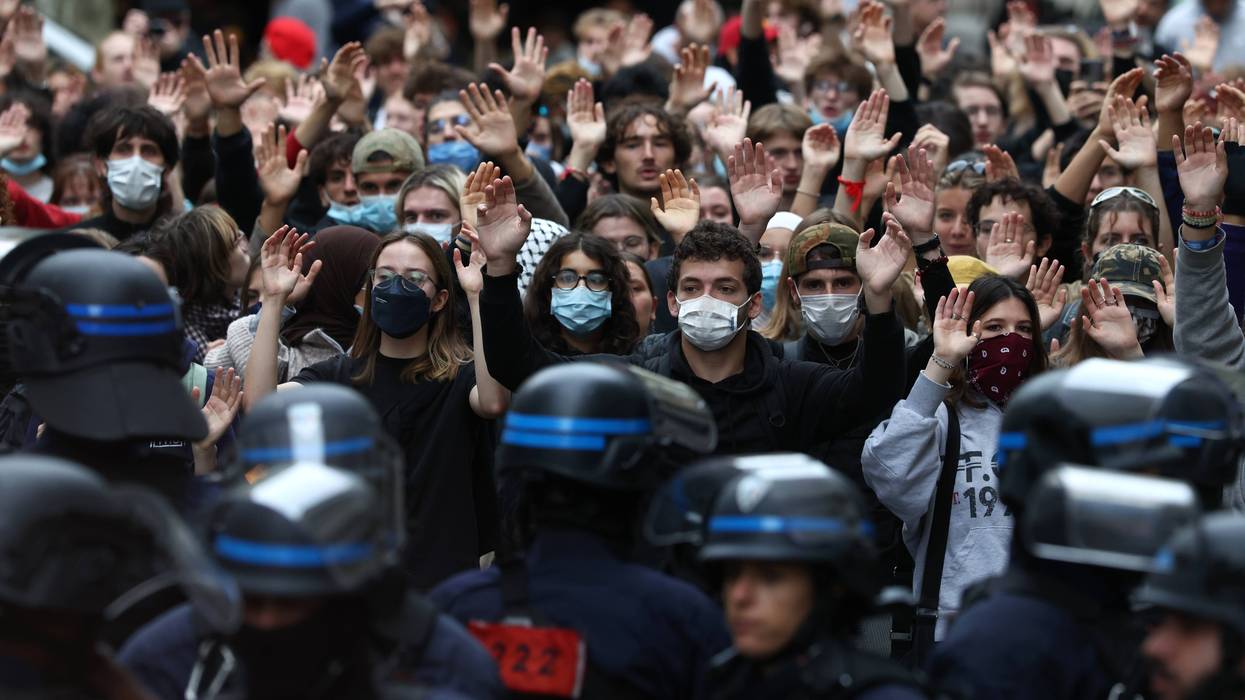
The banging of war drums in France and the student protests there for better schools bring to the fore the class interests of the rulers and the ruled.
A recent Al Jazeera piece entitled, “Can Protests in Europe Bring About Change?” is instructive. A guest from academia shared a key assumption behind the budget priorities of the Macron government in France, as high school students protested for improved learning and teaching conditions, amid a drop in living standards; the affordability crisis of rising fuel, food, and rent prices; and stagnating wages.
The economic crisis of neoliberal capitalism for the poor and working classes, with youth protesters pushing back against this order, is playing out in the streets of Austria, Belgium, France, Greece, Ireland, Italy, and Spain, along with Albania and Serbia (non-European Union nations). Back to “Can protests in Europe bring about change?” Rainbow Murray, a professor of politics at Queen Mary University of London, stated in the Al Jazeera piece that there are obstacles to the French government increasing its investments in public services such as education.
Why? The professor cited Russia's threat to France. The corporate and upper class control of the national government is not a threat to the working class majority, apparently.
The political donor class in France’s private sector benefits from Macron's budget priorities. High school students and their teachers don’t benefit. This contradiction seeks a resolution, one that is impossible to predict.
That ideology serves the economic interests of a tiny minority against a laboring many across neoliberal capitalist governments in the Global North. EU student protests for more government spending on public services such as education have no parallel in the US. American student protests that have come the closest to the French uprising have been walkouts against school shootings, such as the recent one in Bend, Oregon.
In the meantime, France is stepping up military spending to defend against apparent threats from Russia, despite or because of its war with Ukraine. President Emmanuel Macron has called for French rearmament to accelerate, doubling military spending in the 2027 budget from its level in 2017, when the first of his two terms began.
French high school students see their government’s funneling money into the military instead of their education as unacceptable. Students' rejection of that budget priority brings its importance to the national but also global radar screen. That's an important development, broadening the boundaries of the possible outcomes for the poor and working class across the Global North.
In the meantime, the political donor class in France’s private sector benefits from Macron's budget priorities. High school students and their teachers don’t benefit. This contradiction seeks a resolution, one that is impossible to predict.
It's easier to look back at government budget decisions. Here's one. “French carmaker Renault has agreed to cooperate with French defence company Turgis Gaillard to produce drones for Ukraine in a move supported by the French Ministry of Defence,” according to the Financial Times. For Renault, profits in drone making versus car making are fine.
Meanwhile, the Russian bear is threatening France. The same bear that lost 27 million people defeating the German Nazis in World War II also threatened the US during the Cold War. In both cases, a threat from Russia has fueled increased military spending.
The geopolitical context of France’s student protests is the unprovoked and unpopular US-Israel attack on Iran and Ukraine’s US- and NATO-backed war with Russia. Geopolitics flows from the profit interests of the domestic donor class. Look no farther than the tech billionaires profiting from fat government contracts after donating millions of dollars to the president, GOP politicians, and so-called opposition Democrats who support forever wars now and in the post-World War II past.
The banging of war drums in France and the student protests there for better schools bring to the fore the class interests of the rulers and the ruled. Will protests in Europe yield social change that improves the lives of protesters? To say that's a heavy lift is an understatement, given the resources that the prosperous few have—beginning with government violence, a fascist option—to maintain a status quo.
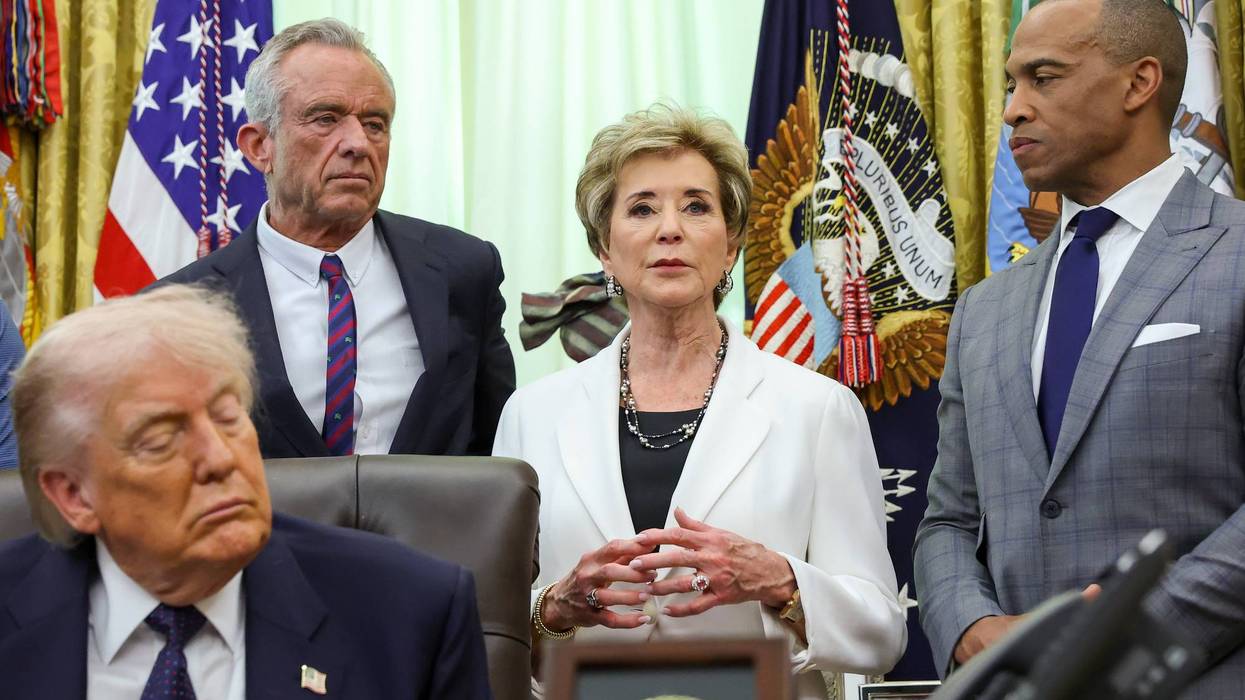
"It is unjustifiable to buy new furniture while students lose access to education services you are illegally dismantling and suffer from painful funding cuts."
Linda McMahon, President Donald Trump's billionaire education secretary, faced backlash on Wednesday over her plans to spend more than $43,000 of taxpayer money on new furniture for her government office as she works to illegally dismantle the department she leads, harming students across the country.
Democratic Sens. Patty Murray (Wash.) and Tammy Baldwin (Wis.) wrote in a letter to McMahon that "it is unjustifiable to buy new furniture while students lose access to education services you are illegally dismantling and suffer from painful funding cuts that were not authorized by Congress."
A senior official at the Education Department, whose staff has been gutted during Trump's second term, told The New York Times that the roughly $43,000 in costs "included a new desk, conference table, chairs and other items." The department informed lawmakers that existing furniture can't be "aesthetically integrated into the agency’s new office space"—a privately owned building that housed the US Agency for International Development before the Trump administration shut it down.
Murray and Baldwin wrote in their letter to McMahon, a former professional wrestling executive whose net worth is estimated to be around $3 billion, that "you have asked students, families, and teachers across the country to endure extraordinarily painful cuts in the name of 'fiscal responsibility,' and you have pushed out nearly half of the staff at the department in a chaotic, illegal campaign to fire employees tasked with protecting students with disabilities in the classroom and going after predatory student lenders."
"This year, you have asked Congress to slash funding for important K-12 programs and to cut funding for higher education programs by nearly $5 billion—including by destroying programs like TRIO and Federal Work Study," the senators added. "But it is clear that you do not think that you should have to abide by the same rules you want to apply to others."
The senators noted that as McMahon moves to spend taxpayer dollars on new furniture for her office, other department employees are working in spaces that have been deemed "unsafe and in disrepair, with water leaking from ceilings, mold in kitchens, extreme temperatures from a failing HVAC system, insect traps filled with dead bugs, and live insects in lactation rooms and work areas."
"The American people are sick of the corruption, sick of the waste, and sick of the hypocrisy coming out of all corners of this administration," Murray and Baldwin wrote. "They deserve a full accounting of how and why their tax dollars are being used to buy new office furniture for a secretary whose stated mission is to put themselves out of a job."
McMahon's office makeover plans were revealed days after reports indicated that she planned to remove the Federal Student Aid office from the Department of Education—without congressional approval—and create a new independent agency to manage roughly $1.6 trillion in debt owed by more than 40 million borrowers. The planned move marks the latest step in McMahon's push to effectively abolish the Education Department, fulfilling a Trump campaign promise.
Mike Pierce, executive director of the advocacy group Protect Borrowers, said in response that "changing the name on the agency letterhead will do nothing to lower costs for working-class families squeezed by rising student loan bills and surging college tuition."
"More than 3 million student loan borrowers defaulted on a loan last year, and more than 3 million more are on track to do the same this year," said Pierce. "Due to the Trump administration’s reckless actions, millions have seen their credit scores ruined. As a result, a generation of Americans will be locked out of the mortgage market, denied a typical car loan, and pay far more for a credit card because Linda McMahon cannot be bothered to fix the broken student loan system."
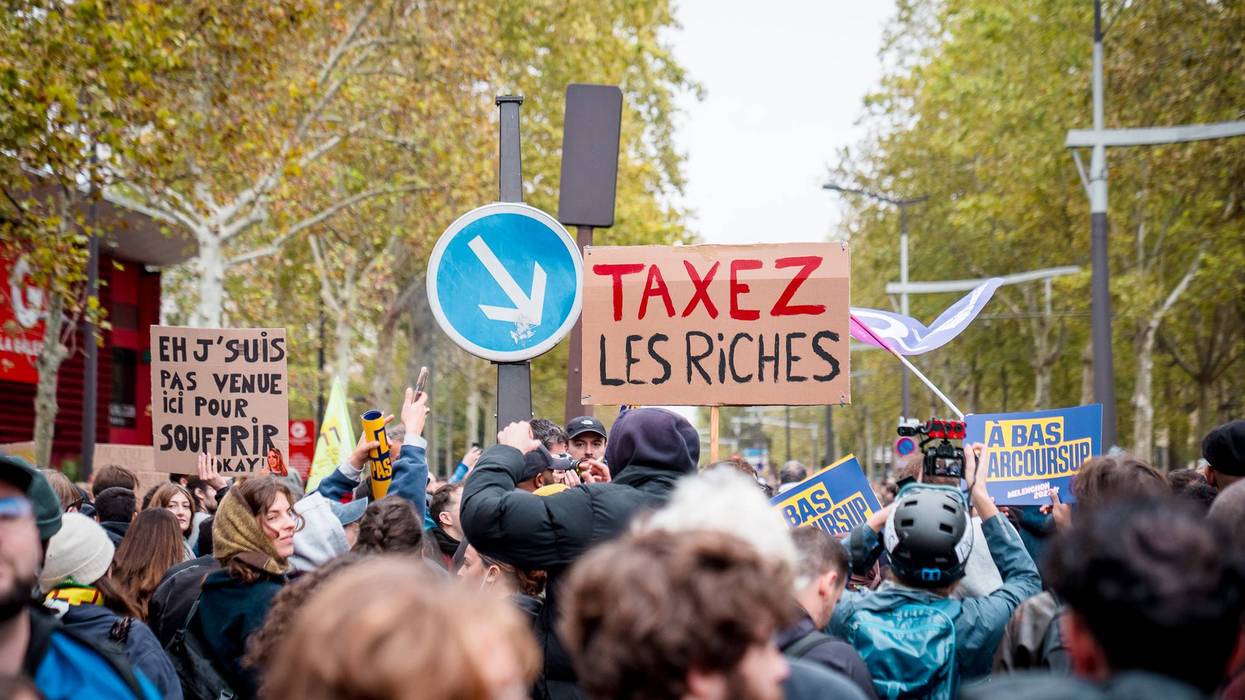
“Looking at countries like the United States, we don’t want to end up like them, where part of the population has everything and the others have nothing,” one French protester said.
Hundreds of thousands of people took to the streets across Europe on Saturday as anger continues to build over the rising cost of living and deteriorating social services.
While demonstrators emphasized different demands in different countries, the protest wave reflects a sense that the status quo has ceased to work for ordinary people, especially the young.
“I see so many more similarities than differences,” Alice de Brito, the vice president of French student union UNEF, told CNN of the protests. “We are all talking about the need for investments in education, in the universities, in youth in general. But we are also talking about the cost of living, about housing.”
Across France, between 410,000 and 800,000 people turned out in the continuation of protests that erupted in September when students began to mobilize against underfunding, teacher shortages, and other poor conditions in their schools. Adult workers have joined with the students, criticizing widespread inequality and the rising cost of living, leading to mass demonstrations on October 17 and again a week later.
“Looking at countries like the United States, we don’t want to end up like them, where part of the population has everything and the others have nothing,” Paris protester Louis Ledoux--Xatard told The Associated Press.
“Too many billionaires; we are preparing the revolution," one group of protesters chanted, according to Al Jazeera.
There were 289 protests in France, including in Marseilles, Nantes, Nice, Lyon, Bordeaux, and Orleans. Interior Minister Laurent Nunez said that almost 1,000 people were arrested, though the number was expected to grow. Two people sustained significant injuries.
"Behind every police officer, a compliant camera."
The protest in Paris had originally been scheduled to run through the center of the city, but authorities relocated it to outskirts and banned marches organized by groups other than unions.
"It won’t stop the movement. It won’t stop students from demanding better conditions in schools,” nurse Soumaya Abed told AP of the changes.
Jean-Luc Mélenchon, who leads the left-wing France Unbowed party, criticized the government of President Emmanuel Macron for changing the route, but also praised the marchers for carrying on.
"Total victory for the social movement," Mélenchon wrote on social media. "The march gathered at the new authorized point and is now flowing calmly over more than four kilometers. The provocations for disorder by the Paris police prefect and [French Prime Minister Sébastien] Lecornu are a total failure. For the authorities, it is time to give in, or soon they will have only the exit door left."
Victoire totale du mouvement social. La marche s'est rassemblée au nouveau point autorisé et déferle dans le calme sur plus de quatre kilomètres. Les provocations aux désordres du préfet de police et de Lecornu sont un échec total. Pour les autorités, il est temps de céder, sinon il ne leur restera bientôt que la porte de sortie.
— Jean-Luc Mélenchon (@JLMelenchon) October 24, 2026
Media reported that the Parisian demonstration was largely peaceful until the end, when police released tear gas and fired water cannons and some black-clad protesters threw projectiles.
Reporters with Agence France-Presse said they saw:
police charge several times and vigorously use tear gas and batons against some, mostly young, protesters.
"The police started moving towards everyone, telling them to get down and back off. They were just taking people down, you know, beating protesters," one demonstrator bleeding from a baton blow to his face, who gave his first name as David, told AFP.
Other witnesses also described a repressive police response to The Guardian:
Mike, a 23-year-old student who also declined to give his surname, said: “Look around, they’re just teenagers. Is it normal for teenagers to be teargassed and beaten with batons?”
For Jessica, a 24-year-old student, said: “I just don’t understand why there’s so much violence. I feel like our right to protest is being trampled on.”
Mélenchon lambasted the police and the media for working together to discredit the movement.
"In Paris, to ruin the day and unwind, the so-called forces of law and order gas and fire into the crowd at the back of the procession, all in a bid to get footage for the domestic news channels that spent the whole week airing the images that spurred the Trappes killer," he wrote on social media, referring to a racially motivated shooting west of Paris on Friday that killed one and wounded five.
In a second post, he added: "It continues with the policing of minds through the televisions of power. Tonight, staging of the « tails of the procession » to spew hatred against the popular movement. Without a single image of the masses in peaceful action. Behind every police officer, a compliant camera."
He encouraged readers to "turn off the televisions! Form your own opinion without a guardian. Journey through social networks. Stay free to think for yourselves."
In neighboring Belgium, hundreds of people marched in Brussels in a continuation of demonstrations for improvements in the education system.
“We are here for young people’s future, for better work," rally speaker Celia Ponce told the crowd, as The Brussels Times reported.
She also accused governments of wanting to "destroy public services."
Protesters build barricades with bikes and scooters in Brussels, Belgium.Follow Press TV on Telegram: https://t.co/1ymjeeywxb https://t.co/TtQNj1BQYU
— PressTV Extra (@PresstvExtra) October 24, 2026
Police used tear gas to disperse some protesters and, in an incident reported by Reuters, kicked and hit one demonstrator after they fell during a chase.
Approximately 25,000 people marched in Madrid to support Spain's pension system and demand that it keep pace with inflation and that a gender gap be eliminated, according to Al Jazeera.
"How beautiful Madrid is when it defends its rights," Emilio Delgado, deputy spokesperson for left party Mas Madrid, wrote on social media. "We propose that no pension should be below the minimum wage. A lifetime of work deserves a dignified retirement."
Un aviso a @NunezFeijoo: No vamos a permitir que recortéis las pensiones. https://t.co/lQ7V0cQomZ
— Emilio Delgado (@EmilioDelgadoOr) October 24, 2026
The protests come a month ahead of Spain's general election, in which current Prime Minister Pedro Sanchez's Spanish Socialist Workers' Party will face off against the right-wing Popular Party. Popular Party leader Alberto Nunez Feijoo has promised to adjust pensions according to inflation if his party wins, but demonstrators are still concerned about what a right-wing victory would mean for the pension system.
In Portugal, meanwhile, the main demand was affordable housing.
People marched in Lisbon, continuing a movement that began October 10 in the city of Porto calling on the government to address the country's housing crisis, according to The Resident.
Palco dos protestos promovidos pelo movimento Acampada de Lisboa, o Rossio voltou a acolher "um mar de gente" que reivindica soluções do Governo para a atual crise da habitação.Veja a reportagem em direto no local: https://t.co/gpSIyl2mLr#agitacaosocial #europa #protestos #manifestacoes #lisboa #rossio #pais #portugal #habitacao #custodevida #noticias #sicnoticias
— SIC Notícias (@SICNoticias) October 24, 2026
"We have no home, so we set up tents!” read the slogan of the March, organized by the Acampada de Lisboa movement.
The protesters also opposed new policies from Prime Minister Luis Montenegro that would weaken a limit on annual rent increases and make it easier to evict people who are unable to make rent payments, according to AP.
Thousands of people joined demonstrations across Italy to protest the affordability crisis as well as the right-wing government of Prime Minister Giorgia Meloni. Protests were called for eight cities including Milan, Turin, and Rome, with 10,000 attending the Milan demonstration alone.
“We are here because of the rising prices and because I believe that our government has no respect for its citizens,” a 17-year-old student participant, who did not give a name, told Al Jazeera. “There are four people in my family. My mother works in a factory, but my father is about to lose his job. It’s hard to make ends meet on just one salary."
Thousands of protesters took to the streets across Italy to demonstrate against Giorgia Meloni’s right-wing government and the rising cost of living, as hundreds of soldiers were deployed to Milan as protests continue.🔗: https://t.co/JquqwnAyhj https://t.co/B97TnZaY9L
— Al Jazeera English (@AJEnglish) October 24, 2026
The Italian protests were a continuation of demonstrations that have taken place throughout October. There were fewer clashes between police and demonstrators on Saturday compared with earlier marches, though some protesters tried to enter the Colosseum before being pushed back.
In Albania, outrage over plans by US President Donald Trump's son-in-law Jared Kushner to build a luxury resort near a protected wildlife area—which is widely seen as an example of government corruption—has dovetailed with demands by students for less corruption in the education system specifically as well as lower tuition fees and more funding.
A demonstration in the capital of Tirana on Saturday marked the 12th day of anti-government protests this month following a summer of mobilizations against the luxury hotel.
Some protesters lit fires and threw projectiles, while police used tear gas, rubber bullets, and water cannons.
Protesters in Albania have fought running battles with police, on a 12th day of anti-government protests. Police in the capital, Tirana, used water cannon, tear gas and rubber bullets after Prime Minister Edi Rama warned he would take strong action to quell unrest. https://t.co/6oZMYPU7Ei
— Al Jazeera English (@AJEnglish) October 24, 2026
One demonstrator, the 28-year-old Daniel Tahiri, told Reuters that the Albanian government was a "dictatorship with the clothes of democracy."
"Albanians have woken up," Tahiri said.