

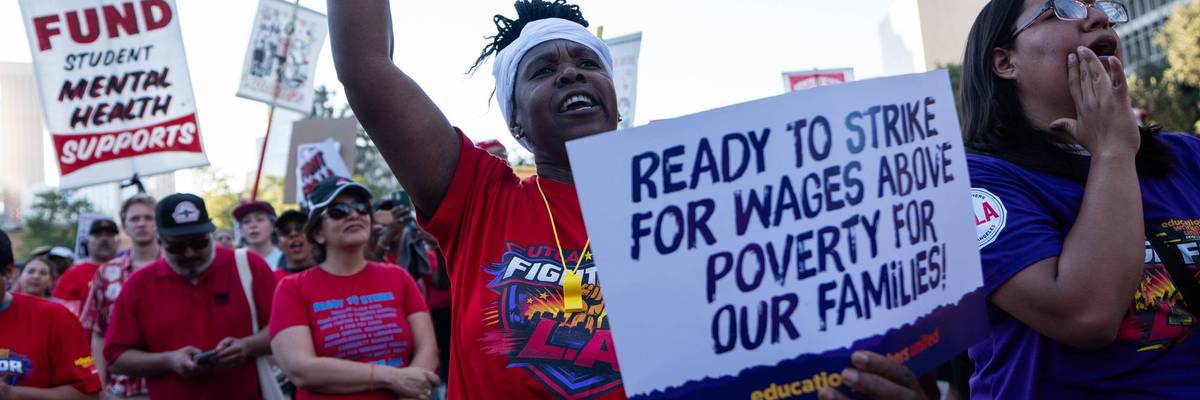
Thousands of teachers and staff go on strike during a rally outside the City Hall on March 18, 2026 in Los Angeles, California, as United Teachers Los Angeles and Local 99 service workers announced members would strike on April 14 if no deal is reached before then.
The Lesson From the LA Teachers' Win: There Is Money to Pay Educators If We Demand It
For too long, the narrative has been that we cannot afford to support teachers. We’ve just shown we cannot afford not to.
Before stepping into the classroom, I spent 12 years as an investigator with the California State Bar, examining cases of attorney misconduct. I chose to teach because I saw a meaningful way to serve my community, and I understood there would be sacrifice. Still, it took 10 years before my salary caught up to what I earned in my final year as an investigator.
In California, becoming an educator is neither easy nor inexpensive. In fact, it is one of the most challenging states to obtain a teaching license. Despite this, teachers remain among the most underpaid professionals relative to their level of education. According to the US Census Bureau, teacher earnings have not only lagged behind comparable fields, but have experienced a steady annual decline.
The debate is not whether schools have enough money, it is about what we choose to spend it on. Today, many educators cannot afford to live where they teach. Teaching, while never lucrative, used to offer a stable path to a middle class life. Educators could buy a home, live in the communities where they worked, and maintain the financial stability expected of other professions with similar levels of education. Sadly, even the most modest of those expectations are rapidly disappearing. I only own a home because I purchased it prior to switching my career.
Most educators did not choose this career for the money, but there is a clear difference between modest compensation and exploitation. Nearly 1 in 5 teachers in Los Angeles are housing insecure. And nearly 60% of educators across the country take on second jobs outside of teaching to make ends meet. It is unacceptable that the people responsible for educating our children are struggling to hold their head above water.
These victories for Los Angeles educators are not perks. They are the foundation of a functioning school system, and a respected career.
Teachers are also expected to subsidize their classrooms out of their own pockets. These stories are often framed as heartwarming and altruistic, but they reflect systemic failure and a lack of meaningful investment in public education. Few other professions require employees to pay out of pocket while already being underpaid.
The consequences of this underinvestment are becoming impossible to ignore. As the cost of living rises, fewer educators can afford to remain in the classroom. A teacher shortage has already hit Southern California, and the impact is profound. Nationally, teaching shortages have led to larger class sizes, burnout, and financial strain on the education system.
Education is expected to operate in scarcity while other sectors experience enormous growth. The education technology market alone is projected to grow by $170.8 billion by 2029. In the Los Angeles Unified School District alone, more than $1.6 billion has been spent on edtech. Framing this as a funding problem misses the point; it is a question of priorities. We are told we can’t make investments in educators, while billions continue to flow toward technology and outside contracts instead of the classrooms they are meant to serve.
And yet, during recent labor negotiations in Los Angeles, we were told a familiar refrain: There is no money.
This was the backdrop of three educational unions, representing more than 70,000 workers, on the brink of striking across Los Angeles. At the center of the dispute for United Teachers Los Angeles was a straightforward demand: a salary structure that reflects economic reality. As negotiations stretched over 14 months, frustration grew not only among educators but across school communities, culminating in escalating public pressure, organizing efforts at school sites, and an overwhelming strike authorization vote that made clear teachers were prepared to act if necessary.
Only when the possibility of a strike became real did the district return to the table with urgency. We ultimately won the majority of our demands, including overhauling the outdated pay system that kept incoming educators at artificially low salaries, raising the starting salary from $68,966 to $77,000 for teachers, and securing an average salary increase of 13.86% across the board. This is evidence that the “no money” claim is negotiable, not factual.
Just as significantly, for the first time in California, educators in Los Angeles have secured four weeks of paid parental leave. This is a historic breakthrough that now sets a precedent for teachers across the state of California, as well as the entire country. Additionally, we won a major expansion of student support, including more than 450 additional social workers, to address the growing mental health crisis among our youth.
These victories for Los Angeles educators are not perks. They are the foundation of a functioning school system, and a respected career.
When teachers are paid a living wage, they stay. When they can afford to live in the communities they serve, schools are more stable. And when students have access to trained mental health professionals, they are better able to learn. Investment is what makes public schools strong. Without it, everything else collapses.
For too long, the narrative has been that we cannot afford to support teachers. We’ve just shown we cannot afford not to. The lesson from Los Angeles is simple: School funding is not fixed by scarcity, but by priorities. And when educators and school workers organize, those priorities can change—for the better.
We are at a crossroads
This country and this world are at a monumental crossroads. In a few short weeks, US voters will have an opportunity to beat back the forces of fascism and confront the billionaires who are rigging the economy, our media system, and our democracy, making it increasingly impossible for ordinary people to get by. We’re not just talking about the election. We’re talking about what must be done once these fascist elements are vanquished from power. We need a bolder set of solutions than what either major party has so far been willing to offer and a working-class movement ready to fight like hell for it. Trump didn't emerge from nowhere. The conditions that fueled MAGA authoritarianism were created by decades of radical neoliberal economic policies and a corrupt political system dominated by corporate interests. They slashed taxes on the super-rich, promising that the benefits would trickle down. They said giveaways to the corporate titans would make life more affordable for the rest of us. It was all bullshit. And when a bitter, betrayed populace searches for someone to blame, right-wing demagogues have little trouble finding scapegoats. People know when they're being lied to, but you won't hear any of this from the corporate media. Only independent journalism—powered and funded by people who believe in building a better world—can deliver truly trustworthy daily news. Our Fall Campaign is underway, and we need your help. To power our newsroom through the rest of the year, we need to raise $125,000 by midnight on October 31. So if you share our vision, please contribute whatever you can to sustain our work. |
Before stepping into the classroom, I spent 12 years as an investigator with the California State Bar, examining cases of attorney misconduct. I chose to teach because I saw a meaningful way to serve my community, and I understood there would be sacrifice. Still, it took 10 years before my salary caught up to what I earned in my final year as an investigator.
In California, becoming an educator is neither easy nor inexpensive. In fact, it is one of the most challenging states to obtain a teaching license. Despite this, teachers remain among the most underpaid professionals relative to their level of education. According to the US Census Bureau, teacher earnings have not only lagged behind comparable fields, but have experienced a steady annual decline.
The debate is not whether schools have enough money, it is about what we choose to spend it on. Today, many educators cannot afford to live where they teach. Teaching, while never lucrative, used to offer a stable path to a middle class life. Educators could buy a home, live in the communities where they worked, and maintain the financial stability expected of other professions with similar levels of education. Sadly, even the most modest of those expectations are rapidly disappearing. I only own a home because I purchased it prior to switching my career.
Most educators did not choose this career for the money, but there is a clear difference between modest compensation and exploitation. Nearly 1 in 5 teachers in Los Angeles are housing insecure. And nearly 60% of educators across the country take on second jobs outside of teaching to make ends meet. It is unacceptable that the people responsible for educating our children are struggling to hold their head above water.
These victories for Los Angeles educators are not perks. They are the foundation of a functioning school system, and a respected career.
Teachers are also expected to subsidize their classrooms out of their own pockets. These stories are often framed as heartwarming and altruistic, but they reflect systemic failure and a lack of meaningful investment in public education. Few other professions require employees to pay out of pocket while already being underpaid.
The consequences of this underinvestment are becoming impossible to ignore. As the cost of living rises, fewer educators can afford to remain in the classroom. A teacher shortage has already hit Southern California, and the impact is profound. Nationally, teaching shortages have led to larger class sizes, burnout, and financial strain on the education system.
Education is expected to operate in scarcity while other sectors experience enormous growth. The education technology market alone is projected to grow by $170.8 billion by 2029. In the Los Angeles Unified School District alone, more than $1.6 billion has been spent on edtech. Framing this as a funding problem misses the point; it is a question of priorities. We are told we can’t make investments in educators, while billions continue to flow toward technology and outside contracts instead of the classrooms they are meant to serve.
And yet, during recent labor negotiations in Los Angeles, we were told a familiar refrain: There is no money.
This was the backdrop of three educational unions, representing more than 70,000 workers, on the brink of striking across Los Angeles. At the center of the dispute for United Teachers Los Angeles was a straightforward demand: a salary structure that reflects economic reality. As negotiations stretched over 14 months, frustration grew not only among educators but across school communities, culminating in escalating public pressure, organizing efforts at school sites, and an overwhelming strike authorization vote that made clear teachers were prepared to act if necessary.
Only when the possibility of a strike became real did the district return to the table with urgency. We ultimately won the majority of our demands, including overhauling the outdated pay system that kept incoming educators at artificially low salaries, raising the starting salary from $68,966 to $77,000 for teachers, and securing an average salary increase of 13.86% across the board. This is evidence that the “no money” claim is negotiable, not factual.
Just as significantly, for the first time in California, educators in Los Angeles have secured four weeks of paid parental leave. This is a historic breakthrough that now sets a precedent for teachers across the state of California, as well as the entire country. Additionally, we won a major expansion of student support, including more than 450 additional social workers, to address the growing mental health crisis among our youth.
These victories for Los Angeles educators are not perks. They are the foundation of a functioning school system, and a respected career.
When teachers are paid a living wage, they stay. When they can afford to live in the communities they serve, schools are more stable. And when students have access to trained mental health professionals, they are better able to learn. Investment is what makes public schools strong. Without it, everything else collapses.
For too long, the narrative has been that we cannot afford to support teachers. We’ve just shown we cannot afford not to. The lesson from Los Angeles is simple: School funding is not fixed by scarcity, but by priorities. And when educators and school workers organize, those priorities can change—for the better.
- Tens of Thousands of LA Teachers to Strike in Solidarity With Support Workers ›
- Teachers Union Leaders on Chicago Charter School Strike Victory ›
- After Historic Union-Backed Strike, Chicago Charter School Teachers Celebrate New Contract as Win for Students ›
- LA Teachers Union: No Endorsements for Genocide Enablers ›
- 'When We Fight, We Win!': LA School Workers Secure Deal After 3-Day Strike ›
- 'Historic Day for American Unions': Los Angeles Teachers Strike Earns Victory for Labor, Public Education ›
Before stepping into the classroom, I spent 12 years as an investigator with the California State Bar, examining cases of attorney misconduct. I chose to teach because I saw a meaningful way to serve my community, and I understood there would be sacrifice. Still, it took 10 years before my salary caught up to what I earned in my final year as an investigator.
In California, becoming an educator is neither easy nor inexpensive. In fact, it is one of the most challenging states to obtain a teaching license. Despite this, teachers remain among the most underpaid professionals relative to their level of education. According to the US Census Bureau, teacher earnings have not only lagged behind comparable fields, but have experienced a steady annual decline.
The debate is not whether schools have enough money, it is about what we choose to spend it on. Today, many educators cannot afford to live where they teach. Teaching, while never lucrative, used to offer a stable path to a middle class life. Educators could buy a home, live in the communities where they worked, and maintain the financial stability expected of other professions with similar levels of education. Sadly, even the most modest of those expectations are rapidly disappearing. I only own a home because I purchased it prior to switching my career.
Most educators did not choose this career for the money, but there is a clear difference between modest compensation and exploitation. Nearly 1 in 5 teachers in Los Angeles are housing insecure. And nearly 60% of educators across the country take on second jobs outside of teaching to make ends meet. It is unacceptable that the people responsible for educating our children are struggling to hold their head above water.
These victories for Los Angeles educators are not perks. They are the foundation of a functioning school system, and a respected career.
Teachers are also expected to subsidize their classrooms out of their own pockets. These stories are often framed as heartwarming and altruistic, but they reflect systemic failure and a lack of meaningful investment in public education. Few other professions require employees to pay out of pocket while already being underpaid.
The consequences of this underinvestment are becoming impossible to ignore. As the cost of living rises, fewer educators can afford to remain in the classroom. A teacher shortage has already hit Southern California, and the impact is profound. Nationally, teaching shortages have led to larger class sizes, burnout, and financial strain on the education system.
Education is expected to operate in scarcity while other sectors experience enormous growth. The education technology market alone is projected to grow by $170.8 billion by 2029. In the Los Angeles Unified School District alone, more than $1.6 billion has been spent on edtech. Framing this as a funding problem misses the point; it is a question of priorities. We are told we can’t make investments in educators, while billions continue to flow toward technology and outside contracts instead of the classrooms they are meant to serve.
And yet, during recent labor negotiations in Los Angeles, we were told a familiar refrain: There is no money.
This was the backdrop of three educational unions, representing more than 70,000 workers, on the brink of striking across Los Angeles. At the center of the dispute for United Teachers Los Angeles was a straightforward demand: a salary structure that reflects economic reality. As negotiations stretched over 14 months, frustration grew not only among educators but across school communities, culminating in escalating public pressure, organizing efforts at school sites, and an overwhelming strike authorization vote that made clear teachers were prepared to act if necessary.
Only when the possibility of a strike became real did the district return to the table with urgency. We ultimately won the majority of our demands, including overhauling the outdated pay system that kept incoming educators at artificially low salaries, raising the starting salary from $68,966 to $77,000 for teachers, and securing an average salary increase of 13.86% across the board. This is evidence that the “no money” claim is negotiable, not factual.
Just as significantly, for the first time in California, educators in Los Angeles have secured four weeks of paid parental leave. This is a historic breakthrough that now sets a precedent for teachers across the state of California, as well as the entire country. Additionally, we won a major expansion of student support, including more than 450 additional social workers, to address the growing mental health crisis among our youth.
These victories for Los Angeles educators are not perks. They are the foundation of a functioning school system, and a respected career.
When teachers are paid a living wage, they stay. When they can afford to live in the communities they serve, schools are more stable. And when students have access to trained mental health professionals, they are better able to learn. Investment is what makes public schools strong. Without it, everything else collapses.
For too long, the narrative has been that we cannot afford to support teachers. We’ve just shown we cannot afford not to. The lesson from Los Angeles is simple: School funding is not fixed by scarcity, but by priorities. And when educators and school workers organize, those priorities can change—for the better.
- Tens of Thousands of LA Teachers to Strike in Solidarity With Support Workers ›
- Teachers Union Leaders on Chicago Charter School Strike Victory ›
- After Historic Union-Backed Strike, Chicago Charter School Teachers Celebrate New Contract as Win for Students ›
- LA Teachers Union: No Endorsements for Genocide Enablers ›
- 'When We Fight, We Win!': LA School Workers Secure Deal After 3-Day Strike ›
- 'Historic Day for American Unions': Los Angeles Teachers Strike Earns Victory for Labor, Public Education ›