SUBSCRIBE TO OUR FREE NEWSLETTER
Daily news & progressive opinion—funded by the people, not the corporations—delivered straight to your inbox.
5
#000000
#FFFFFF
To donate by check, phone, or other method, see our More Ways to Give page.
Daily news & progressive opinion—funded by the people, not the corporations—delivered straight to your inbox.
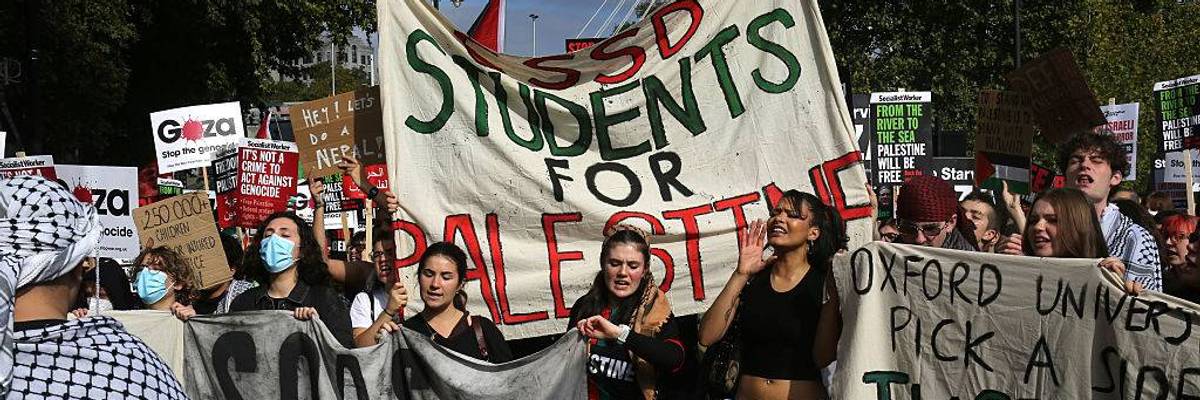
Protesters from the student block prepare to march along the Embankment holding signs and a giant flag during a protest on October 11, 2025 in London, England.
"We knew surveillance was happening by the university, but it is shocking to see how systematized it is," said one student.
A dozen universities in the UK are facing criticism after a joint investigation by Al Jazeera English and Liberty Investigates revealed they hired a security firm run by former military intelligence agents to spy on pro-Palestinian student demonstrators.
Specifically, Al Jazeera English and Liberty Investigates reported they have "uncovered evidence that Horus Security Consultancy Limited trawled through student social media feeds and conducted secret counterterror threat assessments on behalf of some of Britain’s most elite institutions," including the University of Oxford, Imperial College London, University College London.
The investigation found that Horus has been paid $594,000 by the universities since 2022, and it has been asked to monitor targets ranging from a Palestinian academic giving a guest lecture at Manchester Metropolitan University to entire groups of pro-Palestinian organizations at the University of Bristol.
Many of the universities implicated in the investigation declined comment. Imperial College London, however, denied that it paid Horus to spy on its students, and said it merely wanted to "help identify potential security risks to its community, which might include protest activity within the vicinity of its campuses."
This rationale failed to satisfy critics, however.
Gina Romero, the United Nations special rapporteur for freedom of peaceful assembly and of association, told Al Jazeera English and Liberty Investigates that “the use of AI to harvest and analyze student data under the guise of open-source intelligence raises profound legal concerns.”
Romero expressed particular concern that Horus is not accountable to any public scrutiny, and that students have no way to know how the data collected from them will be used in the future.
Lizzie Hobbs, a PhD student at the London School of Economics who has taken part in pro-Palestinian protests, said it was "deeply scary" to see universities invest money in surveilling their own students.
"We knew surveillance was happening by the university," she said, "but it is shocking to see how systematized it is."
Jo Grady, general secretary for the University and College Union, slammed the schools' "shameful" actions and said they had "wasted hundreds of thousands of pounds spying on their own students."
Journalist Mushahid Hussain Sayed also described the universities' actions as "shameful," adding that they discriminated "against students and academics on the basis of their peaceful political beliefs/activism in support of Palestine and against Israel!"
Dear Common Dreams reader, It’s been nearly 30 years since I co-founded Common Dreams with my late wife, Lina Newhouser. We had the radical notion that journalism should serve the public good, not corporate profits. It was clear to us from the outset what it would take to build such a project. No paid advertisements. No corporate sponsors. No millionaire publisher telling us what to think or do. Many people said we wouldn't last a year, but we proved those doubters wrong. Together with a tremendous team of journalists and dedicated staff, we built an independent media outlet free from the constraints of profits and corporate control. Our mission has always been simple: To inform. To inspire. To ignite change for the common good. Building Common Dreams was not easy. Our survival was never guaranteed. When you take on the most powerful forces—Wall Street greed, fossil fuel industry destruction, Big Tech lobbyists, and uber-rich oligarchs who have spent billions upon billions rigging the economy and democracy in their favor—the only bulwark you have is supporters who believe in your work. But here’s the urgent message from me today. It's never been this bad out there. And it's never been this hard to keep us going. At the very moment Common Dreams is most needed, the threats we face are intensifying. We need your support now more than ever. We don't accept corporate advertising and never will. We don't have a paywall because we don't think people should be blocked from critical news based on their ability to pay. Everything we do is funded by the donations of readers like you. When everyone does the little they can afford, we are strong. But if that support retreats or dries up, so do we. Will you donate now to make sure Common Dreams not only survives but thrives? —Craig Brown, Co-founder |
A dozen universities in the UK are facing criticism after a joint investigation by Al Jazeera English and Liberty Investigates revealed they hired a security firm run by former military intelligence agents to spy on pro-Palestinian student demonstrators.
Specifically, Al Jazeera English and Liberty Investigates reported they have "uncovered evidence that Horus Security Consultancy Limited trawled through student social media feeds and conducted secret counterterror threat assessments on behalf of some of Britain’s most elite institutions," including the University of Oxford, Imperial College London, University College London.
The investigation found that Horus has been paid $594,000 by the universities since 2022, and it has been asked to monitor targets ranging from a Palestinian academic giving a guest lecture at Manchester Metropolitan University to entire groups of pro-Palestinian organizations at the University of Bristol.
Many of the universities implicated in the investigation declined comment. Imperial College London, however, denied that it paid Horus to spy on its students, and said it merely wanted to "help identify potential security risks to its community, which might include protest activity within the vicinity of its campuses."
This rationale failed to satisfy critics, however.
Gina Romero, the United Nations special rapporteur for freedom of peaceful assembly and of association, told Al Jazeera English and Liberty Investigates that “the use of AI to harvest and analyze student data under the guise of open-source intelligence raises profound legal concerns.”
Romero expressed particular concern that Horus is not accountable to any public scrutiny, and that students have no way to know how the data collected from them will be used in the future.
Lizzie Hobbs, a PhD student at the London School of Economics who has taken part in pro-Palestinian protests, said it was "deeply scary" to see universities invest money in surveilling their own students.
"We knew surveillance was happening by the university," she said, "but it is shocking to see how systematized it is."
Jo Grady, general secretary for the University and College Union, slammed the schools' "shameful" actions and said they had "wasted hundreds of thousands of pounds spying on their own students."
Journalist Mushahid Hussain Sayed also described the universities' actions as "shameful," adding that they discriminated "against students and academics on the basis of their peaceful political beliefs/activism in support of Palestine and against Israel!"
A dozen universities in the UK are facing criticism after a joint investigation by Al Jazeera English and Liberty Investigates revealed they hired a security firm run by former military intelligence agents to spy on pro-Palestinian student demonstrators.
Specifically, Al Jazeera English and Liberty Investigates reported they have "uncovered evidence that Horus Security Consultancy Limited trawled through student social media feeds and conducted secret counterterror threat assessments on behalf of some of Britain’s most elite institutions," including the University of Oxford, Imperial College London, University College London.
The investigation found that Horus has been paid $594,000 by the universities since 2022, and it has been asked to monitor targets ranging from a Palestinian academic giving a guest lecture at Manchester Metropolitan University to entire groups of pro-Palestinian organizations at the University of Bristol.
Many of the universities implicated in the investigation declined comment. Imperial College London, however, denied that it paid Horus to spy on its students, and said it merely wanted to "help identify potential security risks to its community, which might include protest activity within the vicinity of its campuses."
This rationale failed to satisfy critics, however.
Gina Romero, the United Nations special rapporteur for freedom of peaceful assembly and of association, told Al Jazeera English and Liberty Investigates that “the use of AI to harvest and analyze student data under the guise of open-source intelligence raises profound legal concerns.”
Romero expressed particular concern that Horus is not accountable to any public scrutiny, and that students have no way to know how the data collected from them will be used in the future.
Lizzie Hobbs, a PhD student at the London School of Economics who has taken part in pro-Palestinian protests, said it was "deeply scary" to see universities invest money in surveilling their own students.
"We knew surveillance was happening by the university," she said, "but it is shocking to see how systematized it is."
Jo Grady, general secretary for the University and College Union, slammed the schools' "shameful" actions and said they had "wasted hundreds of thousands of pounds spying on their own students."
Journalist Mushahid Hussain Sayed also described the universities' actions as "shameful," adding that they discriminated "against students and academics on the basis of their peaceful political beliefs/activism in support of Palestine and against Israel!"