SUBSCRIBE TO OUR FREE NEWSLETTER
Daily news & progressive opinion—funded by the people, not the corporations—delivered straight to your inbox.
5
#000000
#FFFFFF
To donate by check, phone, or other method, see our More Ways to Give page.


Daily news & progressive opinion—funded by the people, not the corporations—delivered straight to your inbox.
These numbers are so dramatic that they argue for a reboot of the Trump administration’s economic messaging.
Polling released by the AP/NORC on December 11 shows that the bottom has fallen out for President Donald Trump on his job performance on the economy. Just under a third (31%) approve of Trump’s work on the economy. This is a nine-point drop and is the lowest that the AP/NORC has recorded in either Trump’s first or second terms. Fully 80% of Independent voters give Trump negative scores on his economic stewardship. As you could have guessed, Democrats are nearly unanimous in giving Trump failing grades on the economy (93%). What is quite significant is that 29% of Republicans give Trump failing grades on the economy.
Voters’ perceptions of the economy are also very pessimistic. Overall, 68% say that the economy is in poor shape. Both Democrats (84%) and Independents (80%). Republicans offer a more mixed picture (56% good, 44% poor).
The most significant part of the AP/NORC findings is not Trump’s scores on the economy as they have been poor for some time. What is striking is that on his two signature issues of crime and immigration, Trump fares very poorly. Fully 60% of voters disapprove of Trump’s work on immigration including 70% of Independents. Trump’s grades on immigration are boosted by his GOP support (80% approve, 19% disapprove).
Only in relative terms, does Trump fare better on the issue of crime. Forty-three (43%) approve. Two-thirds (66%) of Independents give Trump failing grades on the economy. As was the case with immigration, Trump’s scores on crime are boosted by his strong support among Republicans (80% approve, 19% disapprove).
If the Trump administration is looking at the data honestly, they must be troubled that Independents and Democratic are on question after questions almost in alignment on their negative assessment of Trump’s job as president.
There is literally no good news for Trump or for that matter the GOP in the AP/NORC polling. These numbers are so dramatic that they argue for a reboot of the Trump administration’s economic messaging. Trump’s ratings on crime and immigration are a real problem, but what really threatens Trump are voters’ perceptions of his economic stewardship. Trump won the presidency in large part because voters thought that he would do a better job on the economy than Vice President Kamala Harris.
Rather than change course on the economy, the Trump administration seems likely to continue to blame the Biden administration for the state of the economy. There is nothing in polling data that would indicate that this will work. Furthermore, Trump’s remarks in Pennsylvania on December 9 also indicate that he is not aware or willing to accept voters’ perceptions of his handling of the economy. This is a clear warning sign of a Democratic landslide in 2026.
Focusing only on GOP voters distorts Trump’s real standing, and his party's chances heading into the midterms.
The New York Times is an incredibly reliable source for anyone seeking to understand the world we live in. In addition, the Times’ polling partner Sienna College is one of the best and most accurate polling organization. So, I was shocked by the analysis in an article “After Volatile Summer, Trump’s Approval Remains Low but Stable, Poll Finds” by Shane Goldmacher and Ruth Igielnik. In their article, Goldmacher and Igielnik argue that:
President Trump’s efforts to send National Guard troops to big cities, punish media organizations, and pressure universities and private businesses are all unpopular with voters. But the continued torrent of policies and tactics has not further weakened Mr. Trump’s overall standing, according to a new poll from The New York Times and Siena University. Instead, Mr. Trump continues to retain the support of roughly nine out of 10 Republican voters. The net result: an unpopular president with an unchanged approval rating of 43 percent.
Now, in all fairness, the Times’ reporting is technically correct. However, it misses the real point: Independent voters have abandoned US President Donald Trump. Saying that Trump is unpopular, but his approval rating is stable is like saying that a student is getting a C minus grade, but he or she has not fallen to a D plus. Let’s look a little deeper into the Times/Sienna College polling.
As the Times reported, 68% of Republican voters strongly approve of Trump’s job performance. On the other hand, 86% of Democrats and 50% of Independent voters strongly disapprove of Trump’s job performance. Furthermore, just under 1 in 3 of Trump’s base, white non-college voters (31%) strongly disapprove of Trump’s job performance.
Overall, 45% of registered voters say that Trump has made the economy worse while 32% say better and 20% are not sure. A 48% plurality of Independent voters think that Trump has made the economy worse. As other polling has found, Trump’s standing with Hispanic voters continues to drop. The Times/Sienna polling finds that fully 58% of Hispanic voters think Trump has made the economy worse.
Rather than drawing the conclusion that “Trump’s polling is bad, but stable,” the Times could have concluded that: “Fully 43 percent of registered voters strongly disapprove of Trump’s performance on his key signature issue of immigration.” The second paragraph of the Times story could have easily argued that “Just 39 percent of Independents approve of Trump’s job performance on immigration.”
Another key point that the Times missed was that among Independent voters, a 49% plurality say they would vote for the Democratic candidate for Congress, while 39% say the GOP and 12% are undecided. While the 2026 midterms are a long time for now and lots of things cad and will happen, a 10-point advantage for a generic Democrat is a substantial advantage.
Thus, while it may be true that Trump’s poll numbers have stabilized, they have stabilized at a very low level. Voters are critical of Trump’s stewardship of the economy and far from impressed on his key signature issue of immigration. In what may be the most important piece of data from the Times/Sienna polling, looking toward the 2026 midterm election, Independents are giving the Democrats a substantial advantage.
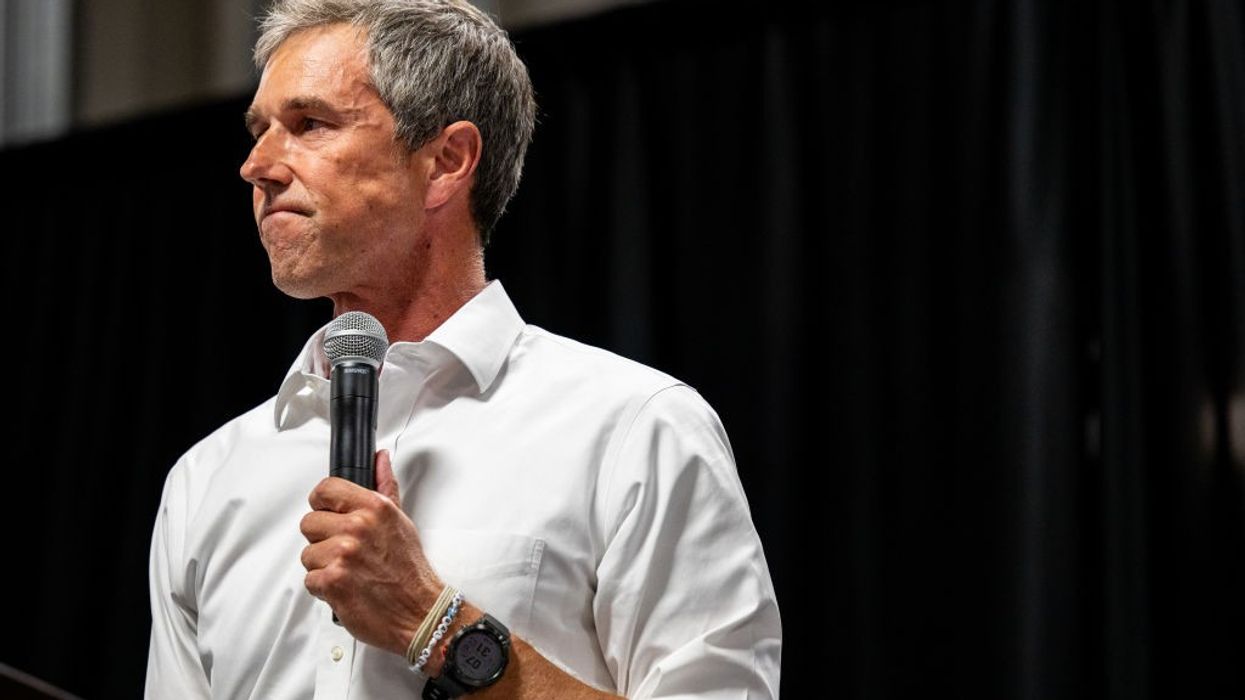
"I think Democrats in the past too often have been more concerned with being right than being in power," O'Rourke said in a CNN interview. "We've seen Republicans only care about being in power regardless of what is right."
As Republicans move forward with an aggressive effort to gerrymander Texas in the coming year, former Rep. Beto O'Rourke called on Democrats Sunday to "match fire with fire" in blue states.
Texas Gov. Greg Abbott said last week he'd follow through on a proposal from President Donald Trump, press legislators to re-draw congressional maps to maximally favor Republicans in the Lone Star State through a highly unusual mid-decade redistricting push.
The effort may net the GOP another five seats in the 2026 midterms. Trump has suggested Republicans push their advantages in "other states" as well, including Ohio.
In response, California Gov. Gavin Newsom said he'd attempt to subvert California's independent state redistricting commission—which seeks to draw maps as fairly as possible—to instead pursue a maximum partisan gerrymander to favor Democrats.
Democrats have tended to be at the forefront of efforts to eliminate partisan redistricting. O'Rourke, a Democrat, has previously called for his state of Texas to have its districts drawn not by political parties but by an independent nonpartisan commission.
But in an interview with CNN's Jake Tapper Sunday, O'Rourke said that while he still disagreed with gerrymandering on principle, as long as Republicans are willing to use it, Democrats need to be willing to play the same game.
"I think Democrats in the past too often have been more concerned with being right than being in power," O'Rourke said. "We've seen Republicans only care about being in power regardless of what is right."
Asked about Newsom's efforts in California, O'Rourke said, "We have to be absolutely ruthless about getting back in power."
He called on Democrats in other blue states to press their advantages as far as possible too.
"In California, in Illinois, in New York, wherever we have the trifecta of power, we have to use that to its absolute extent," he said.
Should Newsom's effort to get around California's redistricting commission succeed, it could net Democrats an additional five to seven seats in the House. With Republicans clinging to just a three-seat majority, it could prove decisive.
However, the plan is a long shot. In 2010, California voters elected to enshrine the independent commission into the state constitution.
Newsom has said that when it comes to stripping the commission of its power, "it's all on the table," including calling a special session of the state legislature and introducing another ballot measure to the public, which he said he thinks they'd win.
He also said there were "other avenues" to consider, like having the legislature draw districts "in between" censuses.
Newsom described this as a legal gray area, since the constitutional amendment only requires the independent commission to create new maps after each census, but says nothing about its role in redistricting mid-decade. However, Dan Vicuña, a redistricting expert at the watchdog group Common Cause, told The Guardian that such an effort was "not lawful in any way."
Newsom said that Republicans, who don't have to worry about redistricting commissions in the states they control, "are playing by a different set of rules."
"From my perspective, if we're going to play fair in a world that is wholly unfair, we may have the higher moral ground, but the ground is shifting from underneath us, and I think we have to wake up to that reality," said the California governor.
The governors of Illinois and New York, meanwhile, have stayed mum on the question of whether they may attempt similar attempts at aggressive redistricting.
Illinois has no rules against partisan gerrymandering and its maps are already heavily weighted in Democrats' favor following the most recent redistricting effort in 2021.
New York's maps are only "slightly" weighted in favor of Democrats and could be made more lopsided. During the most recent redistricting session, which was the subject of a lengthy court battle, Gov. Kathy Hochul agreed to maps that left the seven seats controlled by Republicans intact.
There, the legislature can draw maps, but they must be approved by an independent redistricting committee.
According to reporting by CNN Sunday, Democrats are nevertheless looking into possible efforts to maximize their advantages in New York and other states like New Jersey, Minnesota, and Washington.
In response to Trump's effort to expand Republicans' seats, House Minority Leader Hakeem Jeffries (D-N.Y.) renewed calls for "fair maps" throughout the country, though he declined to comment on Newsom's efforts.
Jeffries is reportedly meeting with Hochul about the possibility of making the maps more "fair," by which he may mean maximizing the Democrats' advantage. This would likely necessitate dispensing with the independent redistricting commission, as Newsom hopes to do.
"If Republicans want to play by these rules, then I think that we shouldn't have one set of rules for one and the other set of rules for another," Rep. Alexandria Ocasio-Cortez (D-N.Y.) told CNN. "I think we need to even the playing board."