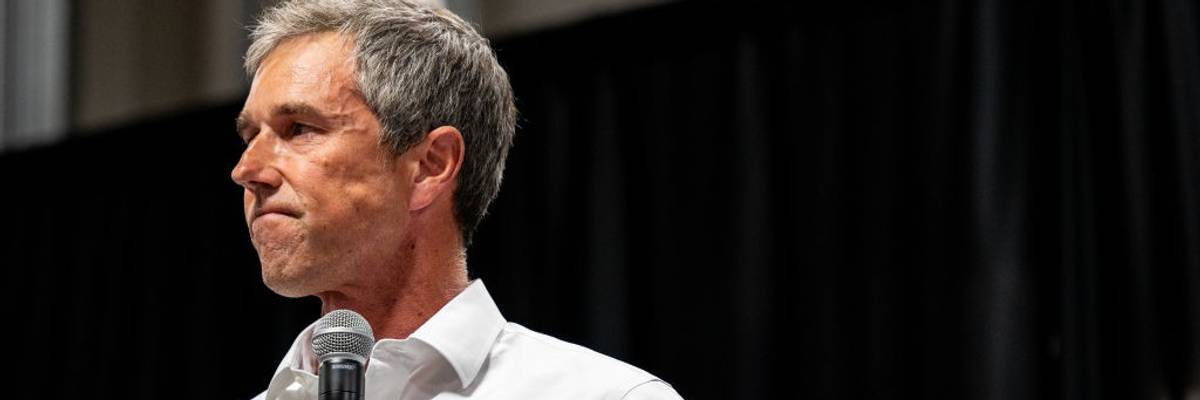
Former U.S. Rep. Beto O'Rourke speaks to attendees during a "Our Fight, Our Future" rally at The Millennium bowling alley on October 2, 2024 in Austin, Texas.
In Response to GOP Gerrymandering, O'Rourke Calls for Dems to 'Match Fire with Fire'
"I think Democrats in the past too often have been more concerned with being right than being in power," O'Rourke said in a CNN interview. "We've seen Republicans only care about being in power regardless of what is right."
As Republicans move forward with an aggressive effort to gerrymander Texas in the coming year, former Rep. Beto O'Rourke called on Democrats Sunday to "match fire with fire" in blue states.
Texas Gov. Greg Abbott said last week he'd follow through on a proposal from President Donald Trump, press legislators to re-draw congressional maps to maximally favor Republicans in the Lone Star State through a highly unusual mid-decade redistricting push.
The effort may net the GOP another five seats in the 2026 midterms. Trump has suggested Republicans push their advantages in "other states" as well, including Ohio.
In response, California Gov. Gavin Newsom said he'd attempt to subvert California's independent state redistricting commission—which seeks to draw maps as fairly as possible—to instead pursue a maximum partisan gerrymander to favor Democrats.
Democrats have tended to be at the forefront of efforts to eliminate partisan redistricting. O'Rourke, a Democrat, has previously called for his state of Texas to have its districts drawn not by political parties but by an independent nonpartisan commission.
But in an interview with CNN's Jake Tapper Sunday, O'Rourke said that while he still disagreed with gerrymandering on principle, as long as Republicans are willing to use it, Democrats need to be willing to play the same game.
"I think Democrats in the past too often have been more concerned with being right than being in power," O'Rourke said. "We've seen Republicans only care about being in power regardless of what is right."
Asked about Newsom's efforts in California, O'Rourke said, "We have to be absolutely ruthless about getting back in power."
He called on Democrats in other blue states to press their advantages as far as possible too.
"In California, in Illinois, in New York, wherever we have the trifecta of power, we have to use that to its absolute extent," he said.
Should Newsom's effort to get around California's redistricting commission succeed, it could net Democrats an additional five to seven seats in the House. With Republicans clinging to just a three-seat majority, it could prove decisive.
However, the plan is a long shot. In 2010, California voters elected to enshrine the independent commission into the state constitution.
Newsom has said that when it comes to stripping the commission of its power, "it's all on the table," including calling a special session of the state legislature and introducing another ballot measure to the public, which he said he thinks they'd win.
He also said there were "other avenues" to consider, like having the legislature draw districts "in between" censuses.
Newsom described this as a legal gray area, since the constitutional amendment only requires the independent commission to create new maps after each census, but says nothing about its role in redistricting mid-decade. However, Dan Vicuña, a redistricting expert at the watchdog group Common Cause, told The Guardian that such an effort was "not lawful in any way."
Newsom said that Republicans, who don't have to worry about redistricting commissions in the states they control, "are playing by a different set of rules."
"From my perspective, if we're going to play fair in a world that is wholly unfair, we may have the higher moral ground, but the ground is shifting from underneath us, and I think we have to wake up to that reality," said the California governor.
The governors of Illinois and New York, meanwhile, have stayed mum on the question of whether they may attempt similar attempts at aggressive redistricting.
Illinois has no rules against partisan gerrymandering and its maps are already heavily weighted in Democrats' favor following the most recent redistricting effort in 2021.
New York's maps are only "slightly" weighted in favor of Democrats and could be made more lopsided. During the most recent redistricting session, which was the subject of a lengthy court battle, Gov. Kathy Hochul agreed to maps that left the seven seats controlled by Republicans intact.
There, the legislature can draw maps, but they must be approved by an independent redistricting committee.
According to reporting by CNN Sunday, Democrats are nevertheless looking into possible efforts to maximize their advantages in New York and other states like New Jersey, Minnesota, and Washington.
In response to Trump's effort to expand Republicans' seats, House Minority Leader Hakeem Jeffries (D-N.Y.) renewed calls for "fair maps" throughout the country, though he declined to comment on Newsom's efforts.
Jeffries is reportedly meeting with Hochul about the possibility of making the maps more "fair," by which he may mean maximizing the Democrats' advantage. This would likely necessitate dispensing with the independent redistricting commission, as Newsom hopes to do.
"If Republicans want to play by these rules, then I think that we shouldn't have one set of rules for one and the other set of rules for another," Rep. Alexandria Ocasio-Cortez (D-N.Y.) told CNN. "I think we need to even the playing board."
We are at a crossroads
This country and this world are at a monumental crossroads. In a few short weeks, US voters will have an opportunity to beat back the forces of fascism and confront the billionaires who are rigging the economy, our media system, and our democracy, making it increasingly impossible for ordinary people to get by. We’re not just talking about the election. We’re talking about what must be done once these fascist elements are vanquished from power. We need a bolder set of solutions than what either major party has so far been willing to offer and a working-class movement ready to fight like hell for it. Trump didn't emerge from nowhere. The conditions that fueled MAGA authoritarianism were created by decades of radical neoliberal economic policies and a corrupt political system dominated by corporate interests. They slashed taxes on the super-rich, promising that the benefits would trickle down. They said giveaways to the corporate titans would make life more affordable for the rest of us. It was all bullshit. And when a bitter, betrayed populace searches for someone to blame, right-wing demagogues have little trouble finding scapegoats. People know when they're being lied to, but you won't hear any of this from the corporate media. Only independent journalism—powered and funded by people who believe in building a better world—can deliver truly trustworthy daily news. Our Fall Campaign is underway, and we need your help. To power our newsroom through the rest of the year, we need to raise $125,000 by midnight on October 31. So if you share our vision, please contribute whatever you can to sustain our work. |
As Republicans move forward with an aggressive effort to gerrymander Texas in the coming year, former Rep. Beto O'Rourke called on Democrats Sunday to "match fire with fire" in blue states.
Texas Gov. Greg Abbott said last week he'd follow through on a proposal from President Donald Trump, press legislators to re-draw congressional maps to maximally favor Republicans in the Lone Star State through a highly unusual mid-decade redistricting push.
The effort may net the GOP another five seats in the 2026 midterms. Trump has suggested Republicans push their advantages in "other states" as well, including Ohio.
In response, California Gov. Gavin Newsom said he'd attempt to subvert California's independent state redistricting commission—which seeks to draw maps as fairly as possible—to instead pursue a maximum partisan gerrymander to favor Democrats.
Democrats have tended to be at the forefront of efforts to eliminate partisan redistricting. O'Rourke, a Democrat, has previously called for his state of Texas to have its districts drawn not by political parties but by an independent nonpartisan commission.
But in an interview with CNN's Jake Tapper Sunday, O'Rourke said that while he still disagreed with gerrymandering on principle, as long as Republicans are willing to use it, Democrats need to be willing to play the same game.
"I think Democrats in the past too often have been more concerned with being right than being in power," O'Rourke said. "We've seen Republicans only care about being in power regardless of what is right."
Asked about Newsom's efforts in California, O'Rourke said, "We have to be absolutely ruthless about getting back in power."
He called on Democrats in other blue states to press their advantages as far as possible too.
"In California, in Illinois, in New York, wherever we have the trifecta of power, we have to use that to its absolute extent," he said.
Should Newsom's effort to get around California's redistricting commission succeed, it could net Democrats an additional five to seven seats in the House. With Republicans clinging to just a three-seat majority, it could prove decisive.
However, the plan is a long shot. In 2010, California voters elected to enshrine the independent commission into the state constitution.
Newsom has said that when it comes to stripping the commission of its power, "it's all on the table," including calling a special session of the state legislature and introducing another ballot measure to the public, which he said he thinks they'd win.
He also said there were "other avenues" to consider, like having the legislature draw districts "in between" censuses.
Newsom described this as a legal gray area, since the constitutional amendment only requires the independent commission to create new maps after each census, but says nothing about its role in redistricting mid-decade. However, Dan Vicuña, a redistricting expert at the watchdog group Common Cause, told The Guardian that such an effort was "not lawful in any way."
Newsom said that Republicans, who don't have to worry about redistricting commissions in the states they control, "are playing by a different set of rules."
"From my perspective, if we're going to play fair in a world that is wholly unfair, we may have the higher moral ground, but the ground is shifting from underneath us, and I think we have to wake up to that reality," said the California governor.
The governors of Illinois and New York, meanwhile, have stayed mum on the question of whether they may attempt similar attempts at aggressive redistricting.
Illinois has no rules against partisan gerrymandering and its maps are already heavily weighted in Democrats' favor following the most recent redistricting effort in 2021.
New York's maps are only "slightly" weighted in favor of Democrats and could be made more lopsided. During the most recent redistricting session, which was the subject of a lengthy court battle, Gov. Kathy Hochul agreed to maps that left the seven seats controlled by Republicans intact.
There, the legislature can draw maps, but they must be approved by an independent redistricting committee.
According to reporting by CNN Sunday, Democrats are nevertheless looking into possible efforts to maximize their advantages in New York and other states like New Jersey, Minnesota, and Washington.
In response to Trump's effort to expand Republicans' seats, House Minority Leader Hakeem Jeffries (D-N.Y.) renewed calls for "fair maps" throughout the country, though he declined to comment on Newsom's efforts.
Jeffries is reportedly meeting with Hochul about the possibility of making the maps more "fair," by which he may mean maximizing the Democrats' advantage. This would likely necessitate dispensing with the independent redistricting commission, as Newsom hopes to do.
"If Republicans want to play by these rules, then I think that we shouldn't have one set of rules for one and the other set of rules for another," Rep. Alexandria Ocasio-Cortez (D-N.Y.) told CNN. "I think we need to even the playing board."
- Greg Casar Rips Texas GOP's Proposed Congressional Map as 'Illegal Voter Suppression' | Common Dreams ›
- 'Fighting Fire With Fire': California Puts Retaliatory Redistricting on November Ballot | Common Dreams ›
- State of the Union on X: ".@BetoORourke now urges blue states to ... ›
- Beto O'Rourke (@betoorourke) • Instagram photos and videos ›
- BETO: “Match fire with fire.” @BetoORourke says Dems in blue ... ›
- O'Rourke says Texas redistricting could ultimately help Democrats ... ›
- Beto O'Rourke calls for Democrats to be 'ruthless' in pursuit of power ... ›
As Republicans move forward with an aggressive effort to gerrymander Texas in the coming year, former Rep. Beto O'Rourke called on Democrats Sunday to "match fire with fire" in blue states.
Texas Gov. Greg Abbott said last week he'd follow through on a proposal from President Donald Trump, press legislators to re-draw congressional maps to maximally favor Republicans in the Lone Star State through a highly unusual mid-decade redistricting push.
The effort may net the GOP another five seats in the 2026 midterms. Trump has suggested Republicans push their advantages in "other states" as well, including Ohio.
In response, California Gov. Gavin Newsom said he'd attempt to subvert California's independent state redistricting commission—which seeks to draw maps as fairly as possible—to instead pursue a maximum partisan gerrymander to favor Democrats.
Democrats have tended to be at the forefront of efforts to eliminate partisan redistricting. O'Rourke, a Democrat, has previously called for his state of Texas to have its districts drawn not by political parties but by an independent nonpartisan commission.
But in an interview with CNN's Jake Tapper Sunday, O'Rourke said that while he still disagreed with gerrymandering on principle, as long as Republicans are willing to use it, Democrats need to be willing to play the same game.
"I think Democrats in the past too often have been more concerned with being right than being in power," O'Rourke said. "We've seen Republicans only care about being in power regardless of what is right."
Asked about Newsom's efforts in California, O'Rourke said, "We have to be absolutely ruthless about getting back in power."
He called on Democrats in other blue states to press their advantages as far as possible too.
"In California, in Illinois, in New York, wherever we have the trifecta of power, we have to use that to its absolute extent," he said.
Should Newsom's effort to get around California's redistricting commission succeed, it could net Democrats an additional five to seven seats in the House. With Republicans clinging to just a three-seat majority, it could prove decisive.
However, the plan is a long shot. In 2010, California voters elected to enshrine the independent commission into the state constitution.
Newsom has said that when it comes to stripping the commission of its power, "it's all on the table," including calling a special session of the state legislature and introducing another ballot measure to the public, which he said he thinks they'd win.
He also said there were "other avenues" to consider, like having the legislature draw districts "in between" censuses.
Newsom described this as a legal gray area, since the constitutional amendment only requires the independent commission to create new maps after each census, but says nothing about its role in redistricting mid-decade. However, Dan Vicuña, a redistricting expert at the watchdog group Common Cause, told The Guardian that such an effort was "not lawful in any way."
Newsom said that Republicans, who don't have to worry about redistricting commissions in the states they control, "are playing by a different set of rules."
"From my perspective, if we're going to play fair in a world that is wholly unfair, we may have the higher moral ground, but the ground is shifting from underneath us, and I think we have to wake up to that reality," said the California governor.
The governors of Illinois and New York, meanwhile, have stayed mum on the question of whether they may attempt similar attempts at aggressive redistricting.
Illinois has no rules against partisan gerrymandering and its maps are already heavily weighted in Democrats' favor following the most recent redistricting effort in 2021.
New York's maps are only "slightly" weighted in favor of Democrats and could be made more lopsided. During the most recent redistricting session, which was the subject of a lengthy court battle, Gov. Kathy Hochul agreed to maps that left the seven seats controlled by Republicans intact.
There, the legislature can draw maps, but they must be approved by an independent redistricting committee.
According to reporting by CNN Sunday, Democrats are nevertheless looking into possible efforts to maximize their advantages in New York and other states like New Jersey, Minnesota, and Washington.
In response to Trump's effort to expand Republicans' seats, House Minority Leader Hakeem Jeffries (D-N.Y.) renewed calls for "fair maps" throughout the country, though he declined to comment on Newsom's efforts.
Jeffries is reportedly meeting with Hochul about the possibility of making the maps more "fair," by which he may mean maximizing the Democrats' advantage. This would likely necessitate dispensing with the independent redistricting commission, as Newsom hopes to do.
"If Republicans want to play by these rules, then I think that we shouldn't have one set of rules for one and the other set of rules for another," Rep. Alexandria Ocasio-Cortez (D-N.Y.) told CNN. "I think we need to even the playing board."
- Greg Casar Rips Texas GOP's Proposed Congressional Map as 'Illegal Voter Suppression' | Common Dreams ›
- 'Fighting Fire With Fire': California Puts Retaliatory Redistricting on November Ballot | Common Dreams ›
- State of the Union on X: ".@BetoORourke now urges blue states to ... ›
- Beto O'Rourke (@betoorourke) • Instagram photos and videos ›
- BETO: “Match fire with fire.” @BetoORourke says Dems in blue ... ›
- O'Rourke says Texas redistricting could ultimately help Democrats ... ›
- Beto O'Rourke calls for Democrats to be 'ruthless' in pursuit of power ... ›