BP was the first to break ranks by changing its old tired logo to a Helios, a Greek sunburst, with its new strapline “beyond petroleum.”
The concept of a fossil fuel company registering a website that mirrors the temperature rise the world is trying to limit itself to because of burning fossil fuels would be seen as deeply ironic by many. But not the deeply misguided leaders at Occidental.
BP never did go beyond petroleum, but the company had thrown a gauntlet down to the others to give the smokescreen of at least beginning to take climate change seriously.
By now, there was emerging scientific consensus that the world had to limit warming to 1.5°C if we wanted a liveable future. So four years later, in 2004, Occidental Petroleum quietly registered the website:
www.1pointfive.com.
The concept of a fossil fuel company registering a website that mirrors the temperature rise the world is trying to limit itself to because of burning fossil fuels would be seen as deeply ironic by many. But not the deeply misguided leaders at Occidental.
As the oil industry expanded its production and still tried to obfuscate action on climate change, the 1pointfive.com website lay dormant for 16 long years. And every year, our climate emergency has worsened.
Finally, in 2020, the website sprung into life. In October of that year, the website was launched, outlining in bold: “A Turning Point for Climate Change.” The website said the mission of the company was “Negative emissions.”.
It stated: “Oxy Low Carbon Ventures and Rusheen Capital have come together to drive change and jumpstart the Direct Air Capture industry around the world.”
Fast forward another three years, and this week, Occidental announced that it had signed an agreement with ADNOC, the Abu Dhabi National Oil company, to evaluate investment opportunities in the controversial technologies of Carbon, Capture, and Storage (CCS), in both the UAE and the U.S..
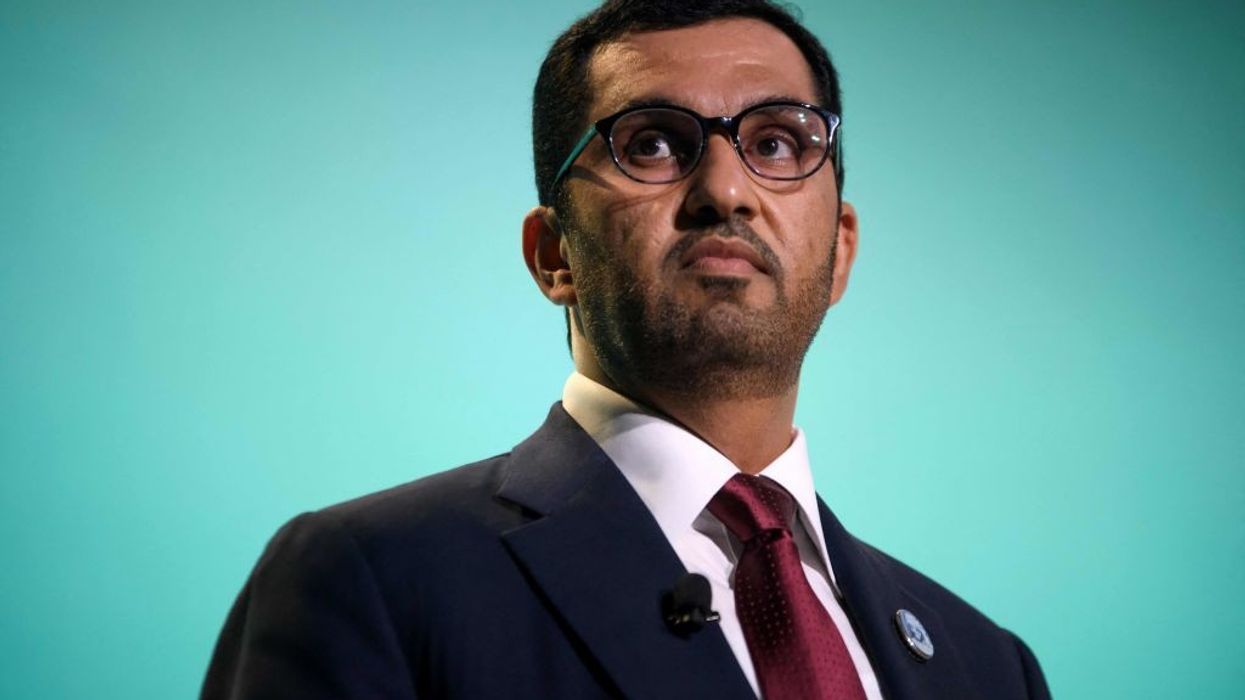
ADNOC is in the spotlight this year because its head, Sultan Ahmed Al Jaber, is the host of
COP28 climate talks, a choice which has drawn criticism from climate activists and scientists alike. Christiana Figueres, ex-Secretary General of the UNFCC, calls the idea of putting Al Jaber in charge of COP as “dangerous.”
She is not the only one outraged that the head of an oil company should host the world’s leading climate conference. It is akin to a tobacco executive hosting a conference on lung cancer and health.
You cannot be an oil company boss and host a climate conference without escaping controversy and scrutiny. So ADNOC is desperate to boost its green credentials, or at least give its operations a good green veneer, just as BP tried to do earlier this century.
To this end, the announcement between
Occidental and ADNOC noted that two oil companies had come together “to develop a carbon management platform to accelerate the net-zero goals of both companies.” The key to this plan is Direct Air Capture—sucking carbon dioxide out of the air and burying it underground.
Recent OCI research has shown that the UAE is poised to become the third-largest expander of oil and gas production between 2023 and 2025, and ADNOC the second-largest expander company.
Despite the spin, even the company’s website shows how futile this procedure is. According to the
1pointfive website, globally it takes 13 hours to emit 67 million tonnes of CO2, enough to fill the Hoover Dam.
In contrast, it states that 1PointFive is developing the world’s largest Direct Air Capture facility, which will suck out 500,000 tonnes per year. That is 0.75% of what the world emits in 13 hours captured in one year.
And even if the Direct Air Capture technology is a success, there are other problems too.
Again trying to ward off its critics, ADNOC has just produced its first-ever report documenting the scale of its carbon emissions. The company says it emitted about 24 million tonnes of carbon dioxide equivalent in 2022. So direct air capture would again only capture 2% of this.
But more importantly, the 24 million tonne
figure is still not including its Scope 3 emissions. These are the emissions from burning oil and gas, which usually equate for 80-90% of an oil or gas company’s emissions.
The Occidental and
ADNOC announcement on carbon capture came a day after ADNOC revised its plans to reach net-zero emissions by 2045 from an original target of 2050. ADNOC also stated that it aimed to achieve zero methane emissions by the end of the decade.
On the surface, this seems welcome, but in reality, it is just more smoke and mirrors.
The announcements form part of a wider climate spin machine that includes fake bots spreading
misinformation on Twitter and a potential rebrand.
Last month, leaked documents obtained by the Centre for Climate Reporting and
Drilled revealed that ADNOC worried about “whats in a name” and had become “increasingly aware of the reputational challenges posed by our brand name.” ADNOC was thinking of future-proofing “the company, without compromising or undermining the equity of the ADNOC brand.”
Due to this, the UAE had contemplated dropping the word oil from ADNOC’s name in a major rebranding—or greenwashing—exercise. Just as BP had changed its name, so ADNOC was thinking of doing the same.
An advertising pitch warned that the ‘National Oil Company’ portion of its name was a “target for potential criticism.” Therefore the rebranded, green-veneered ADNOC would position itself as “a disruptive, ambitious, and confident energy company of the future” that “will invest and operate across the energy spectrum—from hydrocarbons and hydrogen to new and emerging energies.”
The rebrand may not have happened, but there are other flaws too. Firstly, despite this new commitment to reach net zero quicker and to develop its carbon capture technology, ADNOC still plans to increase production.
The reality is, as
The Wall Street Journal so neatly put it in a recent headline: “Occidental Plans to Suck Carbon From the Air—So It Can Keep Pumping Oil.”
CCS should not be used as a smokescreen for real climate action or as an excuse to carry on drilling. We must transition away from oil and gas.
Recent OCI research has shown that the UAE is poised to become the third-largest expander of oil and gas production between 2023 and 2025, and ADNOC the second-largest expander company.
The analysis shows that ADNOC’s new oil and gas production over the next three years would lock in over 2.7 gigatonnes of CO2 emissions, equivalent to one year of the European Union’s CO2 emissions from fossil fuels.
Anything short of phasing out fossil fuel expansion and production will lead to climate chaos.
Secondly, as the
WSJ points out, we have no idea if direct air capture will work at scale. “Removing CO2 from the atmosphere at this scale has never been done before, and the enterprise comes with abundant commercial and scientific uncertainties... Many industry experts doubt that direct-air capture can be done economically because the amounts of air that need to be scrubbed are so large.”
Also, the company is not doing this to save the climate but to make money off the flawed carbon markets. 1pointfive.com is working with
Verra, the industry leader in carbon offsetting. An investigation by The Guardian and Source Material earlier this year found that more than 90% of rainforest carbon offsets issued by Verra were worthless. It’s no wonder commentators are skeptical:
Both announcements are part of a public relations drive by ADNOC in the run-up to COP. Again spin over substance.
David Tong, the Global Industry Campaign Manager for OCI who spoke to Living on Earth this week, said that ADNOC was “on track to be the second largest expander in terms of companies with the most expansion in new oil and gas from this year until 2025. So it’s really concerning to have him presiding over the U.N.’s crucial climate change negotiations.”
Moving the net zero target by five years, says Tong, looks “like a presidency, a country under intense pressure given their extraordinary conflict of interest, that is trying to salvage their credibility by framing themselves as a climate leader, without actually taking meaningful action to achieve this.”
“The UAE has made it very clear that they see it necessary to phase out fossil fuel emissions and argue that that is somehow possible to do without phasing out fossil fuels. That is simply false.”
The domestic policies that the UAE is putting in place have not changed significantly with this new target, and they are grossly insignificant, said Tong. “They’re all in on expanding the use of fossil gas, which is completely at odds with both their climate targets and with what the world needs for 1.5°C.”
“The UAE has made it very clear that they see it necessary to phase out fossil fuel emissions and argue that that is somehow possible to do without phasing out fossil fuels. That is simply false,” says Tong. “And the UAE is planning to do this through claiming that they can use dangerous distractions like carbon capture, which is a smokescreen to allow for continued oil and gas production.”
Finally, Tong said, “Both the Intergovernmental Panel on Climate Change and the International Energy Agency have made it clear that there’s no room for new oil and gas if we are to achieve the objectives of the Paris Agreement and limit warming to 1.5.”
If we are to keep 1.5 alive, we cannot carry on drilling for oil and gas, like ADNOC is. We cannot allow oil companies to set up climate-friendly-sounding websites pushing false and flawed solutions like Occidental has. We have to start phasing out production, which ADNOC is not.
It should also be pointed out that wealthy countries such as Norway, the U.K., Canada, Australia, and the USA have not signalled that they will cut production either. They must act too. But that does not let ADNOC off the hook. No matter how much spin you read or see in the run-up to COP28, ADNOC is not a climate leader until it signals it really is going beyond petroleum and keeping oil in the ground.