SUBSCRIBE TO OUR FREE NEWSLETTER
Daily news & progressive opinion—funded by the people, not the corporations—delivered straight to your inbox.
5
#000000
#FFFFFF
To donate by check, phone, or other method, see our More Ways to Give page.
Daily news & progressive opinion—funded by the people, not the corporations—delivered straight to your inbox.

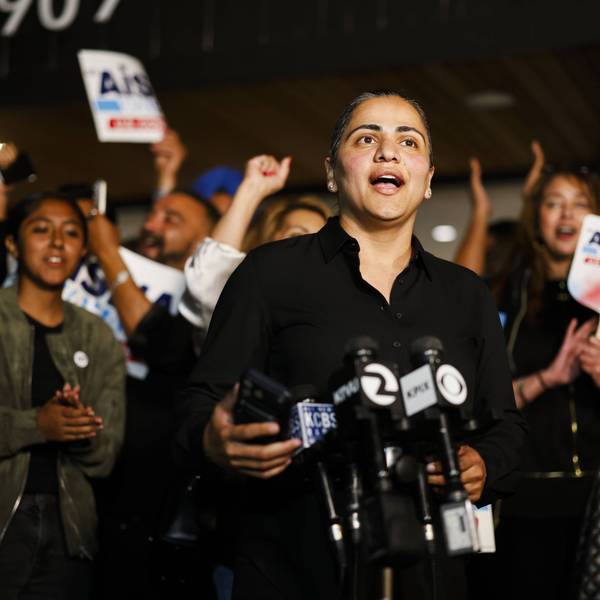
Supporters are seen at the end of an election watch party for Vice President Kamala Harris at The Yard at Howard University in Washington DC, United States on November 5, 2024.
No amount of messaging acumen could have plastered over the gaping hole in Harris’ campaign: a total dearth of popular policies.
As the controversy over the Democratic National Committee’s buried autopsy report continues to rage, more Democrats from the party’s establishment wing are offering their two cents. The latest contribution is a column in The Bulwark, written by Rob Flaherty, the former deputy manager of Kamala Harris’ presidential campaign.
Flaherty’s piece “Here’s What I Told the DNC Autopsy” discusses his conversations with DNC operatives tasked with writing the still-unreleased report. He then continues into his own analysis of what went wrong with Harris’ 2024 campaign for president.
To his credit, Flaherty is willing to do what very few mainstream Democrats have done since Harris' 2024 loss: take a long, and public, look at the campaign’s missteps. But, as with so many other analyses from the establishment wing of the party, he believes that tweaks to the campaign’s messaging strategy and media apparatus could have won the race.
Progressives operating inside the party, meanwhile, have long argued that no amount of messaging acumen could have plastered over the gaping hole in Harris’ campaign: a total dearth of popular policies. (At RootsAction, where I’m the political director, we’ve written our own post-2024 autopsy that focuses exactly on this issue, and where Harris’ campaign fell out of step with popular sentiment.)
If Democrats want to present themselves as a convincing alternative to the post-MAGA Republican Party, they’re going to have to articulate what their political differences are.
Flaherty, by his account, was principally responsible for the digital dimensions of the campaign (social media, content creators, etc.) and so his analysis proceeds through that lens. He devotes a lot of time to worrying over message alignment—alignment between earned and paid media, between the campaign and independent expenditures, and so on. What's missing in that analysis, though, is what that message was.
At the tail end of Joe Biden’s presidency, the nation was embroiled in a number of crises. The recovery from the Covid-19 pandemic had been uneven, with many at the bottom of the labor ladder still struggling to find steady work and keep up with runaway inflation. Americans at all income levels, in fact, were reeling from spiking costs in basic consumer goods. And, while Israel’s slaughter of civilians in Gaza unfolded in full view of anyone with a social media account, Biden and his administration continued their unyielding support for Israel. On top of it all, the unpopular Biden broke his promise to be a “bridge” president, ignored the polls showing that most Democrats wanted a different candidate, and unwisely opted to run for a second term—dropping out only after a disastrous debate and massive pressure from inside the party.
His vice president was then thrust into the unenviable position of having just 107 days (as she often reminds us) to mount a presidential campaign that could defeat Donald Trump.This entailed massive logistical challenges, yes—but it also meant reckoning with Biden’s tenure as president. Would Harris continue to argue, as the Biden administration had, that Bidenomics had been a boon for the working class? Would she continue to support Israeli Prime Minister Benjamin Netanyahu as he laid waste to the Gaza Strip? These questions demanded answers. Harris and her campaign though, seemed loath to provide them.
Flaherty appears to understand that this was a major problem for Harris. He bemoans the campaign's vacillation on its core message, contrasting that with Trump's comms discipline: "Trump's message was much clearer: The economy feels bad and Harris says it's good. Those vibes were tough to argue with."
He is heavily focused on vibes: "The moment the [BidenHQ] account switched from Biden to Harris, the campaign channeled a vibe shift that showed up in polls. We needed to consolidate the base, make the campaign cooler, and have a campaign voice that could be more flexible and nimble than the candidate’s own."
Putting aside how a “vibe shift” appears in polls, it’s clear from the outset that Flaherty’s level of analysis is all branding, no substance. He gets into the weeds of individual social media accounts and their relative impacts with critical constituencies. Was the KamalaHQ online presence too "girls and gays" coded? Did the account turn off men? For someone who devotes a footnote to scolding the “DC crowd” for believing Biden to be broadly unpopular, Flaherty sure seems to have drunk the Beltway insider Kool-Aid when it comes to assessing the impact of an individual social media account on an election in which more than 152 million Americans cast a vote.
Vibes should not be the basis for a campaign. Yes, a sour mood in the electorate requires a particular approach, but it doesn't mean that Democrats can entirely punt on the difficult work of crafting a resonant political message. Coordination and message discipline between social media influencers, independent expenditures, surrogates, and official campaign accounts is meaningless if those voices aren’t making a compelling argument. In 2024, Democrats’ biggest political liability was that voters had no idea what four more years of a Democratic administration would entail. It was like Harris was running back Biden’s infamous campaign promise to donors in 2019: that “nothing would fundamentally change.” Such an approach couldn’t work in 2024, given all the public discontent and anxiety.
When Flaherty steps back from the arcana of digital strategy, he seems to understand this problem quite well. He points out that Democrats, in focusing on picking up comparatively well-off, suburban voters, have shed too many votes elsewhere. "The resulting [Democratic] coalition, which has involved a shrinking share of working-class voters of color, especially men, just isn't big enough to beat a motivated MAGA base." He even goes on to write that Democrats should embrace "economic populism with teeth."
Progressives in the Democratic Party would certainly agree with the last point. Poll after poll confirms that this is popular policy: Most voters support taxing the rich and a more equitable distribution of wealth. Flaherty understands enough to give lip service to this idea, but is either unwilling or unable to continue this line of thinking to its logical conclusion: Democrats should embrace this reality, codify it in their political platform, and let it ring out loudly in all their campaign messaging. Like many in the establishment wing of the Democratic Party, Flaherty shows a remarkable ability to diagnose the party’s political ailments without being able to clamor for a cure.
This trend continues. Flaherty touches briefly on the discord between Harris and pro-ceasefire activists, but he is eager to wave away the negative impact it may have had on her campaign. He writes that the Biden's administration's support for Israel's war in Gaza hurt the campaign "but not in the ways people think." He then goes on to quote another campaign worker who characterizes Biden's support for Israel (and Harris' inability to create daylight between herself and Biden) as a "giant, rotting fish around [the campaign's] neck."
This is actually exactly how progressives think that Gaza hurt the campaign. Those of us who were pro-ceasefire, and who clamored for Harris to reject the policy of unquestioning support that the Biden administration had pushed, worried that the moral stain of US complicity in Gaza would be impossible to wash out, even as the Democrats switched standard-bearers midstream. We worried that critical constituencies—young people, Arab and Muslim Americans—who had been bombarded on social media with an unending stream of carnage from Gaza would be unable to hold their noses in the ballot box when it came time to vote for the Democratic ticket, even against Trump. Harris’ campaign faltered because 6.8 million Americans who supported Biden in 2020 did not support her. With such a stark drop off in support, it makes sense to focus on an issue where the Democratic Party policy was firmly out of step with popular sentiment among the Democrats’ base. This disconnect can’t simply be brushed aside.
Flaherty admits that, by the time the Harris campaign got going, they were “playing around the edges.” That is, campaign staff were permitted only to make marginal tweaks to a campaign that was already underway; the time for grand strategy had passed. Postmortems from insiders about the 2024 election sometimes read like the accounts of survivors struck by some environmental catastrophe. But this was a tragedy of the Democrats’ own making; Flaherty himself was a deputy manager of Biden’s aborted 2024 campaign.
Donald Trump’s political career is nearing its end, but the effects of Trumpism will be felt for decades to come. If Democrats want to present themselves as a convincing alternative to the post-MAGA Republican Party, they’re going to have to articulate what their political differences are. Progressive policy is increasingly popular among Democrats and the broader American electorate: universal healthcare, debt-free public college, AI regulation, and an end to endless war all rank as attractive policy planks with majority support. Any candidate running for the Democratic presidential nomination in 2028 should have this policy at the core of their platform.
Otherwise, there is no amount of consulting, brand management, influencer outreach, or narrative shaping that can save a campaign with no message at its core. If Democrats can’t internalize the real lessons of Harris’ campaign, they may be doomed to repeat its failures.
Dear Common Dreams reader, It’s been nearly 30 years since I co-founded Common Dreams with my late wife, Lina Newhouser. We had the radical notion that journalism should serve the public good, not corporate profits. It was clear to us from the outset what it would take to build such a project. No paid advertisements. No corporate sponsors. No millionaire publisher telling us what to think or do. Many people said we wouldn't last a year, but we proved those doubters wrong. Together with a tremendous team of journalists and dedicated staff, we built an independent media outlet free from the constraints of profits and corporate control. Our mission has always been simple: To inform. To inspire. To ignite change for the common good. Building Common Dreams was not easy. Our survival was never guaranteed. When you take on the most powerful forces—Wall Street greed, fossil fuel industry destruction, Big Tech lobbyists, and uber-rich oligarchs who have spent billions upon billions rigging the economy and democracy in their favor—the only bulwark you have is supporters who believe in your work. But here’s the urgent message from me today. It's never been this bad out there. And it's never been this hard to keep us going. At the very moment Common Dreams is most needed, the threats we face are intensifying. We need your support now more than ever. We don't accept corporate advertising and never will. We don't have a paywall because we don't think people should be blocked from critical news based on their ability to pay. Everything we do is funded by the donations of readers like you. When everyone does the little they can afford, we are strong. But if that support retreats or dries up, so do we. Will you donate now to make sure Common Dreams not only survives but thrives? —Craig Brown, Co-founder |
As the controversy over the Democratic National Committee’s buried autopsy report continues to rage, more Democrats from the party’s establishment wing are offering their two cents. The latest contribution is a column in The Bulwark, written by Rob Flaherty, the former deputy manager of Kamala Harris’ presidential campaign.
Flaherty’s piece “Here’s What I Told the DNC Autopsy” discusses his conversations with DNC operatives tasked with writing the still-unreleased report. He then continues into his own analysis of what went wrong with Harris’ 2024 campaign for president.
To his credit, Flaherty is willing to do what very few mainstream Democrats have done since Harris' 2024 loss: take a long, and public, look at the campaign’s missteps. But, as with so many other analyses from the establishment wing of the party, he believes that tweaks to the campaign’s messaging strategy and media apparatus could have won the race.
Progressives operating inside the party, meanwhile, have long argued that no amount of messaging acumen could have plastered over the gaping hole in Harris’ campaign: a total dearth of popular policies. (At RootsAction, where I’m the political director, we’ve written our own post-2024 autopsy that focuses exactly on this issue, and where Harris’ campaign fell out of step with popular sentiment.)
If Democrats want to present themselves as a convincing alternative to the post-MAGA Republican Party, they’re going to have to articulate what their political differences are.
Flaherty, by his account, was principally responsible for the digital dimensions of the campaign (social media, content creators, etc.) and so his analysis proceeds through that lens. He devotes a lot of time to worrying over message alignment—alignment between earned and paid media, between the campaign and independent expenditures, and so on. What's missing in that analysis, though, is what that message was.
At the tail end of Joe Biden’s presidency, the nation was embroiled in a number of crises. The recovery from the Covid-19 pandemic had been uneven, with many at the bottom of the labor ladder still struggling to find steady work and keep up with runaway inflation. Americans at all income levels, in fact, were reeling from spiking costs in basic consumer goods. And, while Israel’s slaughter of civilians in Gaza unfolded in full view of anyone with a social media account, Biden and his administration continued their unyielding support for Israel. On top of it all, the unpopular Biden broke his promise to be a “bridge” president, ignored the polls showing that most Democrats wanted a different candidate, and unwisely opted to run for a second term—dropping out only after a disastrous debate and massive pressure from inside the party.
His vice president was then thrust into the unenviable position of having just 107 days (as she often reminds us) to mount a presidential campaign that could defeat Donald Trump.This entailed massive logistical challenges, yes—but it also meant reckoning with Biden’s tenure as president. Would Harris continue to argue, as the Biden administration had, that Bidenomics had been a boon for the working class? Would she continue to support Israeli Prime Minister Benjamin Netanyahu as he laid waste to the Gaza Strip? These questions demanded answers. Harris and her campaign though, seemed loath to provide them.
Flaherty appears to understand that this was a major problem for Harris. He bemoans the campaign's vacillation on its core message, contrasting that with Trump's comms discipline: "Trump's message was much clearer: The economy feels bad and Harris says it's good. Those vibes were tough to argue with."
He is heavily focused on vibes: "The moment the [BidenHQ] account switched from Biden to Harris, the campaign channeled a vibe shift that showed up in polls. We needed to consolidate the base, make the campaign cooler, and have a campaign voice that could be more flexible and nimble than the candidate’s own."
Putting aside how a “vibe shift” appears in polls, it’s clear from the outset that Flaherty’s level of analysis is all branding, no substance. He gets into the weeds of individual social media accounts and their relative impacts with critical constituencies. Was the KamalaHQ online presence too "girls and gays" coded? Did the account turn off men? For someone who devotes a footnote to scolding the “DC crowd” for believing Biden to be broadly unpopular, Flaherty sure seems to have drunk the Beltway insider Kool-Aid when it comes to assessing the impact of an individual social media account on an election in which more than 152 million Americans cast a vote.
Vibes should not be the basis for a campaign. Yes, a sour mood in the electorate requires a particular approach, but it doesn't mean that Democrats can entirely punt on the difficult work of crafting a resonant political message. Coordination and message discipline between social media influencers, independent expenditures, surrogates, and official campaign accounts is meaningless if those voices aren’t making a compelling argument. In 2024, Democrats’ biggest political liability was that voters had no idea what four more years of a Democratic administration would entail. It was like Harris was running back Biden’s infamous campaign promise to donors in 2019: that “nothing would fundamentally change.” Such an approach couldn’t work in 2024, given all the public discontent and anxiety.
When Flaherty steps back from the arcana of digital strategy, he seems to understand this problem quite well. He points out that Democrats, in focusing on picking up comparatively well-off, suburban voters, have shed too many votes elsewhere. "The resulting [Democratic] coalition, which has involved a shrinking share of working-class voters of color, especially men, just isn't big enough to beat a motivated MAGA base." He even goes on to write that Democrats should embrace "economic populism with teeth."
Progressives in the Democratic Party would certainly agree with the last point. Poll after poll confirms that this is popular policy: Most voters support taxing the rich and a more equitable distribution of wealth. Flaherty understands enough to give lip service to this idea, but is either unwilling or unable to continue this line of thinking to its logical conclusion: Democrats should embrace this reality, codify it in their political platform, and let it ring out loudly in all their campaign messaging. Like many in the establishment wing of the Democratic Party, Flaherty shows a remarkable ability to diagnose the party’s political ailments without being able to clamor for a cure.
This trend continues. Flaherty touches briefly on the discord between Harris and pro-ceasefire activists, but he is eager to wave away the negative impact it may have had on her campaign. He writes that the Biden's administration's support for Israel's war in Gaza hurt the campaign "but not in the ways people think." He then goes on to quote another campaign worker who characterizes Biden's support for Israel (and Harris' inability to create daylight between herself and Biden) as a "giant, rotting fish around [the campaign's] neck."
This is actually exactly how progressives think that Gaza hurt the campaign. Those of us who were pro-ceasefire, and who clamored for Harris to reject the policy of unquestioning support that the Biden administration had pushed, worried that the moral stain of US complicity in Gaza would be impossible to wash out, even as the Democrats switched standard-bearers midstream. We worried that critical constituencies—young people, Arab and Muslim Americans—who had been bombarded on social media with an unending stream of carnage from Gaza would be unable to hold their noses in the ballot box when it came time to vote for the Democratic ticket, even against Trump. Harris’ campaign faltered because 6.8 million Americans who supported Biden in 2020 did not support her. With such a stark drop off in support, it makes sense to focus on an issue where the Democratic Party policy was firmly out of step with popular sentiment among the Democrats’ base. This disconnect can’t simply be brushed aside.
Flaherty admits that, by the time the Harris campaign got going, they were “playing around the edges.” That is, campaign staff were permitted only to make marginal tweaks to a campaign that was already underway; the time for grand strategy had passed. Postmortems from insiders about the 2024 election sometimes read like the accounts of survivors struck by some environmental catastrophe. But this was a tragedy of the Democrats’ own making; Flaherty himself was a deputy manager of Biden’s aborted 2024 campaign.
Donald Trump’s political career is nearing its end, but the effects of Trumpism will be felt for decades to come. If Democrats want to present themselves as a convincing alternative to the post-MAGA Republican Party, they’re going to have to articulate what their political differences are. Progressive policy is increasingly popular among Democrats and the broader American electorate: universal healthcare, debt-free public college, AI regulation, and an end to endless war all rank as attractive policy planks with majority support. Any candidate running for the Democratic presidential nomination in 2028 should have this policy at the core of their platform.
Otherwise, there is no amount of consulting, brand management, influencer outreach, or narrative shaping that can save a campaign with no message at its core. If Democrats can’t internalize the real lessons of Harris’ campaign, they may be doomed to repeat its failures.
As the controversy over the Democratic National Committee’s buried autopsy report continues to rage, more Democrats from the party’s establishment wing are offering their two cents. The latest contribution is a column in The Bulwark, written by Rob Flaherty, the former deputy manager of Kamala Harris’ presidential campaign.
Flaherty’s piece “Here’s What I Told the DNC Autopsy” discusses his conversations with DNC operatives tasked with writing the still-unreleased report. He then continues into his own analysis of what went wrong with Harris’ 2024 campaign for president.
To his credit, Flaherty is willing to do what very few mainstream Democrats have done since Harris' 2024 loss: take a long, and public, look at the campaign’s missteps. But, as with so many other analyses from the establishment wing of the party, he believes that tweaks to the campaign’s messaging strategy and media apparatus could have won the race.
Progressives operating inside the party, meanwhile, have long argued that no amount of messaging acumen could have plastered over the gaping hole in Harris’ campaign: a total dearth of popular policies. (At RootsAction, where I’m the political director, we’ve written our own post-2024 autopsy that focuses exactly on this issue, and where Harris’ campaign fell out of step with popular sentiment.)
If Democrats want to present themselves as a convincing alternative to the post-MAGA Republican Party, they’re going to have to articulate what their political differences are.
Flaherty, by his account, was principally responsible for the digital dimensions of the campaign (social media, content creators, etc.) and so his analysis proceeds through that lens. He devotes a lot of time to worrying over message alignment—alignment between earned and paid media, between the campaign and independent expenditures, and so on. What's missing in that analysis, though, is what that message was.
At the tail end of Joe Biden’s presidency, the nation was embroiled in a number of crises. The recovery from the Covid-19 pandemic had been uneven, with many at the bottom of the labor ladder still struggling to find steady work and keep up with runaway inflation. Americans at all income levels, in fact, were reeling from spiking costs in basic consumer goods. And, while Israel’s slaughter of civilians in Gaza unfolded in full view of anyone with a social media account, Biden and his administration continued their unyielding support for Israel. On top of it all, the unpopular Biden broke his promise to be a “bridge” president, ignored the polls showing that most Democrats wanted a different candidate, and unwisely opted to run for a second term—dropping out only after a disastrous debate and massive pressure from inside the party.
His vice president was then thrust into the unenviable position of having just 107 days (as she often reminds us) to mount a presidential campaign that could defeat Donald Trump.This entailed massive logistical challenges, yes—but it also meant reckoning with Biden’s tenure as president. Would Harris continue to argue, as the Biden administration had, that Bidenomics had been a boon for the working class? Would she continue to support Israeli Prime Minister Benjamin Netanyahu as he laid waste to the Gaza Strip? These questions demanded answers. Harris and her campaign though, seemed loath to provide them.
Flaherty appears to understand that this was a major problem for Harris. He bemoans the campaign's vacillation on its core message, contrasting that with Trump's comms discipline: "Trump's message was much clearer: The economy feels bad and Harris says it's good. Those vibes were tough to argue with."
He is heavily focused on vibes: "The moment the [BidenHQ] account switched from Biden to Harris, the campaign channeled a vibe shift that showed up in polls. We needed to consolidate the base, make the campaign cooler, and have a campaign voice that could be more flexible and nimble than the candidate’s own."
Putting aside how a “vibe shift” appears in polls, it’s clear from the outset that Flaherty’s level of analysis is all branding, no substance. He gets into the weeds of individual social media accounts and their relative impacts with critical constituencies. Was the KamalaHQ online presence too "girls and gays" coded? Did the account turn off men? For someone who devotes a footnote to scolding the “DC crowd” for believing Biden to be broadly unpopular, Flaherty sure seems to have drunk the Beltway insider Kool-Aid when it comes to assessing the impact of an individual social media account on an election in which more than 152 million Americans cast a vote.
Vibes should not be the basis for a campaign. Yes, a sour mood in the electorate requires a particular approach, but it doesn't mean that Democrats can entirely punt on the difficult work of crafting a resonant political message. Coordination and message discipline between social media influencers, independent expenditures, surrogates, and official campaign accounts is meaningless if those voices aren’t making a compelling argument. In 2024, Democrats’ biggest political liability was that voters had no idea what four more years of a Democratic administration would entail. It was like Harris was running back Biden’s infamous campaign promise to donors in 2019: that “nothing would fundamentally change.” Such an approach couldn’t work in 2024, given all the public discontent and anxiety.
When Flaherty steps back from the arcana of digital strategy, he seems to understand this problem quite well. He points out that Democrats, in focusing on picking up comparatively well-off, suburban voters, have shed too many votes elsewhere. "The resulting [Democratic] coalition, which has involved a shrinking share of working-class voters of color, especially men, just isn't big enough to beat a motivated MAGA base." He even goes on to write that Democrats should embrace "economic populism with teeth."
Progressives in the Democratic Party would certainly agree with the last point. Poll after poll confirms that this is popular policy: Most voters support taxing the rich and a more equitable distribution of wealth. Flaherty understands enough to give lip service to this idea, but is either unwilling or unable to continue this line of thinking to its logical conclusion: Democrats should embrace this reality, codify it in their political platform, and let it ring out loudly in all their campaign messaging. Like many in the establishment wing of the Democratic Party, Flaherty shows a remarkable ability to diagnose the party’s political ailments without being able to clamor for a cure.
This trend continues. Flaherty touches briefly on the discord between Harris and pro-ceasefire activists, but he is eager to wave away the negative impact it may have had on her campaign. He writes that the Biden's administration's support for Israel's war in Gaza hurt the campaign "but not in the ways people think." He then goes on to quote another campaign worker who characterizes Biden's support for Israel (and Harris' inability to create daylight between herself and Biden) as a "giant, rotting fish around [the campaign's] neck."
This is actually exactly how progressives think that Gaza hurt the campaign. Those of us who were pro-ceasefire, and who clamored for Harris to reject the policy of unquestioning support that the Biden administration had pushed, worried that the moral stain of US complicity in Gaza would be impossible to wash out, even as the Democrats switched standard-bearers midstream. We worried that critical constituencies—young people, Arab and Muslim Americans—who had been bombarded on social media with an unending stream of carnage from Gaza would be unable to hold their noses in the ballot box when it came time to vote for the Democratic ticket, even against Trump. Harris’ campaign faltered because 6.8 million Americans who supported Biden in 2020 did not support her. With such a stark drop off in support, it makes sense to focus on an issue where the Democratic Party policy was firmly out of step with popular sentiment among the Democrats’ base. This disconnect can’t simply be brushed aside.
Flaherty admits that, by the time the Harris campaign got going, they were “playing around the edges.” That is, campaign staff were permitted only to make marginal tweaks to a campaign that was already underway; the time for grand strategy had passed. Postmortems from insiders about the 2024 election sometimes read like the accounts of survivors struck by some environmental catastrophe. But this was a tragedy of the Democrats’ own making; Flaherty himself was a deputy manager of Biden’s aborted 2024 campaign.
Donald Trump’s political career is nearing its end, but the effects of Trumpism will be felt for decades to come. If Democrats want to present themselves as a convincing alternative to the post-MAGA Republican Party, they’re going to have to articulate what their political differences are. Progressive policy is increasingly popular among Democrats and the broader American electorate: universal healthcare, debt-free public college, AI regulation, and an end to endless war all rank as attractive policy planks with majority support. Any candidate running for the Democratic presidential nomination in 2028 should have this policy at the core of their platform.
Otherwise, there is no amount of consulting, brand management, influencer outreach, or narrative shaping that can save a campaign with no message at its core. If Democrats can’t internalize the real lessons of Harris’ campaign, they may be doomed to repeat its failures.