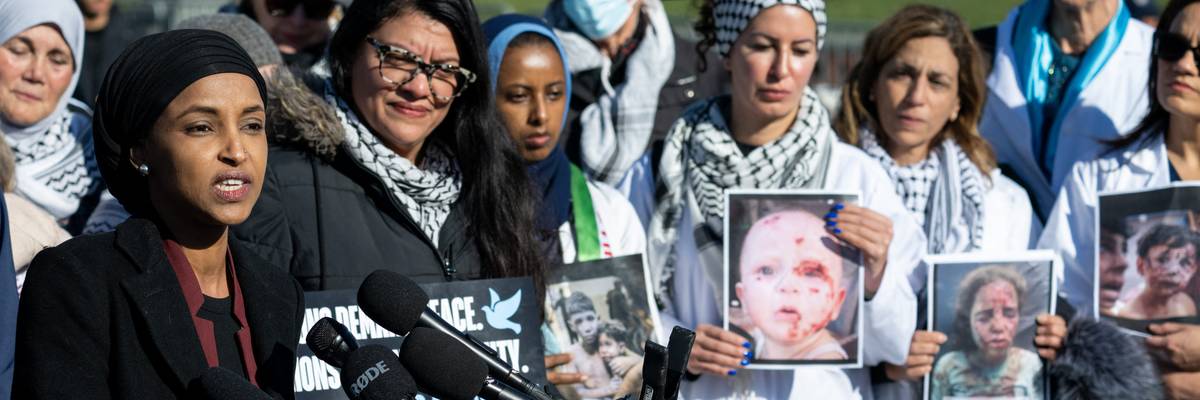
US Rep. Ilhan Omar, Democrat of Minnesota, speaks alongside Rep. Rashida Tlaib (2nd L), Democrat from Michigan, during a press conference with union leaders and supporters of a ceasefire in Gaza outside the US Capitol in Washington, DC, on December 14, 2023.
The American Reckoning
Someday Israeli leaders will stand in The Hague for what they have done in Gaza, and they will deserve to. But if we are honest, we know US leaders belong there too.
I have met people who gave me grace in Iran, in Mexico, in Haiti, in Gaza, in Cambodia, in Vietnam. People who understood the difference between ordinary citizens and the governments that rule them. People who offered me kindness when they had every reason not to. That grace stays with me.
As a US citizen and physician, I have lived my life trying to hold onto a sense of responsibility. But what I see now, in Gaza, in Haiti, in the wake of Iraq and Afghanistan, is the full weight of what psychologists call diffusion of responsibility. It is the shrug that says: Someone else will answer for this, someone else will carry the shame.
The United States cannot keep living in that shrug. We armed, funded, and protected Israel as it has carried out the genocide of the Palestinian people. We have supplied not only weapons but coordination, intelligence, and political cover. We let the American Israel Public Affairs Committee function as the arm of a foreign government, not as a lobbying group. We looked away from the checkpoints, the administrative cruelty, the killing of children. This is our legacy.
But Gaza is not an aberration. It is a mirror held up to the long history of our interventions. We overthrew Mohammad Mossadegh, the democratically elected prime minister of Iran, in 1953, not because he was a tyrant but because he dared to nationalize oil. We turned that nation toward dictatorship and decades of repression, then had the arrogance to call it democracy. In Central America, we toppled leaders and propped up death squads. In Chile, we helped usher in the bloody reign of Augusto Pinochet, betraying yet another democratic choice in favor of authoritarian brutality.
We speak of Russian President Vladimir Putin’s murderous ways as if they are foreign to us. They are not. We have assassinated leaders. We have sanctioned extrajudicial killings, calling them “targeted strikes.” We have funded militias and trained torturers. We still carry Guantánamo on our conscience. We are not better than Putin. We are his rival and his mirror.
We should be an anti-interventionist nation, one that stops imagining itself as the builder of nations and instead takes responsibility for its own failures, its own violence, and its own complicity.
In Vietnam, we unleashed hell. Entire villages were burned to the ground. At My Lai, US soldiers slaughtered more than 500 unarmed civilians, women, children, elders. It was not an accident, not a one-off. It was part of a culture of violence we exported and excused.
And then there is the School of the Americas, now rebranded as Western Hemisphere Institute for Security Cooperation, a US military institution in Panama where we trained some of the worst dictators and death squad leaders in Latin America. The manuals we gave them were explicit: torture, execution, terror as tools of governance. We sowed horror and called it security.
Someday Israeli leaders will stand in The Hague for what they have done in Gaza, and they will deserve to. But if we are honest, we know we belong there too. For Mossadegh, for Pinochet, for Central America, for My Lai, for every extrajudicial killing and every sanctioned massacre, and most immediately for Gaza, we should be in the dock as well. We should stand in handcuffs, our heads lowered in shame, finally facing the truth of what we have unleashed in the world.
The truth is that our foreign policy has been one long history of intervention, violence, and betrayal of human dignity. We were in Haiti. We were in Iraq. We were in Afghanistan. We have left the Middle East, Latin America, and Africa littered with the bones of our experiments. Always we tell ourselves it was complicated. Always we tell ourselves we meant well. But what we meant was power, and what we left was ruin.
What reparation looks like now is not cash or aid dropped into a void. It is restoring justice. It is ending our culture of nation building and intervention, and replacing it with support for people, families, language, culture, dignity, and jurisprudence. It is standing against genocide, no matter who commits it. It is admitting that our strength lies not in military power but in whether we can build schools instead of prisons, communities instead of empires.
This is not just a populist opinion. It is a moral imperative. We should be an anti-interventionist nation, one that stops imagining itself as the builder of nations and instead takes responsibility for its own failures, its own violence, and its own complicity.
I am a doctor. My oath is to heal, to do no harm. But as a citizen, I see harm everywhere our government touches. We cannot keep pretending that this is someone else’s crime, someone else’s burden. This is ours.
The reckoning will not wait forever. The question is whether we face it with honesty now, or whether we let it destroy us later.
We are at a crossroads
This country and this world are at a monumental crossroads. In a few short weeks, US voters will have an opportunity to beat back the forces of fascism and confront the billionaires who are rigging the economy, our media system, and our democracy, making it increasingly impossible for ordinary people to get by. We’re not just talking about the election. We’re talking about what must be done once these fascist elements are vanquished from power. We need a bolder set of solutions than what either major party has so far been willing to offer and a working-class movement ready to fight like hell for it. Trump didn't emerge from nowhere. The conditions that fueled MAGA authoritarianism were created by decades of radical neoliberal economic policies and a corrupt political system dominated by corporate interests. They slashed taxes on the super-rich, promising that the benefits would trickle down. They said giveaways to the corporate titans would make life more affordable for the rest of us. It was all bullshit. And when a bitter, betrayed populace searches for someone to blame, right-wing demagogues have little trouble finding scapegoats. People know when they're being lied to, but you won't hear any of this from the corporate media. Only independent journalism—powered and funded by people who believe in building a better world—can deliver truly trustworthy daily news. Our Fall Campaign is underway, and we need your help. To power our newsroom through the rest of the year, we need to raise $125,000 by midnight on October 31. So if you share our vision, please contribute whatever you can to sustain our work. |
I have met people who gave me grace in Iran, in Mexico, in Haiti, in Gaza, in Cambodia, in Vietnam. People who understood the difference between ordinary citizens and the governments that rule them. People who offered me kindness when they had every reason not to. That grace stays with me.
As a US citizen and physician, I have lived my life trying to hold onto a sense of responsibility. But what I see now, in Gaza, in Haiti, in the wake of Iraq and Afghanistan, is the full weight of what psychologists call diffusion of responsibility. It is the shrug that says: Someone else will answer for this, someone else will carry the shame.
The United States cannot keep living in that shrug. We armed, funded, and protected Israel as it has carried out the genocide of the Palestinian people. We have supplied not only weapons but coordination, intelligence, and political cover. We let the American Israel Public Affairs Committee function as the arm of a foreign government, not as a lobbying group. We looked away from the checkpoints, the administrative cruelty, the killing of children. This is our legacy.
But Gaza is not an aberration. It is a mirror held up to the long history of our interventions. We overthrew Mohammad Mossadegh, the democratically elected prime minister of Iran, in 1953, not because he was a tyrant but because he dared to nationalize oil. We turned that nation toward dictatorship and decades of repression, then had the arrogance to call it democracy. In Central America, we toppled leaders and propped up death squads. In Chile, we helped usher in the bloody reign of Augusto Pinochet, betraying yet another democratic choice in favor of authoritarian brutality.
We speak of Russian President Vladimir Putin’s murderous ways as if they are foreign to us. They are not. We have assassinated leaders. We have sanctioned extrajudicial killings, calling them “targeted strikes.” We have funded militias and trained torturers. We still carry Guantánamo on our conscience. We are not better than Putin. We are his rival and his mirror.
We should be an anti-interventionist nation, one that stops imagining itself as the builder of nations and instead takes responsibility for its own failures, its own violence, and its own complicity.
In Vietnam, we unleashed hell. Entire villages were burned to the ground. At My Lai, US soldiers slaughtered more than 500 unarmed civilians, women, children, elders. It was not an accident, not a one-off. It was part of a culture of violence we exported and excused.
And then there is the School of the Americas, now rebranded as Western Hemisphere Institute for Security Cooperation, a US military institution in Panama where we trained some of the worst dictators and death squad leaders in Latin America. The manuals we gave them were explicit: torture, execution, terror as tools of governance. We sowed horror and called it security.
Someday Israeli leaders will stand in The Hague for what they have done in Gaza, and they will deserve to. But if we are honest, we know we belong there too. For Mossadegh, for Pinochet, for Central America, for My Lai, for every extrajudicial killing and every sanctioned massacre, and most immediately for Gaza, we should be in the dock as well. We should stand in handcuffs, our heads lowered in shame, finally facing the truth of what we have unleashed in the world.
The truth is that our foreign policy has been one long history of intervention, violence, and betrayal of human dignity. We were in Haiti. We were in Iraq. We were in Afghanistan. We have left the Middle East, Latin America, and Africa littered with the bones of our experiments. Always we tell ourselves it was complicated. Always we tell ourselves we meant well. But what we meant was power, and what we left was ruin.
What reparation looks like now is not cash or aid dropped into a void. It is restoring justice. It is ending our culture of nation building and intervention, and replacing it with support for people, families, language, culture, dignity, and jurisprudence. It is standing against genocide, no matter who commits it. It is admitting that our strength lies not in military power but in whether we can build schools instead of prisons, communities instead of empires.
This is not just a populist opinion. It is a moral imperative. We should be an anti-interventionist nation, one that stops imagining itself as the builder of nations and instead takes responsibility for its own failures, its own violence, and its own complicity.
I am a doctor. My oath is to heal, to do no harm. But as a citizen, I see harm everywhere our government touches. We cannot keep pretending that this is someone else’s crime, someone else’s burden. This is ours.
The reckoning will not wait forever. The question is whether we face it with honesty now, or whether we let it destroy us later.
I have met people who gave me grace in Iran, in Mexico, in Haiti, in Gaza, in Cambodia, in Vietnam. People who understood the difference between ordinary citizens and the governments that rule them. People who offered me kindness when they had every reason not to. That grace stays with me.
As a US citizen and physician, I have lived my life trying to hold onto a sense of responsibility. But what I see now, in Gaza, in Haiti, in the wake of Iraq and Afghanistan, is the full weight of what psychologists call diffusion of responsibility. It is the shrug that says: Someone else will answer for this, someone else will carry the shame.
The United States cannot keep living in that shrug. We armed, funded, and protected Israel as it has carried out the genocide of the Palestinian people. We have supplied not only weapons but coordination, intelligence, and political cover. We let the American Israel Public Affairs Committee function as the arm of a foreign government, not as a lobbying group. We looked away from the checkpoints, the administrative cruelty, the killing of children. This is our legacy.
But Gaza is not an aberration. It is a mirror held up to the long history of our interventions. We overthrew Mohammad Mossadegh, the democratically elected prime minister of Iran, in 1953, not because he was a tyrant but because he dared to nationalize oil. We turned that nation toward dictatorship and decades of repression, then had the arrogance to call it democracy. In Central America, we toppled leaders and propped up death squads. In Chile, we helped usher in the bloody reign of Augusto Pinochet, betraying yet another democratic choice in favor of authoritarian brutality.
We speak of Russian President Vladimir Putin’s murderous ways as if they are foreign to us. They are not. We have assassinated leaders. We have sanctioned extrajudicial killings, calling them “targeted strikes.” We have funded militias and trained torturers. We still carry Guantánamo on our conscience. We are not better than Putin. We are his rival and his mirror.
We should be an anti-interventionist nation, one that stops imagining itself as the builder of nations and instead takes responsibility for its own failures, its own violence, and its own complicity.
In Vietnam, we unleashed hell. Entire villages were burned to the ground. At My Lai, US soldiers slaughtered more than 500 unarmed civilians, women, children, elders. It was not an accident, not a one-off. It was part of a culture of violence we exported and excused.
And then there is the School of the Americas, now rebranded as Western Hemisphere Institute for Security Cooperation, a US military institution in Panama where we trained some of the worst dictators and death squad leaders in Latin America. The manuals we gave them were explicit: torture, execution, terror as tools of governance. We sowed horror and called it security.
Someday Israeli leaders will stand in The Hague for what they have done in Gaza, and they will deserve to. But if we are honest, we know we belong there too. For Mossadegh, for Pinochet, for Central America, for My Lai, for every extrajudicial killing and every sanctioned massacre, and most immediately for Gaza, we should be in the dock as well. We should stand in handcuffs, our heads lowered in shame, finally facing the truth of what we have unleashed in the world.
The truth is that our foreign policy has been one long history of intervention, violence, and betrayal of human dignity. We were in Haiti. We were in Iraq. We were in Afghanistan. We have left the Middle East, Latin America, and Africa littered with the bones of our experiments. Always we tell ourselves it was complicated. Always we tell ourselves we meant well. But what we meant was power, and what we left was ruin.
What reparation looks like now is not cash or aid dropped into a void. It is restoring justice. It is ending our culture of nation building and intervention, and replacing it with support for people, families, language, culture, dignity, and jurisprudence. It is standing against genocide, no matter who commits it. It is admitting that our strength lies not in military power but in whether we can build schools instead of prisons, communities instead of empires.
This is not just a populist opinion. It is a moral imperative. We should be an anti-interventionist nation, one that stops imagining itself as the builder of nations and instead takes responsibility for its own failures, its own violence, and its own complicity.
I am a doctor. My oath is to heal, to do no harm. But as a citizen, I see harm everywhere our government touches. We cannot keep pretending that this is someone else’s crime, someone else’s burden. This is ours.
The reckoning will not wait forever. The question is whether we face it with honesty now, or whether we let it destroy us later.