5
#000000
#FFFFFF
To donate by check, phone, or other method, see our More Ways to Give page.
Daily news & progressive opinion—funded by the people, not the corporations—delivered straight to your inbox.
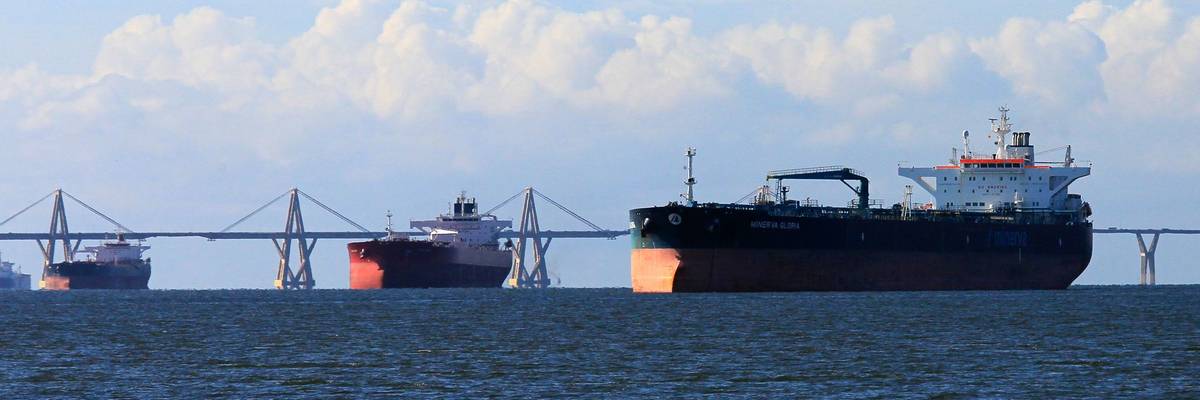
Oil tankers are seen anchored in Lake Maracaibo in Venezuela after loading crude oil at the Bajo Grande Refinery port.
Venezuela needs recovery, investment, and reform but that process must be led by Venezuelans, not dictated by foreign powers claiming historical rights to expropriate.
President Donald Trump’s statement that United States should go into Venezuela and “take back" the oil reflects historical ignorance, and a deeply entrenched extractive mindset—a mindset that has treated Latin America as a resource colony for over a century.
His claim that Venezuela “stole” US oil refers to Hugo Chávez’s decision in the early 2000s to nationalize foreign-owned oil assets, including those held by American companies. To understand that decision, we must look at the conditions that provoked it. For decades, foreign firms and domestic elites extracted enormous profits while ordinary Venezuelans languished in poverty. By the late 1990s, nearly half the population lived below the poverty line despite massive oil revenues, and income inequality was extreme.
Chávez rejected the 1990s Apertura Petrolera model, which opened the oil sector to foreign investment on highly favorable terms, allowing multinational corporations to capture disproportionate gains while the state received relatively little. The 2001 hydrocarbons law reversed this: Royalties were increased to 30%, joint ventures required majority state ownership, and PDVSA reclaimed control over production. Oil revenue was redirected to misiones—social programs that reduced poverty from 50-30%. Venezuela’s resource nationalism disrupted entrenched profit expectations, and that disruption angered the powers accustomed to extractive entitlement.
And this is not new. History shows that the United States has long responded aggressively when resource-rich countries assert control over their own wealth. A striking example is Iran in the early 1950s. Prime Minister Mohammad Mosaddegh, who became premier in 1951, moved to nationalize the Iranian oil industry, previously controlled by the British-owned Anglo-Iranian Oil Company. This bold assertion of sovereignty enraged foreign powers, leading Britain and, eventually, the US, to orchestrate a coup in 1953. Known as Operation Ajax (CIA) and Operation Boot (MI6), the intervention involved bribing politicians and military officials, disinformation campaigns in the media, and street riots to destabilize the government. Mosaddegh was overthrown, and the Shah reinstated, ensuring continued foreign access to Iranian oil.
Trump’s promise to “take the oil” is an insult to the sovereignty of Venezuela and the dignity of its people, effectively saying that national wealth is only legitimate when it aligns with US corporate interests.
Chávez’s Venezuela follows the same pattern. By denying US companies unfettered profits from national resources, he provoked the wrath of powers accustomed to resource imperialism. The outrage was not about governance or efficiency, it was about lost profits and disrupted expectations. When Trump threatens to “take the oil,” he is articulating a familiar imperial logic: Countries that assert control over their resources, rather than surrender them to foreign extraction, are to be punished. Venezuela is merely the latest chapter in a long story of sovereign nations being denied the right to decide how their wealth is used.
This is not to claim that Chávez’s policies were without flaws. Large-scale expropriations discouraged investment, PDVSA became politicized, technical expertise left the country, and overreliance on oil left the economy vulnerable. Production fell from around 3.5 million barrels per day in 1998 to roughly 2.5 million by 2013. But these economic and institutional shortcomings do not legitimize foreign seizure. Venezuela’s resources belong to its people, not to external actors asserting entitlement through power.
Trump’s rhetoric also ignores the environmental reality of Venezuela’s oil. The country’s reserves are among the heaviest and most carbon intensive in the world. Extraction requires enormous energy inputs, produces high methane emissions, and relies heavily on gas flaring. Venezuela has suffered repeated oil spills, chronic gas leaks, and widespread infrastructure decay. Increasing production under these conditions would intensify ecological damage in an already fragile system.
Trump’s promise to “take the oil” is an insult to the sovereignty of Venezuela and the dignity of its people, effectively saying that national wealth is only legitimate when it aligns with US corporate interests. Resource nationalism is a legitimate exercise of sovereignty, but the reaction to it frames it as illegitimate and criminal.
The lesson from Venezuela is not that resource nationalism should be abandoned. It is that sovereignty and markets must be balanced, executed carefully and democratically. Ignoring either leads to failure. Venezuela needs recovery, investment, and reform but that process must be led by Venezuelans, not dictated by foreign powers claiming historical rights to expropriate. Going in to extract oil under US control would deepen environmental damage, compound social injustice, and revive a colonial logic the world has spent decades trying to leave behind.
Dear Common Dreams reader, The U.S. is on a fast track to authoritarianism like nothing I've ever seen. Meanwhile, corporate news outlets are utterly capitulating to Trump, twisting their coverage to avoid drawing his ire while lining up to stuff cash in his pockets. That's why I believe that Common Dreams is doing the best and most consequential reporting that we've ever done. Our small but mighty team is a progressive reporting powerhouse, covering the news every day that the corporate media never will. Our mission has always been simple: To inform. To inspire. And to ignite change for the common good. Now here's the key piece that I want all our readers to understand: None of this would be possible without your financial support. That's not just some fundraising cliche. It's the absolute and literal truth. We don't accept corporate advertising and never will. We don't have a paywall because we don't think people should be blocked from critical news based on their ability to pay. Everything we do is funded by the donations of readers like you. Will you donate now to help power the nonprofit, independent reporting of Common Dreams? Thank you for being a vital member of our community. Together, we can keep independent journalism alive when it’s needed most. - Craig Brown, Co-founder |
President Donald Trump’s statement that United States should go into Venezuela and “take back" the oil reflects historical ignorance, and a deeply entrenched extractive mindset—a mindset that has treated Latin America as a resource colony for over a century.
His claim that Venezuela “stole” US oil refers to Hugo Chávez’s decision in the early 2000s to nationalize foreign-owned oil assets, including those held by American companies. To understand that decision, we must look at the conditions that provoked it. For decades, foreign firms and domestic elites extracted enormous profits while ordinary Venezuelans languished in poverty. By the late 1990s, nearly half the population lived below the poverty line despite massive oil revenues, and income inequality was extreme.
Chávez rejected the 1990s Apertura Petrolera model, which opened the oil sector to foreign investment on highly favorable terms, allowing multinational corporations to capture disproportionate gains while the state received relatively little. The 2001 hydrocarbons law reversed this: Royalties were increased to 30%, joint ventures required majority state ownership, and PDVSA reclaimed control over production. Oil revenue was redirected to misiones—social programs that reduced poverty from 50-30%. Venezuela’s resource nationalism disrupted entrenched profit expectations, and that disruption angered the powers accustomed to extractive entitlement.
And this is not new. History shows that the United States has long responded aggressively when resource-rich countries assert control over their own wealth. A striking example is Iran in the early 1950s. Prime Minister Mohammad Mosaddegh, who became premier in 1951, moved to nationalize the Iranian oil industry, previously controlled by the British-owned Anglo-Iranian Oil Company. This bold assertion of sovereignty enraged foreign powers, leading Britain and, eventually, the US, to orchestrate a coup in 1953. Known as Operation Ajax (CIA) and Operation Boot (MI6), the intervention involved bribing politicians and military officials, disinformation campaigns in the media, and street riots to destabilize the government. Mosaddegh was overthrown, and the Shah reinstated, ensuring continued foreign access to Iranian oil.
Trump’s promise to “take the oil” is an insult to the sovereignty of Venezuela and the dignity of its people, effectively saying that national wealth is only legitimate when it aligns with US corporate interests.
Chávez’s Venezuela follows the same pattern. By denying US companies unfettered profits from national resources, he provoked the wrath of powers accustomed to resource imperialism. The outrage was not about governance or efficiency, it was about lost profits and disrupted expectations. When Trump threatens to “take the oil,” he is articulating a familiar imperial logic: Countries that assert control over their resources, rather than surrender them to foreign extraction, are to be punished. Venezuela is merely the latest chapter in a long story of sovereign nations being denied the right to decide how their wealth is used.
This is not to claim that Chávez’s policies were without flaws. Large-scale expropriations discouraged investment, PDVSA became politicized, technical expertise left the country, and overreliance on oil left the economy vulnerable. Production fell from around 3.5 million barrels per day in 1998 to roughly 2.5 million by 2013. But these economic and institutional shortcomings do not legitimize foreign seizure. Venezuela’s resources belong to its people, not to external actors asserting entitlement through power.
Trump’s rhetoric also ignores the environmental reality of Venezuela’s oil. The country’s reserves are among the heaviest and most carbon intensive in the world. Extraction requires enormous energy inputs, produces high methane emissions, and relies heavily on gas flaring. Venezuela has suffered repeated oil spills, chronic gas leaks, and widespread infrastructure decay. Increasing production under these conditions would intensify ecological damage in an already fragile system.
Trump’s promise to “take the oil” is an insult to the sovereignty of Venezuela and the dignity of its people, effectively saying that national wealth is only legitimate when it aligns with US corporate interests. Resource nationalism is a legitimate exercise of sovereignty, but the reaction to it frames it as illegitimate and criminal.
The lesson from Venezuela is not that resource nationalism should be abandoned. It is that sovereignty and markets must be balanced, executed carefully and democratically. Ignoring either leads to failure. Venezuela needs recovery, investment, and reform but that process must be led by Venezuelans, not dictated by foreign powers claiming historical rights to expropriate. Going in to extract oil under US control would deepen environmental damage, compound social injustice, and revive a colonial logic the world has spent decades trying to leave behind.
President Donald Trump’s statement that United States should go into Venezuela and “take back" the oil reflects historical ignorance, and a deeply entrenched extractive mindset—a mindset that has treated Latin America as a resource colony for over a century.
His claim that Venezuela “stole” US oil refers to Hugo Chávez’s decision in the early 2000s to nationalize foreign-owned oil assets, including those held by American companies. To understand that decision, we must look at the conditions that provoked it. For decades, foreign firms and domestic elites extracted enormous profits while ordinary Venezuelans languished in poverty. By the late 1990s, nearly half the population lived below the poverty line despite massive oil revenues, and income inequality was extreme.
Chávez rejected the 1990s Apertura Petrolera model, which opened the oil sector to foreign investment on highly favorable terms, allowing multinational corporations to capture disproportionate gains while the state received relatively little. The 2001 hydrocarbons law reversed this: Royalties were increased to 30%, joint ventures required majority state ownership, and PDVSA reclaimed control over production. Oil revenue was redirected to misiones—social programs that reduced poverty from 50-30%. Venezuela’s resource nationalism disrupted entrenched profit expectations, and that disruption angered the powers accustomed to extractive entitlement.
And this is not new. History shows that the United States has long responded aggressively when resource-rich countries assert control over their own wealth. A striking example is Iran in the early 1950s. Prime Minister Mohammad Mosaddegh, who became premier in 1951, moved to nationalize the Iranian oil industry, previously controlled by the British-owned Anglo-Iranian Oil Company. This bold assertion of sovereignty enraged foreign powers, leading Britain and, eventually, the US, to orchestrate a coup in 1953. Known as Operation Ajax (CIA) and Operation Boot (MI6), the intervention involved bribing politicians and military officials, disinformation campaigns in the media, and street riots to destabilize the government. Mosaddegh was overthrown, and the Shah reinstated, ensuring continued foreign access to Iranian oil.
Trump’s promise to “take the oil” is an insult to the sovereignty of Venezuela and the dignity of its people, effectively saying that national wealth is only legitimate when it aligns with US corporate interests.
Chávez’s Venezuela follows the same pattern. By denying US companies unfettered profits from national resources, he provoked the wrath of powers accustomed to resource imperialism. The outrage was not about governance or efficiency, it was about lost profits and disrupted expectations. When Trump threatens to “take the oil,” he is articulating a familiar imperial logic: Countries that assert control over their resources, rather than surrender them to foreign extraction, are to be punished. Venezuela is merely the latest chapter in a long story of sovereign nations being denied the right to decide how their wealth is used.
This is not to claim that Chávez’s policies were without flaws. Large-scale expropriations discouraged investment, PDVSA became politicized, technical expertise left the country, and overreliance on oil left the economy vulnerable. Production fell from around 3.5 million barrels per day in 1998 to roughly 2.5 million by 2013. But these economic and institutional shortcomings do not legitimize foreign seizure. Venezuela’s resources belong to its people, not to external actors asserting entitlement through power.
Trump’s rhetoric also ignores the environmental reality of Venezuela’s oil. The country’s reserves are among the heaviest and most carbon intensive in the world. Extraction requires enormous energy inputs, produces high methane emissions, and relies heavily on gas flaring. Venezuela has suffered repeated oil spills, chronic gas leaks, and widespread infrastructure decay. Increasing production under these conditions would intensify ecological damage in an already fragile system.
Trump’s promise to “take the oil” is an insult to the sovereignty of Venezuela and the dignity of its people, effectively saying that national wealth is only legitimate when it aligns with US corporate interests. Resource nationalism is a legitimate exercise of sovereignty, but the reaction to it frames it as illegitimate and criminal.
The lesson from Venezuela is not that resource nationalism should be abandoned. It is that sovereignty and markets must be balanced, executed carefully and democratically. Ignoring either leads to failure. Venezuela needs recovery, investment, and reform but that process must be led by Venezuelans, not dictated by foreign powers claiming historical rights to expropriate. Going in to extract oil under US control would deepen environmental damage, compound social injustice, and revive a colonial logic the world has spent decades trying to leave behind.