SUBSCRIBE TO OUR FREE NEWSLETTER
Daily news & progressive opinion—funded by the people, not the corporations—delivered straight to your inbox.
5
#000000
#FFFFFF
To donate by check, phone, or other method, see our More Ways to Give page.
Daily news & progressive opinion—funded by the people, not the corporations—delivered straight to your inbox.
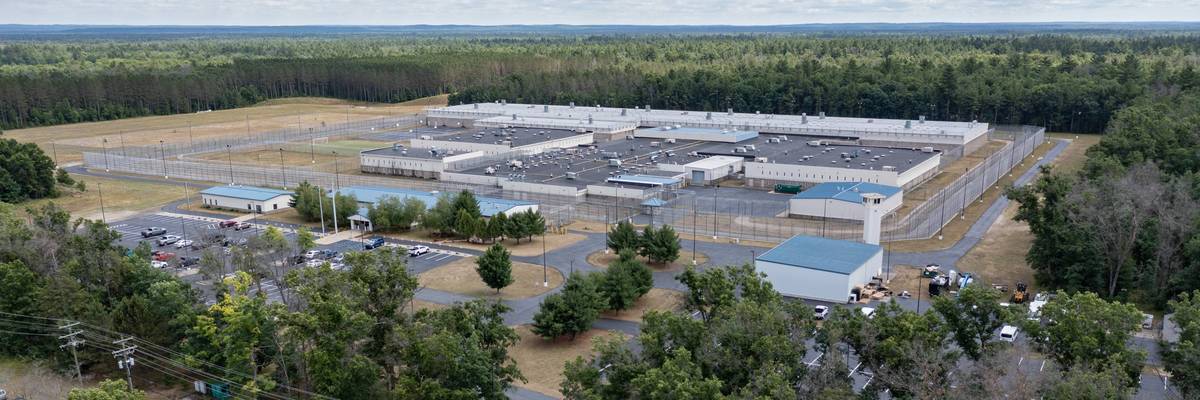
Activists rally against the North Lake Correctional Facility, which has just been reopened as the largest immigrant detention center in the Midwest. The rural Michigan facility is owned by the GEO Group and will house immigrants detained by ICE.
A system of concentration camps is being built and it's time the nation reckon with this monstrosity before any more people are killed.
The March 4, 2026, edition of the Arizona Daily Star put the facts succinctly: “A Haitian asylum seeker held for four months at Florence Correctional Center died Monday at a Scottsdale hospital due to complications from an infected tooth.” It seems the infection spread from his tooth to his lungs, and he developed the pneumonia that killed him.
In other words, U.S. Immigration and Customs Enforcement (ICE) allowed a prisoner to die of a toothache. His name was Emmanuel Damas. He was 56 years old and the father of two.
And we can only expect medical treatment at ICE centers to deteriorate further. As Judd Legum at Popular Information reported in January 2026:
“ICE… has not paid any third-party providers for medical care for detainees since October 3, 2025. Last week, ICE posted a notice on an obscure government website announcing it will not begin processing such claims until at least April 30, 2026. Until then, medical providers are instructed ‘to hold all claims submissions.’”
Emmanuel Damas’s unnecessary death would be outrageous enough, were it the only one of its kind. In fact, 32 people died in ICE custody during 2025, the most in two decades. Another six died in January 2026 alone, among them Geraldo Lunas Campos, a Cuban father aged 55, at Camp East Montana detention center in El Paso, Texas.
Although ICE initially claimed Lunas Campos had attempted suicide, the American Immigration Council reports that “the El Paso County Medical Examiner ruled his death was a homicide arising from asphyxia due to neck and torso compression.” Of course, it’s pretty hard to strangle yourself to death. Witnesses, however, described his murder this way: “Mr. Lunas Campos was handcuffed, while at least five guards held him down and one guard squeezed his neck until he was unconscious.” At least one other man has died at the Camp East Montana detention center, where tuberculosis and measles are also spreading.
Damas and Lunas Campos were among the roughly 73,000 people whom ICE currently holds in a tangle of detention camps sprawled across the country. And more centers are under construction. Many of them are former warehouses designed to function, as ICE acting director Todd Lyons put it last year, “like Amazon Prime for human beings.” (Like many Trump appointees, Lyons has not received Senate confirmation. His actual title, according to ICE, is “Senior Official Performing the Duties of the Director of U.S. Immigration and Customs Enforcement.”)
What Is a Concentration Camp?
Taken together, this network of prisons or, more accurately, concentration camps, constitutes an American gulag. “Gulag” is not so much a word as a Russian initialism that came to stand for the Soviet Union’s concentration camp program, originally developed under Joseph Stalin. The term stands for “Main Directorate of Correctional Labor Camps” and originally referred to the officials running the camps. Later, “gulag” came to indicate the camps themselves, which were a central instrument of Soviet political repression. Most Americans first learned about those camps through Aleksandr Solzhenitsyn’s 1973 internationally bestselling memoir, The Gulag Archipelago.
As Andrea Pitzer, author of One Long Night: A Global History of Concentration Camps, has written, such institutions are a relatively recent phenomenon. While human beings have long contrived ways to isolate groups they identify as enemies — for example, in the enclosed Jewish ghettos of medieval Europe — the modern concentration camp evolved thanks to two key inventions: barbed wire and the machine gun. That pair of technological advances made it possible for a small number of guards to control and contain a large number of people in one place.
Concentration camps have a number of defining features:
A Brief History of U.S. Concentration Camps
The Soviet gulag was not the world’s first concentration camp, although such institutions are, in fact, a relatively recent phenomenon. Human beings have long contrived to isolate groups they identify as enemies, as Americans at times did with enslaved Africans and the native peoples of this continent. Indeed, when the Cherokee nation was evicted from its lands under the 1830 Indian Removal Act and forced to travel the “Trail of Tears,” many of them were kept for some time in “emigration depots” in Alabama and Tennessee.
Almost everyone in this country has heard of Nazi Germany’s camps, but the history of the modern concentration camp really began at the end of the nineteenth century. As Andrea Pitzer recounted in a recent interview, Americans first became aware of such camps in the 1890s, when Spain instituted a policy of reconcentración in its efforts to put down a rebellion in Cuba. As has happened in ICE detention camps today, malnourished men, women, and children were shoved into holding camps there, where crowded conditions and poor sanitation led many to sicken and die. News of the horrifying conditions in Cuba led Americans to organize material aid for those being held.
The United States then dispatched the battleship Maine to accompany the ships carrying relief supplies to Cuba. When the Maine sank in Havana harbor under murky circumstances, the U.S. government had the pretext it needed to mount a military campaign against the remnants of Spanish colonial control in the Americas and the Pacific. That relatively short war ended with the U.S. in possession of most of Spain’s remaining colonies, including the island of Puerto Rico, and what would eventually become the nation of the Philippines. Almost immediately, the new American colonizers reproduced in the Philippines the kind of reconcentración camps they had supposedly gone to war to eradicate in Cuba. In another parallel with the twenty-first century, it was during the occupation of the Philippines that U.S. forces invented the form of torture we have come to call “waterboarding.”
Most Americans know about President Franklin D. Roosevelt’s 1942 executive order creating 10 concentration camps to hold people of Japanese descent, about two-thirds of whom were U.S. citizens mostly living in the western United States. Over 120,000 men, women, and children were interned for the duration of World War II. Many lost their homes, farms, businesses, and other property (often seized by their non-Japanese neighbors). A much smaller number of Italian and German nationals were also interned, as Germans had also been during World War I.
The Japanese camps were constructed by the Works Progress Administration (WPA), the same federal agency that provided mass employment for millions during the Great Depression under Roosevelt’s New Deal program. Few Americans know that, in addition to building roads, schools, dams, and the occasional zoo, the WPA also built the barracks and strung the barbed wire that enclosed World War II internees.
ICE’s predecessor agency, the Immigration and Naturalization Service (INS), ran about 20 of those camps, primarily ones imprisoning Japanese, German, and Italian non-citizens. Three of them were built in Texas to hold people from those countries who had been deported from Latin America. (Most of them were Japanese from Peru.) Those camps were guarded by the Border Patrol, rather than the military police. In other words, ICE and U.S. Customs and Border Protection (CBP) have a long history of running the U.S. version of concentration camps. They’re used to it.
American Gulag
It’s no exaggeration to say that ICE detention camps now threaten to become a central instrument of repression under the Trump administration. As many as 40 people have died in the camps since Trump returned to office in January 2025. And those are only the deaths that have been publicly acknowledged.
If Camp East Montana is the biggest ICE camp in the country, the most notorious may well be the Florida site in the Everglades that has come to be known as “Alligator Alcatraz.” Constructed hastily over just a week, according to Amnesty International, it “houses” people in horrific conditions:
“Inside, people are crammed into overcrowded cages around bunk beds with little room to move. Food is spoiled and maggot-infested. Mosquitoes swarm constantly, showers are scarce, and extreme heat and humidity make the center unbearable. There appear to be almost no reliable or confidential means for detainees to communicate with their attorneys or family members.”
That description is echoed in the testimony of people held in ICE detention camps nationwide. A complete report on the conditions at all of those camps would run to hundreds of thousands of words. Indeed, it’s hard to get a handle on the full scope of ICE’s concentration camp program, since reports on the number and size of such camps change quickly as new ones are proposed or come online. The organization Freedom for Immigrants maintains an interactive immigration detention map which identifies at least 200 separate locations where immigrants (and the occasional U.S. citizen) are detained. And the Trump administration is not done. According to the Guardian, DHS plans to spend $3.8 billion “upgrading” 24 existing warehouses to implement ICE Acting Director Todd Lyons’s dream of treating immigrants like human widgets.
And that brings us back to the point of all this. Concentration camps exist to support and expand the power of an authoritarian regime. They make everyone afraid of being treated like the current targets of the regime. Like state torture programs, concentration camps accelerate the process of dehumanizing groups of people in the public imagination. Such a process often begins by describing the target group as non-human, as “vermin” or “garbage” (as Trump has, of course, done). Ironically, the very act of placing people in inhumane conditions can amplify the public’s perception of their inhumanity. After all, would genuine human beings submit to such treatment? Would our good nation treat genuine human beings that way?
One other significant aspect of all this: the enrichment of a few corporations. President Trump’s “Big Beautiful Bill” gave ICE upwards of $45 billion to spend on those camps, which meant that there was a lot of money to be made. Today most of them are run by two private prison companies, CoreCivic and the GEO Group. The president’s Big Beautiful Bill also allows the Department of Homeland Security to expedite that money-making by using the U.S. Navy’s Supply Systems Command program, which serves as an end-run around the usual bidding process for federal contracts.
This morning, I asked my partner whether she thought that the Trump administration could make the transition from concentration camps, where people die as a “side effect” of their internment, to actual death camps. “I think it’s possible,” she responded — and so, horribly — do I.
It’s possible, but not yet inevitable. To date, local actions have provided the most effective means of resisting the creation of the American gulag our federal government is constructing. These have included organizing to oppose siting camps in specific communities, efforts to leverage local zoning laws to stop them, and attempts to generate state-level political opposition to them. (The Washington Post had an excellent roundup of recent efforts in one county in Maryland to block such a camp.)
We know what’s at stake. We know we can dismantle the American gulag, because some of us are already doing it. It’s time for the rest of us to get to work.
Dear Common Dreams reader, It’s been nearly 30 years since I co-founded Common Dreams with my late wife, Lina Newhouser. We had the radical notion that journalism should serve the public good, not corporate profits. It was clear to us from the outset what it would take to build such a project. No paid advertisements. No corporate sponsors. No millionaire publisher telling us what to think or do. Many people said we wouldn't last a year, but we proved those doubters wrong. Together with a tremendous team of journalists and dedicated staff, we built an independent media outlet free from the constraints of profits and corporate control. Our mission has always been simple: To inform. To inspire. To ignite change for the common good. Building Common Dreams was not easy. Our survival was never guaranteed. When you take on the most powerful forces—Wall Street greed, fossil fuel industry destruction, Big Tech lobbyists, and uber-rich oligarchs who have spent billions upon billions rigging the economy and democracy in their favor—the only bulwark you have is supporters who believe in your work. But here’s the urgent message from me today. It's never been this bad out there. And it's never been this hard to keep us going. At the very moment Common Dreams is most needed, the threats we face are intensifying. We need your support now more than ever. We don't accept corporate advertising and never will. We don't have a paywall because we don't think people should be blocked from critical news based on their ability to pay. Everything we do is funded by the donations of readers like you. When everyone does the little they can afford, we are strong. But if that support retreats or dries up, so do we. Will you donate now to make sure Common Dreams not only survives but thrives? —Craig Brown, Co-founder |
The March 4, 2026, edition of the Arizona Daily Star put the facts succinctly: “A Haitian asylum seeker held for four months at Florence Correctional Center died Monday at a Scottsdale hospital due to complications from an infected tooth.” It seems the infection spread from his tooth to his lungs, and he developed the pneumonia that killed him.
In other words, U.S. Immigration and Customs Enforcement (ICE) allowed a prisoner to die of a toothache. His name was Emmanuel Damas. He was 56 years old and the father of two.
And we can only expect medical treatment at ICE centers to deteriorate further. As Judd Legum at Popular Information reported in January 2026:
“ICE… has not paid any third-party providers for medical care for detainees since October 3, 2025. Last week, ICE posted a notice on an obscure government website announcing it will not begin processing such claims until at least April 30, 2026. Until then, medical providers are instructed ‘to hold all claims submissions.’”
Emmanuel Damas’s unnecessary death would be outrageous enough, were it the only one of its kind. In fact, 32 people died in ICE custody during 2025, the most in two decades. Another six died in January 2026 alone, among them Geraldo Lunas Campos, a Cuban father aged 55, at Camp East Montana detention center in El Paso, Texas.
Although ICE initially claimed Lunas Campos had attempted suicide, the American Immigration Council reports that “the El Paso County Medical Examiner ruled his death was a homicide arising from asphyxia due to neck and torso compression.” Of course, it’s pretty hard to strangle yourself to death. Witnesses, however, described his murder this way: “Mr. Lunas Campos was handcuffed, while at least five guards held him down and one guard squeezed his neck until he was unconscious.” At least one other man has died at the Camp East Montana detention center, where tuberculosis and measles are also spreading.
Damas and Lunas Campos were among the roughly 73,000 people whom ICE currently holds in a tangle of detention camps sprawled across the country. And more centers are under construction. Many of them are former warehouses designed to function, as ICE acting director Todd Lyons put it last year, “like Amazon Prime for human beings.” (Like many Trump appointees, Lyons has not received Senate confirmation. His actual title, according to ICE, is “Senior Official Performing the Duties of the Director of U.S. Immigration and Customs Enforcement.”)
What Is a Concentration Camp?
Taken together, this network of prisons or, more accurately, concentration camps, constitutes an American gulag. “Gulag” is not so much a word as a Russian initialism that came to stand for the Soviet Union’s concentration camp program, originally developed under Joseph Stalin. The term stands for “Main Directorate of Correctional Labor Camps” and originally referred to the officials running the camps. Later, “gulag” came to indicate the camps themselves, which were a central instrument of Soviet political repression. Most Americans first learned about those camps through Aleksandr Solzhenitsyn’s 1973 internationally bestselling memoir, The Gulag Archipelago.
As Andrea Pitzer, author of One Long Night: A Global History of Concentration Camps, has written, such institutions are a relatively recent phenomenon. While human beings have long contrived ways to isolate groups they identify as enemies — for example, in the enclosed Jewish ghettos of medieval Europe — the modern concentration camp evolved thanks to two key inventions: barbed wire and the machine gun. That pair of technological advances made it possible for a small number of guards to control and contain a large number of people in one place.
Concentration camps have a number of defining features:
A Brief History of U.S. Concentration Camps
The Soviet gulag was not the world’s first concentration camp, although such institutions are, in fact, a relatively recent phenomenon. Human beings have long contrived to isolate groups they identify as enemies, as Americans at times did with enslaved Africans and the native peoples of this continent. Indeed, when the Cherokee nation was evicted from its lands under the 1830 Indian Removal Act and forced to travel the “Trail of Tears,” many of them were kept for some time in “emigration depots” in Alabama and Tennessee.
Almost everyone in this country has heard of Nazi Germany’s camps, but the history of the modern concentration camp really began at the end of the nineteenth century. As Andrea Pitzer recounted in a recent interview, Americans first became aware of such camps in the 1890s, when Spain instituted a policy of reconcentración in its efforts to put down a rebellion in Cuba. As has happened in ICE detention camps today, malnourished men, women, and children were shoved into holding camps there, where crowded conditions and poor sanitation led many to sicken and die. News of the horrifying conditions in Cuba led Americans to organize material aid for those being held.
The United States then dispatched the battleship Maine to accompany the ships carrying relief supplies to Cuba. When the Maine sank in Havana harbor under murky circumstances, the U.S. government had the pretext it needed to mount a military campaign against the remnants of Spanish colonial control in the Americas and the Pacific. That relatively short war ended with the U.S. in possession of most of Spain’s remaining colonies, including the island of Puerto Rico, and what would eventually become the nation of the Philippines. Almost immediately, the new American colonizers reproduced in the Philippines the kind of reconcentración camps they had supposedly gone to war to eradicate in Cuba. In another parallel with the twenty-first century, it was during the occupation of the Philippines that U.S. forces invented the form of torture we have come to call “waterboarding.”
Most Americans know about President Franklin D. Roosevelt’s 1942 executive order creating 10 concentration camps to hold people of Japanese descent, about two-thirds of whom were U.S. citizens mostly living in the western United States. Over 120,000 men, women, and children were interned for the duration of World War II. Many lost their homes, farms, businesses, and other property (often seized by their non-Japanese neighbors). A much smaller number of Italian and German nationals were also interned, as Germans had also been during World War I.
The Japanese camps were constructed by the Works Progress Administration (WPA), the same federal agency that provided mass employment for millions during the Great Depression under Roosevelt’s New Deal program. Few Americans know that, in addition to building roads, schools, dams, and the occasional zoo, the WPA also built the barracks and strung the barbed wire that enclosed World War II internees.
ICE’s predecessor agency, the Immigration and Naturalization Service (INS), ran about 20 of those camps, primarily ones imprisoning Japanese, German, and Italian non-citizens. Three of them were built in Texas to hold people from those countries who had been deported from Latin America. (Most of them were Japanese from Peru.) Those camps were guarded by the Border Patrol, rather than the military police. In other words, ICE and U.S. Customs and Border Protection (CBP) have a long history of running the U.S. version of concentration camps. They’re used to it.
American Gulag
It’s no exaggeration to say that ICE detention camps now threaten to become a central instrument of repression under the Trump administration. As many as 40 people have died in the camps since Trump returned to office in January 2025. And those are only the deaths that have been publicly acknowledged.
If Camp East Montana is the biggest ICE camp in the country, the most notorious may well be the Florida site in the Everglades that has come to be known as “Alligator Alcatraz.” Constructed hastily over just a week, according to Amnesty International, it “houses” people in horrific conditions:
“Inside, people are crammed into overcrowded cages around bunk beds with little room to move. Food is spoiled and maggot-infested. Mosquitoes swarm constantly, showers are scarce, and extreme heat and humidity make the center unbearable. There appear to be almost no reliable or confidential means for detainees to communicate with their attorneys or family members.”
That description is echoed in the testimony of people held in ICE detention camps nationwide. A complete report on the conditions at all of those camps would run to hundreds of thousands of words. Indeed, it’s hard to get a handle on the full scope of ICE’s concentration camp program, since reports on the number and size of such camps change quickly as new ones are proposed or come online. The organization Freedom for Immigrants maintains an interactive immigration detention map which identifies at least 200 separate locations where immigrants (and the occasional U.S. citizen) are detained. And the Trump administration is not done. According to the Guardian, DHS plans to spend $3.8 billion “upgrading” 24 existing warehouses to implement ICE Acting Director Todd Lyons’s dream of treating immigrants like human widgets.
And that brings us back to the point of all this. Concentration camps exist to support and expand the power of an authoritarian regime. They make everyone afraid of being treated like the current targets of the regime. Like state torture programs, concentration camps accelerate the process of dehumanizing groups of people in the public imagination. Such a process often begins by describing the target group as non-human, as “vermin” or “garbage” (as Trump has, of course, done). Ironically, the very act of placing people in inhumane conditions can amplify the public’s perception of their inhumanity. After all, would genuine human beings submit to such treatment? Would our good nation treat genuine human beings that way?
One other significant aspect of all this: the enrichment of a few corporations. President Trump’s “Big Beautiful Bill” gave ICE upwards of $45 billion to spend on those camps, which meant that there was a lot of money to be made. Today most of them are run by two private prison companies, CoreCivic and the GEO Group. The president’s Big Beautiful Bill also allows the Department of Homeland Security to expedite that money-making by using the U.S. Navy’s Supply Systems Command program, which serves as an end-run around the usual bidding process for federal contracts.
This morning, I asked my partner whether she thought that the Trump administration could make the transition from concentration camps, where people die as a “side effect” of their internment, to actual death camps. “I think it’s possible,” she responded — and so, horribly — do I.
It’s possible, but not yet inevitable. To date, local actions have provided the most effective means of resisting the creation of the American gulag our federal government is constructing. These have included organizing to oppose siting camps in specific communities, efforts to leverage local zoning laws to stop them, and attempts to generate state-level political opposition to them. (The Washington Post had an excellent roundup of recent efforts in one county in Maryland to block such a camp.)
We know what’s at stake. We know we can dismantle the American gulag, because some of us are already doing it. It’s time for the rest of us to get to work.
The March 4, 2026, edition of the Arizona Daily Star put the facts succinctly: “A Haitian asylum seeker held for four months at Florence Correctional Center died Monday at a Scottsdale hospital due to complications from an infected tooth.” It seems the infection spread from his tooth to his lungs, and he developed the pneumonia that killed him.
In other words, U.S. Immigration and Customs Enforcement (ICE) allowed a prisoner to die of a toothache. His name was Emmanuel Damas. He was 56 years old and the father of two.
And we can only expect medical treatment at ICE centers to deteriorate further. As Judd Legum at Popular Information reported in January 2026:
“ICE… has not paid any third-party providers for medical care for detainees since October 3, 2025. Last week, ICE posted a notice on an obscure government website announcing it will not begin processing such claims until at least April 30, 2026. Until then, medical providers are instructed ‘to hold all claims submissions.’”
Emmanuel Damas’s unnecessary death would be outrageous enough, were it the only one of its kind. In fact, 32 people died in ICE custody during 2025, the most in two decades. Another six died in January 2026 alone, among them Geraldo Lunas Campos, a Cuban father aged 55, at Camp East Montana detention center in El Paso, Texas.
Although ICE initially claimed Lunas Campos had attempted suicide, the American Immigration Council reports that “the El Paso County Medical Examiner ruled his death was a homicide arising from asphyxia due to neck and torso compression.” Of course, it’s pretty hard to strangle yourself to death. Witnesses, however, described his murder this way: “Mr. Lunas Campos was handcuffed, while at least five guards held him down and one guard squeezed his neck until he was unconscious.” At least one other man has died at the Camp East Montana detention center, where tuberculosis and measles are also spreading.
Damas and Lunas Campos were among the roughly 73,000 people whom ICE currently holds in a tangle of detention camps sprawled across the country. And more centers are under construction. Many of them are former warehouses designed to function, as ICE acting director Todd Lyons put it last year, “like Amazon Prime for human beings.” (Like many Trump appointees, Lyons has not received Senate confirmation. His actual title, according to ICE, is “Senior Official Performing the Duties of the Director of U.S. Immigration and Customs Enforcement.”)
What Is a Concentration Camp?
Taken together, this network of prisons or, more accurately, concentration camps, constitutes an American gulag. “Gulag” is not so much a word as a Russian initialism that came to stand for the Soviet Union’s concentration camp program, originally developed under Joseph Stalin. The term stands for “Main Directorate of Correctional Labor Camps” and originally referred to the officials running the camps. Later, “gulag” came to indicate the camps themselves, which were a central instrument of Soviet political repression. Most Americans first learned about those camps through Aleksandr Solzhenitsyn’s 1973 internationally bestselling memoir, The Gulag Archipelago.
As Andrea Pitzer, author of One Long Night: A Global History of Concentration Camps, has written, such institutions are a relatively recent phenomenon. While human beings have long contrived ways to isolate groups they identify as enemies — for example, in the enclosed Jewish ghettos of medieval Europe — the modern concentration camp evolved thanks to two key inventions: barbed wire and the machine gun. That pair of technological advances made it possible for a small number of guards to control and contain a large number of people in one place.
Concentration camps have a number of defining features:
A Brief History of U.S. Concentration Camps
The Soviet gulag was not the world’s first concentration camp, although such institutions are, in fact, a relatively recent phenomenon. Human beings have long contrived to isolate groups they identify as enemies, as Americans at times did with enslaved Africans and the native peoples of this continent. Indeed, when the Cherokee nation was evicted from its lands under the 1830 Indian Removal Act and forced to travel the “Trail of Tears,” many of them were kept for some time in “emigration depots” in Alabama and Tennessee.
Almost everyone in this country has heard of Nazi Germany’s camps, but the history of the modern concentration camp really began at the end of the nineteenth century. As Andrea Pitzer recounted in a recent interview, Americans first became aware of such camps in the 1890s, when Spain instituted a policy of reconcentración in its efforts to put down a rebellion in Cuba. As has happened in ICE detention camps today, malnourished men, women, and children were shoved into holding camps there, where crowded conditions and poor sanitation led many to sicken and die. News of the horrifying conditions in Cuba led Americans to organize material aid for those being held.
The United States then dispatched the battleship Maine to accompany the ships carrying relief supplies to Cuba. When the Maine sank in Havana harbor under murky circumstances, the U.S. government had the pretext it needed to mount a military campaign against the remnants of Spanish colonial control in the Americas and the Pacific. That relatively short war ended with the U.S. in possession of most of Spain’s remaining colonies, including the island of Puerto Rico, and what would eventually become the nation of the Philippines. Almost immediately, the new American colonizers reproduced in the Philippines the kind of reconcentración camps they had supposedly gone to war to eradicate in Cuba. In another parallel with the twenty-first century, it was during the occupation of the Philippines that U.S. forces invented the form of torture we have come to call “waterboarding.”
Most Americans know about President Franklin D. Roosevelt’s 1942 executive order creating 10 concentration camps to hold people of Japanese descent, about two-thirds of whom were U.S. citizens mostly living in the western United States. Over 120,000 men, women, and children were interned for the duration of World War II. Many lost their homes, farms, businesses, and other property (often seized by their non-Japanese neighbors). A much smaller number of Italian and German nationals were also interned, as Germans had also been during World War I.
The Japanese camps were constructed by the Works Progress Administration (WPA), the same federal agency that provided mass employment for millions during the Great Depression under Roosevelt’s New Deal program. Few Americans know that, in addition to building roads, schools, dams, and the occasional zoo, the WPA also built the barracks and strung the barbed wire that enclosed World War II internees.
ICE’s predecessor agency, the Immigration and Naturalization Service (INS), ran about 20 of those camps, primarily ones imprisoning Japanese, German, and Italian non-citizens. Three of them were built in Texas to hold people from those countries who had been deported from Latin America. (Most of them were Japanese from Peru.) Those camps were guarded by the Border Patrol, rather than the military police. In other words, ICE and U.S. Customs and Border Protection (CBP) have a long history of running the U.S. version of concentration camps. They’re used to it.
American Gulag
It’s no exaggeration to say that ICE detention camps now threaten to become a central instrument of repression under the Trump administration. As many as 40 people have died in the camps since Trump returned to office in January 2025. And those are only the deaths that have been publicly acknowledged.
If Camp East Montana is the biggest ICE camp in the country, the most notorious may well be the Florida site in the Everglades that has come to be known as “Alligator Alcatraz.” Constructed hastily over just a week, according to Amnesty International, it “houses” people in horrific conditions:
“Inside, people are crammed into overcrowded cages around bunk beds with little room to move. Food is spoiled and maggot-infested. Mosquitoes swarm constantly, showers are scarce, and extreme heat and humidity make the center unbearable. There appear to be almost no reliable or confidential means for detainees to communicate with their attorneys or family members.”
That description is echoed in the testimony of people held in ICE detention camps nationwide. A complete report on the conditions at all of those camps would run to hundreds of thousands of words. Indeed, it’s hard to get a handle on the full scope of ICE’s concentration camp program, since reports on the number and size of such camps change quickly as new ones are proposed or come online. The organization Freedom for Immigrants maintains an interactive immigration detention map which identifies at least 200 separate locations where immigrants (and the occasional U.S. citizen) are detained. And the Trump administration is not done. According to the Guardian, DHS plans to spend $3.8 billion “upgrading” 24 existing warehouses to implement ICE Acting Director Todd Lyons’s dream of treating immigrants like human widgets.
And that brings us back to the point of all this. Concentration camps exist to support and expand the power of an authoritarian regime. They make everyone afraid of being treated like the current targets of the regime. Like state torture programs, concentration camps accelerate the process of dehumanizing groups of people in the public imagination. Such a process often begins by describing the target group as non-human, as “vermin” or “garbage” (as Trump has, of course, done). Ironically, the very act of placing people in inhumane conditions can amplify the public’s perception of their inhumanity. After all, would genuine human beings submit to such treatment? Would our good nation treat genuine human beings that way?
One other significant aspect of all this: the enrichment of a few corporations. President Trump’s “Big Beautiful Bill” gave ICE upwards of $45 billion to spend on those camps, which meant that there was a lot of money to be made. Today most of them are run by two private prison companies, CoreCivic and the GEO Group. The president’s Big Beautiful Bill also allows the Department of Homeland Security to expedite that money-making by using the U.S. Navy’s Supply Systems Command program, which serves as an end-run around the usual bidding process for federal contracts.
This morning, I asked my partner whether she thought that the Trump administration could make the transition from concentration camps, where people die as a “side effect” of their internment, to actual death camps. “I think it’s possible,” she responded — and so, horribly — do I.
It’s possible, but not yet inevitable. To date, local actions have provided the most effective means of resisting the creation of the American gulag our federal government is constructing. These have included organizing to oppose siting camps in specific communities, efforts to leverage local zoning laws to stop them, and attempts to generate state-level political opposition to them. (The Washington Post had an excellent roundup of recent efforts in one county in Maryland to block such a camp.)
We know what’s at stake. We know we can dismantle the American gulag, because some of us are already doing it. It’s time for the rest of us to get to work.