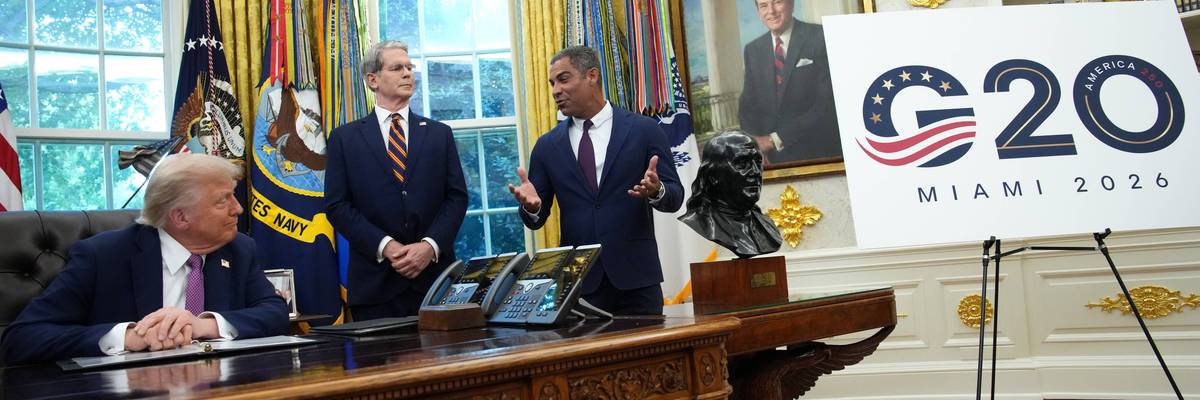
Miami Mayor Francis Suarez (R) speaks as US President Donald Trump announces plans to host the 2026 G20 summit in Miami, Florida while US Treasury Secretary Scott Bessent (C) looks on during a press availability in the Oval Office of the White House on September 5, 2025 in Washington, DC.
The US G20 Presidency Could Take Trump's Pro-Billionaire Agenda Global
There’s a real risk that the US presidency could advance an economic agenda that prioritizes the interests of the wealthy while sidelining efforts to tackle inequality, strengthen fair taxation, and resolve deepening debt crises worldwide.
In just a year, the wealth of the 10 richest US billionaires increased by $698 billion dollars, while low-wage workers struggled as the Trump administration pushed an inequality-fueling agenda. Now, concerns are growing that the same policy choices—those driving a massive transfer of wealth to the richest—could be projected onto the global stage.
The United States recently assumed the presidency of the G20—a major platform for heads of state and governments to address global economic issues. The presidency is a role that carries significant influence over global economic priorities. There’s a real risk that the US presidency could advance an economic agenda that prioritizes the interests of the wealthy while sidelining efforts to tackle inequality, strengthen fair taxation, and resolve deepening debt crises worldwide.
Instead of focusing the G20 on poverty alleviation, reducing inequality, or dealing with a pending global economic crisis, the US government focus will center on removing regulatory burdens, unlocking energy supply chains, and pioneering new technologies and innovation. This marks a sharp departure from the 2025 theme of “Solidarity, Equality, and Sustainability” and signals a shift toward exporting the Trump administration’s domestic agenda to the global stage.
This all comes at a time when inequality is rising across most countries, and many low- and middle-income nations face mounting debt and stagnant growth.
As the US government so blatantly prioritizes wealthy interests, it is a critical moment for civil society to step forward—organizing and advancing an agenda that breaks decisively from the G20’s all-too-often emphasis on preserving the status quo.
US officials are pitching a “back to the basics” approach—which in reality is a sidelining of issues such as inequality, poverty, labor, climate, and gender. It is also widely anticipated that the Trump administration will restrict avenues for civil society participation.
Current plans suggest a focus on the leaders’ summit and financial track; a reduction in working groups; and formal engagement limited to business stakeholders, excluding civil society organizations, women’s groups, labor unions, and youth representatives. Even acknowledging that past G20 efforts on sustainable development have been uneven, this “back to the basics” approach risks abandoning critical priorities altogether.
Recent G20 presidencies led by Brazil and South Africa demonstrated a different trajectory, placing inequality and debt at the center of global discussions. South Africa’s 2025 presidency elevated the urgency of inequality by commissioning the first-ever G20 report on the issue. Led by professor Joseph Stiglitz, the report described a global “inequality emergency” and proposed the creation of an International Panel on Inequality to guide coordinated action.
Against this backdrop, the Trump administration’s domestic policies, including the 2025 One Big Beautiful Bill Act (OBBBA), represent one of the largest upward transfers of wealth in decades, making it unlikely that current US leadership will champion similar efforts internationally.
Progress on global tax cooperation is also under threat. Brazil’s 2024 presidency achieved a breakthrough agreement to cooperate on taxing high-net-worth individuals. While extreme wealth concentration has increased in recent years, research shows billionaires pay effective tax rates close to 0.3% of their wealth—well below what average workers contribute.
Yet in 2025, the Trump administration has already taken actions that undermine these efforts, including withdrawing from United Nations tax negotiations, pressuring other advanced economies to shield US corporations from global tax agreements, and opposing measures such as digital services and carbon taxes.
Climate action presents another area of concern. G20 countries are responsible for approximately 80% of global greenhouse gas emissions, yet many continue to fall short of their commitments. The US administration’s withdrawal from the Paris Agreement and rollback of domestic climate policies reflect a broader retreat from climate leadership.
The Trump administration’s emphasis on expanding energy supply chains raises the possibility that fossil fuel development could be prioritized over clean energy transitions, particularly if multilateral development banks are encouraged to increase investments in oil and gas projects.
Taken together, these signals suggest that the 2026 US G20 presidency could mark a significant retreat. Rather than building on recent efforts to address inequality, debt, and climate change, it may instead shift the forum toward a narrower agenda that prioritizes elite and corporate interests.
The direction ultimately taken will have far-reaching consequences, not only for the credibility of the G20 but for the future of global economic cooperation. As the US government so blatantly prioritizes wealthy interests, it is a critical moment for civil society to step forward—organizing and advancing an agenda that breaks decisively from the G20’s all-too-often emphasis on preserving the status quo.
Now is the time for people, institutions, and movements to unite and champion bold new forms of multilateral cooperation that serve billions, not billionaires.
We are at a crossroads
This country and this world are at a monumental crossroads. In a few short weeks, US voters will have an opportunity to beat back the forces of fascism and confront the billionaires who are rigging the economy, our media system, and our democracy, making it increasingly impossible for ordinary people to get by. We’re not just talking about the election. We’re talking about what must be done once these fascist elements are vanquished from power. We need a bolder set of solutions than what either major party has so far been willing to offer and a working-class movement ready to fight like hell for it. Trump didn't emerge from nowhere. The conditions that fueled MAGA authoritarianism were created by decades of radical neoliberal economic policies and a corrupt political system dominated by corporate interests. They slashed taxes on the super-rich, promising that the benefits would trickle down. They said giveaways to the corporate titans would make life more affordable for the rest of us. It was all bullshit. And when a bitter, betrayed populace searches for someone to blame, right-wing demagogues have little trouble finding scapegoats. People know when they're being lied to, but you won't hear any of this from the corporate media. Only independent journalism—powered and funded by people who believe in building a better world—can deliver truly trustworthy daily news. Our Fall Campaign is underway, and we need your help. To power our newsroom through the rest of the year, we need to raise $125,000 by midnight on October 31. So if you share our vision, please contribute whatever you can to sustain our work. |
In just a year, the wealth of the 10 richest US billionaires increased by $698 billion dollars, while low-wage workers struggled as the Trump administration pushed an inequality-fueling agenda. Now, concerns are growing that the same policy choices—those driving a massive transfer of wealth to the richest—could be projected onto the global stage.
The United States recently assumed the presidency of the G20—a major platform for heads of state and governments to address global economic issues. The presidency is a role that carries significant influence over global economic priorities. There’s a real risk that the US presidency could advance an economic agenda that prioritizes the interests of the wealthy while sidelining efforts to tackle inequality, strengthen fair taxation, and resolve deepening debt crises worldwide.
Instead of focusing the G20 on poverty alleviation, reducing inequality, or dealing with a pending global economic crisis, the US government focus will center on removing regulatory burdens, unlocking energy supply chains, and pioneering new technologies and innovation. This marks a sharp departure from the 2025 theme of “Solidarity, Equality, and Sustainability” and signals a shift toward exporting the Trump administration’s domestic agenda to the global stage.
This all comes at a time when inequality is rising across most countries, and many low- and middle-income nations face mounting debt and stagnant growth.
As the US government so blatantly prioritizes wealthy interests, it is a critical moment for civil society to step forward—organizing and advancing an agenda that breaks decisively from the G20’s all-too-often emphasis on preserving the status quo.
US officials are pitching a “back to the basics” approach—which in reality is a sidelining of issues such as inequality, poverty, labor, climate, and gender. It is also widely anticipated that the Trump administration will restrict avenues for civil society participation.
Current plans suggest a focus on the leaders’ summit and financial track; a reduction in working groups; and formal engagement limited to business stakeholders, excluding civil society organizations, women’s groups, labor unions, and youth representatives. Even acknowledging that past G20 efforts on sustainable development have been uneven, this “back to the basics” approach risks abandoning critical priorities altogether.
Recent G20 presidencies led by Brazil and South Africa demonstrated a different trajectory, placing inequality and debt at the center of global discussions. South Africa’s 2025 presidency elevated the urgency of inequality by commissioning the first-ever G20 report on the issue. Led by professor Joseph Stiglitz, the report described a global “inequality emergency” and proposed the creation of an International Panel on Inequality to guide coordinated action.
Against this backdrop, the Trump administration’s domestic policies, including the 2025 One Big Beautiful Bill Act (OBBBA), represent one of the largest upward transfers of wealth in decades, making it unlikely that current US leadership will champion similar efforts internationally.
Progress on global tax cooperation is also under threat. Brazil’s 2024 presidency achieved a breakthrough agreement to cooperate on taxing high-net-worth individuals. While extreme wealth concentration has increased in recent years, research shows billionaires pay effective tax rates close to 0.3% of their wealth—well below what average workers contribute.
Yet in 2025, the Trump administration has already taken actions that undermine these efforts, including withdrawing from United Nations tax negotiations, pressuring other advanced economies to shield US corporations from global tax agreements, and opposing measures such as digital services and carbon taxes.
Climate action presents another area of concern. G20 countries are responsible for approximately 80% of global greenhouse gas emissions, yet many continue to fall short of their commitments. The US administration’s withdrawal from the Paris Agreement and rollback of domestic climate policies reflect a broader retreat from climate leadership.
The Trump administration’s emphasis on expanding energy supply chains raises the possibility that fossil fuel development could be prioritized over clean energy transitions, particularly if multilateral development banks are encouraged to increase investments in oil and gas projects.
Taken together, these signals suggest that the 2026 US G20 presidency could mark a significant retreat. Rather than building on recent efforts to address inequality, debt, and climate change, it may instead shift the forum toward a narrower agenda that prioritizes elite and corporate interests.
The direction ultimately taken will have far-reaching consequences, not only for the credibility of the G20 but for the future of global economic cooperation. As the US government so blatantly prioritizes wealthy interests, it is a critical moment for civil society to step forward—organizing and advancing an agenda that breaks decisively from the G20’s all-too-often emphasis on preserving the status quo.
Now is the time for people, institutions, and movements to unite and champion bold new forms of multilateral cooperation that serve billions, not billionaires.
- 300+ Economists, Millionaires, and Elected Officials to G20: 'Tax Extreme Wealth' ›
- Trump's Billionaires Cometh ›
- Trump Delivered 22% Boost to Billionaire Wealth in 2025, But Catastrophe for Working Class ›
- Billionaires for Trump and Vance ›
- Wealth of Global Billionaires Surged by $10 Billion Per Day in January ›
- Even Most Millionaires Think the Superrich Influencing Trump Threatens Global Stability ›
In just a year, the wealth of the 10 richest US billionaires increased by $698 billion dollars, while low-wage workers struggled as the Trump administration pushed an inequality-fueling agenda. Now, concerns are growing that the same policy choices—those driving a massive transfer of wealth to the richest—could be projected onto the global stage.
The United States recently assumed the presidency of the G20—a major platform for heads of state and governments to address global economic issues. The presidency is a role that carries significant influence over global economic priorities. There’s a real risk that the US presidency could advance an economic agenda that prioritizes the interests of the wealthy while sidelining efforts to tackle inequality, strengthen fair taxation, and resolve deepening debt crises worldwide.
Instead of focusing the G20 on poverty alleviation, reducing inequality, or dealing with a pending global economic crisis, the US government focus will center on removing regulatory burdens, unlocking energy supply chains, and pioneering new technologies and innovation. This marks a sharp departure from the 2025 theme of “Solidarity, Equality, and Sustainability” and signals a shift toward exporting the Trump administration’s domestic agenda to the global stage.
This all comes at a time when inequality is rising across most countries, and many low- and middle-income nations face mounting debt and stagnant growth.
As the US government so blatantly prioritizes wealthy interests, it is a critical moment for civil society to step forward—organizing and advancing an agenda that breaks decisively from the G20’s all-too-often emphasis on preserving the status quo.
US officials are pitching a “back to the basics” approach—which in reality is a sidelining of issues such as inequality, poverty, labor, climate, and gender. It is also widely anticipated that the Trump administration will restrict avenues for civil society participation.
Current plans suggest a focus on the leaders’ summit and financial track; a reduction in working groups; and formal engagement limited to business stakeholders, excluding civil society organizations, women’s groups, labor unions, and youth representatives. Even acknowledging that past G20 efforts on sustainable development have been uneven, this “back to the basics” approach risks abandoning critical priorities altogether.
Recent G20 presidencies led by Brazil and South Africa demonstrated a different trajectory, placing inequality and debt at the center of global discussions. South Africa’s 2025 presidency elevated the urgency of inequality by commissioning the first-ever G20 report on the issue. Led by professor Joseph Stiglitz, the report described a global “inequality emergency” and proposed the creation of an International Panel on Inequality to guide coordinated action.
Against this backdrop, the Trump administration’s domestic policies, including the 2025 One Big Beautiful Bill Act (OBBBA), represent one of the largest upward transfers of wealth in decades, making it unlikely that current US leadership will champion similar efforts internationally.
Progress on global tax cooperation is also under threat. Brazil’s 2024 presidency achieved a breakthrough agreement to cooperate on taxing high-net-worth individuals. While extreme wealth concentration has increased in recent years, research shows billionaires pay effective tax rates close to 0.3% of their wealth—well below what average workers contribute.
Yet in 2025, the Trump administration has already taken actions that undermine these efforts, including withdrawing from United Nations tax negotiations, pressuring other advanced economies to shield US corporations from global tax agreements, and opposing measures such as digital services and carbon taxes.
Climate action presents another area of concern. G20 countries are responsible for approximately 80% of global greenhouse gas emissions, yet many continue to fall short of their commitments. The US administration’s withdrawal from the Paris Agreement and rollback of domestic climate policies reflect a broader retreat from climate leadership.
The Trump administration’s emphasis on expanding energy supply chains raises the possibility that fossil fuel development could be prioritized over clean energy transitions, particularly if multilateral development banks are encouraged to increase investments in oil and gas projects.
Taken together, these signals suggest that the 2026 US G20 presidency could mark a significant retreat. Rather than building on recent efforts to address inequality, debt, and climate change, it may instead shift the forum toward a narrower agenda that prioritizes elite and corporate interests.
The direction ultimately taken will have far-reaching consequences, not only for the credibility of the G20 but for the future of global economic cooperation. As the US government so blatantly prioritizes wealthy interests, it is a critical moment for civil society to step forward—organizing and advancing an agenda that breaks decisively from the G20’s all-too-often emphasis on preserving the status quo.
Now is the time for people, institutions, and movements to unite and champion bold new forms of multilateral cooperation that serve billions, not billionaires.
- 300+ Economists, Millionaires, and Elected Officials to G20: 'Tax Extreme Wealth' ›
- Trump's Billionaires Cometh ›
- Trump Delivered 22% Boost to Billionaire Wealth in 2025, But Catastrophe for Working Class ›
- Billionaires for Trump and Vance ›
- Wealth of Global Billionaires Surged by $10 Billion Per Day in January ›
- Even Most Millionaires Think the Superrich Influencing Trump Threatens Global Stability ›