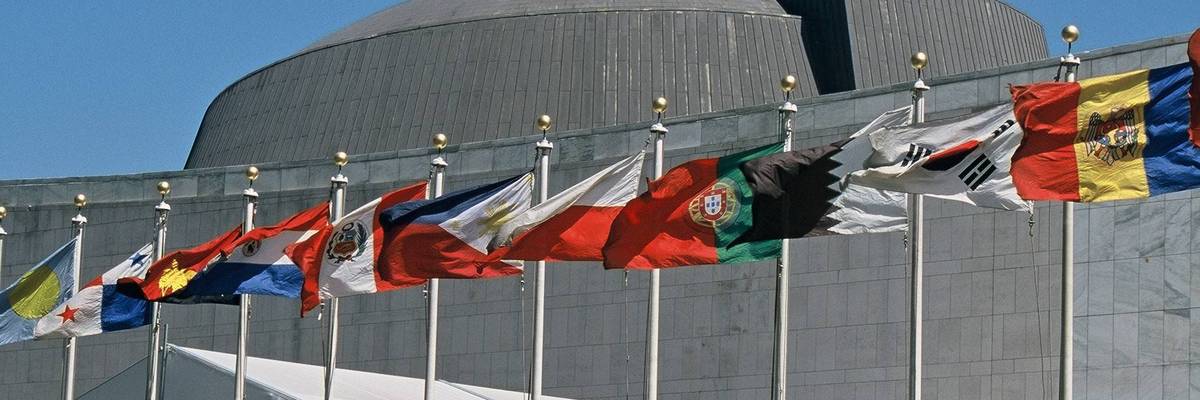
Flags of member states are seen at United Nations headquarters in New York.
The Trump Administration’s Anti-Blackness is Showing on the Global Stage
The United States’ actions are not just a betrayal of the rest of the world; they are the latest examples of the Trump administration's betrayal of its own people—and in particular, of the 45 million Americans who are of African descent.
On March 25, the International Day of Remembrance of the Victims of Slavery and the Transatlantic Slave Trade, the United Nations General Assembly adopted a historic resolution marking an extraordinary step forward for global racial justice. Spearheaded by Ghana and co-sponsored by more than 65 countries largely from Africa, the Caribbean, and Latin America, a declaration designating slavery as the gravest crime against humanity passed the General Assembly. Through this, the majority of the world aligned on one key message: The enslavement of millions of Africans and their descendants for over 400 years is the gravest crime against humanity, we are still dealing with the consequences, and there must be reparatory justice to address the lingering impacts.
In a shameful moment for Americans and the world, the Trump administration voted against this resolution on behalf of the United States—only 1 of 3 countries to do so. This decision comes just months after the US withdrew from the UN Permanent Forum on People of African Descent, falsely claiming it was “racist.” These two actions show that the Trump administration’s anti-Blackness is not limited to its domestic policy—it’s on full display on the global stage, too.
The history bears repeating: The slave trade ignited 400 years of racialized chattel slavery, representing the longest running system of organized human exploitation in history. This period marked the first time in human history when race defined the global political, economic, and social hierarchy. The United States was a driver in creating and perpetuating this unprecedented form of slavery. Across the globe, countries mimicked the United States’ policies to deprive an entire race of its humanity. The centuries-long system impacted millions upon millions of people of African descent, and even after this inhumane system of trafficking, selling, and enslaving human beings was abolished, its legacy continues to be felt today.
The resolution spearheaded by Ghana represents the worldwide atonement for chattel slavery that continues to have immeasurable consequences on the world. Because it is not legally binding, the only rationale for a country like the US to vote against it is that its leaders believe in erasing our world's greatest atrocity. It signals to the international community that the United States refuses to recognize the ugly parts of our past and how it impacts current realities.
The Trump administration’s actions to undermine forums at the UN designed to promote the rights and equality of people of African descent will be a stain on our nation’s history.
In his opposition to the resolution, the US representative characterized it as a scheme for developing (read: African) countries to gain leverage for the future allocation of resources. Additionally, he accused the resolution of being an attempt to establish a hierarchy of crimes against humanity (note: This was the same justification that the UK, Canada, and EU countries cited as explanation for their abstentions). Yet, this narrow-minded mischaracterization fails to recognize that the transatlantic slave trade and racialized slavery comprised all crimes against humanity: trafficking, forced labor, sexual assault, disease, famine, and the dehumanization of an entire race.
And yet, this is not the only instance of the Trump administration displaying its anti-Blackness on the world stage. When the administration made the decision in January 2026 to withdraw from the UN Permanent Forum on People of African Descent (PFPAD) because it was “contrary to the interests of the United States,” it was saying the quiet part out loud: This administration does not care about or represent the interests of Black Americans.
The UN PFPAD was created in 2021 as a space for people of African descent to discuss ways to improve the quality of life and livelihoods of people of African descent and share recommendations with member states. Its mandate includes promoting “the full political, economic, and social inclusion of people of African descent in societies in which they live as equal citizens without discrimination of any kind” and “ensuring equal enjoyment of all human rights.” The forum’s annual meeting represents the largest UN gathering of Black civil society from around the world. Its fifth session just concluded in Geneva, Switzerland, where the US government’s absence was noticed, but overshadowed by the energy and momentum behind Ghana’s historic resolution.
Civil society from around the world noted the fact that the world’s “superpower” was 1 of 3 countries to vote against the resolution, but the sheer number and diversity of Black American civil society leaders present at the forum made it clear that this shameful vote does not reflect our unwavering commitment to and solidarity in the global struggle for reparatory justice.
The United States’ actions are not just a betrayal of the rest of the world; they are the latest examples of the Trump administration's betrayal of its own people—and in particular, of the 45 million Americans who are of African descent. This is why the video message from Congressional Black Caucus Chair Rep. Yvette Clarke (D-NY) in the PFPAD closing ceremony was so important: When the federal government fails to represent our interests or even be present in rooms where our issues are being discussed, Black civil society and congressional leaders have always stepped up to fill the void.
The Trump administration’s actions to undermine forums at the UN designed to promote the rights and equality of people of African descent will be a stain on our nation’s history. The administration is telling us loud and clear that it does not view ensuring Black people’s equal human rights as a priority. So, while this administration falsely claims that “President Trump has done more for Black Americans than any other president,” we must remember the words of our great James Baldwin, “I cannot believe what you say because I see what you do.”
We are at a crossroads
This country and this world are at a monumental crossroads. In a few short weeks, US voters will have an opportunity to beat back the forces of fascism and confront the billionaires who are rigging the economy, our media system, and our democracy, making it increasingly impossible for ordinary people to get by. We’re not just talking about the election. We’re talking about what must be done once these fascist elements are vanquished from power. We need a bolder set of solutions than what either major party has so far been willing to offer and a working-class movement ready to fight like hell for it. Trump didn't emerge from nowhere. The conditions that fueled MAGA authoritarianism were created by decades of radical neoliberal economic policies and a corrupt political system dominated by corporate interests. They slashed taxes on the super-rich, promising that the benefits would trickle down. They said giveaways to the corporate titans would make life more affordable for the rest of us. It was all bullshit. And when a bitter, betrayed populace searches for someone to blame, right-wing demagogues have little trouble finding scapegoats. People know when they're being lied to, but you won't hear any of this from the corporate media. Only independent journalism—powered and funded by people who believe in building a better world—can deliver truly trustworthy daily news. Our Fall Campaign is underway, and we need your help. To power our newsroom through the rest of the year, we need to raise $125,000 by midnight on October 31. So if you share our vision, please contribute whatever you can to sustain our work. |
On March 25, the International Day of Remembrance of the Victims of Slavery and the Transatlantic Slave Trade, the United Nations General Assembly adopted a historic resolution marking an extraordinary step forward for global racial justice. Spearheaded by Ghana and co-sponsored by more than 65 countries largely from Africa, the Caribbean, and Latin America, a declaration designating slavery as the gravest crime against humanity passed the General Assembly. Through this, the majority of the world aligned on one key message: The enslavement of millions of Africans and their descendants for over 400 years is the gravest crime against humanity, we are still dealing with the consequences, and there must be reparatory justice to address the lingering impacts.
In a shameful moment for Americans and the world, the Trump administration voted against this resolution on behalf of the United States—only 1 of 3 countries to do so. This decision comes just months after the US withdrew from the UN Permanent Forum on People of African Descent, falsely claiming it was “racist.” These two actions show that the Trump administration’s anti-Blackness is not limited to its domestic policy—it’s on full display on the global stage, too.
The history bears repeating: The slave trade ignited 400 years of racialized chattel slavery, representing the longest running system of organized human exploitation in history. This period marked the first time in human history when race defined the global political, economic, and social hierarchy. The United States was a driver in creating and perpetuating this unprecedented form of slavery. Across the globe, countries mimicked the United States’ policies to deprive an entire race of its humanity. The centuries-long system impacted millions upon millions of people of African descent, and even after this inhumane system of trafficking, selling, and enslaving human beings was abolished, its legacy continues to be felt today.
The resolution spearheaded by Ghana represents the worldwide atonement for chattel slavery that continues to have immeasurable consequences on the world. Because it is not legally binding, the only rationale for a country like the US to vote against it is that its leaders believe in erasing our world's greatest atrocity. It signals to the international community that the United States refuses to recognize the ugly parts of our past and how it impacts current realities.
The Trump administration’s actions to undermine forums at the UN designed to promote the rights and equality of people of African descent will be a stain on our nation’s history.
In his opposition to the resolution, the US representative characterized it as a scheme for developing (read: African) countries to gain leverage for the future allocation of resources. Additionally, he accused the resolution of being an attempt to establish a hierarchy of crimes against humanity (note: This was the same justification that the UK, Canada, and EU countries cited as explanation for their abstentions). Yet, this narrow-minded mischaracterization fails to recognize that the transatlantic slave trade and racialized slavery comprised all crimes against humanity: trafficking, forced labor, sexual assault, disease, famine, and the dehumanization of an entire race.
And yet, this is not the only instance of the Trump administration displaying its anti-Blackness on the world stage. When the administration made the decision in January 2026 to withdraw from the UN Permanent Forum on People of African Descent (PFPAD) because it was “contrary to the interests of the United States,” it was saying the quiet part out loud: This administration does not care about or represent the interests of Black Americans.
The UN PFPAD was created in 2021 as a space for people of African descent to discuss ways to improve the quality of life and livelihoods of people of African descent and share recommendations with member states. Its mandate includes promoting “the full political, economic, and social inclusion of people of African descent in societies in which they live as equal citizens without discrimination of any kind” and “ensuring equal enjoyment of all human rights.” The forum’s annual meeting represents the largest UN gathering of Black civil society from around the world. Its fifth session just concluded in Geneva, Switzerland, where the US government’s absence was noticed, but overshadowed by the energy and momentum behind Ghana’s historic resolution.
Civil society from around the world noted the fact that the world’s “superpower” was 1 of 3 countries to vote against the resolution, but the sheer number and diversity of Black American civil society leaders present at the forum made it clear that this shameful vote does not reflect our unwavering commitment to and solidarity in the global struggle for reparatory justice.
The United States’ actions are not just a betrayal of the rest of the world; they are the latest examples of the Trump administration's betrayal of its own people—and in particular, of the 45 million Americans who are of African descent. This is why the video message from Congressional Black Caucus Chair Rep. Yvette Clarke (D-NY) in the PFPAD closing ceremony was so important: When the federal government fails to represent our interests or even be present in rooms where our issues are being discussed, Black civil society and congressional leaders have always stepped up to fill the void.
The Trump administration’s actions to undermine forums at the UN designed to promote the rights and equality of people of African descent will be a stain on our nation’s history. The administration is telling us loud and clear that it does not view ensuring Black people’s equal human rights as a priority. So, while this administration falsely claims that “President Trump has done more for Black Americans than any other president,” we must remember the words of our great James Baldwin, “I cannot believe what you say because I see what you do.”
- Will Black Trump Supporters Speak Out Against His Racist and Authoritarian Government? ›
- How Donald Trump (and the New York Times) Perpetuate Biological Racism ›
- It's Too Late, Trump. You Cannot Undo the Multi-Racial, Multi-National Real America ›
- Trump Intensifies His Crusade to Re-Whiten America ›
- MAGA Is Anti-Black ›
- Trump Ripped for 'Absurdly Low' and 'Racist' Refugee Cap Prioritizing White South Africans ›
On March 25, the International Day of Remembrance of the Victims of Slavery and the Transatlantic Slave Trade, the United Nations General Assembly adopted a historic resolution marking an extraordinary step forward for global racial justice. Spearheaded by Ghana and co-sponsored by more than 65 countries largely from Africa, the Caribbean, and Latin America, a declaration designating slavery as the gravest crime against humanity passed the General Assembly. Through this, the majority of the world aligned on one key message: The enslavement of millions of Africans and their descendants for over 400 years is the gravest crime against humanity, we are still dealing with the consequences, and there must be reparatory justice to address the lingering impacts.
In a shameful moment for Americans and the world, the Trump administration voted against this resolution on behalf of the United States—only 1 of 3 countries to do so. This decision comes just months after the US withdrew from the UN Permanent Forum on People of African Descent, falsely claiming it was “racist.” These two actions show that the Trump administration’s anti-Blackness is not limited to its domestic policy—it’s on full display on the global stage, too.
The history bears repeating: The slave trade ignited 400 years of racialized chattel slavery, representing the longest running system of organized human exploitation in history. This period marked the first time in human history when race defined the global political, economic, and social hierarchy. The United States was a driver in creating and perpetuating this unprecedented form of slavery. Across the globe, countries mimicked the United States’ policies to deprive an entire race of its humanity. The centuries-long system impacted millions upon millions of people of African descent, and even after this inhumane system of trafficking, selling, and enslaving human beings was abolished, its legacy continues to be felt today.
The resolution spearheaded by Ghana represents the worldwide atonement for chattel slavery that continues to have immeasurable consequences on the world. Because it is not legally binding, the only rationale for a country like the US to vote against it is that its leaders believe in erasing our world's greatest atrocity. It signals to the international community that the United States refuses to recognize the ugly parts of our past and how it impacts current realities.
The Trump administration’s actions to undermine forums at the UN designed to promote the rights and equality of people of African descent will be a stain on our nation’s history.
In his opposition to the resolution, the US representative characterized it as a scheme for developing (read: African) countries to gain leverage for the future allocation of resources. Additionally, he accused the resolution of being an attempt to establish a hierarchy of crimes against humanity (note: This was the same justification that the UK, Canada, and EU countries cited as explanation for their abstentions). Yet, this narrow-minded mischaracterization fails to recognize that the transatlantic slave trade and racialized slavery comprised all crimes against humanity: trafficking, forced labor, sexual assault, disease, famine, and the dehumanization of an entire race.
And yet, this is not the only instance of the Trump administration displaying its anti-Blackness on the world stage. When the administration made the decision in January 2026 to withdraw from the UN Permanent Forum on People of African Descent (PFPAD) because it was “contrary to the interests of the United States,” it was saying the quiet part out loud: This administration does not care about or represent the interests of Black Americans.
The UN PFPAD was created in 2021 as a space for people of African descent to discuss ways to improve the quality of life and livelihoods of people of African descent and share recommendations with member states. Its mandate includes promoting “the full political, economic, and social inclusion of people of African descent in societies in which they live as equal citizens without discrimination of any kind” and “ensuring equal enjoyment of all human rights.” The forum’s annual meeting represents the largest UN gathering of Black civil society from around the world. Its fifth session just concluded in Geneva, Switzerland, where the US government’s absence was noticed, but overshadowed by the energy and momentum behind Ghana’s historic resolution.
Civil society from around the world noted the fact that the world’s “superpower” was 1 of 3 countries to vote against the resolution, but the sheer number and diversity of Black American civil society leaders present at the forum made it clear that this shameful vote does not reflect our unwavering commitment to and solidarity in the global struggle for reparatory justice.
The United States’ actions are not just a betrayal of the rest of the world; they are the latest examples of the Trump administration's betrayal of its own people—and in particular, of the 45 million Americans who are of African descent. This is why the video message from Congressional Black Caucus Chair Rep. Yvette Clarke (D-NY) in the PFPAD closing ceremony was so important: When the federal government fails to represent our interests or even be present in rooms where our issues are being discussed, Black civil society and congressional leaders have always stepped up to fill the void.
The Trump administration’s actions to undermine forums at the UN designed to promote the rights and equality of people of African descent will be a stain on our nation’s history. The administration is telling us loud and clear that it does not view ensuring Black people’s equal human rights as a priority. So, while this administration falsely claims that “President Trump has done more for Black Americans than any other president,” we must remember the words of our great James Baldwin, “I cannot believe what you say because I see what you do.”
- Will Black Trump Supporters Speak Out Against His Racist and Authoritarian Government? ›
- How Donald Trump (and the New York Times) Perpetuate Biological Racism ›
- It's Too Late, Trump. You Cannot Undo the Multi-Racial, Multi-National Real America ›
- Trump Intensifies His Crusade to Re-Whiten America ›
- MAGA Is Anti-Black ›
- Trump Ripped for 'Absurdly Low' and 'Racist' Refugee Cap Prioritizing White South Africans ›