5
#000000
#FFFFFF
To donate by check, phone, or other method, see our More Ways to Give page.
Daily news & progressive opinion—funded by the people, not the corporations—delivered straight to your inbox.
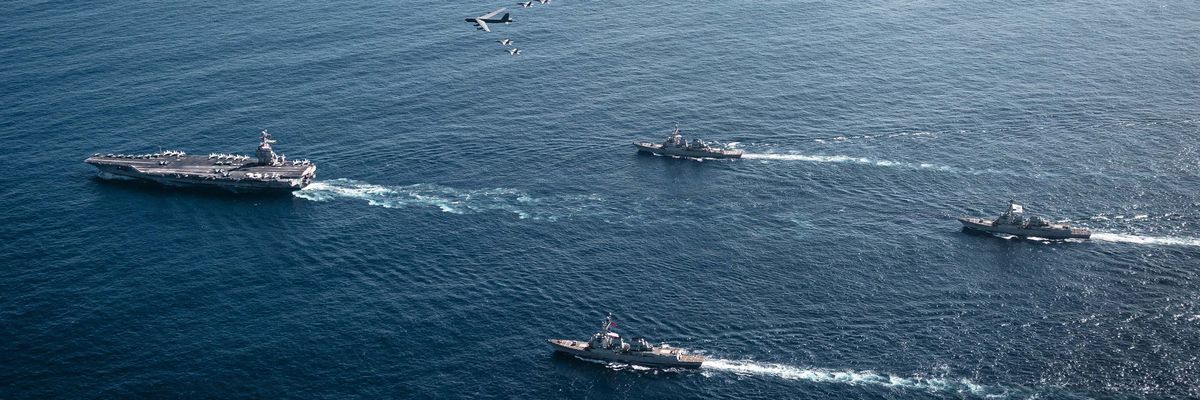
In this handout provided by the U.S. Navy, The U.S. Navy's Gerald R. Ford Carrier Strike Group, including the flagship USS Gerald R. Ford (CVN 78), left, USS Winston S. Churchill (DDG 81), front, USS Mahan (DDG 72), back, USS Bainbridge (DDG 96), and embarked Carrier Air Wing Eight F/A-18E/F Super Hornets assigned to Strike Fighter Squadrons 31, 37, 87, and 213, operates as a joint, multi-domain force with a U.S. Air Force B-52 Stratofortress, November 13, 2025.
Any act of war by the United States against Venezuela is a terrible idea.
When the Spanish King Charles I learned that Pizarro and his men had executed the Inca king Atahualpa, the Spanish monarch was deeply troubled. He worried about what precedent might be set in the killing of kings, even Latin American ones.
The United States has assembled a large fleet of warships off the coast of Venezuela, vessels crammed to the railings with sailors and Marines. Naturally, many people are wondering what the purpose of all this might be. The flotilla deployed seems at once too large and yet too small for the success of any possible mission.
The Trump administration’s claim that the US military actions in the Caribbean and now the Pacific–carrying out strikes on small boats, allegedly to stem the flow of fentanyl and/or cocaine to the US–does not match the facts. Fentanyl for US drug users is manufactured in Mexico using raw materials the cartels import from China. Fentanyl comes into the US mainly hidden in trucks driving in from Mexico. Cocaine, made from coca leaves grown in Colombia, Peru, and Bolivia, is processed in Colombia and then shipped to Central America or Mexico to be imported into the US, mainly in trucks. Venezuela is a minor player in the drug trade to the US, instead taking part in some of the transport of cocaine to European consumers.
The American military power now in the Caribbean has been very poorly positioned if the purpose is to halt the flow of illegal drugs into the United States. The warships are in the wrong place and the fleet is needlessly large for the task. If the point is to blow up more small craft suspected of moving illegal drugs, it is worth recalling that, until now, drug running has not been a death penalty offense in the United States. Until now, drug dealers have received trials, with evidence presented, and juries deciding guilt or innocence.
Since President Richard Nixon declared a “war on drugs,” the project has lumbered on, decade after decade (except of course in the case of the heretofore dangerous and illegal drug marijuana, which can now be lawfully purchased and used for recreational purposes in 24 states). The war on drugs was ill-conceived from the beginning. It has cost countless lives, wasted billions of dollars, and has been, it is fair to say, a complete failure. It is way past time for taking a different approach, one that has as its goal the minimization of the harm that dangerous, addictive drugs can do. What drug addicts deserve is not prison; they deserve our sympathy.
If the purpose of the positioning of US warships near Venezuela is to kill President Nicolás Maduro, then this is the sort of project that even Charles I would agree is a bad example to set. It should not be American policy to murder tyrannical leaders, no matter how bad.
If the plan is to strike at the Venezuelan military, this attack could not possibly kill anywhere near enough of the young men and women who joined the military out of patriotism or because they had so few other job options. The Venezuelan military and militia number in the hundreds of thousands. If attacked, we would be wise to suppose that their response will be motivated by national pride and acts of self-defense.
If the plan is to destroy Venezuela’s economic assets, this would be an especially bad idea. We would be attacking a US company, as much of the petroleum equipment belongs to Chevron Oil. Worse still, if the economic misery of the Venezuelan people is horrible now, it will be even worse if the U.S. destroys the nation’s number one economic asset.
If the plan is to invade Venezuela and topple the government, then the U.S. would need a vastly larger force. Recall that when the U.S. invaded Iraq in 1991 to free the monarchy of Kuwait from Iraqi control, the U.S. military assembled an army of over 500,000 to carry out the mission. At most, the U.S. has 16,000 armed troops bobbing about on ships adjacent to Venezuela. If the U.S. invades Venezuela with a force of this size, don’t count on an easy victory. Invading Venezuela would be another Bay of Pigs, the 1961 CIA operation to overthrow Castro that ended in a bloody fiasco.
If the US somehow manages to kill Maduro, don’t expect a happy result for Venezuela. The Venezuelan military is united in one goal: corruptly profiting from an authoritarian regime. If Maduro is dead or gone, one can expect that the various elements of the Venezuelan armed forces will splinter and fight one another over which branch or group in the military will get to control the continuing looting of the nation. With a US military invasion–either with the impossible goal of trying to occupy the country, or even with less ambitious goal of just assassinating Maduro–the likely result in Venezuela will be civil war and military rule.
There are many authoritarian leaders in the world, those who try to stage coups to overturn election results, vastly overstep the laws that would limit their power, those who rule by decree, and who try to jail their personal enemies. But no one is proposing that the American armed forces should remove any of these autocratic rulers.
Any US act of war against Venezuela is a terrible idea. Many people will die, nothing will be solved, and America will find that it has created a new generation of enemies.
Dear Common Dreams reader, It’s been nearly 30 years since I co-founded Common Dreams with my late wife, Lina Newhouser. We had the radical notion that journalism should serve the public good, not corporate profits. It was clear to us from the outset what it would take to build such a project. No paid advertisements. No corporate sponsors. No millionaire publisher telling us what to think or do. Many people said we wouldn't last a year, but we proved those doubters wrong. Together with a tremendous team of journalists and dedicated staff, we built an independent media outlet free from the constraints of profits and corporate control. Our mission has always been simple: To inform. To inspire. To ignite change for the common good. Building Common Dreams was not easy. Our survival was never guaranteed. When you take on the most powerful forces—Wall Street greed, fossil fuel industry destruction, Big Tech lobbyists, and uber-rich oligarchs who have spent billions upon billions rigging the economy and democracy in their favor—the only bulwark you have is supporters who believe in your work. But here’s the urgent message from me today. It's never been this bad out there. And it's never been this hard to keep us going. At the very moment Common Dreams is most needed, the threats we face are intensifying. We need your support now more than ever. We don't accept corporate advertising and never will. We don't have a paywall because we don't think people should be blocked from critical news based on their ability to pay. Everything we do is funded by the donations of readers like you. When everyone does the little they can afford, we are strong. But if that support retreats or dries up, so do we. Will you donate now to make sure Common Dreams not only survives but thrives? —Craig Brown, Co-founder |
When the Spanish King Charles I learned that Pizarro and his men had executed the Inca king Atahualpa, the Spanish monarch was deeply troubled. He worried about what precedent might be set in the killing of kings, even Latin American ones.
The United States has assembled a large fleet of warships off the coast of Venezuela, vessels crammed to the railings with sailors and Marines. Naturally, many people are wondering what the purpose of all this might be. The flotilla deployed seems at once too large and yet too small for the success of any possible mission.
The Trump administration’s claim that the US military actions in the Caribbean and now the Pacific–carrying out strikes on small boats, allegedly to stem the flow of fentanyl and/or cocaine to the US–does not match the facts. Fentanyl for US drug users is manufactured in Mexico using raw materials the cartels import from China. Fentanyl comes into the US mainly hidden in trucks driving in from Mexico. Cocaine, made from coca leaves grown in Colombia, Peru, and Bolivia, is processed in Colombia and then shipped to Central America or Mexico to be imported into the US, mainly in trucks. Venezuela is a minor player in the drug trade to the US, instead taking part in some of the transport of cocaine to European consumers.
The American military power now in the Caribbean has been very poorly positioned if the purpose is to halt the flow of illegal drugs into the United States. The warships are in the wrong place and the fleet is needlessly large for the task. If the point is to blow up more small craft suspected of moving illegal drugs, it is worth recalling that, until now, drug running has not been a death penalty offense in the United States. Until now, drug dealers have received trials, with evidence presented, and juries deciding guilt or innocence.
Since President Richard Nixon declared a “war on drugs,” the project has lumbered on, decade after decade (except of course in the case of the heretofore dangerous and illegal drug marijuana, which can now be lawfully purchased and used for recreational purposes in 24 states). The war on drugs was ill-conceived from the beginning. It has cost countless lives, wasted billions of dollars, and has been, it is fair to say, a complete failure. It is way past time for taking a different approach, one that has as its goal the minimization of the harm that dangerous, addictive drugs can do. What drug addicts deserve is not prison; they deserve our sympathy.
If the purpose of the positioning of US warships near Venezuela is to kill President Nicolás Maduro, then this is the sort of project that even Charles I would agree is a bad example to set. It should not be American policy to murder tyrannical leaders, no matter how bad.
If the plan is to strike at the Venezuelan military, this attack could not possibly kill anywhere near enough of the young men and women who joined the military out of patriotism or because they had so few other job options. The Venezuelan military and militia number in the hundreds of thousands. If attacked, we would be wise to suppose that their response will be motivated by national pride and acts of self-defense.
If the plan is to destroy Venezuela’s economic assets, this would be an especially bad idea. We would be attacking a US company, as much of the petroleum equipment belongs to Chevron Oil. Worse still, if the economic misery of the Venezuelan people is horrible now, it will be even worse if the U.S. destroys the nation’s number one economic asset.
If the plan is to invade Venezuela and topple the government, then the U.S. would need a vastly larger force. Recall that when the U.S. invaded Iraq in 1991 to free the monarchy of Kuwait from Iraqi control, the U.S. military assembled an army of over 500,000 to carry out the mission. At most, the U.S. has 16,000 armed troops bobbing about on ships adjacent to Venezuela. If the U.S. invades Venezuela with a force of this size, don’t count on an easy victory. Invading Venezuela would be another Bay of Pigs, the 1961 CIA operation to overthrow Castro that ended in a bloody fiasco.
If the US somehow manages to kill Maduro, don’t expect a happy result for Venezuela. The Venezuelan military is united in one goal: corruptly profiting from an authoritarian regime. If Maduro is dead or gone, one can expect that the various elements of the Venezuelan armed forces will splinter and fight one another over which branch or group in the military will get to control the continuing looting of the nation. With a US military invasion–either with the impossible goal of trying to occupy the country, or even with less ambitious goal of just assassinating Maduro–the likely result in Venezuela will be civil war and military rule.
There are many authoritarian leaders in the world, those who try to stage coups to overturn election results, vastly overstep the laws that would limit their power, those who rule by decree, and who try to jail their personal enemies. But no one is proposing that the American armed forces should remove any of these autocratic rulers.
Any US act of war against Venezuela is a terrible idea. Many people will die, nothing will be solved, and America will find that it has created a new generation of enemies.
When the Spanish King Charles I learned that Pizarro and his men had executed the Inca king Atahualpa, the Spanish monarch was deeply troubled. He worried about what precedent might be set in the killing of kings, even Latin American ones.
The United States has assembled a large fleet of warships off the coast of Venezuela, vessels crammed to the railings with sailors and Marines. Naturally, many people are wondering what the purpose of all this might be. The flotilla deployed seems at once too large and yet too small for the success of any possible mission.
The Trump administration’s claim that the US military actions in the Caribbean and now the Pacific–carrying out strikes on small boats, allegedly to stem the flow of fentanyl and/or cocaine to the US–does not match the facts. Fentanyl for US drug users is manufactured in Mexico using raw materials the cartels import from China. Fentanyl comes into the US mainly hidden in trucks driving in from Mexico. Cocaine, made from coca leaves grown in Colombia, Peru, and Bolivia, is processed in Colombia and then shipped to Central America or Mexico to be imported into the US, mainly in trucks. Venezuela is a minor player in the drug trade to the US, instead taking part in some of the transport of cocaine to European consumers.
The American military power now in the Caribbean has been very poorly positioned if the purpose is to halt the flow of illegal drugs into the United States. The warships are in the wrong place and the fleet is needlessly large for the task. If the point is to blow up more small craft suspected of moving illegal drugs, it is worth recalling that, until now, drug running has not been a death penalty offense in the United States. Until now, drug dealers have received trials, with evidence presented, and juries deciding guilt or innocence.
Since President Richard Nixon declared a “war on drugs,” the project has lumbered on, decade after decade (except of course in the case of the heretofore dangerous and illegal drug marijuana, which can now be lawfully purchased and used for recreational purposes in 24 states). The war on drugs was ill-conceived from the beginning. It has cost countless lives, wasted billions of dollars, and has been, it is fair to say, a complete failure. It is way past time for taking a different approach, one that has as its goal the minimization of the harm that dangerous, addictive drugs can do. What drug addicts deserve is not prison; they deserve our sympathy.
If the purpose of the positioning of US warships near Venezuela is to kill President Nicolás Maduro, then this is the sort of project that even Charles I would agree is a bad example to set. It should not be American policy to murder tyrannical leaders, no matter how bad.
If the plan is to strike at the Venezuelan military, this attack could not possibly kill anywhere near enough of the young men and women who joined the military out of patriotism or because they had so few other job options. The Venezuelan military and militia number in the hundreds of thousands. If attacked, we would be wise to suppose that their response will be motivated by national pride and acts of self-defense.
If the plan is to destroy Venezuela’s economic assets, this would be an especially bad idea. We would be attacking a US company, as much of the petroleum equipment belongs to Chevron Oil. Worse still, if the economic misery of the Venezuelan people is horrible now, it will be even worse if the U.S. destroys the nation’s number one economic asset.
If the plan is to invade Venezuela and topple the government, then the U.S. would need a vastly larger force. Recall that when the U.S. invaded Iraq in 1991 to free the monarchy of Kuwait from Iraqi control, the U.S. military assembled an army of over 500,000 to carry out the mission. At most, the U.S. has 16,000 armed troops bobbing about on ships adjacent to Venezuela. If the U.S. invades Venezuela with a force of this size, don’t count on an easy victory. Invading Venezuela would be another Bay of Pigs, the 1961 CIA operation to overthrow Castro that ended in a bloody fiasco.
If the US somehow manages to kill Maduro, don’t expect a happy result for Venezuela. The Venezuelan military is united in one goal: corruptly profiting from an authoritarian regime. If Maduro is dead or gone, one can expect that the various elements of the Venezuelan armed forces will splinter and fight one another over which branch or group in the military will get to control the continuing looting of the nation. With a US military invasion–either with the impossible goal of trying to occupy the country, or even with less ambitious goal of just assassinating Maduro–the likely result in Venezuela will be civil war and military rule.
There are many authoritarian leaders in the world, those who try to stage coups to overturn election results, vastly overstep the laws that would limit their power, those who rule by decree, and who try to jail their personal enemies. But no one is proposing that the American armed forces should remove any of these autocratic rulers.
Any US act of war against Venezuela is a terrible idea. Many people will die, nothing will be solved, and America will find that it has created a new generation of enemies.