SUBSCRIBE TO OUR FREE NEWSLETTER
Daily news & progressive opinion—funded by the people, not the corporations—delivered straight to your inbox.
5
#000000
#FFFFFF
To donate by check, phone, or other method, see our More Ways to Give page.
Daily news & progressive opinion—funded by the people, not the corporations—delivered straight to your inbox.
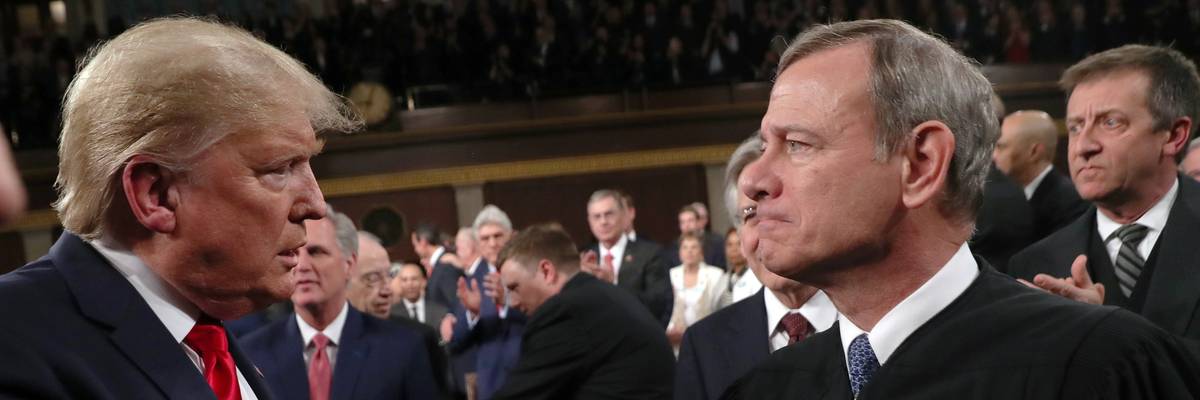
US President Donald Trump shakes hands with Supreme Court Chief Justice John Roberts before the State of the Union address in the House chamber on February 4, 2020 in Washington, DC.
By relying on the fiction they invented rather than the president we actually have, the Supreme Court has chosen to treat Donald Trump as someone who not only can be, but must be, trusted with yet more unfettered power.
While driving home on June 30, my head nearly exploded as I listened to the evening news. Reporting on a raft of last-minute decisions passed by the Supreme Court in advance of the summer holidays, the SCOTUS correspondent explained that certain contra-Trump statutes barely managed to hold on for dear life while a more substantial pile of pro-Trump agenda items flew through with room to spare. It was the “you win some, you lose some” tone of the report that set my blood boiling. It felt like I was being told that, on the one hand, SCOTUS had cleared the way for the private purchase of thermonuclear weapons over the internet, exactly as the framers of the Constitution intended, but on the other, that such weapons could not (at least for the moment) be purchased by children under 12 without parental consent. So it’s a win for both sides.
It wasn’t as blatantly bad as that, I admit. But the strained attempt to keep things balanced, if only for old time’s sake, was certainly there. Times being what they are now, it did not sit well with me.
But the single most infuriating moment of the report was when the SCOTUS correspondent quoted Chief Justice Roberts defending the 6-3 decision to strike down a 91-year-old precedent that barred the president from firing members of the Federal Trade Commission (FTC) other than for reasons of “inefficiency, neglect of duty, or malfeasance.” In writing for the majority, Roberts argued that “the President must have the assistance of officers he can trust.”
It was upon hearing those exact words that my head exploded. Did Chief Justice Roberts actually write what the reporter just claimed he wrote? Could he really have allowed himself to frame the decision in terms of trust?!! The absurdity of the rationale blew my mind. The whole idea of creating multi-member commissions, such as the FTC, as independent agencies in the first place was to ensure that they could be trusted. It is their independence that actually allows the members of the commission to do their work without fear of reprisal. It’s what keeps them from becoming a board of lackeys subservient to the whims of whoever happens to be in power. In a word, the thing that the Supreme Court ruled out by this decision is the one thing that has always allowed us to trust these agencies. Without it, trust disappears.
According to those rules, instead of causing people to tell lies and flatter egos as their best means of survival, the act of investing one man with the power to bully, punish, and fire as he pleases brings about a relationship of “trust.”
One of the biggest problems in states ruled by autocrats is precisely that: Trust goes missing, becoming a rare commodity desperately sought after, but rarely found. During the Hellenistic Period in ancient Greece, regional monarchs would invite Cynic philosophers into their courts so that they might have just one person to talk to who could be counted on to tell them the truth. As impoverished beggars, happy in that condition, the Cynics had nothing to gain by lying, nothing to lose by telling the truth. They were independent.
But Chief Justice Roberts would have us believe that he knows better about such things. He and the wiser minds of his Supreme Court treat their legal interpretations as a kind of parlor game played by experts for the sake of theoretical purity and one-upmanship. Like Medieval scholars arguing over how many thorns were in Christ’s crown, they don their robes, play their game, issue their rulings, and retire to their summer homes. Meanwhile, their decisions have consequences in the world outside the parlor that, somehow, aren’t really their concern. No. Their focus is on the intentions of the Constitution’s framers. They are the ones they want to make sure are happy and well cared for by their decisions. They, the long dead, ghosts of their own invention, are the ones that really matter.
In fact, the one non-dead person whom Chief Justice Roberts expressed a keen interest in helping with his decision was just that: one person. The president. Not the demos of our democracy, the voting citizens of this country, to the tune of several hundred million people who are still very much alive. He worried that that one man’s power might be unduly hampered if he were not allowed to fire whomever he wanted for whatever reason. His rationale amounts to a set of quotes from the rule book of a new game that he and his like-minded friends on the court have invented. They play it within his parlor while sipping brandy. It’s called “The Unitary Executive.”
This is a fantasy game, rather like Dungeons and Dragons. In it, the rules of reality outside the parlor, out in the real world, are called off in favor of the rules of the parlor and of the game itself. According to those rules, instead of causing people to tell lies and flatter egos as their best means of survival, the act of investing one man with the power to bully, punish, and fire as he pleases brings about a relationship of “trust.” It’s all quite wonderful.
To make this game work, Justice Roberts and his parlor friends had to invent an equally fantastical person to do the trusting: a president who has our best interests in mind, one who can always be counted on to act in good faith. This, their game-piece president, is not a vindictive liar, greedy for power. He is a wonderful fiction, good to play with. And so it is that, by relying on the parlor fiction they invented rather than the president we actually have, the Supreme Court has chosen to treat Donald Trump as someone who not only can be, but must be, trusted with yet more unfettered power. But not to worry. They assure us that, according to the rules of the game, nothing bad can come of this.
Dear Common Dreams reader, It’s been nearly 30 years since I co-founded Common Dreams with my late wife, Lina Newhouser. We had the radical notion that journalism should serve the public good, not corporate profits. It was clear to us from the outset what it would take to build such a project. No paid advertisements. No corporate sponsors. No millionaire publisher telling us what to think or do. Many people said we wouldn't last a year, but we proved those doubters wrong. Together with a tremendous team of journalists and dedicated staff, we built an independent media outlet free from the constraints of profits and corporate control. Our mission has always been simple: To inform. To inspire. To ignite change for the common good. Building Common Dreams was not easy. Our survival was never guaranteed. When you take on the most powerful forces—Wall Street greed, fossil fuel industry destruction, Big Tech lobbyists, and uber-rich oligarchs who have spent billions upon billions rigging the economy and democracy in their favor—the only bulwark you have is supporters who believe in your work. But here’s the urgent message from me today. It's never been this bad out there. And it's never been this hard to keep us going. At the very moment Common Dreams is most needed, the threats we face are intensifying. We need your support now more than ever. We don't accept corporate advertising and never will. We don't have a paywall because we don't think people should be blocked from critical news based on their ability to pay. Everything we do is funded by the donations of readers like you. When everyone does the little they can afford, we are strong. But if that support retreats or dries up, so do we. Will you donate now to make sure Common Dreams not only survives but thrives? —Craig Brown, Co-founder |
While driving home on June 30, my head nearly exploded as I listened to the evening news. Reporting on a raft of last-minute decisions passed by the Supreme Court in advance of the summer holidays, the SCOTUS correspondent explained that certain contra-Trump statutes barely managed to hold on for dear life while a more substantial pile of pro-Trump agenda items flew through with room to spare. It was the “you win some, you lose some” tone of the report that set my blood boiling. It felt like I was being told that, on the one hand, SCOTUS had cleared the way for the private purchase of thermonuclear weapons over the internet, exactly as the framers of the Constitution intended, but on the other, that such weapons could not (at least for the moment) be purchased by children under 12 without parental consent. So it’s a win for both sides.
It wasn’t as blatantly bad as that, I admit. But the strained attempt to keep things balanced, if only for old time’s sake, was certainly there. Times being what they are now, it did not sit well with me.
But the single most infuriating moment of the report was when the SCOTUS correspondent quoted Chief Justice Roberts defending the 6-3 decision to strike down a 91-year-old precedent that barred the president from firing members of the Federal Trade Commission (FTC) other than for reasons of “inefficiency, neglect of duty, or malfeasance.” In writing for the majority, Roberts argued that “the President must have the assistance of officers he can trust.”
It was upon hearing those exact words that my head exploded. Did Chief Justice Roberts actually write what the reporter just claimed he wrote? Could he really have allowed himself to frame the decision in terms of trust?!! The absurdity of the rationale blew my mind. The whole idea of creating multi-member commissions, such as the FTC, as independent agencies in the first place was to ensure that they could be trusted. It is their independence that actually allows the members of the commission to do their work without fear of reprisal. It’s what keeps them from becoming a board of lackeys subservient to the whims of whoever happens to be in power. In a word, the thing that the Supreme Court ruled out by this decision is the one thing that has always allowed us to trust these agencies. Without it, trust disappears.
According to those rules, instead of causing people to tell lies and flatter egos as their best means of survival, the act of investing one man with the power to bully, punish, and fire as he pleases brings about a relationship of “trust.”
One of the biggest problems in states ruled by autocrats is precisely that: Trust goes missing, becoming a rare commodity desperately sought after, but rarely found. During the Hellenistic Period in ancient Greece, regional monarchs would invite Cynic philosophers into their courts so that they might have just one person to talk to who could be counted on to tell them the truth. As impoverished beggars, happy in that condition, the Cynics had nothing to gain by lying, nothing to lose by telling the truth. They were independent.
But Chief Justice Roberts would have us believe that he knows better about such things. He and the wiser minds of his Supreme Court treat their legal interpretations as a kind of parlor game played by experts for the sake of theoretical purity and one-upmanship. Like Medieval scholars arguing over how many thorns were in Christ’s crown, they don their robes, play their game, issue their rulings, and retire to their summer homes. Meanwhile, their decisions have consequences in the world outside the parlor that, somehow, aren’t really their concern. No. Their focus is on the intentions of the Constitution’s framers. They are the ones they want to make sure are happy and well cared for by their decisions. They, the long dead, ghosts of their own invention, are the ones that really matter.
In fact, the one non-dead person whom Chief Justice Roberts expressed a keen interest in helping with his decision was just that: one person. The president. Not the demos of our democracy, the voting citizens of this country, to the tune of several hundred million people who are still very much alive. He worried that that one man’s power might be unduly hampered if he were not allowed to fire whomever he wanted for whatever reason. His rationale amounts to a set of quotes from the rule book of a new game that he and his like-minded friends on the court have invented. They play it within his parlor while sipping brandy. It’s called “The Unitary Executive.”
This is a fantasy game, rather like Dungeons and Dragons. In it, the rules of reality outside the parlor, out in the real world, are called off in favor of the rules of the parlor and of the game itself. According to those rules, instead of causing people to tell lies and flatter egos as their best means of survival, the act of investing one man with the power to bully, punish, and fire as he pleases brings about a relationship of “trust.” It’s all quite wonderful.
To make this game work, Justice Roberts and his parlor friends had to invent an equally fantastical person to do the trusting: a president who has our best interests in mind, one who can always be counted on to act in good faith. This, their game-piece president, is not a vindictive liar, greedy for power. He is a wonderful fiction, good to play with. And so it is that, by relying on the parlor fiction they invented rather than the president we actually have, the Supreme Court has chosen to treat Donald Trump as someone who not only can be, but must be, trusted with yet more unfettered power. But not to worry. They assure us that, according to the rules of the game, nothing bad can come of this.
While driving home on June 30, my head nearly exploded as I listened to the evening news. Reporting on a raft of last-minute decisions passed by the Supreme Court in advance of the summer holidays, the SCOTUS correspondent explained that certain contra-Trump statutes barely managed to hold on for dear life while a more substantial pile of pro-Trump agenda items flew through with room to spare. It was the “you win some, you lose some” tone of the report that set my blood boiling. It felt like I was being told that, on the one hand, SCOTUS had cleared the way for the private purchase of thermonuclear weapons over the internet, exactly as the framers of the Constitution intended, but on the other, that such weapons could not (at least for the moment) be purchased by children under 12 without parental consent. So it’s a win for both sides.
It wasn’t as blatantly bad as that, I admit. But the strained attempt to keep things balanced, if only for old time’s sake, was certainly there. Times being what they are now, it did not sit well with me.
But the single most infuriating moment of the report was when the SCOTUS correspondent quoted Chief Justice Roberts defending the 6-3 decision to strike down a 91-year-old precedent that barred the president from firing members of the Federal Trade Commission (FTC) other than for reasons of “inefficiency, neglect of duty, or malfeasance.” In writing for the majority, Roberts argued that “the President must have the assistance of officers he can trust.”
It was upon hearing those exact words that my head exploded. Did Chief Justice Roberts actually write what the reporter just claimed he wrote? Could he really have allowed himself to frame the decision in terms of trust?!! The absurdity of the rationale blew my mind. The whole idea of creating multi-member commissions, such as the FTC, as independent agencies in the first place was to ensure that they could be trusted. It is their independence that actually allows the members of the commission to do their work without fear of reprisal. It’s what keeps them from becoming a board of lackeys subservient to the whims of whoever happens to be in power. In a word, the thing that the Supreme Court ruled out by this decision is the one thing that has always allowed us to trust these agencies. Without it, trust disappears.
According to those rules, instead of causing people to tell lies and flatter egos as their best means of survival, the act of investing one man with the power to bully, punish, and fire as he pleases brings about a relationship of “trust.”
One of the biggest problems in states ruled by autocrats is precisely that: Trust goes missing, becoming a rare commodity desperately sought after, but rarely found. During the Hellenistic Period in ancient Greece, regional monarchs would invite Cynic philosophers into their courts so that they might have just one person to talk to who could be counted on to tell them the truth. As impoverished beggars, happy in that condition, the Cynics had nothing to gain by lying, nothing to lose by telling the truth. They were independent.
But Chief Justice Roberts would have us believe that he knows better about such things. He and the wiser minds of his Supreme Court treat their legal interpretations as a kind of parlor game played by experts for the sake of theoretical purity and one-upmanship. Like Medieval scholars arguing over how many thorns were in Christ’s crown, they don their robes, play their game, issue their rulings, and retire to their summer homes. Meanwhile, their decisions have consequences in the world outside the parlor that, somehow, aren’t really their concern. No. Their focus is on the intentions of the Constitution’s framers. They are the ones they want to make sure are happy and well cared for by their decisions. They, the long dead, ghosts of their own invention, are the ones that really matter.
In fact, the one non-dead person whom Chief Justice Roberts expressed a keen interest in helping with his decision was just that: one person. The president. Not the demos of our democracy, the voting citizens of this country, to the tune of several hundred million people who are still very much alive. He worried that that one man’s power might be unduly hampered if he were not allowed to fire whomever he wanted for whatever reason. His rationale amounts to a set of quotes from the rule book of a new game that he and his like-minded friends on the court have invented. They play it within his parlor while sipping brandy. It’s called “The Unitary Executive.”
This is a fantasy game, rather like Dungeons and Dragons. In it, the rules of reality outside the parlor, out in the real world, are called off in favor of the rules of the parlor and of the game itself. According to those rules, instead of causing people to tell lies and flatter egos as their best means of survival, the act of investing one man with the power to bully, punish, and fire as he pleases brings about a relationship of “trust.” It’s all quite wonderful.
To make this game work, Justice Roberts and his parlor friends had to invent an equally fantastical person to do the trusting: a president who has our best interests in mind, one who can always be counted on to act in good faith. This, their game-piece president, is not a vindictive liar, greedy for power. He is a wonderful fiction, good to play with. And so it is that, by relying on the parlor fiction they invented rather than the president we actually have, the Supreme Court has chosen to treat Donald Trump as someone who not only can be, but must be, trusted with yet more unfettered power. But not to worry. They assure us that, according to the rules of the game, nothing bad can come of this.