SUBSCRIBE TO OUR FREE NEWSLETTER
Daily news & progressive opinion—funded by the people, not the corporations—delivered straight to your inbox.
5
#000000
#FFFFFF
To donate by check, phone, or other method, see our More Ways to Give page.
Daily news & progressive opinion—funded by the people, not the corporations—delivered straight to your inbox.
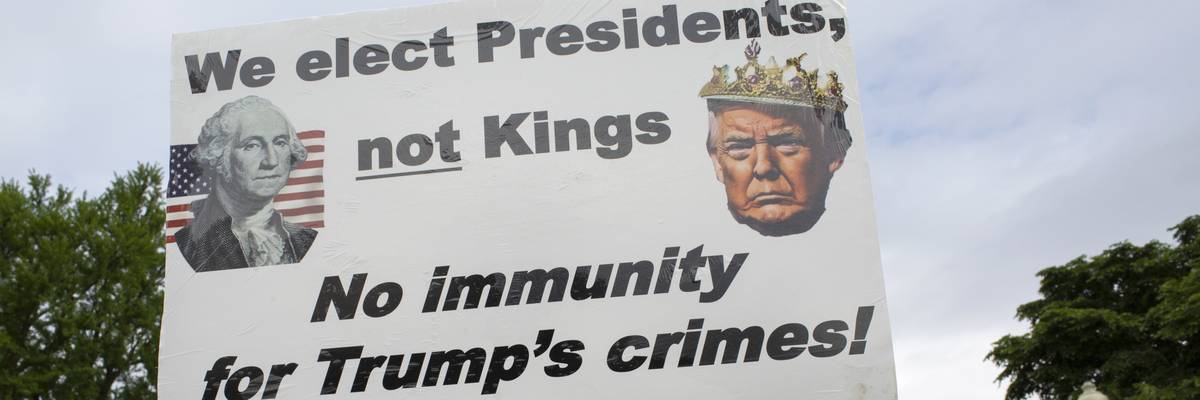
An activist holding a sign with “We elect Presidents, Not Kings, No Immunity for Trump’s Crimes” written on it stands outside the U.S. Supreme Court on April 25, 2024 as the court prepares to hear arguments on the immunity of former U.S. President Donald Trump in Washington, D.C.
The court has issued an instruction manual for future lawbreaking presidents: Make sure you conspire only with other government employees. You’ll never be held to account.
It long had seemed that the “stall” would be the worst thing the Supreme Court could do when it came to Donald Trump’s claim of immunity from prosecution. How naive.
Delay there will be. The six justices in the Republican-appointed supermajority held, “A former president is entitled to absolute immunity from criminal prosecution for actions within his ‘conclusive and preclusive constitutional authority.’” They added, “There is no immunity for unofficial acts.” Rather than make clear that trying to overthrow the Constitution’s peaceful transfer of power is not an official act, the justices send the whole matter back to trial judge Tanya Chutkan. Expect more consideration, more parsing, more rulings, more appeals. It will all likely end up at the Supreme Court again in a year, if the whole prosecution isn’t shut down entirely.
But damage to our system goes well beyond delay. Trump v. U.S. astounds in its implications. It grants the president the power of a monarch. Richard Nixon defended his conduct in Watergate, telling interviewer David Frost, “When the president does it, that means it’s not illegal.” Effectively, the Supreme Court’s supermajority has now enshrined that brazen claim.
The presidential immunity concocted today would have blessed most of Nixon’s crimes.
To be clear, there are reasons to be nervous about prosecuting former chief executives, so some standards make sense. In this case, though, the court has issued an instruction manual for future lawbreaking presidents: Make sure you conspire only with other government employees. You’ll never be held to account.
What makes something an official act? “In dividing official from unofficial conduct, courts may not inquire into the president’s motives,” the justices ruled. And a jury cannot learn about the other parts of a criminal conspiracy that may involve official acts.
Justice Amy Coney Barrett did not agree with this last critical point. She said that of course juries can consider the context of a criminal act. Neither Justice Samuel Alito (who flew insurrectionist flags outside his two homes) nor Justice Clarence Thomas (whose wife was on the Ellipse on January 6) recused themselves. They cast the deciding votes to keep from jurors the full story of the attempted overthrow of the Constitution.
The founders said repeatedly that presidents have no special immunity, as a brief filed by the Brennan Center on behalf of top historians made plain. After all, that was one of the very things about the British monarchy that they hated and against which they rebelled.
Even more directly, this ruling undoes the restrictions on presidential abuse of power put in place by officials and jurists of both parties since the 1970s.
The imperial presidency described an age of growing executive authority and abuse of power. It came crashing to an end during Watergate and after revelations about the misuse of intelligence and law enforcement by Nixon’s predecessors.
The presidential immunity concocted today would have blessed most of Nixon’s crimes. Nixon ordered his White House counsel to pay hush money to burglars in an Oval Office meeting on March 21, 1973. Presumptively an official act? He dangled clemency before E. Howard Hunt, one of the conspirators. Use of the pardon power—entirely immune? He resigned when a tape revealed he had ordered the CIA to go to the FBI to end the investigation of the burglars sent by his campaign committee. “Play it tough,” he told his White House chief of staff. On its face, official.
What about other criminal cases involving high officials? In the Iran-Contra scandal of the late 1980s, numerous officials were charged (including the national security adviser and the defense secretary). Ronald Reagan faced no charges, but not because he was presumed immune. What if he did break the law—would he have escaped accountability? In 2001, federal prosecutors probed whether Bill Clinton sold pardons. They cleared him—but issuing a pardon is surely an official act.
In her dissent, Justice Sonia Sotomayor said it plainly: “Under [the majority’s] rule, any use of official power for any purpose, even the most corrupt purpose indicated by objective evidence of the most corrupt motives and intent, remains official and immune. Under the majority’s test, if it can be called a test, the category of presidential action that can be deemed ‘unofficial’ is destined to be vanishingly small.”
So, yes, all this will delay Trump’s trial. In that sense, he gets what he craved. But the implications are far worse for the structure of American self-government.
It is a massive failure for Chief Justice John Roberts. The other major rulings on presidential accountability for legal wrongdoing have been unanimous. U.S. v. Nixon (limiting executive privilege) was written by the Republican chief justice Nixon appointed, and it was unanimous. Clinton v. Jones (opening the president to civil suit even while in office) was unanimous. Let’s grant that Roberts is an institutionalist. He is presiding over the collapse of public trust in the very institution he purports to revere.
And Trump v. U.S. has enormous implications for the future of the presidency. Remember that utterly bonkers hypothetical from the appeals court argument—that a president could order SEAL Team Six to assassinate an opponent? Sotomayor again: “A hypothetical president who admits to having ordered the assassinations of his political rivals or critics... has a fair shot at getting immunity under the majority’s new presidential accountability model.”
We read sonorous language in the majority opinion that “the president is not above the law.” But just in time for Independence Day, the Supreme Court brings us closer to having a king again.
Dear Common Dreams reader, It’s been nearly 30 years since I co-founded Common Dreams with my late wife, Lina Newhouser. We had the radical notion that journalism should serve the public good, not corporate profits. It was clear to us from the outset what it would take to build such a project. No paid advertisements. No corporate sponsors. No millionaire publisher telling us what to think or do. Many people said we wouldn't last a year, but we proved those doubters wrong. Together with a tremendous team of journalists and dedicated staff, we built an independent media outlet free from the constraints of profits and corporate control. Our mission has always been simple: To inform. To inspire. To ignite change for the common good. Building Common Dreams was not easy. Our survival was never guaranteed. When you take on the most powerful forces—Wall Street greed, fossil fuel industry destruction, Big Tech lobbyists, and uber-rich oligarchs who have spent billions upon billions rigging the economy and democracy in their favor—the only bulwark you have is supporters who believe in your work. But here’s the urgent message from me today. It's never been this bad out there. And it's never been this hard to keep us going. At the very moment Common Dreams is most needed, the threats we face are intensifying. We need your support now more than ever. We don't accept corporate advertising and never will. We don't have a paywall because we don't think people should be blocked from critical news based on their ability to pay. Everything we do is funded by the donations of readers like you. When everyone does the little they can afford, we are strong. But if that support retreats or dries up, so do we. Will you donate now to make sure Common Dreams not only survives but thrives? —Craig Brown, Co-founder |
It long had seemed that the “stall” would be the worst thing the Supreme Court could do when it came to Donald Trump’s claim of immunity from prosecution. How naive.
Delay there will be. The six justices in the Republican-appointed supermajority held, “A former president is entitled to absolute immunity from criminal prosecution for actions within his ‘conclusive and preclusive constitutional authority.’” They added, “There is no immunity for unofficial acts.” Rather than make clear that trying to overthrow the Constitution’s peaceful transfer of power is not an official act, the justices send the whole matter back to trial judge Tanya Chutkan. Expect more consideration, more parsing, more rulings, more appeals. It will all likely end up at the Supreme Court again in a year, if the whole prosecution isn’t shut down entirely.
But damage to our system goes well beyond delay. Trump v. U.S. astounds in its implications. It grants the president the power of a monarch. Richard Nixon defended his conduct in Watergate, telling interviewer David Frost, “When the president does it, that means it’s not illegal.” Effectively, the Supreme Court’s supermajority has now enshrined that brazen claim.
The presidential immunity concocted today would have blessed most of Nixon’s crimes.
To be clear, there are reasons to be nervous about prosecuting former chief executives, so some standards make sense. In this case, though, the court has issued an instruction manual for future lawbreaking presidents: Make sure you conspire only with other government employees. You’ll never be held to account.
What makes something an official act? “In dividing official from unofficial conduct, courts may not inquire into the president’s motives,” the justices ruled. And a jury cannot learn about the other parts of a criminal conspiracy that may involve official acts.
Justice Amy Coney Barrett did not agree with this last critical point. She said that of course juries can consider the context of a criminal act. Neither Justice Samuel Alito (who flew insurrectionist flags outside his two homes) nor Justice Clarence Thomas (whose wife was on the Ellipse on January 6) recused themselves. They cast the deciding votes to keep from jurors the full story of the attempted overthrow of the Constitution.
The founders said repeatedly that presidents have no special immunity, as a brief filed by the Brennan Center on behalf of top historians made plain. After all, that was one of the very things about the British monarchy that they hated and against which they rebelled.
Even more directly, this ruling undoes the restrictions on presidential abuse of power put in place by officials and jurists of both parties since the 1970s.
The imperial presidency described an age of growing executive authority and abuse of power. It came crashing to an end during Watergate and after revelations about the misuse of intelligence and law enforcement by Nixon’s predecessors.
The presidential immunity concocted today would have blessed most of Nixon’s crimes. Nixon ordered his White House counsel to pay hush money to burglars in an Oval Office meeting on March 21, 1973. Presumptively an official act? He dangled clemency before E. Howard Hunt, one of the conspirators. Use of the pardon power—entirely immune? He resigned when a tape revealed he had ordered the CIA to go to the FBI to end the investigation of the burglars sent by his campaign committee. “Play it tough,” he told his White House chief of staff. On its face, official.
What about other criminal cases involving high officials? In the Iran-Contra scandal of the late 1980s, numerous officials were charged (including the national security adviser and the defense secretary). Ronald Reagan faced no charges, but not because he was presumed immune. What if he did break the law—would he have escaped accountability? In 2001, federal prosecutors probed whether Bill Clinton sold pardons. They cleared him—but issuing a pardon is surely an official act.
In her dissent, Justice Sonia Sotomayor said it plainly: “Under [the majority’s] rule, any use of official power for any purpose, even the most corrupt purpose indicated by objective evidence of the most corrupt motives and intent, remains official and immune. Under the majority’s test, if it can be called a test, the category of presidential action that can be deemed ‘unofficial’ is destined to be vanishingly small.”
So, yes, all this will delay Trump’s trial. In that sense, he gets what he craved. But the implications are far worse for the structure of American self-government.
It is a massive failure for Chief Justice John Roberts. The other major rulings on presidential accountability for legal wrongdoing have been unanimous. U.S. v. Nixon (limiting executive privilege) was written by the Republican chief justice Nixon appointed, and it was unanimous. Clinton v. Jones (opening the president to civil suit even while in office) was unanimous. Let’s grant that Roberts is an institutionalist. He is presiding over the collapse of public trust in the very institution he purports to revere.
And Trump v. U.S. has enormous implications for the future of the presidency. Remember that utterly bonkers hypothetical from the appeals court argument—that a president could order SEAL Team Six to assassinate an opponent? Sotomayor again: “A hypothetical president who admits to having ordered the assassinations of his political rivals or critics... has a fair shot at getting immunity under the majority’s new presidential accountability model.”
We read sonorous language in the majority opinion that “the president is not above the law.” But just in time for Independence Day, the Supreme Court brings us closer to having a king again.
It long had seemed that the “stall” would be the worst thing the Supreme Court could do when it came to Donald Trump’s claim of immunity from prosecution. How naive.
Delay there will be. The six justices in the Republican-appointed supermajority held, “A former president is entitled to absolute immunity from criminal prosecution for actions within his ‘conclusive and preclusive constitutional authority.’” They added, “There is no immunity for unofficial acts.” Rather than make clear that trying to overthrow the Constitution’s peaceful transfer of power is not an official act, the justices send the whole matter back to trial judge Tanya Chutkan. Expect more consideration, more parsing, more rulings, more appeals. It will all likely end up at the Supreme Court again in a year, if the whole prosecution isn’t shut down entirely.
But damage to our system goes well beyond delay. Trump v. U.S. astounds in its implications. It grants the president the power of a monarch. Richard Nixon defended his conduct in Watergate, telling interviewer David Frost, “When the president does it, that means it’s not illegal.” Effectively, the Supreme Court’s supermajority has now enshrined that brazen claim.
The presidential immunity concocted today would have blessed most of Nixon’s crimes.
To be clear, there are reasons to be nervous about prosecuting former chief executives, so some standards make sense. In this case, though, the court has issued an instruction manual for future lawbreaking presidents: Make sure you conspire only with other government employees. You’ll never be held to account.
What makes something an official act? “In dividing official from unofficial conduct, courts may not inquire into the president’s motives,” the justices ruled. And a jury cannot learn about the other parts of a criminal conspiracy that may involve official acts.
Justice Amy Coney Barrett did not agree with this last critical point. She said that of course juries can consider the context of a criminal act. Neither Justice Samuel Alito (who flew insurrectionist flags outside his two homes) nor Justice Clarence Thomas (whose wife was on the Ellipse on January 6) recused themselves. They cast the deciding votes to keep from jurors the full story of the attempted overthrow of the Constitution.
The founders said repeatedly that presidents have no special immunity, as a brief filed by the Brennan Center on behalf of top historians made plain. After all, that was one of the very things about the British monarchy that they hated and against which they rebelled.
Even more directly, this ruling undoes the restrictions on presidential abuse of power put in place by officials and jurists of both parties since the 1970s.
The imperial presidency described an age of growing executive authority and abuse of power. It came crashing to an end during Watergate and after revelations about the misuse of intelligence and law enforcement by Nixon’s predecessors.
The presidential immunity concocted today would have blessed most of Nixon’s crimes. Nixon ordered his White House counsel to pay hush money to burglars in an Oval Office meeting on March 21, 1973. Presumptively an official act? He dangled clemency before E. Howard Hunt, one of the conspirators. Use of the pardon power—entirely immune? He resigned when a tape revealed he had ordered the CIA to go to the FBI to end the investigation of the burglars sent by his campaign committee. “Play it tough,” he told his White House chief of staff. On its face, official.
What about other criminal cases involving high officials? In the Iran-Contra scandal of the late 1980s, numerous officials were charged (including the national security adviser and the defense secretary). Ronald Reagan faced no charges, but not because he was presumed immune. What if he did break the law—would he have escaped accountability? In 2001, federal prosecutors probed whether Bill Clinton sold pardons. They cleared him—but issuing a pardon is surely an official act.
In her dissent, Justice Sonia Sotomayor said it plainly: “Under [the majority’s] rule, any use of official power for any purpose, even the most corrupt purpose indicated by objective evidence of the most corrupt motives and intent, remains official and immune. Under the majority’s test, if it can be called a test, the category of presidential action that can be deemed ‘unofficial’ is destined to be vanishingly small.”
So, yes, all this will delay Trump’s trial. In that sense, he gets what he craved. But the implications are far worse for the structure of American self-government.
It is a massive failure for Chief Justice John Roberts. The other major rulings on presidential accountability for legal wrongdoing have been unanimous. U.S. v. Nixon (limiting executive privilege) was written by the Republican chief justice Nixon appointed, and it was unanimous. Clinton v. Jones (opening the president to civil suit even while in office) was unanimous. Let’s grant that Roberts is an institutionalist. He is presiding over the collapse of public trust in the very institution he purports to revere.
And Trump v. U.S. has enormous implications for the future of the presidency. Remember that utterly bonkers hypothetical from the appeals court argument—that a president could order SEAL Team Six to assassinate an opponent? Sotomayor again: “A hypothetical president who admits to having ordered the assassinations of his political rivals or critics... has a fair shot at getting immunity under the majority’s new presidential accountability model.”
We read sonorous language in the majority opinion that “the president is not above the law.” But just in time for Independence Day, the Supreme Court brings us closer to having a king again.