

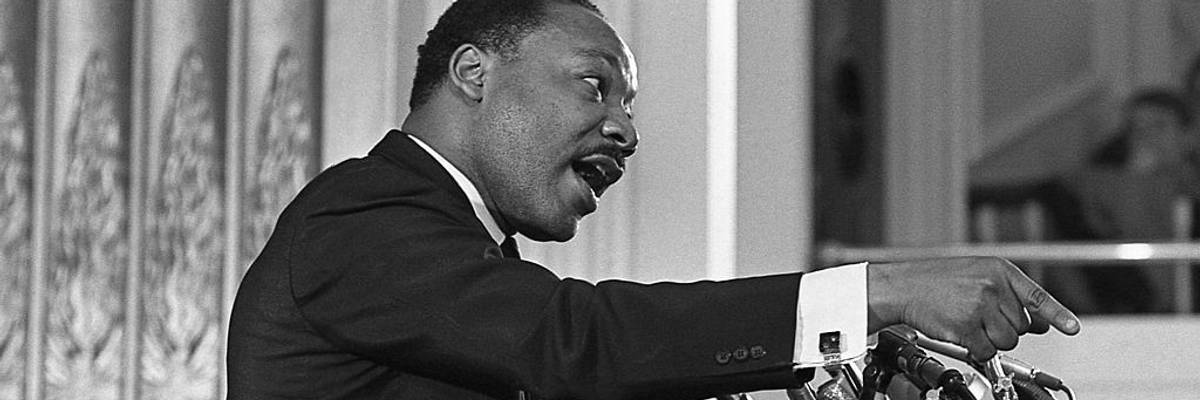
Profile view of American Civil Rights leader Dr. Martin Luther King Jr (1929 - 1968) as he speaks from a lecturn at the New York Avenue Presbyterian Church, Washington DC, February 6, 1968. D
Thoughts on the Anniversary of 'Letter from Birmingham Jail'
Comparing the religious rhetoric and call to civic virtue of Martin Luther King, Jr. to the vile language and deeds of morally corrupt individuals as Donald Trump, JD Vance, and Pete Hegseth.
Today is the 63rd anniversary of Martin Luther King, Jr.’s release from the Birmingham, Alabama jail in which he penned his famous “Letter from Birmingham Jail.”
The “Letter,” a response to eight White moderate clergyman who publicly called on King’s Southern Christian Leadership Conference to stop its desegregation campaign in the name of “law and order and common sense,” is one of the most widely discussed texts in US history. Most of the discussion has focused, rightly, on the way King carefully and respectfully outlines a justification and strategy of non-violent civil disobedience, to be undertaken when attempts to redress grievances are repeatedly ignored; after careful preparation; and in the name of a higher law. While scholars continue to discuss and debate the nuances of King’s text, the force of his arguments, and their general applicability, there can be no doubt that both the “Letter” and the Birmingham campaign that the “Letter” explains and justifies have informed subsequent generations of protest in the US and the world at large.
At a time when the Trump administration is making war on “domestic enemies” and continuing a campaign of terror against undocumented immigrants and anyone suspected of being “an illegal,” and when citizens have resisted these efforts in the streets of major American cities--most notably in Minneapolis this past January—both King’s example, and his “Letter,” justifiably loom large in public discussion. And while the citizens of Minneapolis surely did not literally follow King’s the letter of King’s “Letter,” their extraordinary and successful campaign of resistance to ICE was surely in the spirit of King’s text and his example.
To read King’s “Letter from Birmingham Jail” is to be reminded of just how low our public life has fallen in the age of Trump...
As I reflect today on the “Letter,” however, I want to focus on a different dimension of the “Letter”: the way King--a holder of a doctorate in theology, a Black Baptist Minister, and the leader of the Southern Christian Leadership Conference—carefully braided together religious and secular rhetoric to make the case for a more inclusive democracy, invoking a range of exemplary religious figures and texts while deliberately using language that was itself manifestly inclusive. Many scholars have written about this. At the same time, I think it bears special emphasis given the way that the Trump administration, in ways large and small, hidden and public, is now promoting, with a vengeance, what can only be described as a form of militant Christian nationalism.
The New York Times reports that “Trump’s Planning of America’s 250th Suggests a Religious Focus.” Columnist Ja'han Jones, writing for MS Now, goes further, observing that “Trump is planning a Christian ‘revival’ for America’s 250th anniversary,” continuing: “Let there be no doubt. The president is using the milestone celebration to promote far-right evangelism and Trump-centric Christianity.”
In the same vein, Politico reports on the administration’s Easter enthusiasm:
several key Cabinet departments [were] heralding Christ’s resurrection on their official social media accounts. “He is risen,” declared the Department of Homeland Security and the State Department. The Defense Department shared a post on X from Defense Secretary Pete Hegseth: “The tomb is empty. The promise is fulfilled. Through His sacrifice, we are redeemed. We stand firm in faith, courage, and truth.” The Justice Department also chimed in on X:“Today, as millions of Christians gather in their churches across the nation to celebrate the resurrection of Christ, this Department—is proud to defend religious liberty.”
Most disturbing has been the way the Trump administration has very publicly treated its war on Iran as a Christian holy war. Trump did this indirectly when he declared, on Good Friday, that:
As we rejoice in this Easter season, we are reminded that the life of Jesus Christ and the truths of the Gospel have inspired our way of life and our national identity for 250 years. From the Christian patriots who won and secured our liberty on the battlefield and every generation since, the love of Christ has unfailingly guided our Nation through calm waters and dark storms. . . . We acknowledge that, through Christ’s redeeming sacrifice, in the words of Holy Scripture, “Death is swallowed up in victory.” Above all, we echo with tremendous joy those sacred words that have given life, hope, and purpose to Christians for thousands of years: He is risen.
Hegseth has been more emphatically bellicose, especially in this much discussed, bone-chilling prayer offered at a recent Pentagon worship service:
Let every round find its mark against the enemies of righteousness and our great nation. Give them wisdom in every decision, endurance for the trial ahead, unbreakable unity, and overwhelming violence of action against those who deserve no mercy.
The administration has been so resolutely Manichean and indeed bloodthirsty in its war rhetoric—with Trump going as far as to threaten the literal annihilation of not simply Iran but Iranian civilization itself—that Pope Leo XIV has felt obliged to publicly weigh in to call it to account. As Trump and his supine protégé JD Vance have responded with a combination of vituperation and arrogance, Leo has become more sharply critical even as he has continued to speak with great nuance. Trump’s Social Truth post representing himself as Jesus Christ, and the widespread charges of “blasphemy” that have followed, are simply surface expressions of the much deeper and more dangerous fact that the Trump administration is acting with utter contempt for any moral or political limits, and doing so by presenting itself as the veritable agent of a Christian holy war against the forces of the anti-Christ.
At a moment when such morally corrupt individuals as Trump, Vance, and Hegseth present themselves as agents of both religious virtue and “American Greatness,” King’s “Letter” exemplifies the way that serious moral and religious commitment can elevate democratic politics.
Beginning his “Letter” by immediately addressing the claim of his religious critics that he is an “outsider,” King makes no bones about his own religious connections and convictions. He points out that as President of the Southern Christian Leadership Conference, he has come to Birmingham at the invitation of the Alabama Christian Movement for Human Rights. He then goes further, situating himself openly in a long tradition of Christian dissent:
I am in Birmingham because injustice is here. Just as the prophets of the eighth century b.c. left their villages and carried their “thus saith the Lord” far beyond the boundaries of their home towns, and just as the Apostle Paul left his village of Tarsus and carried the gospel of Jesus Christ to the far corners of the Greco-Roman world, so am I compelled to carry the gospel of freedom beyond my own home town. Like Paul, I must constantly respond to the Macedonian call for aid.
But he then quickly shifts to the third and more general reason for his presence, articulating what are the most famous sentences of the “Letter”:
I am cognizant of the interrelatedness of all communities and states. I cannot sit idly by in Atlanta and not be concerned about what happens in Birmingham. Injustice anywhere is a threat to justice everywhere. We are caught in an inescapable network of mutuality, tied in a single garment of destiny. Whatever affects one directly, affects all indirectly. Never again can we afford to live with the narrow, provincial “outside agitator” idea. Anyone who lives inside the United States can never be considered an outsider anywhere within its bounds.
From the start, then, King articulates a pluralistic sense of his own identity, as the leader of a specific Christian movement, as a Christian, and as a citizen of the US and indeed of the world.
The entire “Letter” draws its force from King’s consistent and persistent performance of a rhetorical and political pluralism. When rebutting the charge that he is an “extremist,” he begins, famously, by asking “was not Jesus an extremist for love”—and it is relevant that he speaks here of “Jesus” the man, and not “Christ,” not because he abjures the language of “Christ,” but because he wishes to strike an ecumenical tone, and to call attention to a kind of courage to which any good man can aspire. King then continues, in the same paragraph and in the same vein, to list the others with whom he identifies: Amos, Paul, Martin Luther, Paul Bunyan, Lincoln, Jefferson, three of whom are quite obviously not “Christian” at all.
When explaining his distinction between a just and an unjust law, he writes that “a just law is a man-made code that squares with the moral law or the law of God. An unjust law is a code that is out of harmony with the moral law,” and then explains by citing Augustine and Thomas Aquinas, Paul Tillich, “the Jewish philosopher Martin Buber,” and the language of the Brown v. Board decision itself.
When recalling heroic dissidents of the past, he names Shadrach, Meshach and Abednego from the Hebrew Bible’s Book of Daniel, the early Christians, Socrates, and the rebels behind the Boston Tea Party.
Every move King makes in the first half of the “Letter” is deliberately ecumenical, drawing on a plurality of religious sources, Biblical and theological, and a variety of secular sources, from Socrates to the American revolutionaries to Lincoln.
When King then shifts into a more direct critique of the church, he explicitly includes “white ministers, priests, and rabbis.” And when he makes clear his own deep personal Christian faith, charity, and love, he immediately shifts into a more general tone:
In deep disappointment I have wept over the laxity of the church. But be assured that my tears have been tears of love. There can be no deep disappointment where there is not deep love. Yes, I love the church. How could I do otherwise? I am in the rather unique position of being the son, the grandson and the great-grandson of preachers. Yes, I see the church as the body of Christ. But, oh! How we have blemished and scarred that body through social neglect and through fear of being nonconformists.
What then follows is a long critique of the church for its forgetfulness of a “God intoxication” that demands a concern for justice, concluding that “the judgment of God is upon the church as never before.” But even here, King refuses the rhetoric of jeremiad, opting instead for the words of hopeful persuasion with which he concludes:
I hope this letter finds you strong in the faith. I also hope that circumstances will soon make it possible for me to meet each of you, not as an integrationist or a civil-rights leader but as a fellow clergyman and a Christian brother. Let us all hope that the dark clouds of racial prejudice will soon pass away and the deep fog of misunderstanding will be lifted from our fear-drenched communities, and in some not too distant tomorrow the radiant stars of love and brotherhood will shine over our great nation with all their scintillating beauty.
In his “Letter” King performs a sincere and serious religious commitment—a Christian, Baptist religious commitment, which he completely owns—while simultaneously performing a commitment to religious pluralism, democratic citizenship, and human rights. He ends with the hope of one day meeting his interlocutors “as a fellow clergyman and a Christian brother” because he is a clergyman and a Christian, who is directly engaging other religious leaders, each of whom leads a different community in a distinct way, and each of whom can be regarded as a kind of “brother.” He does not limit this hope to only Christians. He makes no reference here to Christ or the crucifixion or the resurrection or the end of days or God’s harsh judgment. King speaks not in the language of Holy War or Crusade. He speaks in the language of brotherhood, fraternity, commonality, and citizenship.
And indeed, while speaking in the language of universalism and ecumenicism, King also very deliberately, and emphatically, invokes a distinctly American political tradition of freedom, articulating this political vision:
One day the South will know that when these disinherited children of God sat down at lunch counters, they were in reality standing up for what is best in the American dream and for the most sacred values in our Judaeo-Christian heritage, thereby bringing our nation back to those great wells of democracy which were dug deep by the founding fathers in their formulation of the Constitution and the Declaration of Independence.
Unlike Trump and Hegseth, who wrap their unaccountable rhetorical and deadly violence in a cloak of evangelical Christian righteousness, Martin Luther King, Jr. wrote these, his most famous words, from a jail cell, while placing his life on the line in the name of a real commitment to freedom and justice. It is impossible to separate out King’s exemplary political courage from his profound Christian convictions, which he shared with his SCLC colleagues, even as he marched and collaborated with many who did not share these convictions. King makes his Christian faith clear. But he makes equally clear that in a democratic society, or at least a society professing democratic values, it is both possible and necessary for people of good will from a variety of religious, cultural, and moral places to reach toward an overlapping and common commitment to equal dignity, justice, and citizenship.
To read King’s “Letter From Birmingham Jail” is to be reminded of just how low our public life has fallen in the age of Trump, and how corrupt, venal, and dangerous is the rhetoric of religious fundamentalism when deployed by cynical autocrats intent on targeting and destroying “enemies.” But it is also to be reminded that words can elevate as well as denigrate, and that true moral conviction, whatever its cultural or religious grounding, can make a real difference in promoting a better, more just and more democratic world.
An Urgent Message From Our Co-Founder
Dear Common Dreams reader, It’s been nearly 30 years since I co-founded Common Dreams with my late wife, Lina Newhouser. We had the radical notion that journalism should serve the public good, not corporate profits. It was clear to us from the outset what it would take to build such a project. No paid advertisements. No corporate sponsors. No millionaire publisher telling us what to think or do. Many people said we wouldn't last a year, but we proved those doubters wrong. Together with a tremendous team of journalists and dedicated staff, we built an independent media outlet free from the constraints of profits and corporate control. Our mission has always been simple: To inform. To inspire. To ignite change for the common good. Building Common Dreams was not easy. Our survival was never guaranteed. When you take on the most powerful forces—Wall Street greed, fossil fuel industry destruction, Big Tech lobbyists, and uber-rich oligarchs who have spent billions upon billions rigging the economy and democracy in their favor—the only bulwark you have is supporters who believe in your work. But here’s the urgent message from me today. It's never been this bad out there. And it's never been this hard to keep us going. At the very moment Common Dreams is most needed, the threats we face are intensifying. We need your support now more than ever. We don't accept corporate advertising and never will. We don't have a paywall because we don't think people should be blocked from critical news based on their ability to pay. Everything we do is funded by the donations of readers like you. When everyone does the little they can afford, we are strong. But if that support retreats or dries up, so do we. Will you donate now to make sure Common Dreams not only survives but thrives? —Craig Brown, Co-founder |
Today is the 63rd anniversary of Martin Luther King, Jr.’s release from the Birmingham, Alabama jail in which he penned his famous “Letter from Birmingham Jail.”
The “Letter,” a response to eight White moderate clergyman who publicly called on King’s Southern Christian Leadership Conference to stop its desegregation campaign in the name of “law and order and common sense,” is one of the most widely discussed texts in US history. Most of the discussion has focused, rightly, on the way King carefully and respectfully outlines a justification and strategy of non-violent civil disobedience, to be undertaken when attempts to redress grievances are repeatedly ignored; after careful preparation; and in the name of a higher law. While scholars continue to discuss and debate the nuances of King’s text, the force of his arguments, and their general applicability, there can be no doubt that both the “Letter” and the Birmingham campaign that the “Letter” explains and justifies have informed subsequent generations of protest in the US and the world at large.
At a time when the Trump administration is making war on “domestic enemies” and continuing a campaign of terror against undocumented immigrants and anyone suspected of being “an illegal,” and when citizens have resisted these efforts in the streets of major American cities--most notably in Minneapolis this past January—both King’s example, and his “Letter,” justifiably loom large in public discussion. And while the citizens of Minneapolis surely did not literally follow King’s the letter of King’s “Letter,” their extraordinary and successful campaign of resistance to ICE was surely in the spirit of King’s text and his example.
To read King’s “Letter from Birmingham Jail” is to be reminded of just how low our public life has fallen in the age of Trump...
As I reflect today on the “Letter,” however, I want to focus on a different dimension of the “Letter”: the way King--a holder of a doctorate in theology, a Black Baptist Minister, and the leader of the Southern Christian Leadership Conference—carefully braided together religious and secular rhetoric to make the case for a more inclusive democracy, invoking a range of exemplary religious figures and texts while deliberately using language that was itself manifestly inclusive. Many scholars have written about this. At the same time, I think it bears special emphasis given the way that the Trump administration, in ways large and small, hidden and public, is now promoting, with a vengeance, what can only be described as a form of militant Christian nationalism.
The New York Times reports that “Trump’s Planning of America’s 250th Suggests a Religious Focus.” Columnist Ja'han Jones, writing for MS Now, goes further, observing that “Trump is planning a Christian ‘revival’ for America’s 250th anniversary,” continuing: “Let there be no doubt. The president is using the milestone celebration to promote far-right evangelism and Trump-centric Christianity.”
In the same vein, Politico reports on the administration’s Easter enthusiasm:
several key Cabinet departments [were] heralding Christ’s resurrection on their official social media accounts. “He is risen,” declared the Department of Homeland Security and the State Department. The Defense Department shared a post on X from Defense Secretary Pete Hegseth: “The tomb is empty. The promise is fulfilled. Through His sacrifice, we are redeemed. We stand firm in faith, courage, and truth.” The Justice Department also chimed in on X:“Today, as millions of Christians gather in their churches across the nation to celebrate the resurrection of Christ, this Department—is proud to defend religious liberty.”
Most disturbing has been the way the Trump administration has very publicly treated its war on Iran as a Christian holy war. Trump did this indirectly when he declared, on Good Friday, that:
As we rejoice in this Easter season, we are reminded that the life of Jesus Christ and the truths of the Gospel have inspired our way of life and our national identity for 250 years. From the Christian patriots who won and secured our liberty on the battlefield and every generation since, the love of Christ has unfailingly guided our Nation through calm waters and dark storms. . . . We acknowledge that, through Christ’s redeeming sacrifice, in the words of Holy Scripture, “Death is swallowed up in victory.” Above all, we echo with tremendous joy those sacred words that have given life, hope, and purpose to Christians for thousands of years: He is risen.
Hegseth has been more emphatically bellicose, especially in this much discussed, bone-chilling prayer offered at a recent Pentagon worship service:
Let every round find its mark against the enemies of righteousness and our great nation. Give them wisdom in every decision, endurance for the trial ahead, unbreakable unity, and overwhelming violence of action against those who deserve no mercy.
The administration has been so resolutely Manichean and indeed bloodthirsty in its war rhetoric—with Trump going as far as to threaten the literal annihilation of not simply Iran but Iranian civilization itself—that Pope Leo XIV has felt obliged to publicly weigh in to call it to account. As Trump and his supine protégé JD Vance have responded with a combination of vituperation and arrogance, Leo has become more sharply critical even as he has continued to speak with great nuance. Trump’s Social Truth post representing himself as Jesus Christ, and the widespread charges of “blasphemy” that have followed, are simply surface expressions of the much deeper and more dangerous fact that the Trump administration is acting with utter contempt for any moral or political limits, and doing so by presenting itself as the veritable agent of a Christian holy war against the forces of the anti-Christ.
At a moment when such morally corrupt individuals as Trump, Vance, and Hegseth present themselves as agents of both religious virtue and “American Greatness,” King’s “Letter” exemplifies the way that serious moral and religious commitment can elevate democratic politics.
Beginning his “Letter” by immediately addressing the claim of his religious critics that he is an “outsider,” King makes no bones about his own religious connections and convictions. He points out that as President of the Southern Christian Leadership Conference, he has come to Birmingham at the invitation of the Alabama Christian Movement for Human Rights. He then goes further, situating himself openly in a long tradition of Christian dissent:
I am in Birmingham because injustice is here. Just as the prophets of the eighth century b.c. left their villages and carried their “thus saith the Lord” far beyond the boundaries of their home towns, and just as the Apostle Paul left his village of Tarsus and carried the gospel of Jesus Christ to the far corners of the Greco-Roman world, so am I compelled to carry the gospel of freedom beyond my own home town. Like Paul, I must constantly respond to the Macedonian call for aid.
But he then quickly shifts to the third and more general reason for his presence, articulating what are the most famous sentences of the “Letter”:
I am cognizant of the interrelatedness of all communities and states. I cannot sit idly by in Atlanta and not be concerned about what happens in Birmingham. Injustice anywhere is a threat to justice everywhere. We are caught in an inescapable network of mutuality, tied in a single garment of destiny. Whatever affects one directly, affects all indirectly. Never again can we afford to live with the narrow, provincial “outside agitator” idea. Anyone who lives inside the United States can never be considered an outsider anywhere within its bounds.
From the start, then, King articulates a pluralistic sense of his own identity, as the leader of a specific Christian movement, as a Christian, and as a citizen of the US and indeed of the world.
The entire “Letter” draws its force from King’s consistent and persistent performance of a rhetorical and political pluralism. When rebutting the charge that he is an “extremist,” he begins, famously, by asking “was not Jesus an extremist for love”—and it is relevant that he speaks here of “Jesus” the man, and not “Christ,” not because he abjures the language of “Christ,” but because he wishes to strike an ecumenical tone, and to call attention to a kind of courage to which any good man can aspire. King then continues, in the same paragraph and in the same vein, to list the others with whom he identifies: Amos, Paul, Martin Luther, Paul Bunyan, Lincoln, Jefferson, three of whom are quite obviously not “Christian” at all.
When explaining his distinction between a just and an unjust law, he writes that “a just law is a man-made code that squares with the moral law or the law of God. An unjust law is a code that is out of harmony with the moral law,” and then explains by citing Augustine and Thomas Aquinas, Paul Tillich, “the Jewish philosopher Martin Buber,” and the language of the Brown v. Board decision itself.
When recalling heroic dissidents of the past, he names Shadrach, Meshach and Abednego from the Hebrew Bible’s Book of Daniel, the early Christians, Socrates, and the rebels behind the Boston Tea Party.
Every move King makes in the first half of the “Letter” is deliberately ecumenical, drawing on a plurality of religious sources, Biblical and theological, and a variety of secular sources, from Socrates to the American revolutionaries to Lincoln.
When King then shifts into a more direct critique of the church, he explicitly includes “white ministers, priests, and rabbis.” And when he makes clear his own deep personal Christian faith, charity, and love, he immediately shifts into a more general tone:
In deep disappointment I have wept over the laxity of the church. But be assured that my tears have been tears of love. There can be no deep disappointment where there is not deep love. Yes, I love the church. How could I do otherwise? I am in the rather unique position of being the son, the grandson and the great-grandson of preachers. Yes, I see the church as the body of Christ. But, oh! How we have blemished and scarred that body through social neglect and through fear of being nonconformists.
What then follows is a long critique of the church for its forgetfulness of a “God intoxication” that demands a concern for justice, concluding that “the judgment of God is upon the church as never before.” But even here, King refuses the rhetoric of jeremiad, opting instead for the words of hopeful persuasion with which he concludes:
I hope this letter finds you strong in the faith. I also hope that circumstances will soon make it possible for me to meet each of you, not as an integrationist or a civil-rights leader but as a fellow clergyman and a Christian brother. Let us all hope that the dark clouds of racial prejudice will soon pass away and the deep fog of misunderstanding will be lifted from our fear-drenched communities, and in some not too distant tomorrow the radiant stars of love and brotherhood will shine over our great nation with all their scintillating beauty.
In his “Letter” King performs a sincere and serious religious commitment—a Christian, Baptist religious commitment, which he completely owns—while simultaneously performing a commitment to religious pluralism, democratic citizenship, and human rights. He ends with the hope of one day meeting his interlocutors “as a fellow clergyman and a Christian brother” because he is a clergyman and a Christian, who is directly engaging other religious leaders, each of whom leads a different community in a distinct way, and each of whom can be regarded as a kind of “brother.” He does not limit this hope to only Christians. He makes no reference here to Christ or the crucifixion or the resurrection or the end of days or God’s harsh judgment. King speaks not in the language of Holy War or Crusade. He speaks in the language of brotherhood, fraternity, commonality, and citizenship.
And indeed, while speaking in the language of universalism and ecumenicism, King also very deliberately, and emphatically, invokes a distinctly American political tradition of freedom, articulating this political vision:
One day the South will know that when these disinherited children of God sat down at lunch counters, they were in reality standing up for what is best in the American dream and for the most sacred values in our Judaeo-Christian heritage, thereby bringing our nation back to those great wells of democracy which were dug deep by the founding fathers in their formulation of the Constitution and the Declaration of Independence.
Unlike Trump and Hegseth, who wrap their unaccountable rhetorical and deadly violence in a cloak of evangelical Christian righteousness, Martin Luther King, Jr. wrote these, his most famous words, from a jail cell, while placing his life on the line in the name of a real commitment to freedom and justice. It is impossible to separate out King’s exemplary political courage from his profound Christian convictions, which he shared with his SCLC colleagues, even as he marched and collaborated with many who did not share these convictions. King makes his Christian faith clear. But he makes equally clear that in a democratic society, or at least a society professing democratic values, it is both possible and necessary for people of good will from a variety of religious, cultural, and moral places to reach toward an overlapping and common commitment to equal dignity, justice, and citizenship.
To read King’s “Letter From Birmingham Jail” is to be reminded of just how low our public life has fallen in the age of Trump, and how corrupt, venal, and dangerous is the rhetoric of religious fundamentalism when deployed by cynical autocrats intent on targeting and destroying “enemies.” But it is also to be reminded that words can elevate as well as denigrate, and that true moral conviction, whatever its cultural or religious grounding, can make a real difference in promoting a better, more just and more democratic world.
Today is the 63rd anniversary of Martin Luther King, Jr.’s release from the Birmingham, Alabama jail in which he penned his famous “Letter from Birmingham Jail.”
The “Letter,” a response to eight White moderate clergyman who publicly called on King’s Southern Christian Leadership Conference to stop its desegregation campaign in the name of “law and order and common sense,” is one of the most widely discussed texts in US history. Most of the discussion has focused, rightly, on the way King carefully and respectfully outlines a justification and strategy of non-violent civil disobedience, to be undertaken when attempts to redress grievances are repeatedly ignored; after careful preparation; and in the name of a higher law. While scholars continue to discuss and debate the nuances of King’s text, the force of his arguments, and their general applicability, there can be no doubt that both the “Letter” and the Birmingham campaign that the “Letter” explains and justifies have informed subsequent generations of protest in the US and the world at large.
At a time when the Trump administration is making war on “domestic enemies” and continuing a campaign of terror against undocumented immigrants and anyone suspected of being “an illegal,” and when citizens have resisted these efforts in the streets of major American cities--most notably in Minneapolis this past January—both King’s example, and his “Letter,” justifiably loom large in public discussion. And while the citizens of Minneapolis surely did not literally follow King’s the letter of King’s “Letter,” their extraordinary and successful campaign of resistance to ICE was surely in the spirit of King’s text and his example.
To read King’s “Letter from Birmingham Jail” is to be reminded of just how low our public life has fallen in the age of Trump...
As I reflect today on the “Letter,” however, I want to focus on a different dimension of the “Letter”: the way King--a holder of a doctorate in theology, a Black Baptist Minister, and the leader of the Southern Christian Leadership Conference—carefully braided together religious and secular rhetoric to make the case for a more inclusive democracy, invoking a range of exemplary religious figures and texts while deliberately using language that was itself manifestly inclusive. Many scholars have written about this. At the same time, I think it bears special emphasis given the way that the Trump administration, in ways large and small, hidden and public, is now promoting, with a vengeance, what can only be described as a form of militant Christian nationalism.
The New York Times reports that “Trump’s Planning of America’s 250th Suggests a Religious Focus.” Columnist Ja'han Jones, writing for MS Now, goes further, observing that “Trump is planning a Christian ‘revival’ for America’s 250th anniversary,” continuing: “Let there be no doubt. The president is using the milestone celebration to promote far-right evangelism and Trump-centric Christianity.”
In the same vein, Politico reports on the administration’s Easter enthusiasm:
several key Cabinet departments [were] heralding Christ’s resurrection on their official social media accounts. “He is risen,” declared the Department of Homeland Security and the State Department. The Defense Department shared a post on X from Defense Secretary Pete Hegseth: “The tomb is empty. The promise is fulfilled. Through His sacrifice, we are redeemed. We stand firm in faith, courage, and truth.” The Justice Department also chimed in on X:“Today, as millions of Christians gather in their churches across the nation to celebrate the resurrection of Christ, this Department—is proud to defend religious liberty.”
Most disturbing has been the way the Trump administration has very publicly treated its war on Iran as a Christian holy war. Trump did this indirectly when he declared, on Good Friday, that:
As we rejoice in this Easter season, we are reminded that the life of Jesus Christ and the truths of the Gospel have inspired our way of life and our national identity for 250 years. From the Christian patriots who won and secured our liberty on the battlefield and every generation since, the love of Christ has unfailingly guided our Nation through calm waters and dark storms. . . . We acknowledge that, through Christ’s redeeming sacrifice, in the words of Holy Scripture, “Death is swallowed up in victory.” Above all, we echo with tremendous joy those sacred words that have given life, hope, and purpose to Christians for thousands of years: He is risen.
Hegseth has been more emphatically bellicose, especially in this much discussed, bone-chilling prayer offered at a recent Pentagon worship service:
Let every round find its mark against the enemies of righteousness and our great nation. Give them wisdom in every decision, endurance for the trial ahead, unbreakable unity, and overwhelming violence of action against those who deserve no mercy.
The administration has been so resolutely Manichean and indeed bloodthirsty in its war rhetoric—with Trump going as far as to threaten the literal annihilation of not simply Iran but Iranian civilization itself—that Pope Leo XIV has felt obliged to publicly weigh in to call it to account. As Trump and his supine protégé JD Vance have responded with a combination of vituperation and arrogance, Leo has become more sharply critical even as he has continued to speak with great nuance. Trump’s Social Truth post representing himself as Jesus Christ, and the widespread charges of “blasphemy” that have followed, are simply surface expressions of the much deeper and more dangerous fact that the Trump administration is acting with utter contempt for any moral or political limits, and doing so by presenting itself as the veritable agent of a Christian holy war against the forces of the anti-Christ.
At a moment when such morally corrupt individuals as Trump, Vance, and Hegseth present themselves as agents of both religious virtue and “American Greatness,” King’s “Letter” exemplifies the way that serious moral and religious commitment can elevate democratic politics.
Beginning his “Letter” by immediately addressing the claim of his religious critics that he is an “outsider,” King makes no bones about his own religious connections and convictions. He points out that as President of the Southern Christian Leadership Conference, he has come to Birmingham at the invitation of the Alabama Christian Movement for Human Rights. He then goes further, situating himself openly in a long tradition of Christian dissent:
I am in Birmingham because injustice is here. Just as the prophets of the eighth century b.c. left their villages and carried their “thus saith the Lord” far beyond the boundaries of their home towns, and just as the Apostle Paul left his village of Tarsus and carried the gospel of Jesus Christ to the far corners of the Greco-Roman world, so am I compelled to carry the gospel of freedom beyond my own home town. Like Paul, I must constantly respond to the Macedonian call for aid.
But he then quickly shifts to the third and more general reason for his presence, articulating what are the most famous sentences of the “Letter”:
I am cognizant of the interrelatedness of all communities and states. I cannot sit idly by in Atlanta and not be concerned about what happens in Birmingham. Injustice anywhere is a threat to justice everywhere. We are caught in an inescapable network of mutuality, tied in a single garment of destiny. Whatever affects one directly, affects all indirectly. Never again can we afford to live with the narrow, provincial “outside agitator” idea. Anyone who lives inside the United States can never be considered an outsider anywhere within its bounds.
From the start, then, King articulates a pluralistic sense of his own identity, as the leader of a specific Christian movement, as a Christian, and as a citizen of the US and indeed of the world.
The entire “Letter” draws its force from King’s consistent and persistent performance of a rhetorical and political pluralism. When rebutting the charge that he is an “extremist,” he begins, famously, by asking “was not Jesus an extremist for love”—and it is relevant that he speaks here of “Jesus” the man, and not “Christ,” not because he abjures the language of “Christ,” but because he wishes to strike an ecumenical tone, and to call attention to a kind of courage to which any good man can aspire. King then continues, in the same paragraph and in the same vein, to list the others with whom he identifies: Amos, Paul, Martin Luther, Paul Bunyan, Lincoln, Jefferson, three of whom are quite obviously not “Christian” at all.
When explaining his distinction between a just and an unjust law, he writes that “a just law is a man-made code that squares with the moral law or the law of God. An unjust law is a code that is out of harmony with the moral law,” and then explains by citing Augustine and Thomas Aquinas, Paul Tillich, “the Jewish philosopher Martin Buber,” and the language of the Brown v. Board decision itself.
When recalling heroic dissidents of the past, he names Shadrach, Meshach and Abednego from the Hebrew Bible’s Book of Daniel, the early Christians, Socrates, and the rebels behind the Boston Tea Party.
Every move King makes in the first half of the “Letter” is deliberately ecumenical, drawing on a plurality of religious sources, Biblical and theological, and a variety of secular sources, from Socrates to the American revolutionaries to Lincoln.
When King then shifts into a more direct critique of the church, he explicitly includes “white ministers, priests, and rabbis.” And when he makes clear his own deep personal Christian faith, charity, and love, he immediately shifts into a more general tone:
In deep disappointment I have wept over the laxity of the church. But be assured that my tears have been tears of love. There can be no deep disappointment where there is not deep love. Yes, I love the church. How could I do otherwise? I am in the rather unique position of being the son, the grandson and the great-grandson of preachers. Yes, I see the church as the body of Christ. But, oh! How we have blemished and scarred that body through social neglect and through fear of being nonconformists.
What then follows is a long critique of the church for its forgetfulness of a “God intoxication” that demands a concern for justice, concluding that “the judgment of God is upon the church as never before.” But even here, King refuses the rhetoric of jeremiad, opting instead for the words of hopeful persuasion with which he concludes:
I hope this letter finds you strong in the faith. I also hope that circumstances will soon make it possible for me to meet each of you, not as an integrationist or a civil-rights leader but as a fellow clergyman and a Christian brother. Let us all hope that the dark clouds of racial prejudice will soon pass away and the deep fog of misunderstanding will be lifted from our fear-drenched communities, and in some not too distant tomorrow the radiant stars of love and brotherhood will shine over our great nation with all their scintillating beauty.
In his “Letter” King performs a sincere and serious religious commitment—a Christian, Baptist religious commitment, which he completely owns—while simultaneously performing a commitment to religious pluralism, democratic citizenship, and human rights. He ends with the hope of one day meeting his interlocutors “as a fellow clergyman and a Christian brother” because he is a clergyman and a Christian, who is directly engaging other religious leaders, each of whom leads a different community in a distinct way, and each of whom can be regarded as a kind of “brother.” He does not limit this hope to only Christians. He makes no reference here to Christ or the crucifixion or the resurrection or the end of days or God’s harsh judgment. King speaks not in the language of Holy War or Crusade. He speaks in the language of brotherhood, fraternity, commonality, and citizenship.
And indeed, while speaking in the language of universalism and ecumenicism, King also very deliberately, and emphatically, invokes a distinctly American political tradition of freedom, articulating this political vision:
One day the South will know that when these disinherited children of God sat down at lunch counters, they were in reality standing up for what is best in the American dream and for the most sacred values in our Judaeo-Christian heritage, thereby bringing our nation back to those great wells of democracy which were dug deep by the founding fathers in their formulation of the Constitution and the Declaration of Independence.
Unlike Trump and Hegseth, who wrap their unaccountable rhetorical and deadly violence in a cloak of evangelical Christian righteousness, Martin Luther King, Jr. wrote these, his most famous words, from a jail cell, while placing his life on the line in the name of a real commitment to freedom and justice. It is impossible to separate out King’s exemplary political courage from his profound Christian convictions, which he shared with his SCLC colleagues, even as he marched and collaborated with many who did not share these convictions. King makes his Christian faith clear. But he makes equally clear that in a democratic society, or at least a society professing democratic values, it is both possible and necessary for people of good will from a variety of religious, cultural, and moral places to reach toward an overlapping and common commitment to equal dignity, justice, and citizenship.
To read King’s “Letter From Birmingham Jail” is to be reminded of just how low our public life has fallen in the age of Trump, and how corrupt, venal, and dangerous is the rhetoric of religious fundamentalism when deployed by cynical autocrats intent on targeting and destroying “enemies.” But it is also to be reminded that words can elevate as well as denigrate, and that true moral conviction, whatever its cultural or religious grounding, can make a real difference in promoting a better, more just and more democratic world.