SUBSCRIBE TO OUR FREE NEWSLETTER
Daily news & progressive opinion—funded by the people, not the corporations—delivered straight to your inbox.
5
#000000
#FFFFFF
To donate by check, phone, or other method, see our More Ways to Give page.
Daily news & progressive opinion—funded by the people, not the corporations—delivered straight to your inbox.
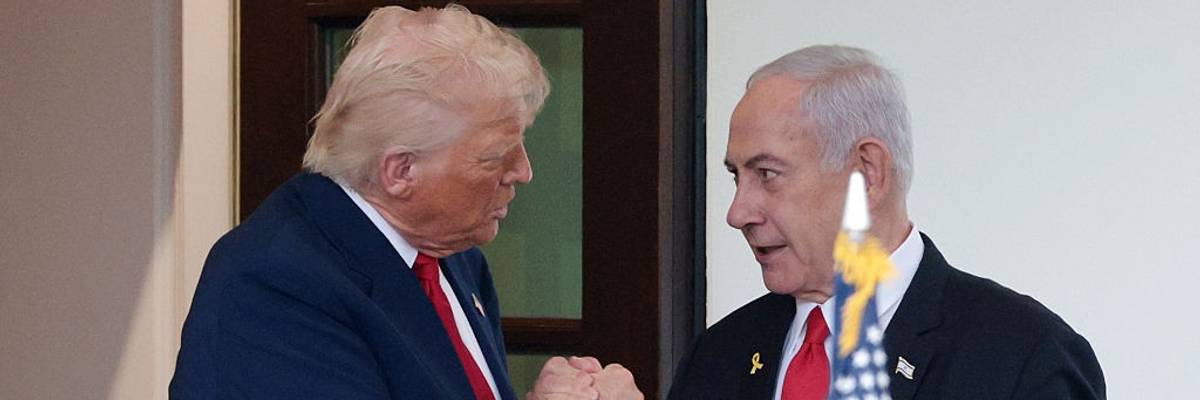
US President Donald Trump ( bids farewell to Israeli Prime Minister Benjamin Netanyahu as he leaves the White House after a meeting on April 07, 2025 in Washington, DC.
Israel believes it can do whatever it wants, wherever it wants, with no consequences. When will world leaders finally intervene with action to stop this lawlessness and madness?
Responding to Israel’s September 10 attack aimed at Hamas negotiators in Qatar, all 12 members of the UN Security Council issued a toothless statement of condemnation that didn’t even mention Israel by name. This cowardly response underscores the pathetic international reaction to nearly two years of genocide.
Israel believes it can do whatever it wants, wherever it wants, with no consequences–which has been true for two years now. It has already destroyed Gaza. It is expanding settlements, annexing the West Bank, threatening Lebanon, Syria, Yemen, and Iran. It has attacked aid flotillas, bombed refugee camps, and assassinated negotiators. Now it has bombed a U.S.-allied Gulf capital. And still, the world hesitates.
One would think that the bombing of Qatar — a U.S. ally, the home of U.S. Central Command, and the very place where ceasefire negotiations were being brokered–would be a game changer. The strike killed five Hamas staffers and a Qatari security officer. The senior Hamas leaders survived, but the real target was not just them. The target was diplomacy itself.
Trump, for his part, has been playing a double game: issuing ultimatums to Hamas while allowing Israel to bomb the very negotiators the U.S. asked Qatar to host. His excuse that his envoy “called too late” to warn Doha is laughable. The truth is simpler: Washington could have stopped this. Its air defenses sat idle. Its umbrella of “protection” never opened. The U.S. is not a bystander; it is complicit.
The world is watching, and millions of people across continents are demanding an end to this genocide.
Netanyahu bragged about authorizing a “surgical precision strike” in Doha on what he called “terrorist chiefs.” But let’s be clear: this was state terrorism, carried out in broad daylight against a sovereign country at the heart of U.S. strategy in the Gulf. It was an assassination attempt deliberately timed to blow up the possibility of a ceasefire by killing the very negotiators needed to reach one. For nearly two years, the Israeli prime minister, Benjamin Netanyahu, has consistently obstructed ceasefire talks. The strike on Doha is final proof that Israel has no interest in peace — only endless war.
In Europe, close Israeli allies Germany, France and Britain condemned the strike, as did China and Russia. Even in Israel, the attack provoked outrage from hostage families. Einav Zangauker, whose son is captive in Gaza, said Netanyahu had “essentially sentenced my Matan to death.” She asked the question millions are asking: why does Israel blow up every small chance for a deal?
And the Arab world? Qatar’s prime minister Mohammed Al Thani called the attack “state terrorism,” warning the region that Netanyahu is destabilizing everything and that Netanyahu needs to be brought to justice. Saudi Arabia called it “a violation of international law and an unacceptable aggression against a fellow Arab state.” Jordan warned of “dangerous escalation.” The UAE expressed “grave concern.”
Yet words are cheap. Where is the action? Where is the red line? Arab states have watched Palestinians burned alive in tents, starved at aid lines, bombed in their homes for two years — and offered little more than statements.
If the world allows Israel to get away with bombing Doha, then no country in the Middle East is safe. Arab leaders who rushed to normalize with Israel under Trump’s so-called Abraham Accords–the UAE, Morocco, Bahrain, Sudan–now find themselves exposed as collaborators while Netanyahu bombs Arab capitals with impunity. The very least they must do right now is rescind those accords, and the rest of the Arab world must denounce any moves to normalize relations.
Qatar is convening an emergency Arab-Islamic summit, and has called for a collective Arab response. This must be more than words: a coordinated campaign to cut trade, sever ties, and impose sanctions on the rogue Israeli state.
Words are cheap. Where is the action? Where is the red line? Arab states have watched Palestinians burned alive in tents, starved at aid lines, bombed in their homes for two years — and offered little more than statements.
From there the crisis will move to New York. As the new session of the UN opens and the U.S. continues to use its veto to stop the Security Council from taking action, the General Assembly must put the crisis at the top of its agenda. It must invoke the Uniting for Peace resolution to call for the following:
The world is watching, and millions of people across continents are demanding an end to this genocide. The UN General Assembly still has the chance to rise to the occasion, to prove that international law is not just words on paper. The bombing of Doha should be the breaking point — the moment the world finally acts.
Dear Common Dreams reader, It’s been nearly 30 years since I co-founded Common Dreams with my late wife, Lina Newhouser. We had the radical notion that journalism should serve the public good, not corporate profits. It was clear to us from the outset what it would take to build such a project. No paid advertisements. No corporate sponsors. No millionaire publisher telling us what to think or do. Many people said we wouldn't last a year, but we proved those doubters wrong. Together with a tremendous team of journalists and dedicated staff, we built an independent media outlet free from the constraints of profits and corporate control. Our mission has always been simple: To inform. To inspire. To ignite change for the common good. Building Common Dreams was not easy. Our survival was never guaranteed. When you take on the most powerful forces—Wall Street greed, fossil fuel industry destruction, Big Tech lobbyists, and uber-rich oligarchs who have spent billions upon billions rigging the economy and democracy in their favor—the only bulwark you have is supporters who believe in your work. But here’s the urgent message from me today. It's never been this bad out there. And it's never been this hard to keep us going. At the very moment Common Dreams is most needed, the threats we face are intensifying. We need your support now more than ever. We don't accept corporate advertising and never will. We don't have a paywall because we don't think people should be blocked from critical news based on their ability to pay. Everything we do is funded by the donations of readers like you. When everyone does the little they can afford, we are strong. But if that support retreats or dries up, so do we. Will you donate now to make sure Common Dreams not only survives but thrives? —Craig Brown, Co-founder |
Responding to Israel’s September 10 attack aimed at Hamas negotiators in Qatar, all 12 members of the UN Security Council issued a toothless statement of condemnation that didn’t even mention Israel by name. This cowardly response underscores the pathetic international reaction to nearly two years of genocide.
Israel believes it can do whatever it wants, wherever it wants, with no consequences–which has been true for two years now. It has already destroyed Gaza. It is expanding settlements, annexing the West Bank, threatening Lebanon, Syria, Yemen, and Iran. It has attacked aid flotillas, bombed refugee camps, and assassinated negotiators. Now it has bombed a U.S.-allied Gulf capital. And still, the world hesitates.
One would think that the bombing of Qatar — a U.S. ally, the home of U.S. Central Command, and the very place where ceasefire negotiations were being brokered–would be a game changer. The strike killed five Hamas staffers and a Qatari security officer. The senior Hamas leaders survived, but the real target was not just them. The target was diplomacy itself.
Trump, for his part, has been playing a double game: issuing ultimatums to Hamas while allowing Israel to bomb the very negotiators the U.S. asked Qatar to host. His excuse that his envoy “called too late” to warn Doha is laughable. The truth is simpler: Washington could have stopped this. Its air defenses sat idle. Its umbrella of “protection” never opened. The U.S. is not a bystander; it is complicit.
The world is watching, and millions of people across continents are demanding an end to this genocide.
Netanyahu bragged about authorizing a “surgical precision strike” in Doha on what he called “terrorist chiefs.” But let’s be clear: this was state terrorism, carried out in broad daylight against a sovereign country at the heart of U.S. strategy in the Gulf. It was an assassination attempt deliberately timed to blow up the possibility of a ceasefire by killing the very negotiators needed to reach one. For nearly two years, the Israeli prime minister, Benjamin Netanyahu, has consistently obstructed ceasefire talks. The strike on Doha is final proof that Israel has no interest in peace — only endless war.
In Europe, close Israeli allies Germany, France and Britain condemned the strike, as did China and Russia. Even in Israel, the attack provoked outrage from hostage families. Einav Zangauker, whose son is captive in Gaza, said Netanyahu had “essentially sentenced my Matan to death.” She asked the question millions are asking: why does Israel blow up every small chance for a deal?
And the Arab world? Qatar’s prime minister Mohammed Al Thani called the attack “state terrorism,” warning the region that Netanyahu is destabilizing everything and that Netanyahu needs to be brought to justice. Saudi Arabia called it “a violation of international law and an unacceptable aggression against a fellow Arab state.” Jordan warned of “dangerous escalation.” The UAE expressed “grave concern.”
Yet words are cheap. Where is the action? Where is the red line? Arab states have watched Palestinians burned alive in tents, starved at aid lines, bombed in their homes for two years — and offered little more than statements.
If the world allows Israel to get away with bombing Doha, then no country in the Middle East is safe. Arab leaders who rushed to normalize with Israel under Trump’s so-called Abraham Accords–the UAE, Morocco, Bahrain, Sudan–now find themselves exposed as collaborators while Netanyahu bombs Arab capitals with impunity. The very least they must do right now is rescind those accords, and the rest of the Arab world must denounce any moves to normalize relations.
Qatar is convening an emergency Arab-Islamic summit, and has called for a collective Arab response. This must be more than words: a coordinated campaign to cut trade, sever ties, and impose sanctions on the rogue Israeli state.
Words are cheap. Where is the action? Where is the red line? Arab states have watched Palestinians burned alive in tents, starved at aid lines, bombed in their homes for two years — and offered little more than statements.
From there the crisis will move to New York. As the new session of the UN opens and the U.S. continues to use its veto to stop the Security Council from taking action, the General Assembly must put the crisis at the top of its agenda. It must invoke the Uniting for Peace resolution to call for the following:
The world is watching, and millions of people across continents are demanding an end to this genocide. The UN General Assembly still has the chance to rise to the occasion, to prove that international law is not just words on paper. The bombing of Doha should be the breaking point — the moment the world finally acts.
Responding to Israel’s September 10 attack aimed at Hamas negotiators in Qatar, all 12 members of the UN Security Council issued a toothless statement of condemnation that didn’t even mention Israel by name. This cowardly response underscores the pathetic international reaction to nearly two years of genocide.
Israel believes it can do whatever it wants, wherever it wants, with no consequences–which has been true for two years now. It has already destroyed Gaza. It is expanding settlements, annexing the West Bank, threatening Lebanon, Syria, Yemen, and Iran. It has attacked aid flotillas, bombed refugee camps, and assassinated negotiators. Now it has bombed a U.S.-allied Gulf capital. And still, the world hesitates.
One would think that the bombing of Qatar — a U.S. ally, the home of U.S. Central Command, and the very place where ceasefire negotiations were being brokered–would be a game changer. The strike killed five Hamas staffers and a Qatari security officer. The senior Hamas leaders survived, but the real target was not just them. The target was diplomacy itself.
Trump, for his part, has been playing a double game: issuing ultimatums to Hamas while allowing Israel to bomb the very negotiators the U.S. asked Qatar to host. His excuse that his envoy “called too late” to warn Doha is laughable. The truth is simpler: Washington could have stopped this. Its air defenses sat idle. Its umbrella of “protection” never opened. The U.S. is not a bystander; it is complicit.
The world is watching, and millions of people across continents are demanding an end to this genocide.
Netanyahu bragged about authorizing a “surgical precision strike” in Doha on what he called “terrorist chiefs.” But let’s be clear: this was state terrorism, carried out in broad daylight against a sovereign country at the heart of U.S. strategy in the Gulf. It was an assassination attempt deliberately timed to blow up the possibility of a ceasefire by killing the very negotiators needed to reach one. For nearly two years, the Israeli prime minister, Benjamin Netanyahu, has consistently obstructed ceasefire talks. The strike on Doha is final proof that Israel has no interest in peace — only endless war.
In Europe, close Israeli allies Germany, France and Britain condemned the strike, as did China and Russia. Even in Israel, the attack provoked outrage from hostage families. Einav Zangauker, whose son is captive in Gaza, said Netanyahu had “essentially sentenced my Matan to death.” She asked the question millions are asking: why does Israel blow up every small chance for a deal?
And the Arab world? Qatar’s prime minister Mohammed Al Thani called the attack “state terrorism,” warning the region that Netanyahu is destabilizing everything and that Netanyahu needs to be brought to justice. Saudi Arabia called it “a violation of international law and an unacceptable aggression against a fellow Arab state.” Jordan warned of “dangerous escalation.” The UAE expressed “grave concern.”
Yet words are cheap. Where is the action? Where is the red line? Arab states have watched Palestinians burned alive in tents, starved at aid lines, bombed in their homes for two years — and offered little more than statements.
If the world allows Israel to get away with bombing Doha, then no country in the Middle East is safe. Arab leaders who rushed to normalize with Israel under Trump’s so-called Abraham Accords–the UAE, Morocco, Bahrain, Sudan–now find themselves exposed as collaborators while Netanyahu bombs Arab capitals with impunity. The very least they must do right now is rescind those accords, and the rest of the Arab world must denounce any moves to normalize relations.
Qatar is convening an emergency Arab-Islamic summit, and has called for a collective Arab response. This must be more than words: a coordinated campaign to cut trade, sever ties, and impose sanctions on the rogue Israeli state.
Words are cheap. Where is the action? Where is the red line? Arab states have watched Palestinians burned alive in tents, starved at aid lines, bombed in their homes for two years — and offered little more than statements.
From there the crisis will move to New York. As the new session of the UN opens and the U.S. continues to use its veto to stop the Security Council from taking action, the General Assembly must put the crisis at the top of its agenda. It must invoke the Uniting for Peace resolution to call for the following:
The world is watching, and millions of people across continents are demanding an end to this genocide. The UN General Assembly still has the chance to rise to the occasion, to prove that international law is not just words on paper. The bombing of Doha should be the breaking point — the moment the world finally acts.