5
#000000
#FFFFFF
To donate by check, phone, or other method, see our More Ways to Give page.
Daily news & progressive opinion—funded by the people, not the corporations—delivered straight to your inbox.
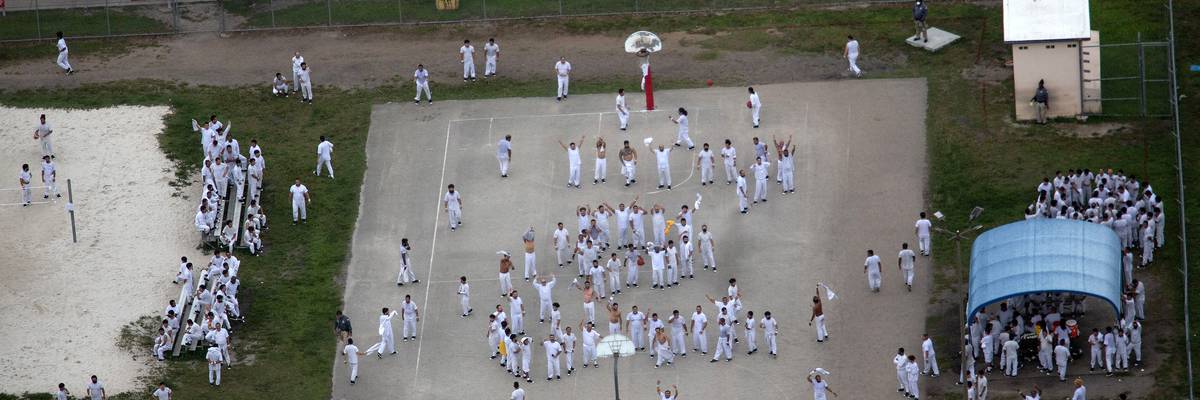
In an aerial view from a helicopter, detainees are seen at Krome Detention Center run by United States Immigration and Customs Enforcement on July 4, 2025 in Miami, Florida.
As immigrants are being targeted, cross-movement solidarity is essential in the fight to free all political prisoners.
Incarceration has been used as a core tactic of the United States in upholding racial capitalism and imperialisms through repression, extraction, and violent control. Growing to more than 65,000 people at the start of 2026, more people than ever are being held in immigration detention centers, with 2025 setting a 20-year record for deaths while detained.
The arrest and detention of dissenting people due to political motivations—or, the making of political prisoners—has required alleged charges, manufactured evidence, and the expansion of detention infrastructure. With the creation and rapid expansion of immigration enforcement agencies, the Department of Homeland Security (DHS) is creating another mass category of political prisoners.
The criminalization of protest and dissent has expanded in mission and in agency, as dissenters without citizenship have been targeted, investigated, and detained.
In a letter sent from inside an Immigration and Customs Enforcement (ICE) detention center in 2025, Palestinian activist Mahmoud Khalil declared, “I am a political prisoner,” as he explained the nature of his warrantless arrest by DHS officers after having been the target of an FBI investigation. Khalil stated, “Justice escapes the contours of this nation’s immigration facilities.”
Movements to end mass incarceration, immigrant justice movements, labor movements, environmental justice movements, and all others need to be interconnected in the fight to free all political prisoners.
Leqaa Kordia, a Palestinian with a pending asylum application in the US, was arrested after attending a protest, her charges were dropped, and she was later placed into custody at an ICE detention facility where she has been held despite a judge's orders for her release. Kordia’s family has shared the conditions she has faced, including being chained while hospitalized and barred from access to her attorneys and family.
A federal judge in Massachusetts ruled that people without citizenship have the same free speech rights as citizens, declaring immigration detention for protest and ideological deportation unconstitutional. Yet, the practice of kidnapping and detaining protesters without citizenship continues. Due to the Israeli occupation, seizure of land, and creation of an apartheid state, Palestinian activists like Mahmoud Khalil, Leqaa Kordia, Mohsen Mahdawi, and others are often considered stateless, making them harder to deport and leading to their indefinite apprehension in immigration detention centers as political prisoners.
In a similar pattern to the prison boom in 1980s California, ICE is rapidly expanding its detention infrastructure. Across the country federal funds are being used to purchase warehouses to convert into detention centers and lease offices to conduct operations in efforts to establish mass permanent presence of ICE around every corner. Abroad, the US is invested in political detention at facilities such as the camps in Guantánamo Bay in Cuba and Centro de Confinamiento del Terrorismo (CECOT) in El Salvador.
Alongside political repression, many of these infrastructure-strengthening actions, such as building and staffing for-profit schools in detention facilities and purchasing surveillance technologies, are increasing profits in the billions for developers, tech giants, and stock holders.
Federal funding of these actions by the billions fuels repression. The backing from elected officials, from local jurisdictions to Congress, supplies the infrastructure needed to build a mass system of political prisoners and violent socialeconomic control.
Prisons are a booming business that require a continued supply of people to ensure continued profit. From what Ruth Wilson Gilmore calls “organized abandonment,” people have been politicized by the repression they experience. The survival behaviors necessary to navigate life in this repression have been criminalized to keep facilities and pockets full.
Because of the nature of detention under racial capitalism, all imprisonment has been considered political, making all who are detained—whether that be in jails, prisons, immigration facilities, involuntary mental health facilities, and other sites of hold—political prisoners. The expansion, then, does not require formal conviction for the state to justify detention indefinitely.
Just like borders, immigration enforcement and detention creates political prisoners. For immigrants in the US, living within its borders is a political act, and continuing to live is a form of resistance. Once detained, immigrants are marked for life as a threat. A child born in an immigration detention facility is born a political prisoner.
These processes make political prisoners common, legitimizing their treatment and making it more difficult to unbuild the systems that keep them.
Political prisoners of movement spaces, such as Assata Shakur, Leonard Peltier, and Xinachtli (Alvaro Luna Hernandez), did not allow their detention to stop their resistance efforts. Many have written letters while incarcerated, providing critical texts revealing the use of detention as a method of political repression while exposing their inhumane living conditions. Others have organized from the inside, building power among incarcerated workers and connections to movements on the outside. And, like those held in immigration detention, some have focused on survival as their act of resistance.
On the outside, organizations such as the National Political Prisoner Coalition, Critical Resistance, the National Alliance Against Racist and Political Repression, and Close Guantánamo and the Center for Victims of Torture, have centered their actions around campaigns to free political prisoners. With the expansion of political prisonership under immigration repression, cross-movement solidarity is needed to work in coordination to interrupt and end all carceral tactics used for repression. Movements to end mass incarceration, immigrant justice movements, labor movements, environmental justice movements, and all others need to be interconnected in the fight to free all political prisoners.
Our survival depends on each other.
Dear Common Dreams reader, It’s been nearly 30 years since I co-founded Common Dreams with my late wife, Lina Newhouser. We had the radical notion that journalism should serve the public good, not corporate profits. It was clear to us from the outset what it would take to build such a project. No paid advertisements. No corporate sponsors. No millionaire publisher telling us what to think or do. Many people said we wouldn't last a year, but we proved those doubters wrong. Together with a tremendous team of journalists and dedicated staff, we built an independent media outlet free from the constraints of profits and corporate control. Our mission has always been simple: To inform. To inspire. To ignite change for the common good. Building Common Dreams was not easy. Our survival was never guaranteed. When you take on the most powerful forces—Wall Street greed, fossil fuel industry destruction, Big Tech lobbyists, and uber-rich oligarchs who have spent billions upon billions rigging the economy and democracy in their favor—the only bulwark you have is supporters who believe in your work. But here’s the urgent message from me today. It's never been this bad out there. And it's never been this hard to keep us going. At the very moment Common Dreams is most needed, the threats we face are intensifying. We need your support now more than ever. We don't accept corporate advertising and never will. We don't have a paywall because we don't think people should be blocked from critical news based on their ability to pay. Everything we do is funded by the donations of readers like you. When everyone does the little they can afford, we are strong. But if that support retreats or dries up, so do we. Will you donate now to make sure Common Dreams not only survives but thrives? —Craig Brown, Co-founder |
Incarceration has been used as a core tactic of the United States in upholding racial capitalism and imperialisms through repression, extraction, and violent control. Growing to more than 65,000 people at the start of 2026, more people than ever are being held in immigration detention centers, with 2025 setting a 20-year record for deaths while detained.
The arrest and detention of dissenting people due to political motivations—or, the making of political prisoners—has required alleged charges, manufactured evidence, and the expansion of detention infrastructure. With the creation and rapid expansion of immigration enforcement agencies, the Department of Homeland Security (DHS) is creating another mass category of political prisoners.
The criminalization of protest and dissent has expanded in mission and in agency, as dissenters without citizenship have been targeted, investigated, and detained.
In a letter sent from inside an Immigration and Customs Enforcement (ICE) detention center in 2025, Palestinian activist Mahmoud Khalil declared, “I am a political prisoner,” as he explained the nature of his warrantless arrest by DHS officers after having been the target of an FBI investigation. Khalil stated, “Justice escapes the contours of this nation’s immigration facilities.”
Movements to end mass incarceration, immigrant justice movements, labor movements, environmental justice movements, and all others need to be interconnected in the fight to free all political prisoners.
Leqaa Kordia, a Palestinian with a pending asylum application in the US, was arrested after attending a protest, her charges were dropped, and she was later placed into custody at an ICE detention facility where she has been held despite a judge's orders for her release. Kordia’s family has shared the conditions she has faced, including being chained while hospitalized and barred from access to her attorneys and family.
A federal judge in Massachusetts ruled that people without citizenship have the same free speech rights as citizens, declaring immigration detention for protest and ideological deportation unconstitutional. Yet, the practice of kidnapping and detaining protesters without citizenship continues. Due to the Israeli occupation, seizure of land, and creation of an apartheid state, Palestinian activists like Mahmoud Khalil, Leqaa Kordia, Mohsen Mahdawi, and others are often considered stateless, making them harder to deport and leading to their indefinite apprehension in immigration detention centers as political prisoners.
In a similar pattern to the prison boom in 1980s California, ICE is rapidly expanding its detention infrastructure. Across the country federal funds are being used to purchase warehouses to convert into detention centers and lease offices to conduct operations in efforts to establish mass permanent presence of ICE around every corner. Abroad, the US is invested in political detention at facilities such as the camps in Guantánamo Bay in Cuba and Centro de Confinamiento del Terrorismo (CECOT) in El Salvador.
Alongside political repression, many of these infrastructure-strengthening actions, such as building and staffing for-profit schools in detention facilities and purchasing surveillance technologies, are increasing profits in the billions for developers, tech giants, and stock holders.
Federal funding of these actions by the billions fuels repression. The backing from elected officials, from local jurisdictions to Congress, supplies the infrastructure needed to build a mass system of political prisoners and violent socialeconomic control.
Prisons are a booming business that require a continued supply of people to ensure continued profit. From what Ruth Wilson Gilmore calls “organized abandonment,” people have been politicized by the repression they experience. The survival behaviors necessary to navigate life in this repression have been criminalized to keep facilities and pockets full.
Because of the nature of detention under racial capitalism, all imprisonment has been considered political, making all who are detained—whether that be in jails, prisons, immigration facilities, involuntary mental health facilities, and other sites of hold—political prisoners. The expansion, then, does not require formal conviction for the state to justify detention indefinitely.
Just like borders, immigration enforcement and detention creates political prisoners. For immigrants in the US, living within its borders is a political act, and continuing to live is a form of resistance. Once detained, immigrants are marked for life as a threat. A child born in an immigration detention facility is born a political prisoner.
These processes make political prisoners common, legitimizing their treatment and making it more difficult to unbuild the systems that keep them.
Political prisoners of movement spaces, such as Assata Shakur, Leonard Peltier, and Xinachtli (Alvaro Luna Hernandez), did not allow their detention to stop their resistance efforts. Many have written letters while incarcerated, providing critical texts revealing the use of detention as a method of political repression while exposing their inhumane living conditions. Others have organized from the inside, building power among incarcerated workers and connections to movements on the outside. And, like those held in immigration detention, some have focused on survival as their act of resistance.
On the outside, organizations such as the National Political Prisoner Coalition, Critical Resistance, the National Alliance Against Racist and Political Repression, and Close Guantánamo and the Center for Victims of Torture, have centered their actions around campaigns to free political prisoners. With the expansion of political prisonership under immigration repression, cross-movement solidarity is needed to work in coordination to interrupt and end all carceral tactics used for repression. Movements to end mass incarceration, immigrant justice movements, labor movements, environmental justice movements, and all others need to be interconnected in the fight to free all political prisoners.
Our survival depends on each other.
Incarceration has been used as a core tactic of the United States in upholding racial capitalism and imperialisms through repression, extraction, and violent control. Growing to more than 65,000 people at the start of 2026, more people than ever are being held in immigration detention centers, with 2025 setting a 20-year record for deaths while detained.
The arrest and detention of dissenting people due to political motivations—or, the making of political prisoners—has required alleged charges, manufactured evidence, and the expansion of detention infrastructure. With the creation and rapid expansion of immigration enforcement agencies, the Department of Homeland Security (DHS) is creating another mass category of political prisoners.
The criminalization of protest and dissent has expanded in mission and in agency, as dissenters without citizenship have been targeted, investigated, and detained.
In a letter sent from inside an Immigration and Customs Enforcement (ICE) detention center in 2025, Palestinian activist Mahmoud Khalil declared, “I am a political prisoner,” as he explained the nature of his warrantless arrest by DHS officers after having been the target of an FBI investigation. Khalil stated, “Justice escapes the contours of this nation’s immigration facilities.”
Movements to end mass incarceration, immigrant justice movements, labor movements, environmental justice movements, and all others need to be interconnected in the fight to free all political prisoners.
Leqaa Kordia, a Palestinian with a pending asylum application in the US, was arrested after attending a protest, her charges were dropped, and she was later placed into custody at an ICE detention facility where she has been held despite a judge's orders for her release. Kordia’s family has shared the conditions she has faced, including being chained while hospitalized and barred from access to her attorneys and family.
A federal judge in Massachusetts ruled that people without citizenship have the same free speech rights as citizens, declaring immigration detention for protest and ideological deportation unconstitutional. Yet, the practice of kidnapping and detaining protesters without citizenship continues. Due to the Israeli occupation, seizure of land, and creation of an apartheid state, Palestinian activists like Mahmoud Khalil, Leqaa Kordia, Mohsen Mahdawi, and others are often considered stateless, making them harder to deport and leading to their indefinite apprehension in immigration detention centers as political prisoners.
In a similar pattern to the prison boom in 1980s California, ICE is rapidly expanding its detention infrastructure. Across the country federal funds are being used to purchase warehouses to convert into detention centers and lease offices to conduct operations in efforts to establish mass permanent presence of ICE around every corner. Abroad, the US is invested in political detention at facilities such as the camps in Guantánamo Bay in Cuba and Centro de Confinamiento del Terrorismo (CECOT) in El Salvador.
Alongside political repression, many of these infrastructure-strengthening actions, such as building and staffing for-profit schools in detention facilities and purchasing surveillance technologies, are increasing profits in the billions for developers, tech giants, and stock holders.
Federal funding of these actions by the billions fuels repression. The backing from elected officials, from local jurisdictions to Congress, supplies the infrastructure needed to build a mass system of political prisoners and violent socialeconomic control.
Prisons are a booming business that require a continued supply of people to ensure continued profit. From what Ruth Wilson Gilmore calls “organized abandonment,” people have been politicized by the repression they experience. The survival behaviors necessary to navigate life in this repression have been criminalized to keep facilities and pockets full.
Because of the nature of detention under racial capitalism, all imprisonment has been considered political, making all who are detained—whether that be in jails, prisons, immigration facilities, involuntary mental health facilities, and other sites of hold—political prisoners. The expansion, then, does not require formal conviction for the state to justify detention indefinitely.
Just like borders, immigration enforcement and detention creates political prisoners. For immigrants in the US, living within its borders is a political act, and continuing to live is a form of resistance. Once detained, immigrants are marked for life as a threat. A child born in an immigration detention facility is born a political prisoner.
These processes make political prisoners common, legitimizing their treatment and making it more difficult to unbuild the systems that keep them.
Political prisoners of movement spaces, such as Assata Shakur, Leonard Peltier, and Xinachtli (Alvaro Luna Hernandez), did not allow their detention to stop their resistance efforts. Many have written letters while incarcerated, providing critical texts revealing the use of detention as a method of political repression while exposing their inhumane living conditions. Others have organized from the inside, building power among incarcerated workers and connections to movements on the outside. And, like those held in immigration detention, some have focused on survival as their act of resistance.
On the outside, organizations such as the National Political Prisoner Coalition, Critical Resistance, the National Alliance Against Racist and Political Repression, and Close Guantánamo and the Center for Victims of Torture, have centered their actions around campaigns to free political prisoners. With the expansion of political prisonership under immigration repression, cross-movement solidarity is needed to work in coordination to interrupt and end all carceral tactics used for repression. Movements to end mass incarceration, immigrant justice movements, labor movements, environmental justice movements, and all others need to be interconnected in the fight to free all political prisoners.
Our survival depends on each other.