SUBSCRIBE TO OUR FREE NEWSLETTER
Daily news & progressive opinion—funded by the people, not the corporations—delivered straight to your inbox.
5
#000000
#FFFFFF
To donate by check, phone, or other method, see our More Ways to Give page.
Daily news & progressive opinion—funded by the people, not the corporations—delivered straight to your inbox.
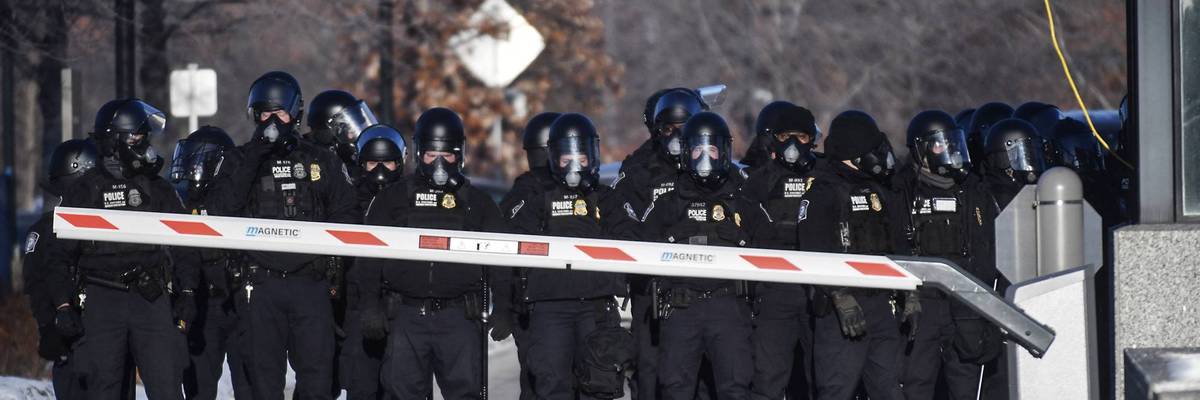
Department of Homeland Security police officers block the entrance of the Bishop Whipple Federal Building while protesters oppose ICE detentions almost week after Alex Pretti was killed by ICE agents in Minneapolis, Minnesota, on January 30, 2026.
They’re trying to convince all colors that resistance is futile, that Trump is all-powerful, and that a totalitarian government with him as its head is inevitable.
In early February, the barbarians reached my gate. There could be no more comfort or denial here on this island where I live. The masked thugs were roving through a town just across the water, a short ferry ride away, harassing and arresting long-time residents.
I was shocked, but not surprised. What do we do now? Yes, we all knew they were coming, still….
I was raised in the post-World War II “it can’t happen here” era. Hadn’t my parents’ generation crushed the Nazis for all time? While we’d been taught that democracy, like a faith or a marriage, did need tending, we had mostly taken it for granted. Yes, I did understand that life as I had lived it was under attack, but there was still, I thought, some time to respond.
The Republicans would come to their senses, right? They weren’t the Germans of a past era. The monster would sooner or later be brought down. And yes, he was bad, but he certainly wasn’t Hitler. And he looked so sickly. Eventually, the court system would kick in or the Epstein files would produce the Big Bang, whatever that might be. This was America, for God’s sake. We didn’t deserve to go down like this.
I also began to understand, however belatedly and somewhat sheepishly, what an enormous difference there was between my leftish friends and me and the mostly white men who now rule America with their cruel selfishness and moral disability.
Like most of my friends, I’d been thinking of little else for much too long and talking about it incessantly in a tone of wonder. Can you believe this shit? Yet living here on my island allowed me the destructive luxury of refusing to understand that we were all Minneapolitans, no matter where we were, even if our portfolios kept rising. Sure, we felt anxious and depressed, were wary of Trumpish neighbors, more generous donors to liberal causes, and active consumers of the media, but we were able to deflect the dangers, given our blind belief that being right was the best defense.
And I had an extra advantage: I was protected by a moat.
Shelter Island is a 28-square-mile town near the eastern end of New York’s Long Island in a region called the East End. It’s surrounded by water, but accessible by ferries from Greenport to the north and North Haven to the south. A third of the island is a protected nature conservancy. There are no street lights. The population in winter is around 3,000, which triples in the summer with tourists and second-home owners.
I’ve owned a home here for more than 30 years and lived here full-time for almost a decade, just about the right amount of time to appreciate the local mythology without entirely absorbing it—that Shelter Island is a quasi-independent republic, populated by rugged individualists who take care of their neighbors, especially seniors, through volunteer organizations (including a fire department and ambulance corps), while stoutly eschewing the glamorous greed of the nearby Hamptons.
It’s not been hard to feel above this country’s recent rush toward autocracy. Meanwhile, in recent decades, the island has been revising its sensibility in some progressive ways. For example, when I first arrived here in the 1980s, Shelter Island’s early history as a place of enslavement and provisioning for the slave trade was not a topic of polite conversation. Now, Sylvester Manor, once one of the earliest and northernmost slave plantations in this country, is internationally known for research and the preservation of slave remains and artifacts. It is also an integral local pillar through its educational farm.
It wasn’t until last year that I even realized just how vulnerable this island was to the whims of wealth and power. Yes, rich people routinely built houses and renovated hotels on the island that violated local zoning rules and they got away with it. But it wasn’t until one of our very own oligarchs casually betrayed our trust that I realized just how naïve we had been.
The Soloviev Group, one of the nation’s largest property owners, particularly of agricultural land, had bought a number of buildings on the island, including an iconic hotel, several stores, and the only pharmacy. Town officials mostly applauded the newcomers as “saviors.” Thanks to them, there would be an injection of money and jobs that would cover up the failures of those officials to come up with a comprehensive plan for taking care of Shelter Island, installing affordable housing, and protecting the water supply. They wouldn’t have to raise taxes, already low by regional standards.
“Shelter Island is like a womb,” said Stacey Soloviev, the ex-wife of Soloviev Group CEO Stefan Soloviev and the company’s cheery local face. “You feel very good when you come to Shelter Island.”
And for a while, the Solovievs did indeed go about their business on the island quietly feeling good without doing much good. Their parent corporation was busier. It tried and failed to build a gambling casino in midtown Manhattan. It negotiated with a nearby town to create a large residential development that would include a luxury spa. And then, out of the blue, in a stunning move with little notice, it suddenly shuttered the local hotel and closed the pharmacy, the only dispenser of medicine for a population that (like me) skewed elderly.
Like most Shelter Islanders, I was furious. As a board member of the town’s Senior Citizens Foundation, a support group for municipal senior services, I understood what an existential problem this could pose for people with limited mobility and resources, which just happens to be a large part of the population.
I also began to understand, however belatedly and somewhat sheepishly, what an enormous difference there was between my leftish friends and me and the mostly white men who now rule America with their cruel selfishness and moral disability. Our compassion, our tendency toward basic decency, our belief in fairness and equality were an enormous disadvantage in the battle against Trumpism, as was the faint shame so many of us felt for what seemed like a righteous posture, a sense of simply being better than those MAGA voters, handicapped as they were by manufactured fear and distinct inferiority complexes.
As for those super rich and intricately well-connected guys like Elon Musk, Jeff Bezos, and Peter Thiel, they were just more intellectually refined models of the genuine nightmare of our world, Donald Trump!
Sadly, of course, like so much else, it was even more complex than that. The rich guys were acting out of their best interests and were not even secretly ashamed, while the rural poor who had played such a role in getting us into this mess with their votes in 2016 and 2024 had not acted malevolently. They were flailing against a society that had ignored their needs.
And I was finally becoming truly woke myself.
As long as we stay in denial, in the bubble, clinging to the dream that goodness or Bad Bunny can save us, we are lost.
In late January, while I was still wallowing in rage at the closing of that pharmacy, a massive snowstorm hit the island. I was sitting in my warm house watching three Latino men wrestle with the foot of snow outside that held me hostage. I knew and liked them from past work, but I had no idea what their citizenship status was (or wasn’t), though I could imagine them becoming targets of the same sort of gang of thugs terrorizing Minneapolis and making sporadic forays into the East End. I assumed, of course, that I was safer than they were. But maybe that was only true for now. After all, out in Minneapolis, white American citizens were being executed—“cruel and unusual punishment”—for bearing witness to Immigration and Customs Enforcement (ICE).
Only a day before that Island snowstorm, a 37-year-old ICU nurse, Alex Pretti, had been gunned down in Minneapolis for observing and recording masked ICE agents too closely and trying to help a female protester they had assaulted. He should have known better. After all, two weeks earlier, poet and mother of three Renee Good had been killed for a similar “offense” in the same city.
A week later, on an 18°F night, we Shelter Islanders held a vigil in front of the community center.
Such a passive demonstration evokes both pathos and courage. It’s pathetic in the sense that nonviolence always seems weak in the face of blatant Trumpian-style aggression, however brave it may, in fact, be in its restraint and promise of commitment. In the long run, however, it is also the strategy most likely to succeed. The campaigns for civil rights and women’s rights provide the best historic lessons about that reality: Just keep coming out and ultimately the secret police and the criminal lunatic who sent them will get the message.
Because of that, I felt very proud that night of my 70-odd neighbors at the vigil, including the local Presbyterian pastor who read the names of the 32 people who had died in ICE custody last year. Most of them had Latino names, a grim reality which obscures for all too many whites the degree to which everybody remains in danger. I remembered that the killer thugs of 1964, the Ku Klux Klan, in their campaign to intimidate resistance and suppress Black voting, killed two young white men, Mickey Schwerner and Andrew Goodman, along with their Black fellow civil rights activist, James Chaney. As then, it was the killing of whites that got national attention, the bad guys’ intent.
By the night of that vigil, the early tutorials about dealing with ICE—including reminding people of their right not to speak to agents or allow them to search their homes and cars without a judicial warrant—seemed almost quixotic. After all, President Trump’s belligerent rhetoric had clearly set the stage for them to disregard both our rights and court orders. More important now, according to an activist friend I called in Minneapolis, was organizing groups to lower the vulnerability of people who might otherwise be prime targets of “our” secret police—drive them to work sites, do their shopping, and act as their lookouts. The shrilling of warning whistles, he said, had become the soundtrack of resistance to the totalitarian goons.
As the media has shrunk from its responsibility to bear witness and inform (while also shrinking in size), the involvement of everyday people (who might not yet be directly affected by the crisis) becomes ever more critical—as is sending money to legal defense groups. That need became even more apparent to me one early weekday morning in early February when ICE raided a line of cars waiting at the North Ferry terminal in Greenport, New York to come to our island for their jobs. Three men were arrested, all long-time residents of the area, none with criminal records (other than alleged illegal entry from Mexico many years ago). One of them, Hugo Leonel Ardon Osorio, was on his way to work at Marcello Masonry on the island. My wife and I remembered him from the crew that had rebuilt our driveway several years ago.
The next week, the snows returned and so did the three men who had cleared it away the last time around. I was happy—and relieved—to see them again.
Make no mistake: The barbarians are still at the gates. The Shelter Island Town Board has been holding meetings to determine what to do if they come across the water and land on our island. Will our local police department cooperate with them in any way? Will ordinary citizens be restricted in their demonstrations? Will the school lock its doors to ICE? (On the day ICE breached that ferry line, a quarter of Greenport’s students stayed away from school.)
The barbarians are now coming for most of us. Their mission has extended well beyond deporting some brown-skinned people. They’re trying to convince all colors that resistance is futile, that Trump is all-powerful, and that a totalitarian government with him as its head is inevitable.
And as long as we stay in denial, in the bubble, clinging to the dream that goodness or Bad Bunny can save us, we are lost. I know that my whistle and enhanced wokeness won’t be anywhere near enough. And I don’t have a plan yet, other than to stay the course, fight despair, support the most vulnerable, and preach to the choir that they—that all of us—should hang tough.
Dear Common Dreams reader, It’s been nearly 30 years since I co-founded Common Dreams with my late wife, Lina Newhouser. We had the radical notion that journalism should serve the public good, not corporate profits. It was clear to us from the outset what it would take to build such a project. No paid advertisements. No corporate sponsors. No millionaire publisher telling us what to think or do. Many people said we wouldn't last a year, but we proved those doubters wrong. Together with a tremendous team of journalists and dedicated staff, we built an independent media outlet free from the constraints of profits and corporate control. Our mission has always been simple: To inform. To inspire. To ignite change for the common good. Building Common Dreams was not easy. Our survival was never guaranteed. When you take on the most powerful forces—Wall Street greed, fossil fuel industry destruction, Big Tech lobbyists, and uber-rich oligarchs who have spent billions upon billions rigging the economy and democracy in their favor—the only bulwark you have is supporters who believe in your work. But here’s the urgent message from me today. It's never been this bad out there. And it's never been this hard to keep us going. At the very moment Common Dreams is most needed, the threats we face are intensifying. We need your support now more than ever. We don't accept corporate advertising and never will. We don't have a paywall because we don't think people should be blocked from critical news based on their ability to pay. Everything we do is funded by the donations of readers like you. When everyone does the little they can afford, we are strong. But if that support retreats or dries up, so do we. Will you donate now to make sure Common Dreams not only survives but thrives? —Craig Brown, Co-founder |
In early February, the barbarians reached my gate. There could be no more comfort or denial here on this island where I live. The masked thugs were roving through a town just across the water, a short ferry ride away, harassing and arresting long-time residents.
I was shocked, but not surprised. What do we do now? Yes, we all knew they were coming, still….
I was raised in the post-World War II “it can’t happen here” era. Hadn’t my parents’ generation crushed the Nazis for all time? While we’d been taught that democracy, like a faith or a marriage, did need tending, we had mostly taken it for granted. Yes, I did understand that life as I had lived it was under attack, but there was still, I thought, some time to respond.
The Republicans would come to their senses, right? They weren’t the Germans of a past era. The monster would sooner or later be brought down. And yes, he was bad, but he certainly wasn’t Hitler. And he looked so sickly. Eventually, the court system would kick in or the Epstein files would produce the Big Bang, whatever that might be. This was America, for God’s sake. We didn’t deserve to go down like this.
I also began to understand, however belatedly and somewhat sheepishly, what an enormous difference there was between my leftish friends and me and the mostly white men who now rule America with their cruel selfishness and moral disability.
Like most of my friends, I’d been thinking of little else for much too long and talking about it incessantly in a tone of wonder. Can you believe this shit? Yet living here on my island allowed me the destructive luxury of refusing to understand that we were all Minneapolitans, no matter where we were, even if our portfolios kept rising. Sure, we felt anxious and depressed, were wary of Trumpish neighbors, more generous donors to liberal causes, and active consumers of the media, but we were able to deflect the dangers, given our blind belief that being right was the best defense.
And I had an extra advantage: I was protected by a moat.
Shelter Island is a 28-square-mile town near the eastern end of New York’s Long Island in a region called the East End. It’s surrounded by water, but accessible by ferries from Greenport to the north and North Haven to the south. A third of the island is a protected nature conservancy. There are no street lights. The population in winter is around 3,000, which triples in the summer with tourists and second-home owners.
I’ve owned a home here for more than 30 years and lived here full-time for almost a decade, just about the right amount of time to appreciate the local mythology without entirely absorbing it—that Shelter Island is a quasi-independent republic, populated by rugged individualists who take care of their neighbors, especially seniors, through volunteer organizations (including a fire department and ambulance corps), while stoutly eschewing the glamorous greed of the nearby Hamptons.
It’s not been hard to feel above this country’s recent rush toward autocracy. Meanwhile, in recent decades, the island has been revising its sensibility in some progressive ways. For example, when I first arrived here in the 1980s, Shelter Island’s early history as a place of enslavement and provisioning for the slave trade was not a topic of polite conversation. Now, Sylvester Manor, once one of the earliest and northernmost slave plantations in this country, is internationally known for research and the preservation of slave remains and artifacts. It is also an integral local pillar through its educational farm.
It wasn’t until last year that I even realized just how vulnerable this island was to the whims of wealth and power. Yes, rich people routinely built houses and renovated hotels on the island that violated local zoning rules and they got away with it. But it wasn’t until one of our very own oligarchs casually betrayed our trust that I realized just how naïve we had been.
The Soloviev Group, one of the nation’s largest property owners, particularly of agricultural land, had bought a number of buildings on the island, including an iconic hotel, several stores, and the only pharmacy. Town officials mostly applauded the newcomers as “saviors.” Thanks to them, there would be an injection of money and jobs that would cover up the failures of those officials to come up with a comprehensive plan for taking care of Shelter Island, installing affordable housing, and protecting the water supply. They wouldn’t have to raise taxes, already low by regional standards.
“Shelter Island is like a womb,” said Stacey Soloviev, the ex-wife of Soloviev Group CEO Stefan Soloviev and the company’s cheery local face. “You feel very good when you come to Shelter Island.”
And for a while, the Solovievs did indeed go about their business on the island quietly feeling good without doing much good. Their parent corporation was busier. It tried and failed to build a gambling casino in midtown Manhattan. It negotiated with a nearby town to create a large residential development that would include a luxury spa. And then, out of the blue, in a stunning move with little notice, it suddenly shuttered the local hotel and closed the pharmacy, the only dispenser of medicine for a population that (like me) skewed elderly.
Like most Shelter Islanders, I was furious. As a board member of the town’s Senior Citizens Foundation, a support group for municipal senior services, I understood what an existential problem this could pose for people with limited mobility and resources, which just happens to be a large part of the population.
I also began to understand, however belatedly and somewhat sheepishly, what an enormous difference there was between my leftish friends and me and the mostly white men who now rule America with their cruel selfishness and moral disability. Our compassion, our tendency toward basic decency, our belief in fairness and equality were an enormous disadvantage in the battle against Trumpism, as was the faint shame so many of us felt for what seemed like a righteous posture, a sense of simply being better than those MAGA voters, handicapped as they were by manufactured fear and distinct inferiority complexes.
As for those super rich and intricately well-connected guys like Elon Musk, Jeff Bezos, and Peter Thiel, they were just more intellectually refined models of the genuine nightmare of our world, Donald Trump!
Sadly, of course, like so much else, it was even more complex than that. The rich guys were acting out of their best interests and were not even secretly ashamed, while the rural poor who had played such a role in getting us into this mess with their votes in 2016 and 2024 had not acted malevolently. They were flailing against a society that had ignored their needs.
And I was finally becoming truly woke myself.
As long as we stay in denial, in the bubble, clinging to the dream that goodness or Bad Bunny can save us, we are lost.
In late January, while I was still wallowing in rage at the closing of that pharmacy, a massive snowstorm hit the island. I was sitting in my warm house watching three Latino men wrestle with the foot of snow outside that held me hostage. I knew and liked them from past work, but I had no idea what their citizenship status was (or wasn’t), though I could imagine them becoming targets of the same sort of gang of thugs terrorizing Minneapolis and making sporadic forays into the East End. I assumed, of course, that I was safer than they were. But maybe that was only true for now. After all, out in Minneapolis, white American citizens were being executed—“cruel and unusual punishment”—for bearing witness to Immigration and Customs Enforcement (ICE).
Only a day before that Island snowstorm, a 37-year-old ICU nurse, Alex Pretti, had been gunned down in Minneapolis for observing and recording masked ICE agents too closely and trying to help a female protester they had assaulted. He should have known better. After all, two weeks earlier, poet and mother of three Renee Good had been killed for a similar “offense” in the same city.
A week later, on an 18°F night, we Shelter Islanders held a vigil in front of the community center.
Such a passive demonstration evokes both pathos and courage. It’s pathetic in the sense that nonviolence always seems weak in the face of blatant Trumpian-style aggression, however brave it may, in fact, be in its restraint and promise of commitment. In the long run, however, it is also the strategy most likely to succeed. The campaigns for civil rights and women’s rights provide the best historic lessons about that reality: Just keep coming out and ultimately the secret police and the criminal lunatic who sent them will get the message.
Because of that, I felt very proud that night of my 70-odd neighbors at the vigil, including the local Presbyterian pastor who read the names of the 32 people who had died in ICE custody last year. Most of them had Latino names, a grim reality which obscures for all too many whites the degree to which everybody remains in danger. I remembered that the killer thugs of 1964, the Ku Klux Klan, in their campaign to intimidate resistance and suppress Black voting, killed two young white men, Mickey Schwerner and Andrew Goodman, along with their Black fellow civil rights activist, James Chaney. As then, it was the killing of whites that got national attention, the bad guys’ intent.
By the night of that vigil, the early tutorials about dealing with ICE—including reminding people of their right not to speak to agents or allow them to search their homes and cars without a judicial warrant—seemed almost quixotic. After all, President Trump’s belligerent rhetoric had clearly set the stage for them to disregard both our rights and court orders. More important now, according to an activist friend I called in Minneapolis, was organizing groups to lower the vulnerability of people who might otherwise be prime targets of “our” secret police—drive them to work sites, do their shopping, and act as their lookouts. The shrilling of warning whistles, he said, had become the soundtrack of resistance to the totalitarian goons.
As the media has shrunk from its responsibility to bear witness and inform (while also shrinking in size), the involvement of everyday people (who might not yet be directly affected by the crisis) becomes ever more critical—as is sending money to legal defense groups. That need became even more apparent to me one early weekday morning in early February when ICE raided a line of cars waiting at the North Ferry terminal in Greenport, New York to come to our island for their jobs. Three men were arrested, all long-time residents of the area, none with criminal records (other than alleged illegal entry from Mexico many years ago). One of them, Hugo Leonel Ardon Osorio, was on his way to work at Marcello Masonry on the island. My wife and I remembered him from the crew that had rebuilt our driveway several years ago.
The next week, the snows returned and so did the three men who had cleared it away the last time around. I was happy—and relieved—to see them again.
Make no mistake: The barbarians are still at the gates. The Shelter Island Town Board has been holding meetings to determine what to do if they come across the water and land on our island. Will our local police department cooperate with them in any way? Will ordinary citizens be restricted in their demonstrations? Will the school lock its doors to ICE? (On the day ICE breached that ferry line, a quarter of Greenport’s students stayed away from school.)
The barbarians are now coming for most of us. Their mission has extended well beyond deporting some brown-skinned people. They’re trying to convince all colors that resistance is futile, that Trump is all-powerful, and that a totalitarian government with him as its head is inevitable.
And as long as we stay in denial, in the bubble, clinging to the dream that goodness or Bad Bunny can save us, we are lost. I know that my whistle and enhanced wokeness won’t be anywhere near enough. And I don’t have a plan yet, other than to stay the course, fight despair, support the most vulnerable, and preach to the choir that they—that all of us—should hang tough.
In early February, the barbarians reached my gate. There could be no more comfort or denial here on this island where I live. The masked thugs were roving through a town just across the water, a short ferry ride away, harassing and arresting long-time residents.
I was shocked, but not surprised. What do we do now? Yes, we all knew they were coming, still….
I was raised in the post-World War II “it can’t happen here” era. Hadn’t my parents’ generation crushed the Nazis for all time? While we’d been taught that democracy, like a faith or a marriage, did need tending, we had mostly taken it for granted. Yes, I did understand that life as I had lived it was under attack, but there was still, I thought, some time to respond.
The Republicans would come to their senses, right? They weren’t the Germans of a past era. The monster would sooner or later be brought down. And yes, he was bad, but he certainly wasn’t Hitler. And he looked so sickly. Eventually, the court system would kick in or the Epstein files would produce the Big Bang, whatever that might be. This was America, for God’s sake. We didn’t deserve to go down like this.
I also began to understand, however belatedly and somewhat sheepishly, what an enormous difference there was between my leftish friends and me and the mostly white men who now rule America with their cruel selfishness and moral disability.
Like most of my friends, I’d been thinking of little else for much too long and talking about it incessantly in a tone of wonder. Can you believe this shit? Yet living here on my island allowed me the destructive luxury of refusing to understand that we were all Minneapolitans, no matter where we were, even if our portfolios kept rising. Sure, we felt anxious and depressed, were wary of Trumpish neighbors, more generous donors to liberal causes, and active consumers of the media, but we were able to deflect the dangers, given our blind belief that being right was the best defense.
And I had an extra advantage: I was protected by a moat.
Shelter Island is a 28-square-mile town near the eastern end of New York’s Long Island in a region called the East End. It’s surrounded by water, but accessible by ferries from Greenport to the north and North Haven to the south. A third of the island is a protected nature conservancy. There are no street lights. The population in winter is around 3,000, which triples in the summer with tourists and second-home owners.
I’ve owned a home here for more than 30 years and lived here full-time for almost a decade, just about the right amount of time to appreciate the local mythology without entirely absorbing it—that Shelter Island is a quasi-independent republic, populated by rugged individualists who take care of their neighbors, especially seniors, through volunteer organizations (including a fire department and ambulance corps), while stoutly eschewing the glamorous greed of the nearby Hamptons.
It’s not been hard to feel above this country’s recent rush toward autocracy. Meanwhile, in recent decades, the island has been revising its sensibility in some progressive ways. For example, when I first arrived here in the 1980s, Shelter Island’s early history as a place of enslavement and provisioning for the slave trade was not a topic of polite conversation. Now, Sylvester Manor, once one of the earliest and northernmost slave plantations in this country, is internationally known for research and the preservation of slave remains and artifacts. It is also an integral local pillar through its educational farm.
It wasn’t until last year that I even realized just how vulnerable this island was to the whims of wealth and power. Yes, rich people routinely built houses and renovated hotels on the island that violated local zoning rules and they got away with it. But it wasn’t until one of our very own oligarchs casually betrayed our trust that I realized just how naïve we had been.
The Soloviev Group, one of the nation’s largest property owners, particularly of agricultural land, had bought a number of buildings on the island, including an iconic hotel, several stores, and the only pharmacy. Town officials mostly applauded the newcomers as “saviors.” Thanks to them, there would be an injection of money and jobs that would cover up the failures of those officials to come up with a comprehensive plan for taking care of Shelter Island, installing affordable housing, and protecting the water supply. They wouldn’t have to raise taxes, already low by regional standards.
“Shelter Island is like a womb,” said Stacey Soloviev, the ex-wife of Soloviev Group CEO Stefan Soloviev and the company’s cheery local face. “You feel very good when you come to Shelter Island.”
And for a while, the Solovievs did indeed go about their business on the island quietly feeling good without doing much good. Their parent corporation was busier. It tried and failed to build a gambling casino in midtown Manhattan. It negotiated with a nearby town to create a large residential development that would include a luxury spa. And then, out of the blue, in a stunning move with little notice, it suddenly shuttered the local hotel and closed the pharmacy, the only dispenser of medicine for a population that (like me) skewed elderly.
Like most Shelter Islanders, I was furious. As a board member of the town’s Senior Citizens Foundation, a support group for municipal senior services, I understood what an existential problem this could pose for people with limited mobility and resources, which just happens to be a large part of the population.
I also began to understand, however belatedly and somewhat sheepishly, what an enormous difference there was between my leftish friends and me and the mostly white men who now rule America with their cruel selfishness and moral disability. Our compassion, our tendency toward basic decency, our belief in fairness and equality were an enormous disadvantage in the battle against Trumpism, as was the faint shame so many of us felt for what seemed like a righteous posture, a sense of simply being better than those MAGA voters, handicapped as they were by manufactured fear and distinct inferiority complexes.
As for those super rich and intricately well-connected guys like Elon Musk, Jeff Bezos, and Peter Thiel, they were just more intellectually refined models of the genuine nightmare of our world, Donald Trump!
Sadly, of course, like so much else, it was even more complex than that. The rich guys were acting out of their best interests and were not even secretly ashamed, while the rural poor who had played such a role in getting us into this mess with their votes in 2016 and 2024 had not acted malevolently. They were flailing against a society that had ignored their needs.
And I was finally becoming truly woke myself.
As long as we stay in denial, in the bubble, clinging to the dream that goodness or Bad Bunny can save us, we are lost.
In late January, while I was still wallowing in rage at the closing of that pharmacy, a massive snowstorm hit the island. I was sitting in my warm house watching three Latino men wrestle with the foot of snow outside that held me hostage. I knew and liked them from past work, but I had no idea what their citizenship status was (or wasn’t), though I could imagine them becoming targets of the same sort of gang of thugs terrorizing Minneapolis and making sporadic forays into the East End. I assumed, of course, that I was safer than they were. But maybe that was only true for now. After all, out in Minneapolis, white American citizens were being executed—“cruel and unusual punishment”—for bearing witness to Immigration and Customs Enforcement (ICE).
Only a day before that Island snowstorm, a 37-year-old ICU nurse, Alex Pretti, had been gunned down in Minneapolis for observing and recording masked ICE agents too closely and trying to help a female protester they had assaulted. He should have known better. After all, two weeks earlier, poet and mother of three Renee Good had been killed for a similar “offense” in the same city.
A week later, on an 18°F night, we Shelter Islanders held a vigil in front of the community center.
Such a passive demonstration evokes both pathos and courage. It’s pathetic in the sense that nonviolence always seems weak in the face of blatant Trumpian-style aggression, however brave it may, in fact, be in its restraint and promise of commitment. In the long run, however, it is also the strategy most likely to succeed. The campaigns for civil rights and women’s rights provide the best historic lessons about that reality: Just keep coming out and ultimately the secret police and the criminal lunatic who sent them will get the message.
Because of that, I felt very proud that night of my 70-odd neighbors at the vigil, including the local Presbyterian pastor who read the names of the 32 people who had died in ICE custody last year. Most of them had Latino names, a grim reality which obscures for all too many whites the degree to which everybody remains in danger. I remembered that the killer thugs of 1964, the Ku Klux Klan, in their campaign to intimidate resistance and suppress Black voting, killed two young white men, Mickey Schwerner and Andrew Goodman, along with their Black fellow civil rights activist, James Chaney. As then, it was the killing of whites that got national attention, the bad guys’ intent.
By the night of that vigil, the early tutorials about dealing with ICE—including reminding people of their right not to speak to agents or allow them to search their homes and cars without a judicial warrant—seemed almost quixotic. After all, President Trump’s belligerent rhetoric had clearly set the stage for them to disregard both our rights and court orders. More important now, according to an activist friend I called in Minneapolis, was organizing groups to lower the vulnerability of people who might otherwise be prime targets of “our” secret police—drive them to work sites, do their shopping, and act as their lookouts. The shrilling of warning whistles, he said, had become the soundtrack of resistance to the totalitarian goons.
As the media has shrunk from its responsibility to bear witness and inform (while also shrinking in size), the involvement of everyday people (who might not yet be directly affected by the crisis) becomes ever more critical—as is sending money to legal defense groups. That need became even more apparent to me one early weekday morning in early February when ICE raided a line of cars waiting at the North Ferry terminal in Greenport, New York to come to our island for their jobs. Three men were arrested, all long-time residents of the area, none with criminal records (other than alleged illegal entry from Mexico many years ago). One of them, Hugo Leonel Ardon Osorio, was on his way to work at Marcello Masonry on the island. My wife and I remembered him from the crew that had rebuilt our driveway several years ago.
The next week, the snows returned and so did the three men who had cleared it away the last time around. I was happy—and relieved—to see them again.
Make no mistake: The barbarians are still at the gates. The Shelter Island Town Board has been holding meetings to determine what to do if they come across the water and land on our island. Will our local police department cooperate with them in any way? Will ordinary citizens be restricted in their demonstrations? Will the school lock its doors to ICE? (On the day ICE breached that ferry line, a quarter of Greenport’s students stayed away from school.)
The barbarians are now coming for most of us. Their mission has extended well beyond deporting some brown-skinned people. They’re trying to convince all colors that resistance is futile, that Trump is all-powerful, and that a totalitarian government with him as its head is inevitable.
And as long as we stay in denial, in the bubble, clinging to the dream that goodness or Bad Bunny can save us, we are lost. I know that my whistle and enhanced wokeness won’t be anywhere near enough. And I don’t have a plan yet, other than to stay the course, fight despair, support the most vulnerable, and preach to the choir that they—that all of us—should hang tough.