SUBSCRIBE TO OUR FREE NEWSLETTER
Daily news & progressive opinion—funded by the people, not the corporations—delivered straight to your inbox.
5
#000000
#FFFFFF
To donate by check, phone, or other method, see our More Ways to Give page.
Daily news & progressive opinion—funded by the people, not the corporations—delivered straight to your inbox.
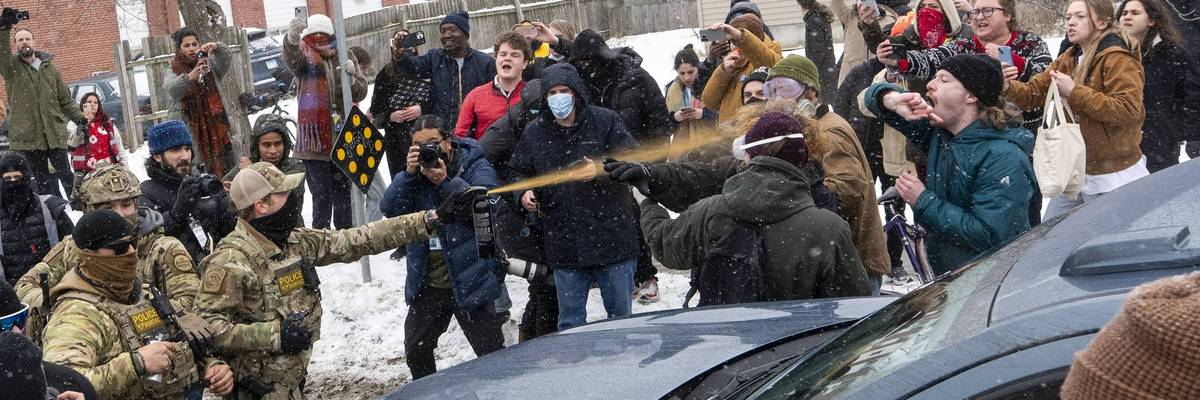
A Border Patrol member pepper sprays observers after getting into a car accident on Blaisdell Avenue on January 21, 2026 in Minneapolis, Minnesota. The driver and passenger of a vehicle and several observers were arrested by Border Patrol after the incident. The Trump administration has sent a reported 3,000 federal plus federal agents into the area, with more on the way, as they make a push to arrest undocumented immigrants in the region.
A letter from business leaders about the uprising against Donald Trump's lawless tactics in Minneapolis is remarkable not for what it says, but for what it refuses to acknowledge.
One of the many remarkable and lasting ideas the Rev. Dr. Martin Luther King Jr. placed into the national conversation was the concept of something he called “negative peace.”
Although the phrase began appearing in the writings of the civil rights leader in the late 1950s, King made the idea famous in his 1963 “Letter From Birmingham Jail,” where he was locked up for fighting segregation in Alabama’s largest city. He was annoyed by a letter from eight local white clergymen, titled a “Call for Unity,” that begged King to end a civil disobedience crusade for racial integration and seek progress through negotiations and the courts.
When an aide smuggled the newspaper into King’s cell, he began furiously scribbling his response in the margins of the ad before writing more on any scrap of paper he could find. His key passage argues that the white moderate was a greater threat to Black freedom than the KKK, because he was someone “more devoted to ‘order’ than to justice; who prefers a negative peace which is the absence of tension to a positive peace which is the presence of justice,” and who wants African Americans to wait for a “more convenient season.”
Flash-forward 63 years, and the grand pooh-bahs of US capitalism have learned nothing from this. On Sunday, 60 major corporations based in Minnesota — feeling caught in the crossfire of the federal immigration raids tearing apart Greater Minneapolis and the growing resistance movement — issued a cowardly and pathetic call for a negative peace to reduce the tensions.
The open letter that was released through the Minnesota Chamber of Commerce was signed by the CEOs or equivalents of almost every major Gopher State brand that you could think of — including Target, 3M, General Mills, Hormel, UnitedHealth (yes, that UnitedHealth), and all five major sports franchises. Some of these firms are beginning to see real economic fallout from the U.S. Immigration and Customs Enforcement raids and protest activities, which have kept some frightened Black and brown workers at home and triggered a large general strike last Friday.
The letter reads little differently from the Birmingham ministers’ “Call for Unity.”
“With yesterday’s tragic news”—a vague, bloodless reference to the 10 shots fired by federal officers into a 37-year-old intensive care nurse named Alex Pretti—“we are calling for an immediate deescalation of tensions and for state, local and federal officials to work together to find real solutions,” the letter states. It notes that Minnesota business leaders have been in touch with Gov. Tim Walz, the Donald Trump White House, and others in pleading for what it hopes would be a solution to the state’s crisis.
Pretti is never mentioned in the letter. Neither is Renee Nicole Good, the 37-year-old mother of three who was gunned down behind the wheel of her family SUV by an ICE agent as she attempted to drive away from a confrontation. In fact, ICE is never mentioned, nor are the federal agency’s most outrageous tactics, such as the seizure of a 5-year-old boy as “bait” to detain him and his father, or dragging a barely dressed Hmong refugee who is a U.S. citizen out of his home in frigid weather.
The entire letter is remarkable not for what it says—since it says very little beyond praying this whole mess somehow goes away so they can go back to making money without thinking about such dreadful things—than for what it doesn’t say.
There is no condemnation of the murders of two U.S. citizens who did nothing beyond legally monitoring the federal officers and their activities while on public streets. There is no condemnation of the ICE tactics in seizing hardworking migrants with no criminal records who are the backbone of the Minnesota community. There is nothing about what MLK would have called “positive peace”—a desire for real justice.
That’s probably because positive peace requires bold choices and displays of real courage—qualities that modern corporate America seems to have misplaced in a giant warehouse somewhere.
Exhibit A would have to be Target, the large national retailer that, with its hundreds of stores and its name slapped on the NBA’s Timberwolves’ arena, is now to many Americans the corporate face of Minnesota. Under pressure from demonstrators, including more than 100 clergy who protested outside Target’s Minneapolis headquarters on Friday, the retailer still said nothing — before the tepid group letter — about the ongoing ICE raids, or why agents have been allowed to stage operations in its parking lots and even inside stores.
There’s a bleak history here. In 2020, Minnesota became the epicenter of the fight for racial justice when the Minneapolis police murder of George Floyd was captured on video. That time, the state’s CEOs not only expressed moral outrage but pledged to spend heavily on diversity initiatives. Five years later, the local news site Racket reported many of these firms had backtracked, and that barely a third of the pledged $550 million had been spent.
This time, the business leaders just want the “tension” to disappear. That’s not so easy. Just ask Target. Its early 2025 move to end its diversity initiatives as Trump took office sparked calls from Black leaders for a boycott that has cut into store traffic and lowered Target’s stock price. It seems that moral surrender actually does have a price.
Also on Sunday, the team chaplain for the Timberwolves—ironically, one of the teams that signed onto the corporate letter—issued a personal statement with loud echoes of the “Letter from Birmingham Jail,” calling out any churches that had prayed that morning for peace and unity but not for justice.
“Peace is what the powerful ask for when they don’t want to be interrupted,” Matt Moberg wrote in a short piece that went viral on social media, adding, “Unity that refuses to name violence is just loyalty to the ones holding the weapons.”
This wouldn’t be the first time corporate America misread the room. Sunday’s statement suggested a continued deer-in-the-headlights reaction from the shock of Trump’s return to office—even as the CEOs ignore not just the power of the Target boycotts but the recent success of economic justice campaigns against firms from Disney to Avelo Airlines, not to mention the solidarity that drove the Minneapolis general strike.
Already, there is growing talk of a national general strike or expanded boycotts by millions of citizens who are also consumers, and who are both furious over the Good and Pretti murders and now flabbergasted by the corporate cone of silence. America’s business leaders don’t understand that cowardice has a steep cost attached.
Dear Common Dreams reader, It’s been nearly 30 years since I co-founded Common Dreams with my late wife, Lina Newhouser. We had the radical notion that journalism should serve the public good, not corporate profits. It was clear to us from the outset what it would take to build such a project. No paid advertisements. No corporate sponsors. No millionaire publisher telling us what to think or do. Many people said we wouldn't last a year, but we proved those doubters wrong. Together with a tremendous team of journalists and dedicated staff, we built an independent media outlet free from the constraints of profits and corporate control. Our mission has always been simple: To inform. To inspire. To ignite change for the common good. Building Common Dreams was not easy. Our survival was never guaranteed. When you take on the most powerful forces—Wall Street greed, fossil fuel industry destruction, Big Tech lobbyists, and uber-rich oligarchs who have spent billions upon billions rigging the economy and democracy in their favor—the only bulwark you have is supporters who believe in your work. But here’s the urgent message from me today. It's never been this bad out there. And it's never been this hard to keep us going. At the very moment Common Dreams is most needed, the threats we face are intensifying. We need your support now more than ever. We don't accept corporate advertising and never will. We don't have a paywall because we don't think people should be blocked from critical news based on their ability to pay. Everything we do is funded by the donations of readers like you. When everyone does the little they can afford, we are strong. But if that support retreats or dries up, so do we. Will you donate now to make sure Common Dreams not only survives but thrives? —Craig Brown, Co-founder |
One of the many remarkable and lasting ideas the Rev. Dr. Martin Luther King Jr. placed into the national conversation was the concept of something he called “negative peace.”
Although the phrase began appearing in the writings of the civil rights leader in the late 1950s, King made the idea famous in his 1963 “Letter From Birmingham Jail,” where he was locked up for fighting segregation in Alabama’s largest city. He was annoyed by a letter from eight local white clergymen, titled a “Call for Unity,” that begged King to end a civil disobedience crusade for racial integration and seek progress through negotiations and the courts.
When an aide smuggled the newspaper into King’s cell, he began furiously scribbling his response in the margins of the ad before writing more on any scrap of paper he could find. His key passage argues that the white moderate was a greater threat to Black freedom than the KKK, because he was someone “more devoted to ‘order’ than to justice; who prefers a negative peace which is the absence of tension to a positive peace which is the presence of justice,” and who wants African Americans to wait for a “more convenient season.”
Flash-forward 63 years, and the grand pooh-bahs of US capitalism have learned nothing from this. On Sunday, 60 major corporations based in Minnesota — feeling caught in the crossfire of the federal immigration raids tearing apart Greater Minneapolis and the growing resistance movement — issued a cowardly and pathetic call for a negative peace to reduce the tensions.
The open letter that was released through the Minnesota Chamber of Commerce was signed by the CEOs or equivalents of almost every major Gopher State brand that you could think of — including Target, 3M, General Mills, Hormel, UnitedHealth (yes, that UnitedHealth), and all five major sports franchises. Some of these firms are beginning to see real economic fallout from the U.S. Immigration and Customs Enforcement raids and protest activities, which have kept some frightened Black and brown workers at home and triggered a large general strike last Friday.
The letter reads little differently from the Birmingham ministers’ “Call for Unity.”
“With yesterday’s tragic news”—a vague, bloodless reference to the 10 shots fired by federal officers into a 37-year-old intensive care nurse named Alex Pretti—“we are calling for an immediate deescalation of tensions and for state, local and federal officials to work together to find real solutions,” the letter states. It notes that Minnesota business leaders have been in touch with Gov. Tim Walz, the Donald Trump White House, and others in pleading for what it hopes would be a solution to the state’s crisis.
Pretti is never mentioned in the letter. Neither is Renee Nicole Good, the 37-year-old mother of three who was gunned down behind the wheel of her family SUV by an ICE agent as she attempted to drive away from a confrontation. In fact, ICE is never mentioned, nor are the federal agency’s most outrageous tactics, such as the seizure of a 5-year-old boy as “bait” to detain him and his father, or dragging a barely dressed Hmong refugee who is a U.S. citizen out of his home in frigid weather.
The entire letter is remarkable not for what it says—since it says very little beyond praying this whole mess somehow goes away so they can go back to making money without thinking about such dreadful things—than for what it doesn’t say.
There is no condemnation of the murders of two U.S. citizens who did nothing beyond legally monitoring the federal officers and their activities while on public streets. There is no condemnation of the ICE tactics in seizing hardworking migrants with no criminal records who are the backbone of the Minnesota community. There is nothing about what MLK would have called “positive peace”—a desire for real justice.
That’s probably because positive peace requires bold choices and displays of real courage—qualities that modern corporate America seems to have misplaced in a giant warehouse somewhere.
Exhibit A would have to be Target, the large national retailer that, with its hundreds of stores and its name slapped on the NBA’s Timberwolves’ arena, is now to many Americans the corporate face of Minnesota. Under pressure from demonstrators, including more than 100 clergy who protested outside Target’s Minneapolis headquarters on Friday, the retailer still said nothing — before the tepid group letter — about the ongoing ICE raids, or why agents have been allowed to stage operations in its parking lots and even inside stores.
There’s a bleak history here. In 2020, Minnesota became the epicenter of the fight for racial justice when the Minneapolis police murder of George Floyd was captured on video. That time, the state’s CEOs not only expressed moral outrage but pledged to spend heavily on diversity initiatives. Five years later, the local news site Racket reported many of these firms had backtracked, and that barely a third of the pledged $550 million had been spent.
This time, the business leaders just want the “tension” to disappear. That’s not so easy. Just ask Target. Its early 2025 move to end its diversity initiatives as Trump took office sparked calls from Black leaders for a boycott that has cut into store traffic and lowered Target’s stock price. It seems that moral surrender actually does have a price.
Also on Sunday, the team chaplain for the Timberwolves—ironically, one of the teams that signed onto the corporate letter—issued a personal statement with loud echoes of the “Letter from Birmingham Jail,” calling out any churches that had prayed that morning for peace and unity but not for justice.
“Peace is what the powerful ask for when they don’t want to be interrupted,” Matt Moberg wrote in a short piece that went viral on social media, adding, “Unity that refuses to name violence is just loyalty to the ones holding the weapons.”
This wouldn’t be the first time corporate America misread the room. Sunday’s statement suggested a continued deer-in-the-headlights reaction from the shock of Trump’s return to office—even as the CEOs ignore not just the power of the Target boycotts but the recent success of economic justice campaigns against firms from Disney to Avelo Airlines, not to mention the solidarity that drove the Minneapolis general strike.
Already, there is growing talk of a national general strike or expanded boycotts by millions of citizens who are also consumers, and who are both furious over the Good and Pretti murders and now flabbergasted by the corporate cone of silence. America’s business leaders don’t understand that cowardice has a steep cost attached.
One of the many remarkable and lasting ideas the Rev. Dr. Martin Luther King Jr. placed into the national conversation was the concept of something he called “negative peace.”
Although the phrase began appearing in the writings of the civil rights leader in the late 1950s, King made the idea famous in his 1963 “Letter From Birmingham Jail,” where he was locked up for fighting segregation in Alabama’s largest city. He was annoyed by a letter from eight local white clergymen, titled a “Call for Unity,” that begged King to end a civil disobedience crusade for racial integration and seek progress through negotiations and the courts.
When an aide smuggled the newspaper into King’s cell, he began furiously scribbling his response in the margins of the ad before writing more on any scrap of paper he could find. His key passage argues that the white moderate was a greater threat to Black freedom than the KKK, because he was someone “more devoted to ‘order’ than to justice; who prefers a negative peace which is the absence of tension to a positive peace which is the presence of justice,” and who wants African Americans to wait for a “more convenient season.”
Flash-forward 63 years, and the grand pooh-bahs of US capitalism have learned nothing from this. On Sunday, 60 major corporations based in Minnesota — feeling caught in the crossfire of the federal immigration raids tearing apart Greater Minneapolis and the growing resistance movement — issued a cowardly and pathetic call for a negative peace to reduce the tensions.
The open letter that was released through the Minnesota Chamber of Commerce was signed by the CEOs or equivalents of almost every major Gopher State brand that you could think of — including Target, 3M, General Mills, Hormel, UnitedHealth (yes, that UnitedHealth), and all five major sports franchises. Some of these firms are beginning to see real economic fallout from the U.S. Immigration and Customs Enforcement raids and protest activities, which have kept some frightened Black and brown workers at home and triggered a large general strike last Friday.
The letter reads little differently from the Birmingham ministers’ “Call for Unity.”
“With yesterday’s tragic news”—a vague, bloodless reference to the 10 shots fired by federal officers into a 37-year-old intensive care nurse named Alex Pretti—“we are calling for an immediate deescalation of tensions and for state, local and federal officials to work together to find real solutions,” the letter states. It notes that Minnesota business leaders have been in touch with Gov. Tim Walz, the Donald Trump White House, and others in pleading for what it hopes would be a solution to the state’s crisis.
Pretti is never mentioned in the letter. Neither is Renee Nicole Good, the 37-year-old mother of three who was gunned down behind the wheel of her family SUV by an ICE agent as she attempted to drive away from a confrontation. In fact, ICE is never mentioned, nor are the federal agency’s most outrageous tactics, such as the seizure of a 5-year-old boy as “bait” to detain him and his father, or dragging a barely dressed Hmong refugee who is a U.S. citizen out of his home in frigid weather.
The entire letter is remarkable not for what it says—since it says very little beyond praying this whole mess somehow goes away so they can go back to making money without thinking about such dreadful things—than for what it doesn’t say.
There is no condemnation of the murders of two U.S. citizens who did nothing beyond legally monitoring the federal officers and their activities while on public streets. There is no condemnation of the ICE tactics in seizing hardworking migrants with no criminal records who are the backbone of the Minnesota community. There is nothing about what MLK would have called “positive peace”—a desire for real justice.
That’s probably because positive peace requires bold choices and displays of real courage—qualities that modern corporate America seems to have misplaced in a giant warehouse somewhere.
Exhibit A would have to be Target, the large national retailer that, with its hundreds of stores and its name slapped on the NBA’s Timberwolves’ arena, is now to many Americans the corporate face of Minnesota. Under pressure from demonstrators, including more than 100 clergy who protested outside Target’s Minneapolis headquarters on Friday, the retailer still said nothing — before the tepid group letter — about the ongoing ICE raids, or why agents have been allowed to stage operations in its parking lots and even inside stores.
There’s a bleak history here. In 2020, Minnesota became the epicenter of the fight for racial justice when the Minneapolis police murder of George Floyd was captured on video. That time, the state’s CEOs not only expressed moral outrage but pledged to spend heavily on diversity initiatives. Five years later, the local news site Racket reported many of these firms had backtracked, and that barely a third of the pledged $550 million had been spent.
This time, the business leaders just want the “tension” to disappear. That’s not so easy. Just ask Target. Its early 2025 move to end its diversity initiatives as Trump took office sparked calls from Black leaders for a boycott that has cut into store traffic and lowered Target’s stock price. It seems that moral surrender actually does have a price.
Also on Sunday, the team chaplain for the Timberwolves—ironically, one of the teams that signed onto the corporate letter—issued a personal statement with loud echoes of the “Letter from Birmingham Jail,” calling out any churches that had prayed that morning for peace and unity but not for justice.
“Peace is what the powerful ask for when they don’t want to be interrupted,” Matt Moberg wrote in a short piece that went viral on social media, adding, “Unity that refuses to name violence is just loyalty to the ones holding the weapons.”
This wouldn’t be the first time corporate America misread the room. Sunday’s statement suggested a continued deer-in-the-headlights reaction from the shock of Trump’s return to office—even as the CEOs ignore not just the power of the Target boycotts but the recent success of economic justice campaigns against firms from Disney to Avelo Airlines, not to mention the solidarity that drove the Minneapolis general strike.
Already, there is growing talk of a national general strike or expanded boycotts by millions of citizens who are also consumers, and who are both furious over the Good and Pretti murders and now flabbergasted by the corporate cone of silence. America’s business leaders don’t understand that cowardice has a steep cost attached.