SUBSCRIBE TO OUR FREE NEWSLETTER
Daily news & progressive opinion—funded by the people, not the corporations—delivered straight to your inbox.
5
#000000
#FFFFFF
To donate by check, phone, or other method, see our More Ways to Give page.
Daily news & progressive opinion—funded by the people, not the corporations—delivered straight to your inbox.
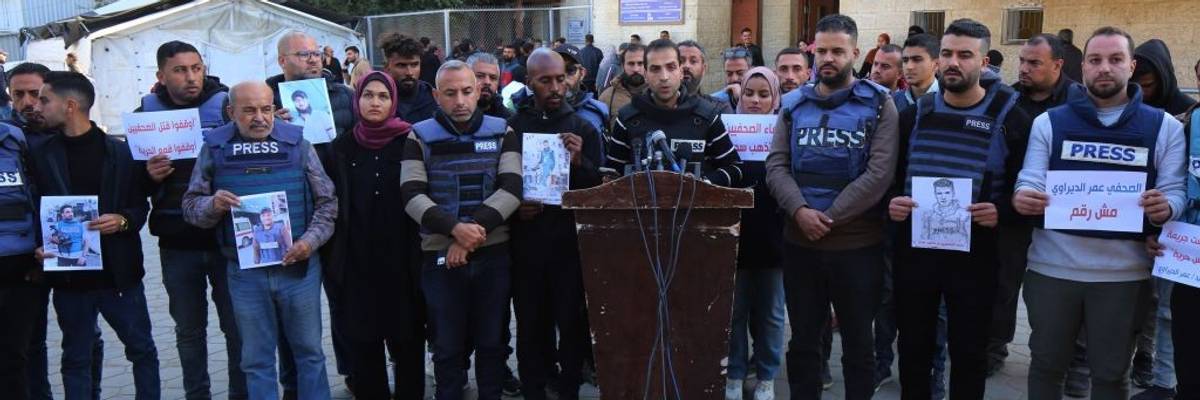
Journalists protest against the Israeli attacks on the Palestinian journalists outside a hospital in Deir al-Balah city, central Gaza Strip, on Jan. 8, 2025.
Youth support for Palestine reflects a changing media landscape.
As unconditional support for Israel becomes more of a political liability and solidarity with Palestine establishes itself as a litmus test, former Secretary of State Hillary Clinton and her fellow status-quo defenders are blaming social media for the US public’s growing solidarity with Palestine.
In accusing young people of falling for fake news, they rely on an outdated assumption that equates social media with falsehoods—and equates legacy media with trustworthiness. What’s clear is that Clinton and her peers who partake in similar rhetoric fail to grasp the nuances of today’s media landscape, particularly as it has unraveled around Palestine.
More and more Americans have realized that Israel’s post-October 7 assault on Gaza is not only disproportionate but genocidal, and that in spite of the carnage, the US government continues to provide diplomatic cover and send billions in military aid. It’s no wonder that public sentiment has shifted considerably against Israel in the past two years, with young people in particular being increasingly supportive of Palestine. This sea change has made establishment politicians very nervous. In several recent speaking engagements, former Secretary of State Hillary Clinton has lamented that these pro-Palestine young people have the unfortunate habit of getting their news from social media; to her, that makes them uninformed and sorely misled.
“More than 50% of young people in America get their news from social media. Just pause on that for a second,” she said at an event for the newspaper Israel Hayom earlier this month. “They are seeing short-form videos, some of them totally made up, some of them not at all representing what they claim to be showing. And that’s where they get their information.”
The claim that social media is misleading and misinforming young people is simply an attempt not only to delegitimize pro-Palestine sentiment but to cast doubt on the devastation in Gaza itself.
Clinton’s framing is reminiscent of 2016-era misinformation discourse, back when the US public hadn’t fully figured out what to do with social media’s rapid acceleration and impact on politics. But that familiar rhetoric does not apply to the youth-driven political realignment on Palestine. When Clinton implies that pro-Palestine sentiment is a result of misinformation—a fraught umbrella diagnosis that often tries to encompass too much, and whose remedies can clash with the ideals of free speech—she attempts to place it within the context of Facebook fueling atrocities in Myanmar, Russian information campaigns working to influence the US election, and then-candidate Donald Trump labeling every media outlet “fake news,” forcing them to have tough conversations about when and how to fact-check his claims.
While the current media landscape and its relationship to politics is still bleak, Clinton’s accusation is much more about her fealty to Israel and the centrist-liberal order. The claim that social media is misleading and misinforming young people is simply an attempt not only to delegitimize pro-Palestine sentiment but to cast doubt on the devastation in Gaza itself.
The data point that half of Americans get (some of) their news from social media alarms most people—perhaps a valid instinct, given the current media landscape of local news in decline, billionaires taking over outlets, and profit-driven influencers peddling dubious wellness claims via vertical video. Social media did democratize information sharing without necessarily embedding any accountability mechanism for its quality and accuracy, resulting in a lot of low-quality content of dubious veracity.
But this doesn’t mean that social media users are only, primarily, or even significantly consuming fake news or slop. Pew Research Center reports that users, shockingly, do make assessments about what content they’re looking at. Not to mention that plenty of the content on social media is content from news outlets themselves.
According to Clinton, what’s most concerning is the fact that so many young people are getting their information from TikTok, given that the app is “governed by an algorithm—at least up til now—still largely manipulated by the Chinese Communist Party.” Her geopolitical paranoia echoes CNN commentator Van Jones, who in October placed blame on Iran and Qatar for running a “disinformation campaign” that flooded social media users with images of “dead Gaza baby, dead Gaza baby, dead Gaza baby.” Both try to convince audiences that concern for Palestine is just an information-operations campaign from our geopolitical enemies. Reports from earlier this year indicated that the legislation banning TikTok was, in part, ushered along by lawmakers’ worries about the prevalence of content critical of Israel on the platform.
Yet the most damning lesson here is not the growing reliance on getting information from social media, or even the fact that our collective outlook toward it should be more nuanced (it should!). Rather, it’s the collapse of trust in traditional legacy media that has accompanied young peoples’ shifting views on Palestine. The media industry utterly failed in its charge to report the news, and it failed to defend colleagues in Gaza as they were systematically murdered by the Israeli government. The New York Times in particular has been especially egregious, most infamously failing to retract their story “Screams Without Words” even after its credibility was seriously questioned.
Let’s say Clinton and her peers are only consuming these news sources (and even then, they’d have to be taking great lengths to avoid reading the quality reporting on Gaza that mainstream publications do often release, not to mention ignoring the numerous reports from human rights organizations and experts), then they’d be the ones who are uninformed—not the bogeyman of kids on social media.
The Lemkin Institute for Genocide Prevention and Human Security issued a statement last week on Clinton’s baseless accusations:
What truly seems to unsettle Secretary Clinton is not “misinformation,” but rather the fact that younger generations are no longer consuming a single, state-controlled narrative. They are accessing unfiltered images and testimonies that challenge decades of political messaging.
Clinton’s basic premise—denying the genocide in Gaza—is false. Young people know that they’re being gaslit. Yes, it is true that they’ve experienced “TikTok smashing their brains all day long with videos of carnage in Gaza.” They’ve seen Western media bend over backwards to diminish blame on Israel. And they’ve seen resilient Palestinian journalists like Bisan Owda showing Gaza through her own eyes.
At the Doha Forum, Clinton said it’s “a provable fact that most Americans... get their news from social media.” To echo Foreign Policy editor-in-chief Ravi Agrawal’s response: “Is that a bad thing?”
Dear Common Dreams reader, It’s been nearly 30 years since I co-founded Common Dreams with my late wife, Lina Newhouser. We had the radical notion that journalism should serve the public good, not corporate profits. It was clear to us from the outset what it would take to build such a project. No paid advertisements. No corporate sponsors. No millionaire publisher telling us what to think or do. Many people said we wouldn't last a year, but we proved those doubters wrong. Together with a tremendous team of journalists and dedicated staff, we built an independent media outlet free from the constraints of profits and corporate control. Our mission has always been simple: To inform. To inspire. To ignite change for the common good. Building Common Dreams was not easy. Our survival was never guaranteed. When you take on the most powerful forces—Wall Street greed, fossil fuel industry destruction, Big Tech lobbyists, and uber-rich oligarchs who have spent billions upon billions rigging the economy and democracy in their favor—the only bulwark you have is supporters who believe in your work. But here’s the urgent message from me today. It's never been this bad out there. And it's never been this hard to keep us going. At the very moment Common Dreams is most needed, the threats we face are intensifying. We need your support now more than ever. We don't accept corporate advertising and never will. We don't have a paywall because we don't think people should be blocked from critical news based on their ability to pay. Everything we do is funded by the donations of readers like you. When everyone does the little they can afford, we are strong. But if that support retreats or dries up, so do we. Will you donate now to make sure Common Dreams not only survives but thrives? —Craig Brown, Co-founder |
As unconditional support for Israel becomes more of a political liability and solidarity with Palestine establishes itself as a litmus test, former Secretary of State Hillary Clinton and her fellow status-quo defenders are blaming social media for the US public’s growing solidarity with Palestine.
In accusing young people of falling for fake news, they rely on an outdated assumption that equates social media with falsehoods—and equates legacy media with trustworthiness. What’s clear is that Clinton and her peers who partake in similar rhetoric fail to grasp the nuances of today’s media landscape, particularly as it has unraveled around Palestine.
More and more Americans have realized that Israel’s post-October 7 assault on Gaza is not only disproportionate but genocidal, and that in spite of the carnage, the US government continues to provide diplomatic cover and send billions in military aid. It’s no wonder that public sentiment has shifted considerably against Israel in the past two years, with young people in particular being increasingly supportive of Palestine. This sea change has made establishment politicians very nervous. In several recent speaking engagements, former Secretary of State Hillary Clinton has lamented that these pro-Palestine young people have the unfortunate habit of getting their news from social media; to her, that makes them uninformed and sorely misled.
“More than 50% of young people in America get their news from social media. Just pause on that for a second,” she said at an event for the newspaper Israel Hayom earlier this month. “They are seeing short-form videos, some of them totally made up, some of them not at all representing what they claim to be showing. And that’s where they get their information.”
The claim that social media is misleading and misinforming young people is simply an attempt not only to delegitimize pro-Palestine sentiment but to cast doubt on the devastation in Gaza itself.
Clinton’s framing is reminiscent of 2016-era misinformation discourse, back when the US public hadn’t fully figured out what to do with social media’s rapid acceleration and impact on politics. But that familiar rhetoric does not apply to the youth-driven political realignment on Palestine. When Clinton implies that pro-Palestine sentiment is a result of misinformation—a fraught umbrella diagnosis that often tries to encompass too much, and whose remedies can clash with the ideals of free speech—she attempts to place it within the context of Facebook fueling atrocities in Myanmar, Russian information campaigns working to influence the US election, and then-candidate Donald Trump labeling every media outlet “fake news,” forcing them to have tough conversations about when and how to fact-check his claims.
While the current media landscape and its relationship to politics is still bleak, Clinton’s accusation is much more about her fealty to Israel and the centrist-liberal order. The claim that social media is misleading and misinforming young people is simply an attempt not only to delegitimize pro-Palestine sentiment but to cast doubt on the devastation in Gaza itself.
The data point that half of Americans get (some of) their news from social media alarms most people—perhaps a valid instinct, given the current media landscape of local news in decline, billionaires taking over outlets, and profit-driven influencers peddling dubious wellness claims via vertical video. Social media did democratize information sharing without necessarily embedding any accountability mechanism for its quality and accuracy, resulting in a lot of low-quality content of dubious veracity.
But this doesn’t mean that social media users are only, primarily, or even significantly consuming fake news or slop. Pew Research Center reports that users, shockingly, do make assessments about what content they’re looking at. Not to mention that plenty of the content on social media is content from news outlets themselves.
According to Clinton, what’s most concerning is the fact that so many young people are getting their information from TikTok, given that the app is “governed by an algorithm—at least up til now—still largely manipulated by the Chinese Communist Party.” Her geopolitical paranoia echoes CNN commentator Van Jones, who in October placed blame on Iran and Qatar for running a “disinformation campaign” that flooded social media users with images of “dead Gaza baby, dead Gaza baby, dead Gaza baby.” Both try to convince audiences that concern for Palestine is just an information-operations campaign from our geopolitical enemies. Reports from earlier this year indicated that the legislation banning TikTok was, in part, ushered along by lawmakers’ worries about the prevalence of content critical of Israel on the platform.
Yet the most damning lesson here is not the growing reliance on getting information from social media, or even the fact that our collective outlook toward it should be more nuanced (it should!). Rather, it’s the collapse of trust in traditional legacy media that has accompanied young peoples’ shifting views on Palestine. The media industry utterly failed in its charge to report the news, and it failed to defend colleagues in Gaza as they were systematically murdered by the Israeli government. The New York Times in particular has been especially egregious, most infamously failing to retract their story “Screams Without Words” even after its credibility was seriously questioned.
Let’s say Clinton and her peers are only consuming these news sources (and even then, they’d have to be taking great lengths to avoid reading the quality reporting on Gaza that mainstream publications do often release, not to mention ignoring the numerous reports from human rights organizations and experts), then they’d be the ones who are uninformed—not the bogeyman of kids on social media.
The Lemkin Institute for Genocide Prevention and Human Security issued a statement last week on Clinton’s baseless accusations:
What truly seems to unsettle Secretary Clinton is not “misinformation,” but rather the fact that younger generations are no longer consuming a single, state-controlled narrative. They are accessing unfiltered images and testimonies that challenge decades of political messaging.
Clinton’s basic premise—denying the genocide in Gaza—is false. Young people know that they’re being gaslit. Yes, it is true that they’ve experienced “TikTok smashing their brains all day long with videos of carnage in Gaza.” They’ve seen Western media bend over backwards to diminish blame on Israel. And they’ve seen resilient Palestinian journalists like Bisan Owda showing Gaza through her own eyes.
At the Doha Forum, Clinton said it’s “a provable fact that most Americans... get their news from social media.” To echo Foreign Policy editor-in-chief Ravi Agrawal’s response: “Is that a bad thing?”
As unconditional support for Israel becomes more of a political liability and solidarity with Palestine establishes itself as a litmus test, former Secretary of State Hillary Clinton and her fellow status-quo defenders are blaming social media for the US public’s growing solidarity with Palestine.
In accusing young people of falling for fake news, they rely on an outdated assumption that equates social media with falsehoods—and equates legacy media with trustworthiness. What’s clear is that Clinton and her peers who partake in similar rhetoric fail to grasp the nuances of today’s media landscape, particularly as it has unraveled around Palestine.
More and more Americans have realized that Israel’s post-October 7 assault on Gaza is not only disproportionate but genocidal, and that in spite of the carnage, the US government continues to provide diplomatic cover and send billions in military aid. It’s no wonder that public sentiment has shifted considerably against Israel in the past two years, with young people in particular being increasingly supportive of Palestine. This sea change has made establishment politicians very nervous. In several recent speaking engagements, former Secretary of State Hillary Clinton has lamented that these pro-Palestine young people have the unfortunate habit of getting their news from social media; to her, that makes them uninformed and sorely misled.
“More than 50% of young people in America get their news from social media. Just pause on that for a second,” she said at an event for the newspaper Israel Hayom earlier this month. “They are seeing short-form videos, some of them totally made up, some of them not at all representing what they claim to be showing. And that’s where they get their information.”
The claim that social media is misleading and misinforming young people is simply an attempt not only to delegitimize pro-Palestine sentiment but to cast doubt on the devastation in Gaza itself.
Clinton’s framing is reminiscent of 2016-era misinformation discourse, back when the US public hadn’t fully figured out what to do with social media’s rapid acceleration and impact on politics. But that familiar rhetoric does not apply to the youth-driven political realignment on Palestine. When Clinton implies that pro-Palestine sentiment is a result of misinformation—a fraught umbrella diagnosis that often tries to encompass too much, and whose remedies can clash with the ideals of free speech—she attempts to place it within the context of Facebook fueling atrocities in Myanmar, Russian information campaigns working to influence the US election, and then-candidate Donald Trump labeling every media outlet “fake news,” forcing them to have tough conversations about when and how to fact-check his claims.
While the current media landscape and its relationship to politics is still bleak, Clinton’s accusation is much more about her fealty to Israel and the centrist-liberal order. The claim that social media is misleading and misinforming young people is simply an attempt not only to delegitimize pro-Palestine sentiment but to cast doubt on the devastation in Gaza itself.
The data point that half of Americans get (some of) their news from social media alarms most people—perhaps a valid instinct, given the current media landscape of local news in decline, billionaires taking over outlets, and profit-driven influencers peddling dubious wellness claims via vertical video. Social media did democratize information sharing without necessarily embedding any accountability mechanism for its quality and accuracy, resulting in a lot of low-quality content of dubious veracity.
But this doesn’t mean that social media users are only, primarily, or even significantly consuming fake news or slop. Pew Research Center reports that users, shockingly, do make assessments about what content they’re looking at. Not to mention that plenty of the content on social media is content from news outlets themselves.
According to Clinton, what’s most concerning is the fact that so many young people are getting their information from TikTok, given that the app is “governed by an algorithm—at least up til now—still largely manipulated by the Chinese Communist Party.” Her geopolitical paranoia echoes CNN commentator Van Jones, who in October placed blame on Iran and Qatar for running a “disinformation campaign” that flooded social media users with images of “dead Gaza baby, dead Gaza baby, dead Gaza baby.” Both try to convince audiences that concern for Palestine is just an information-operations campaign from our geopolitical enemies. Reports from earlier this year indicated that the legislation banning TikTok was, in part, ushered along by lawmakers’ worries about the prevalence of content critical of Israel on the platform.
Yet the most damning lesson here is not the growing reliance on getting information from social media, or even the fact that our collective outlook toward it should be more nuanced (it should!). Rather, it’s the collapse of trust in traditional legacy media that has accompanied young peoples’ shifting views on Palestine. The media industry utterly failed in its charge to report the news, and it failed to defend colleagues in Gaza as they were systematically murdered by the Israeli government. The New York Times in particular has been especially egregious, most infamously failing to retract their story “Screams Without Words” even after its credibility was seriously questioned.
Let’s say Clinton and her peers are only consuming these news sources (and even then, they’d have to be taking great lengths to avoid reading the quality reporting on Gaza that mainstream publications do often release, not to mention ignoring the numerous reports from human rights organizations and experts), then they’d be the ones who are uninformed—not the bogeyman of kids on social media.
The Lemkin Institute for Genocide Prevention and Human Security issued a statement last week on Clinton’s baseless accusations:
What truly seems to unsettle Secretary Clinton is not “misinformation,” but rather the fact that younger generations are no longer consuming a single, state-controlled narrative. They are accessing unfiltered images and testimonies that challenge decades of political messaging.
Clinton’s basic premise—denying the genocide in Gaza—is false. Young people know that they’re being gaslit. Yes, it is true that they’ve experienced “TikTok smashing their brains all day long with videos of carnage in Gaza.” They’ve seen Western media bend over backwards to diminish blame on Israel. And they’ve seen resilient Palestinian journalists like Bisan Owda showing Gaza through her own eyes.
At the Doha Forum, Clinton said it’s “a provable fact that most Americans... get their news from social media.” To echo Foreign Policy editor-in-chief Ravi Agrawal’s response: “Is that a bad thing?”