SUBSCRIBE TO OUR FREE NEWSLETTER
Daily news & progressive opinion—funded by the people, not the corporations—delivered straight to your inbox.
5
#000000
#FFFFFF
To donate by check, phone, or other method, see our More Ways to Give page.
Daily news & progressive opinion—funded by the people, not the corporations—delivered straight to your inbox.
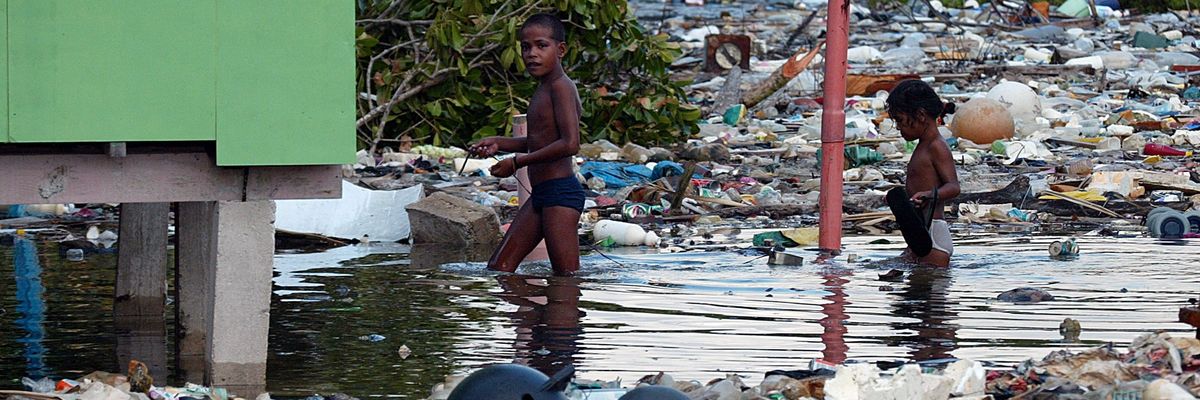
Children wade through floating garbage to reach their house as king tides inundate Funafuti Atoll, on 19 February 2004, home to nearly half of Tuvalu's entire population of 11,500.
An effective treaty must reduce plastic production and prioritize protecting biodiversity, safeguarding the climate and ensuring a just transition to a low-carbon, reuse-based economy.
Climate-crisis-fuelled storms have hit New Zealand hard this year. In January, we suffered unprecedented extreme weather and flooding, followed by Cyclone Gabrielle in February—the worst storm in 55 years—which triggered a national state of emergency. In total, we had 5.5 times more rain than Auckland summers typically receive.
In the aftermath, we saw first-hand one of the causes of the climate crisis: single-use plastic. Te Wai Ōrea, a popular Auckland park, was covered with single-use plastic pollution.
Each stage in the lifecycle of plastic, from production to disposal, fuels the climate crisis—99% of plastics are made from fossil fuels, and corporations keep making more. According to the Minderoo Foundation, annual greenhouse gas emissions from single-use plastics in 2021 exceeded the total annual emissions of the United Kingdom.
Communities on the frontlines of any part of the plastic lifecycle, from oil extraction to trash dumps and everywhere in between, are hit with a trifecta of injustice: plastic pollution, social injustice, and the climate crisis. The plastic deluge that is left after every climate-crisis-fuelled storm only reinforces this point.
I am tangata whenua (Indigenous to Aotearoa New Zealand) and tangata Moana (Indigenous to the Pacific). What I call home is more ocean than it is land, and this ocean is our livelihood. It provides our traditional diet and is a rich source of the stories of our existence. Each Pacific island nation ties to the next through our ancestors’ great migration across the ocean by their navigational skills.
On the east coast of New Zealand’s North Island, heavy rainfall floods the waterways and plastic waste hits the beaches and the waters where locals spend a good chunk of their lives, where they fish and gather food. And every time, they clean up that trash. No one wants to see pollution in places that they have held sacred for many generations.
Communities on the frontlines of any part of the plastic lifecycle, from oil extraction to trash dumps and everywhere in between, are hit with a trifecta of injustice: plastic pollution, social injustice, and the climate crisis. The plastic deluge that is left after every climate-crisis-fuelled storm only reinforces this point.
Right now, nothing is being done ‘upstream’ to stem the flow of plastic so ‘downstream’ action—as effective as an ambulance at the bottom of a cliff—is all that local communities can do.
In Paris from May 29 to June 2, governments from all over the world will meet to continue negotiating a Global Plastics Treaty—a once-in-a generation opportunity. An effective treaty must reduce plastic production and prioritize protecting biodiversity, safeguarding the climate and ensuring a just transition to a low-carbon, reuse-based economy.
Instead, big consumer goods companies, in league with the fossil fuel industry, produce more and more plastic, reaping the profits while disregarding the cost and damages to the climate, environment, and people.
This is where we draw a line in the sand—a treaty that does not stop runaway plastic production and use is bound to fail.
Consider the Cook Islands, where my mother’s parents were raised and married. The way of life has been transformed from a traditional one of circularity and living gently with the land, to one where consumer products—much of it in plastic packaging—have been pushed upon our people since colonisation.
The islands, surrounded by the Pacific Ocean, are now filling up with so much plastic that some might reluctantly feel there are just two options, burn it or bury it. Burning would accelerate the climate crisis and rising sea levels, and there is no land on the islands for bottomless landfills.
Coca-Cola, the world’s worst plastic polluter for five years now according to the Break Free from Plastic brand audits, sells their products in plastic bottles in small island nations without any recycling infrastructure or product stewardship. Coke sells over 100 billion bottles each year and is one of the wealthiest fast-moving consumer goods brands in the world, yet its single-use plastic packaging wreaks havoc on the environment.
In the Global South, single-use sachets that contain only enough product for one serving from consumer goods conglomerates like Unilever and Nestle flood some regions, especially during the regular typhoon season. In 2020, the CEO of Unilever expressed his interest stop selling sachets, yet, since then, Unilever has lobbied against sachet bans in India, the Philippines, and Sri Lanka.
The treaty negotiations so far have seen New Zealand push for an ambitious position that will keep oil and gas in the ground, stop the relentless production and use of plastic, and ensure a just transition to a low-carbon, zero-waste economy with leadership and expertise from Indigenous and most affected communities. In the next round of talks, we need to lift the ambitions of other member states.
My ancestors shared a deep connection with Papatūānuku (our Earth mother), and our well-being is interdependent. We don’t see ourselves as being separate from nature. This Indigenous worldview can lead treaty negotiations, creating systems that are less demanding of our planet and value nature over profit.
A Global Plastics Treaty can stop plastic production at the source and deliver a cleaner, safer planet for us and future generations. Governments need to step up to this moment and not let it go to waste.
Dear Common Dreams reader, It’s been nearly 30 years since I co-founded Common Dreams with my late wife, Lina Newhouser. We had the radical notion that journalism should serve the public good, not corporate profits. It was clear to us from the outset what it would take to build such a project. No paid advertisements. No corporate sponsors. No millionaire publisher telling us what to think or do. Many people said we wouldn't last a year, but we proved those doubters wrong. Together with a tremendous team of journalists and dedicated staff, we built an independent media outlet free from the constraints of profits and corporate control. Our mission has always been simple: To inform. To inspire. To ignite change for the common good. Building Common Dreams was not easy. Our survival was never guaranteed. When you take on the most powerful forces—Wall Street greed, fossil fuel industry destruction, Big Tech lobbyists, and uber-rich oligarchs who have spent billions upon billions rigging the economy and democracy in their favor—the only bulwark you have is supporters who believe in your work. But here’s the urgent message from me today. It's never been this bad out there. And it's never been this hard to keep us going. At the very moment Common Dreams is most needed, the threats we face are intensifying. We need your support now more than ever. We don't accept corporate advertising and never will. We don't have a paywall because we don't think people should be blocked from critical news based on their ability to pay. Everything we do is funded by the donations of readers like you. When everyone does the little they can afford, we are strong. But if that support retreats or dries up, so do we. Will you donate now to make sure Common Dreams not only survives but thrives? —Craig Brown, Co-founder |
Climate-crisis-fuelled storms have hit New Zealand hard this year. In January, we suffered unprecedented extreme weather and flooding, followed by Cyclone Gabrielle in February—the worst storm in 55 years—which triggered a national state of emergency. In total, we had 5.5 times more rain than Auckland summers typically receive.
In the aftermath, we saw first-hand one of the causes of the climate crisis: single-use plastic. Te Wai Ōrea, a popular Auckland park, was covered with single-use plastic pollution.
Each stage in the lifecycle of plastic, from production to disposal, fuels the climate crisis—99% of plastics are made from fossil fuels, and corporations keep making more. According to the Minderoo Foundation, annual greenhouse gas emissions from single-use plastics in 2021 exceeded the total annual emissions of the United Kingdom.
Communities on the frontlines of any part of the plastic lifecycle, from oil extraction to trash dumps and everywhere in between, are hit with a trifecta of injustice: plastic pollution, social injustice, and the climate crisis. The plastic deluge that is left after every climate-crisis-fuelled storm only reinforces this point.
I am tangata whenua (Indigenous to Aotearoa New Zealand) and tangata Moana (Indigenous to the Pacific). What I call home is more ocean than it is land, and this ocean is our livelihood. It provides our traditional diet and is a rich source of the stories of our existence. Each Pacific island nation ties to the next through our ancestors’ great migration across the ocean by their navigational skills.
On the east coast of New Zealand’s North Island, heavy rainfall floods the waterways and plastic waste hits the beaches and the waters where locals spend a good chunk of their lives, where they fish and gather food. And every time, they clean up that trash. No one wants to see pollution in places that they have held sacred for many generations.
Communities on the frontlines of any part of the plastic lifecycle, from oil extraction to trash dumps and everywhere in between, are hit with a trifecta of injustice: plastic pollution, social injustice, and the climate crisis. The plastic deluge that is left after every climate-crisis-fuelled storm only reinforces this point.
Right now, nothing is being done ‘upstream’ to stem the flow of plastic so ‘downstream’ action—as effective as an ambulance at the bottom of a cliff—is all that local communities can do.
In Paris from May 29 to June 2, governments from all over the world will meet to continue negotiating a Global Plastics Treaty—a once-in-a generation opportunity. An effective treaty must reduce plastic production and prioritize protecting biodiversity, safeguarding the climate and ensuring a just transition to a low-carbon, reuse-based economy.
Instead, big consumer goods companies, in league with the fossil fuel industry, produce more and more plastic, reaping the profits while disregarding the cost and damages to the climate, environment, and people.
This is where we draw a line in the sand—a treaty that does not stop runaway plastic production and use is bound to fail.
Consider the Cook Islands, where my mother’s parents were raised and married. The way of life has been transformed from a traditional one of circularity and living gently with the land, to one where consumer products—much of it in plastic packaging—have been pushed upon our people since colonisation.
The islands, surrounded by the Pacific Ocean, are now filling up with so much plastic that some might reluctantly feel there are just two options, burn it or bury it. Burning would accelerate the climate crisis and rising sea levels, and there is no land on the islands for bottomless landfills.
Coca-Cola, the world’s worst plastic polluter for five years now according to the Break Free from Plastic brand audits, sells their products in plastic bottles in small island nations without any recycling infrastructure or product stewardship. Coke sells over 100 billion bottles each year and is one of the wealthiest fast-moving consumer goods brands in the world, yet its single-use plastic packaging wreaks havoc on the environment.
In the Global South, single-use sachets that contain only enough product for one serving from consumer goods conglomerates like Unilever and Nestle flood some regions, especially during the regular typhoon season. In 2020, the CEO of Unilever expressed his interest stop selling sachets, yet, since then, Unilever has lobbied against sachet bans in India, the Philippines, and Sri Lanka.
The treaty negotiations so far have seen New Zealand push for an ambitious position that will keep oil and gas in the ground, stop the relentless production and use of plastic, and ensure a just transition to a low-carbon, zero-waste economy with leadership and expertise from Indigenous and most affected communities. In the next round of talks, we need to lift the ambitions of other member states.
My ancestors shared a deep connection with Papatūānuku (our Earth mother), and our well-being is interdependent. We don’t see ourselves as being separate from nature. This Indigenous worldview can lead treaty negotiations, creating systems that are less demanding of our planet and value nature over profit.
A Global Plastics Treaty can stop plastic production at the source and deliver a cleaner, safer planet for us and future generations. Governments need to step up to this moment and not let it go to waste.
Climate-crisis-fuelled storms have hit New Zealand hard this year. In January, we suffered unprecedented extreme weather and flooding, followed by Cyclone Gabrielle in February—the worst storm in 55 years—which triggered a national state of emergency. In total, we had 5.5 times more rain than Auckland summers typically receive.
In the aftermath, we saw first-hand one of the causes of the climate crisis: single-use plastic. Te Wai Ōrea, a popular Auckland park, was covered with single-use plastic pollution.
Each stage in the lifecycle of plastic, from production to disposal, fuels the climate crisis—99% of plastics are made from fossil fuels, and corporations keep making more. According to the Minderoo Foundation, annual greenhouse gas emissions from single-use plastics in 2021 exceeded the total annual emissions of the United Kingdom.
Communities on the frontlines of any part of the plastic lifecycle, from oil extraction to trash dumps and everywhere in between, are hit with a trifecta of injustice: plastic pollution, social injustice, and the climate crisis. The plastic deluge that is left after every climate-crisis-fuelled storm only reinforces this point.
I am tangata whenua (Indigenous to Aotearoa New Zealand) and tangata Moana (Indigenous to the Pacific). What I call home is more ocean than it is land, and this ocean is our livelihood. It provides our traditional diet and is a rich source of the stories of our existence. Each Pacific island nation ties to the next through our ancestors’ great migration across the ocean by their navigational skills.
On the east coast of New Zealand’s North Island, heavy rainfall floods the waterways and plastic waste hits the beaches and the waters where locals spend a good chunk of their lives, where they fish and gather food. And every time, they clean up that trash. No one wants to see pollution in places that they have held sacred for many generations.
Communities on the frontlines of any part of the plastic lifecycle, from oil extraction to trash dumps and everywhere in between, are hit with a trifecta of injustice: plastic pollution, social injustice, and the climate crisis. The plastic deluge that is left after every climate-crisis-fuelled storm only reinforces this point.
Right now, nothing is being done ‘upstream’ to stem the flow of plastic so ‘downstream’ action—as effective as an ambulance at the bottom of a cliff—is all that local communities can do.
In Paris from May 29 to June 2, governments from all over the world will meet to continue negotiating a Global Plastics Treaty—a once-in-a generation opportunity. An effective treaty must reduce plastic production and prioritize protecting biodiversity, safeguarding the climate and ensuring a just transition to a low-carbon, reuse-based economy.
Instead, big consumer goods companies, in league with the fossil fuel industry, produce more and more plastic, reaping the profits while disregarding the cost and damages to the climate, environment, and people.
This is where we draw a line in the sand—a treaty that does not stop runaway plastic production and use is bound to fail.
Consider the Cook Islands, where my mother’s parents were raised and married. The way of life has been transformed from a traditional one of circularity and living gently with the land, to one where consumer products—much of it in plastic packaging—have been pushed upon our people since colonisation.
The islands, surrounded by the Pacific Ocean, are now filling up with so much plastic that some might reluctantly feel there are just two options, burn it or bury it. Burning would accelerate the climate crisis and rising sea levels, and there is no land on the islands for bottomless landfills.
Coca-Cola, the world’s worst plastic polluter for five years now according to the Break Free from Plastic brand audits, sells their products in plastic bottles in small island nations without any recycling infrastructure or product stewardship. Coke sells over 100 billion bottles each year and is one of the wealthiest fast-moving consumer goods brands in the world, yet its single-use plastic packaging wreaks havoc on the environment.
In the Global South, single-use sachets that contain only enough product for one serving from consumer goods conglomerates like Unilever and Nestle flood some regions, especially during the regular typhoon season. In 2020, the CEO of Unilever expressed his interest stop selling sachets, yet, since then, Unilever has lobbied against sachet bans in India, the Philippines, and Sri Lanka.
The treaty negotiations so far have seen New Zealand push for an ambitious position that will keep oil and gas in the ground, stop the relentless production and use of plastic, and ensure a just transition to a low-carbon, zero-waste economy with leadership and expertise from Indigenous and most affected communities. In the next round of talks, we need to lift the ambitions of other member states.
My ancestors shared a deep connection with Papatūānuku (our Earth mother), and our well-being is interdependent. We don’t see ourselves as being separate from nature. This Indigenous worldview can lead treaty negotiations, creating systems that are less demanding of our planet and value nature over profit.
A Global Plastics Treaty can stop plastic production at the source and deliver a cleaner, safer planet for us and future generations. Governments need to step up to this moment and not let it go to waste.