SUBSCRIBE TO OUR FREE NEWSLETTER
Daily news & progressive opinion—funded by the people, not the corporations—delivered straight to your inbox.
5
#000000
#FFFFFF
To donate by check, phone, or other method, see our More Ways to Give page.
Daily news & progressive opinion—funded by the people, not the corporations—delivered straight to your inbox.
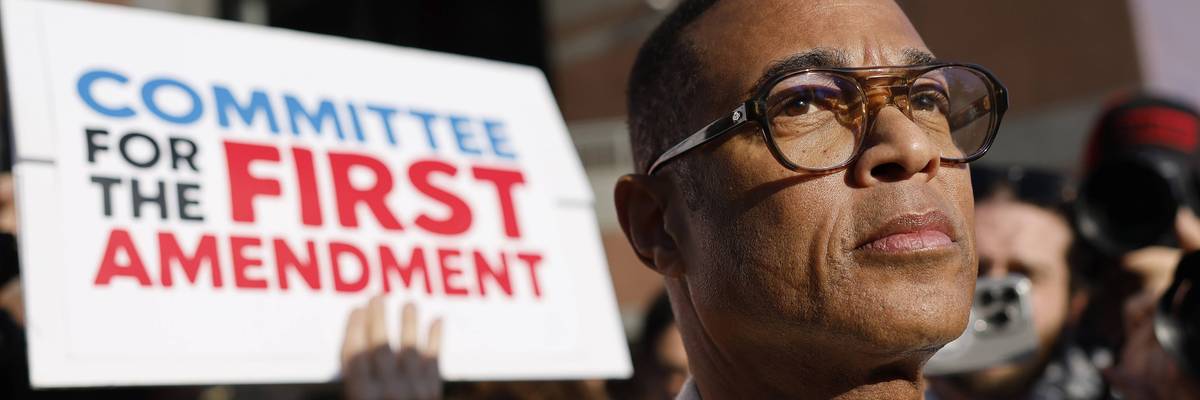
Journalist Don Lemon looks on after issuing a statement to media outside federal court on January 30, 2026 in Los Angeles, California.
When journalists are punished for observation, the public loses access to contested truth and fear becomes a tool of narrative control.
When federal agents arrested journalist Don Lemon and independent reporter Georgia Fort in connection with a protest inside a Minneapolis church, many commentators rushed to frame the incident as a straightforward defense of sacred space: Worship was disrupted, congregants were frightened, and the law intervened to restore order. That framing captures part of the truth—but it obscures the deeper constitutional and moral stakes at play.The arrests are not simply about a protest in a house of worship. They are about whether journalists can witness and document contentious public events—especially those where power, conscience, and institutional authority collide—without facing criminal charges for the act of seeing itself.
The legal action stems from a January demonstration at Cities Church in St. Paul, Minnesota, where protesters interrupted a service after learning that one of the church’s pastors also serves as an official with US Immigration and Customs Enforcement. For demonstrators, that dual role represented a profound moral contradiction: How can a religious leader entrusted with spiritual care also participate in an agency responsible for detention, deportation, and family separation?
Lemon was present to report. He did not identify as a participant, did not lead chants, and did not incite the crowd. He documented the scene, spoke with parishioners and protesters, and relayed what was happening to the public. Georgia Fort, a Minnesota-based independent journalist, was live streaming coverage of the protest and later live streamed her own arrest outside her home. Both were subsequently detained and charged.
Federal prosecutors allege that Lemon, Fort, and others conspired to interfere with religious worship, invoking the Freedom of Access to Clinic Entrances Act, a 1994 law that also applies to religious spaces. Lemon and Fort were released after initial court appearances. A judge placed limits on Lemon’s travel and contact but did not require pretrial supervision. No violence occurred during the protest.
Don Lemon and Georgia Fort did not interrupt worship. They interrupted silence.
That fact matters—but it does not end the ethical inquiry. Fear, particularly in contemporary America, is not abstract. Houses of worship have been sites of mass shootings, and the threat of violence is a lived reality for congregants across faith traditions. No one can read another person’s mind, and no one can fully know the intentions of a group entering a sanctuary in a volatile political moment. Even actions intended as nonviolent moral protest can be experienced as frightening.
Holding this truth is essential. Civil disobedience does not exist in a vacuum, and claims of nonviolence do not erase the perception of danger felt by others. Moral confrontation can be principled and still deeply unsettling. Ethical seriousness requires acknowledging that tension rather than dismissing it.
But fear alone cannot become the standard by which constitutional rights are curtailed—especially the rights of journalists whose role is to observe, document, and inform the public. The central question is not whether congregants felt afraid. It is whether that fear justifies arresting reporters who were not organizing, directing, or participating in the protest.
After his arrest, Lemon emphasized that he was being punished for doing what he has done for decades: covering the news. The First Amendment, he argued, exists precisely to protect that work. Fort echoed this concern, warning that criminalizing documentation of public events—particularly protests—poses a grave threat to journalism itself.
Almost immediately, a familiar dismissal surfaced: Don Lemon is not a “real journalist.” The argument is both unserious and dangerous. Who decides what journalism is? Cable news hosts routinely blend reporting, commentary, and political advocacy, often with privileged access to power. Independent journalists, freelancers, and live streamers—many of whom take on greater personal risk—are frequently denied legitimacy after the fact, especially when their reporting makes institutions uncomfortable.
If journalism is defined by function rather than branding, Lemon and Fort clearly qualify. They observed. They documented. They informed. For that, the state sent federal agents to their doors.
The irony is that Christianity itself has a long and uneasy relationship with disruption. In the Gospels, Jesus repeatedly confronted religious authorities, challenged imperial power, and disrupted ritualized comfort in the name of justice. The early Christian proclamation “Jesus is Lord” was not a private devotional claim; it was a public rejection of imperial sovereignty.
That tradition carried forward. The civil rights movement drew deeply from Christian theology to justify nonviolent confrontation with unjust laws and complicit institutions. Figures such as Martin Luther King Jr., Dorothy Day, Pauli Murray, and James Lawson understood that faith divorced from justice becomes hollow.
Acknowledging this history does not negate the fear congregants may have felt. It clarifies why moral confrontation so often occurs in places of symbolic authority. Sacred space has never been immune from ethical challenge—nor should it be.
This is where the Department of Justice’s response raises deeper concern. The arrests do not merely defend religious freedom; they signal to journalists that covering morally charged protests—particularly those implicating powerful institutions—may carry criminal risk. The chilling effect is unmistakable.
This pattern is not new. Over the past decade, journalists covering protests have faced arrests, equipment seizures, subpoenas, and legal threats. While the legal contexts vary, the cumulative message is consistent: Some forms of witnessing are increasingly treated as suspect. When journalists are punished for observation, the public loses access to contested truth. Fear becomes a tool of narrative control.
This is not a choice between religious freedom and press freedom. Both matter. But when the state treats observation as interference, the balance collapses in favor of power. Protection becomes insulation. Accountability becomes disruption.
Journalism is not a threat to faith. It is a threat to unaccountable authority—especially when that authority cloaks itself in moral or divine legitimacy. A functioning democracy depends on contested spaces, on the ability to observe power where it gathers, even when that power claims holiness.
Don Lemon and Georgia Fort did not interrupt worship. They interrupted silence.
The question now is not only whether Lemon and Fort will prevail in court. It is whether witnessing itself will remain a protected act in American public life—or whether fear, once invoked, will become a legal solvent capable of dissolving press freedom wherever power feels exposed.
If journalists can be arrested for documenting protest inside a church, the precedent will not remain confined to sacred spaces. It will travel—to campuses, courtrooms, town halls, and streets—wherever institutions claim moral authority and demand insulation from scrutiny.
A democracy that punishes witnessing does not preserve order. It preserves silence.
Dear Common Dreams reader, It’s been nearly 30 years since I co-founded Common Dreams with my late wife, Lina Newhouser. We had the radical notion that journalism should serve the public good, not corporate profits. It was clear to us from the outset what it would take to build such a project. No paid advertisements. No corporate sponsors. No millionaire publisher telling us what to think or do. Many people said we wouldn't last a year, but we proved those doubters wrong. Together with a tremendous team of journalists and dedicated staff, we built an independent media outlet free from the constraints of profits and corporate control. Our mission has always been simple: To inform. To inspire. To ignite change for the common good. Building Common Dreams was not easy. Our survival was never guaranteed. When you take on the most powerful forces—Wall Street greed, fossil fuel industry destruction, Big Tech lobbyists, and uber-rich oligarchs who have spent billions upon billions rigging the economy and democracy in their favor—the only bulwark you have is supporters who believe in your work. But here’s the urgent message from me today. It's never been this bad out there. And it's never been this hard to keep us going. At the very moment Common Dreams is most needed, the threats we face are intensifying. We need your support now more than ever. We don't accept corporate advertising and never will. We don't have a paywall because we don't think people should be blocked from critical news based on their ability to pay. Everything we do is funded by the donations of readers like you. When everyone does the little they can afford, we are strong. But if that support retreats or dries up, so do we. Will you donate now to make sure Common Dreams not only survives but thrives? —Craig Brown, Co-founder |
When federal agents arrested journalist Don Lemon and independent reporter Georgia Fort in connection with a protest inside a Minneapolis church, many commentators rushed to frame the incident as a straightforward defense of sacred space: Worship was disrupted, congregants were frightened, and the law intervened to restore order. That framing captures part of the truth—but it obscures the deeper constitutional and moral stakes at play.The arrests are not simply about a protest in a house of worship. They are about whether journalists can witness and document contentious public events—especially those where power, conscience, and institutional authority collide—without facing criminal charges for the act of seeing itself.
The legal action stems from a January demonstration at Cities Church in St. Paul, Minnesota, where protesters interrupted a service after learning that one of the church’s pastors also serves as an official with US Immigration and Customs Enforcement. For demonstrators, that dual role represented a profound moral contradiction: How can a religious leader entrusted with spiritual care also participate in an agency responsible for detention, deportation, and family separation?
Lemon was present to report. He did not identify as a participant, did not lead chants, and did not incite the crowd. He documented the scene, spoke with parishioners and protesters, and relayed what was happening to the public. Georgia Fort, a Minnesota-based independent journalist, was live streaming coverage of the protest and later live streamed her own arrest outside her home. Both were subsequently detained and charged.
Federal prosecutors allege that Lemon, Fort, and others conspired to interfere with religious worship, invoking the Freedom of Access to Clinic Entrances Act, a 1994 law that also applies to religious spaces. Lemon and Fort were released after initial court appearances. A judge placed limits on Lemon’s travel and contact but did not require pretrial supervision. No violence occurred during the protest.
Don Lemon and Georgia Fort did not interrupt worship. They interrupted silence.
That fact matters—but it does not end the ethical inquiry. Fear, particularly in contemporary America, is not abstract. Houses of worship have been sites of mass shootings, and the threat of violence is a lived reality for congregants across faith traditions. No one can read another person’s mind, and no one can fully know the intentions of a group entering a sanctuary in a volatile political moment. Even actions intended as nonviolent moral protest can be experienced as frightening.
Holding this truth is essential. Civil disobedience does not exist in a vacuum, and claims of nonviolence do not erase the perception of danger felt by others. Moral confrontation can be principled and still deeply unsettling. Ethical seriousness requires acknowledging that tension rather than dismissing it.
But fear alone cannot become the standard by which constitutional rights are curtailed—especially the rights of journalists whose role is to observe, document, and inform the public. The central question is not whether congregants felt afraid. It is whether that fear justifies arresting reporters who were not organizing, directing, or participating in the protest.
After his arrest, Lemon emphasized that he was being punished for doing what he has done for decades: covering the news. The First Amendment, he argued, exists precisely to protect that work. Fort echoed this concern, warning that criminalizing documentation of public events—particularly protests—poses a grave threat to journalism itself.
Almost immediately, a familiar dismissal surfaced: Don Lemon is not a “real journalist.” The argument is both unserious and dangerous. Who decides what journalism is? Cable news hosts routinely blend reporting, commentary, and political advocacy, often with privileged access to power. Independent journalists, freelancers, and live streamers—many of whom take on greater personal risk—are frequently denied legitimacy after the fact, especially when their reporting makes institutions uncomfortable.
If journalism is defined by function rather than branding, Lemon and Fort clearly qualify. They observed. They documented. They informed. For that, the state sent federal agents to their doors.
The irony is that Christianity itself has a long and uneasy relationship with disruption. In the Gospels, Jesus repeatedly confronted religious authorities, challenged imperial power, and disrupted ritualized comfort in the name of justice. The early Christian proclamation “Jesus is Lord” was not a private devotional claim; it was a public rejection of imperial sovereignty.
That tradition carried forward. The civil rights movement drew deeply from Christian theology to justify nonviolent confrontation with unjust laws and complicit institutions. Figures such as Martin Luther King Jr., Dorothy Day, Pauli Murray, and James Lawson understood that faith divorced from justice becomes hollow.
Acknowledging this history does not negate the fear congregants may have felt. It clarifies why moral confrontation so often occurs in places of symbolic authority. Sacred space has never been immune from ethical challenge—nor should it be.
This is where the Department of Justice’s response raises deeper concern. The arrests do not merely defend religious freedom; they signal to journalists that covering morally charged protests—particularly those implicating powerful institutions—may carry criminal risk. The chilling effect is unmistakable.
This pattern is not new. Over the past decade, journalists covering protests have faced arrests, equipment seizures, subpoenas, and legal threats. While the legal contexts vary, the cumulative message is consistent: Some forms of witnessing are increasingly treated as suspect. When journalists are punished for observation, the public loses access to contested truth. Fear becomes a tool of narrative control.
This is not a choice between religious freedom and press freedom. Both matter. But when the state treats observation as interference, the balance collapses in favor of power. Protection becomes insulation. Accountability becomes disruption.
Journalism is not a threat to faith. It is a threat to unaccountable authority—especially when that authority cloaks itself in moral or divine legitimacy. A functioning democracy depends on contested spaces, on the ability to observe power where it gathers, even when that power claims holiness.
Don Lemon and Georgia Fort did not interrupt worship. They interrupted silence.
The question now is not only whether Lemon and Fort will prevail in court. It is whether witnessing itself will remain a protected act in American public life—or whether fear, once invoked, will become a legal solvent capable of dissolving press freedom wherever power feels exposed.
If journalists can be arrested for documenting protest inside a church, the precedent will not remain confined to sacred spaces. It will travel—to campuses, courtrooms, town halls, and streets—wherever institutions claim moral authority and demand insulation from scrutiny.
A democracy that punishes witnessing does not preserve order. It preserves silence.
When federal agents arrested journalist Don Lemon and independent reporter Georgia Fort in connection with a protest inside a Minneapolis church, many commentators rushed to frame the incident as a straightforward defense of sacred space: Worship was disrupted, congregants were frightened, and the law intervened to restore order. That framing captures part of the truth—but it obscures the deeper constitutional and moral stakes at play.The arrests are not simply about a protest in a house of worship. They are about whether journalists can witness and document contentious public events—especially those where power, conscience, and institutional authority collide—without facing criminal charges for the act of seeing itself.
The legal action stems from a January demonstration at Cities Church in St. Paul, Minnesota, where protesters interrupted a service after learning that one of the church’s pastors also serves as an official with US Immigration and Customs Enforcement. For demonstrators, that dual role represented a profound moral contradiction: How can a religious leader entrusted with spiritual care also participate in an agency responsible for detention, deportation, and family separation?
Lemon was present to report. He did not identify as a participant, did not lead chants, and did not incite the crowd. He documented the scene, spoke with parishioners and protesters, and relayed what was happening to the public. Georgia Fort, a Minnesota-based independent journalist, was live streaming coverage of the protest and later live streamed her own arrest outside her home. Both were subsequently detained and charged.
Federal prosecutors allege that Lemon, Fort, and others conspired to interfere with religious worship, invoking the Freedom of Access to Clinic Entrances Act, a 1994 law that also applies to religious spaces. Lemon and Fort were released after initial court appearances. A judge placed limits on Lemon’s travel and contact but did not require pretrial supervision. No violence occurred during the protest.
Don Lemon and Georgia Fort did not interrupt worship. They interrupted silence.
That fact matters—but it does not end the ethical inquiry. Fear, particularly in contemporary America, is not abstract. Houses of worship have been sites of mass shootings, and the threat of violence is a lived reality for congregants across faith traditions. No one can read another person’s mind, and no one can fully know the intentions of a group entering a sanctuary in a volatile political moment. Even actions intended as nonviolent moral protest can be experienced as frightening.
Holding this truth is essential. Civil disobedience does not exist in a vacuum, and claims of nonviolence do not erase the perception of danger felt by others. Moral confrontation can be principled and still deeply unsettling. Ethical seriousness requires acknowledging that tension rather than dismissing it.
But fear alone cannot become the standard by which constitutional rights are curtailed—especially the rights of journalists whose role is to observe, document, and inform the public. The central question is not whether congregants felt afraid. It is whether that fear justifies arresting reporters who were not organizing, directing, or participating in the protest.
After his arrest, Lemon emphasized that he was being punished for doing what he has done for decades: covering the news. The First Amendment, he argued, exists precisely to protect that work. Fort echoed this concern, warning that criminalizing documentation of public events—particularly protests—poses a grave threat to journalism itself.
Almost immediately, a familiar dismissal surfaced: Don Lemon is not a “real journalist.” The argument is both unserious and dangerous. Who decides what journalism is? Cable news hosts routinely blend reporting, commentary, and political advocacy, often with privileged access to power. Independent journalists, freelancers, and live streamers—many of whom take on greater personal risk—are frequently denied legitimacy after the fact, especially when their reporting makes institutions uncomfortable.
If journalism is defined by function rather than branding, Lemon and Fort clearly qualify. They observed. They documented. They informed. For that, the state sent federal agents to their doors.
The irony is that Christianity itself has a long and uneasy relationship with disruption. In the Gospels, Jesus repeatedly confronted religious authorities, challenged imperial power, and disrupted ritualized comfort in the name of justice. The early Christian proclamation “Jesus is Lord” was not a private devotional claim; it was a public rejection of imperial sovereignty.
That tradition carried forward. The civil rights movement drew deeply from Christian theology to justify nonviolent confrontation with unjust laws and complicit institutions. Figures such as Martin Luther King Jr., Dorothy Day, Pauli Murray, and James Lawson understood that faith divorced from justice becomes hollow.
Acknowledging this history does not negate the fear congregants may have felt. It clarifies why moral confrontation so often occurs in places of symbolic authority. Sacred space has never been immune from ethical challenge—nor should it be.
This is where the Department of Justice’s response raises deeper concern. The arrests do not merely defend religious freedom; they signal to journalists that covering morally charged protests—particularly those implicating powerful institutions—may carry criminal risk. The chilling effect is unmistakable.
This pattern is not new. Over the past decade, journalists covering protests have faced arrests, equipment seizures, subpoenas, and legal threats. While the legal contexts vary, the cumulative message is consistent: Some forms of witnessing are increasingly treated as suspect. When journalists are punished for observation, the public loses access to contested truth. Fear becomes a tool of narrative control.
This is not a choice between religious freedom and press freedom. Both matter. But when the state treats observation as interference, the balance collapses in favor of power. Protection becomes insulation. Accountability becomes disruption.
Journalism is not a threat to faith. It is a threat to unaccountable authority—especially when that authority cloaks itself in moral or divine legitimacy. A functioning democracy depends on contested spaces, on the ability to observe power where it gathers, even when that power claims holiness.
Don Lemon and Georgia Fort did not interrupt worship. They interrupted silence.
The question now is not only whether Lemon and Fort will prevail in court. It is whether witnessing itself will remain a protected act in American public life—or whether fear, once invoked, will become a legal solvent capable of dissolving press freedom wherever power feels exposed.
If journalists can be arrested for documenting protest inside a church, the precedent will not remain confined to sacred spaces. It will travel—to campuses, courtrooms, town halls, and streets—wherever institutions claim moral authority and demand insulation from scrutiny.
A democracy that punishes witnessing does not preserve order. It preserves silence.