

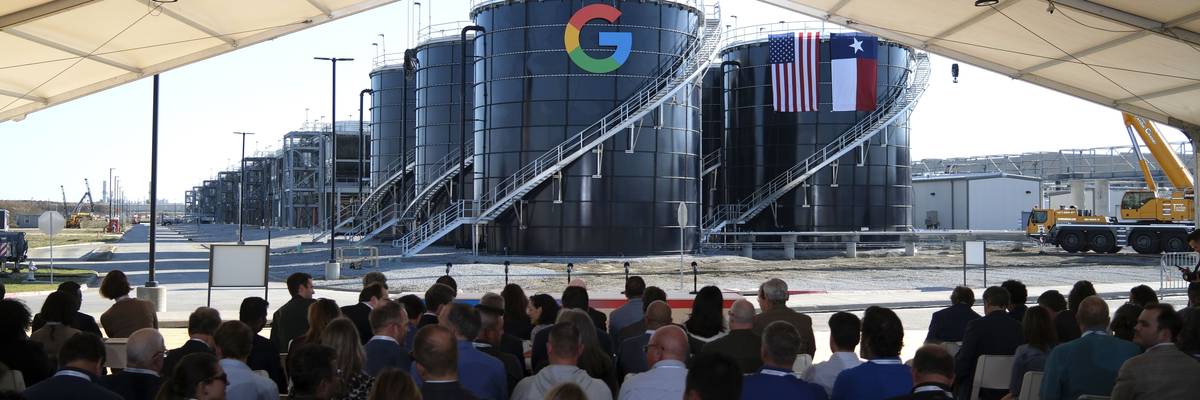
Attendees await the arrival of Texas Gov. Greg Abbott and Alphabet and Google CEO Sundar Pichai at the Google Midlothian Data Center on November 14, 2025 in Midlothian, Texas.
Big Tech's 'AI Climate Hoax': Study Shows 74% of Industry's Claims Unproven
"Tech companies are using vagueness about what happens within energy-hogging data centers to greenwash a planet-wrecking expansion."
A report released on Tuesday says that the tech industry is blowing hot air with its claims that generative artificial intelligence will be beneficial for the climate.
The report, titled "The AI Climate Hoax," was commissioned by a broad consortium of environmental advocacy organizations and authored by climate and energy analyst Ketan Joshi.
In total, it analyzes more than 150 statements made by both big tech companies and organizations such as the International Energy Agency about the supposed benefits of generative AI.
The report finds that 74% of such claims made by these institutions are unproven, with 36% not bothering to cite any evidence whatsoever.
One key finding in the report is that many claims about the purported benefits of the technology conflate traditional AI systems with more recent generative AI systems, which require massive amounts of energy and are spurring demand for the construction of power-and-water-devouring data centers across the US.
"Even if these benefits are real," the report writes of traditional AI systems, "they are unrelated to—and dwarfed by—the massive expansion of energy use from the generative AI industry," which is projected to to consume 13 times as much energy as traditional AI by the year 2030.
Even the more supportable claims about the benefits of traditional AI deserve serious scrutiny, the report notes, since "they tend to rely on weaker forms of evidence, such as corporate websites, rather than published academic research," which was only cited in 26% of claims made about AI benefits.
The report also knocks big tech companies for using assorted strategies to conceal the true extent of their energy use, including buying renewable energy certificates even while relying on fossil fuels to power their operations, and vowing to implement highly implausible solutions to mitigate the climate impact of data centers, including carbon capture technologies and even building orbital data centers in space.
Commenting on the report, study author Joshi said its findings seem to show "tech companies are using vagueness about what happens within energy-hogging data centers to greenwash a planet-wrecking expansion."
"The promises of planet-saving tech remain hollow, while AI data centers breathe life into coal and gas every day," Joshi added. "These claims of climate benefit are unjustified and overhyped, and could cover up irreversible damage being done to communities and society."
Jill McArdle, international corporate campaigner at study sponsor Beyond Fossil Fuels, said the study shows "there is simply no evidence that AI will help the climate more than it will harm it," and accused Big Tech companies of "writing themselves a blank cheque to pollute on the empty promise of future salvation."
AI data centers have become a major controversy throughout the US in recent months, as their massive energy needs have pushed up utility bills and put a strain on communities’ water supplies.
A study published in the journal Nature Sustainability last year found that data centers could soon consume as much water as 10 million Americans and emit as much carbon dioxide as 10 million cars, or roughly the same amount of consumption as the entire state of New York.
We are at a crossroads
This country and this world are at a monumental crossroads. In a few short weeks, US voters will have an opportunity to beat back the forces of fascism and confront the billionaires who are rigging the economy, our media system, and our democracy, making it increasingly impossible for ordinary people to get by. We’re not just talking about the election. We’re talking about what must be done once these fascist elements are vanquished from power. We need a bolder set of solutions than what either major party has so far been willing to offer and a working-class movement ready to fight like hell for it. Trump didn't emerge from nowhere. The conditions that fueled MAGA authoritarianism were created by decades of radical neoliberal economic policies and a corrupt political system dominated by corporate interests. They slashed taxes on the super-rich, promising that the benefits would trickle down. They said giveaways to the corporate titans would make life more affordable for the rest of us. It was all bullshit. And when a bitter, betrayed populace searches for someone to blame, right-wing demagogues have little trouble finding scapegoats. People know when they're being lied to, but you won't hear any of this from the corporate media. Only independent journalism—powered and funded by people who believe in building a better world—can deliver truly trustworthy daily news. Our Fall Campaign is underway, and we need your help. To power our newsroom through the rest of the year, we need to raise $125,000 by midnight on October 31. So if you share our vision, please contribute whatever you can to sustain our work. |
A report released on Tuesday says that the tech industry is blowing hot air with its claims that generative artificial intelligence will be beneficial for the climate.
The report, titled "The AI Climate Hoax," was commissioned by a broad consortium of environmental advocacy organizations and authored by climate and energy analyst Ketan Joshi.
In total, it analyzes more than 150 statements made by both big tech companies and organizations such as the International Energy Agency about the supposed benefits of generative AI.
The report finds that 74% of such claims made by these institutions are unproven, with 36% not bothering to cite any evidence whatsoever.
One key finding in the report is that many claims about the purported benefits of the technology conflate traditional AI systems with more recent generative AI systems, which require massive amounts of energy and are spurring demand for the construction of power-and-water-devouring data centers across the US.
"Even if these benefits are real," the report writes of traditional AI systems, "they are unrelated to—and dwarfed by—the massive expansion of energy use from the generative AI industry," which is projected to to consume 13 times as much energy as traditional AI by the year 2030.
Even the more supportable claims about the benefits of traditional AI deserve serious scrutiny, the report notes, since "they tend to rely on weaker forms of evidence, such as corporate websites, rather than published academic research," which was only cited in 26% of claims made about AI benefits.
The report also knocks big tech companies for using assorted strategies to conceal the true extent of their energy use, including buying renewable energy certificates even while relying on fossil fuels to power their operations, and vowing to implement highly implausible solutions to mitigate the climate impact of data centers, including carbon capture technologies and even building orbital data centers in space.
Commenting on the report, study author Joshi said its findings seem to show "tech companies are using vagueness about what happens within energy-hogging data centers to greenwash a planet-wrecking expansion."
"The promises of planet-saving tech remain hollow, while AI data centers breathe life into coal and gas every day," Joshi added. "These claims of climate benefit are unjustified and overhyped, and could cover up irreversible damage being done to communities and society."
Jill McArdle, international corporate campaigner at study sponsor Beyond Fossil Fuels, said the study shows "there is simply no evidence that AI will help the climate more than it will harm it," and accused Big Tech companies of "writing themselves a blank cheque to pollute on the empty promise of future salvation."
AI data centers have become a major controversy throughout the US in recent months, as their massive energy needs have pushed up utility bills and put a strain on communities’ water supplies.
A study published in the journal Nature Sustainability last year found that data centers could soon consume as much water as 10 million Americans and emit as much carbon dioxide as 10 million cars, or roughly the same amount of consumption as the entire state of New York.
- AI and ChatGPT: Yet Another Assault on Democratic Governance? ›
- No Climate Solutions Without Strong Democracy ›
- Experts Demand 'Pause' on Spread of Artificial Intelligence Until Regulations Imposed ›
A report released on Tuesday says that the tech industry is blowing hot air with its claims that generative artificial intelligence will be beneficial for the climate.
The report, titled "The AI Climate Hoax," was commissioned by a broad consortium of environmental advocacy organizations and authored by climate and energy analyst Ketan Joshi.
In total, it analyzes more than 150 statements made by both big tech companies and organizations such as the International Energy Agency about the supposed benefits of generative AI.
The report finds that 74% of such claims made by these institutions are unproven, with 36% not bothering to cite any evidence whatsoever.
One key finding in the report is that many claims about the purported benefits of the technology conflate traditional AI systems with more recent generative AI systems, which require massive amounts of energy and are spurring demand for the construction of power-and-water-devouring data centers across the US.
"Even if these benefits are real," the report writes of traditional AI systems, "they are unrelated to—and dwarfed by—the massive expansion of energy use from the generative AI industry," which is projected to to consume 13 times as much energy as traditional AI by the year 2030.
Even the more supportable claims about the benefits of traditional AI deserve serious scrutiny, the report notes, since "they tend to rely on weaker forms of evidence, such as corporate websites, rather than published academic research," which was only cited in 26% of claims made about AI benefits.
The report also knocks big tech companies for using assorted strategies to conceal the true extent of their energy use, including buying renewable energy certificates even while relying on fossil fuels to power their operations, and vowing to implement highly implausible solutions to mitigate the climate impact of data centers, including carbon capture technologies and even building orbital data centers in space.
Commenting on the report, study author Joshi said its findings seem to show "tech companies are using vagueness about what happens within energy-hogging data centers to greenwash a planet-wrecking expansion."
"The promises of planet-saving tech remain hollow, while AI data centers breathe life into coal and gas every day," Joshi added. "These claims of climate benefit are unjustified and overhyped, and could cover up irreversible damage being done to communities and society."
Jill McArdle, international corporate campaigner at study sponsor Beyond Fossil Fuels, said the study shows "there is simply no evidence that AI will help the climate more than it will harm it," and accused Big Tech companies of "writing themselves a blank cheque to pollute on the empty promise of future salvation."
AI data centers have become a major controversy throughout the US in recent months, as their massive energy needs have pushed up utility bills and put a strain on communities’ water supplies.
A study published in the journal Nature Sustainability last year found that data centers could soon consume as much water as 10 million Americans and emit as much carbon dioxide as 10 million cars, or roughly the same amount of consumption as the entire state of New York.
- AI and ChatGPT: Yet Another Assault on Democratic Governance? ›
- No Climate Solutions Without Strong Democracy ›
- Experts Demand 'Pause' on Spread of Artificial Intelligence Until Regulations Imposed ›