SUBSCRIBE TO OUR FREE NEWSLETTER
Daily news & progressive opinion—funded by the people, not the corporations—delivered straight to your inbox.
5
#000000
#FFFFFF
To donate by check, phone, or other method, see our More Ways to Give page.
Daily news & progressive opinion—funded by the people, not the corporations—delivered straight to your inbox.
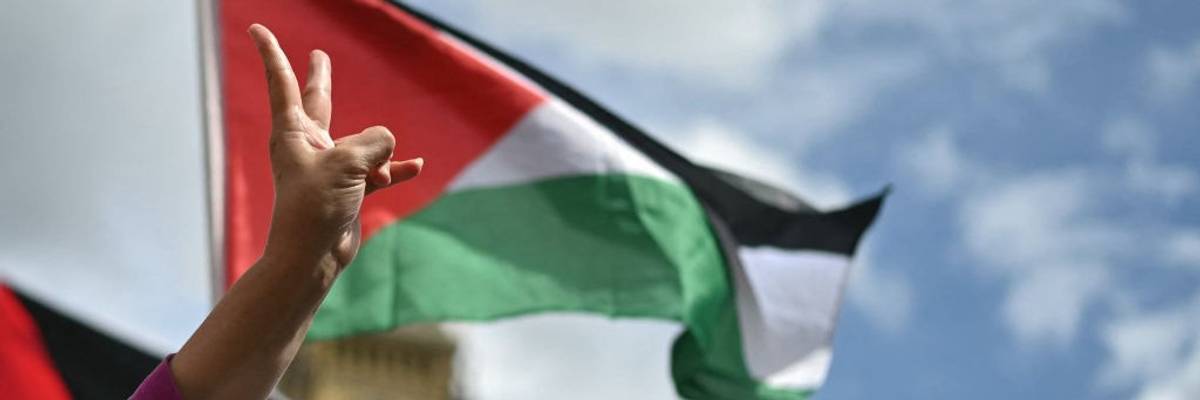
A protester flashes the V sign, also known as the peace sign, among Palestinian flags flapping in the aire, in front Elizabeth Tower, commonly known by the name of the clock's bell "Big Ben", at the Palace of Westminster, home to the Houses of Parliament, central London, on June 8, 2024 at the end of "National March for Gaza", calling to "end the genocide" and "stop arming Israel".
The sheer majority of people in the Middle East, and in the world, yearn for peace. Yet a violent extremist minority commits the region to endless war.
The key to peace in the Middle East is the security of all states and peoples in the region. The arrival of a new presidency in the United States brings the opportunity for a comprehensive peace deal.
The security of all states and peoples would mean the disarming of the militant non-state forces. It would mean the normalization of diplomatic relations among all nations in the region. It would mean that the people of Palestine have their own sovereign state alongside Israel. It would mean the protection of the territorial integrity and stability of neighboring countries Lebanon and Syria. It would mean the commitment of all countries to prevent the proliferation of nuclear weapons in the region. And it would mean that all economic sanctions would be lifted as part of the normalization of diplomatic relations, and as a great stimulus to economic development.
Many millions of people are simply terrified, believing that the other side is an implacable foe out to kill them. False narratives of hatred feed these fears.
Such a comprehensive deal would be in the national security interest of every nation. It would enable all parties to achieve their legitimate aims. Importantly, it would also be line with international law, therefore supported by the United Nations and all its member states.
The sheer majority of people in the Middle East, and in the world, yearn for peace. Yet a violent extremist minority, in Israel and the Arab world, opposes peace. Mercenary armies fight for the spoils of war, and some arms-makers stoke the conflicts. Some opponents of peace dream of restoring ancient empires in flagrant violation of today’s realities.
Many millions of people are simply terrified, believing that the other side is an implacable foe out to kill them. False narratives of hatred feed these fears. To those in great fear, let us recall the wisdom of President John F. Kennedy, who declared sixty years ago:
Indeed, across the gulfs and barriers that now divide us, we must remember that there are no permanent enemies. Hostility today is a fact, but it is not a ruling law. The supreme reality of our time is our indivisibility as children of God and our common vulnerability on this planet.
Kennedy’s confidence in peace enabled the U.S. and the Soviet Union to sign and implement the Partial Nuclear Test Ban Treaty. Today, the “art of the deal” could avert a world war.
The Middle East is known as the cradle of civilization because of its vast and unique history and its gifts to world civilization. The three monotheistic faiths are all born in this region; and they all preach and yearn for peace. With the Middle East today at real risk of nuclear conflagration, the moment has arrived for a comprehensive peace deal. The world’s political leaders and religious leaders have peace within their reach.
A comprehensive peace deal in 2025 should include seven measures:
Let us imagine the happiness and prosperity that will reverberate across this ancient, proud, and magnificent region, if the leaders and peoples rise to the challenge of peace.
Sybil Fares, Senior Advisor on the Middle East for UNSDSN, assisted centrally on this article.
Dear Common Dreams reader, It’s been nearly 30 years since I co-founded Common Dreams with my late wife, Lina Newhouser. We had the radical notion that journalism should serve the public good, not corporate profits. It was clear to us from the outset what it would take to build such a project. No paid advertisements. No corporate sponsors. No millionaire publisher telling us what to think or do. Many people said we wouldn't last a year, but we proved those doubters wrong. Together with a tremendous team of journalists and dedicated staff, we built an independent media outlet free from the constraints of profits and corporate control. Our mission has always been simple: To inform. To inspire. To ignite change for the common good. Building Common Dreams was not easy. Our survival was never guaranteed. When you take on the most powerful forces—Wall Street greed, fossil fuel industry destruction, Big Tech lobbyists, and uber-rich oligarchs who have spent billions upon billions rigging the economy and democracy in their favor—the only bulwark you have is supporters who believe in your work. But here’s the urgent message from me today. It's never been this bad out there. And it's never been this hard to keep us going. At the very moment Common Dreams is most needed, the threats we face are intensifying. We need your support now more than ever. We don't accept corporate advertising and never will. We don't have a paywall because we don't think people should be blocked from critical news based on their ability to pay. Everything we do is funded by the donations of readers like you. When everyone does the little they can afford, we are strong. But if that support retreats or dries up, so do we. Will you donate now to make sure Common Dreams not only survives but thrives? —Craig Brown, Co-founder |
The key to peace in the Middle East is the security of all states and peoples in the region. The arrival of a new presidency in the United States brings the opportunity for a comprehensive peace deal.
The security of all states and peoples would mean the disarming of the militant non-state forces. It would mean the normalization of diplomatic relations among all nations in the region. It would mean that the people of Palestine have their own sovereign state alongside Israel. It would mean the protection of the territorial integrity and stability of neighboring countries Lebanon and Syria. It would mean the commitment of all countries to prevent the proliferation of nuclear weapons in the region. And it would mean that all economic sanctions would be lifted as part of the normalization of diplomatic relations, and as a great stimulus to economic development.
Many millions of people are simply terrified, believing that the other side is an implacable foe out to kill them. False narratives of hatred feed these fears.
Such a comprehensive deal would be in the national security interest of every nation. It would enable all parties to achieve their legitimate aims. Importantly, it would also be line with international law, therefore supported by the United Nations and all its member states.
The sheer majority of people in the Middle East, and in the world, yearn for peace. Yet a violent extremist minority, in Israel and the Arab world, opposes peace. Mercenary armies fight for the spoils of war, and some arms-makers stoke the conflicts. Some opponents of peace dream of restoring ancient empires in flagrant violation of today’s realities.
Many millions of people are simply terrified, believing that the other side is an implacable foe out to kill them. False narratives of hatred feed these fears. To those in great fear, let us recall the wisdom of President John F. Kennedy, who declared sixty years ago:
Indeed, across the gulfs and barriers that now divide us, we must remember that there are no permanent enemies. Hostility today is a fact, but it is not a ruling law. The supreme reality of our time is our indivisibility as children of God and our common vulnerability on this planet.
Kennedy’s confidence in peace enabled the U.S. and the Soviet Union to sign and implement the Partial Nuclear Test Ban Treaty. Today, the “art of the deal” could avert a world war.
The Middle East is known as the cradle of civilization because of its vast and unique history and its gifts to world civilization. The three monotheistic faiths are all born in this region; and they all preach and yearn for peace. With the Middle East today at real risk of nuclear conflagration, the moment has arrived for a comprehensive peace deal. The world’s political leaders and religious leaders have peace within their reach.
A comprehensive peace deal in 2025 should include seven measures:
Let us imagine the happiness and prosperity that will reverberate across this ancient, proud, and magnificent region, if the leaders and peoples rise to the challenge of peace.
Sybil Fares, Senior Advisor on the Middle East for UNSDSN, assisted centrally on this article.
The key to peace in the Middle East is the security of all states and peoples in the region. The arrival of a new presidency in the United States brings the opportunity for a comprehensive peace deal.
The security of all states and peoples would mean the disarming of the militant non-state forces. It would mean the normalization of diplomatic relations among all nations in the region. It would mean that the people of Palestine have their own sovereign state alongside Israel. It would mean the protection of the territorial integrity and stability of neighboring countries Lebanon and Syria. It would mean the commitment of all countries to prevent the proliferation of nuclear weapons in the region. And it would mean that all economic sanctions would be lifted as part of the normalization of diplomatic relations, and as a great stimulus to economic development.
Many millions of people are simply terrified, believing that the other side is an implacable foe out to kill them. False narratives of hatred feed these fears.
Such a comprehensive deal would be in the national security interest of every nation. It would enable all parties to achieve their legitimate aims. Importantly, it would also be line with international law, therefore supported by the United Nations and all its member states.
The sheer majority of people in the Middle East, and in the world, yearn for peace. Yet a violent extremist minority, in Israel and the Arab world, opposes peace. Mercenary armies fight for the spoils of war, and some arms-makers stoke the conflicts. Some opponents of peace dream of restoring ancient empires in flagrant violation of today’s realities.
Many millions of people are simply terrified, believing that the other side is an implacable foe out to kill them. False narratives of hatred feed these fears. To those in great fear, let us recall the wisdom of President John F. Kennedy, who declared sixty years ago:
Indeed, across the gulfs and barriers that now divide us, we must remember that there are no permanent enemies. Hostility today is a fact, but it is not a ruling law. The supreme reality of our time is our indivisibility as children of God and our common vulnerability on this planet.
Kennedy’s confidence in peace enabled the U.S. and the Soviet Union to sign and implement the Partial Nuclear Test Ban Treaty. Today, the “art of the deal” could avert a world war.
The Middle East is known as the cradle of civilization because of its vast and unique history and its gifts to world civilization. The three monotheistic faiths are all born in this region; and they all preach and yearn for peace. With the Middle East today at real risk of nuclear conflagration, the moment has arrived for a comprehensive peace deal. The world’s political leaders and religious leaders have peace within their reach.
A comprehensive peace deal in 2025 should include seven measures:
Let us imagine the happiness and prosperity that will reverberate across this ancient, proud, and magnificent region, if the leaders and peoples rise to the challenge of peace.
Sybil Fares, Senior Advisor on the Middle East for UNSDSN, assisted centrally on this article.