SUBSCRIBE TO OUR FREE NEWSLETTER
Daily news & progressive opinion—funded by the people, not the corporations—delivered straight to your inbox.
5
#000000
#FFFFFF
To donate by check, phone, or other method, see our More Ways to Give page.
Daily news & progressive opinion—funded by the people, not the corporations—delivered straight to your inbox.
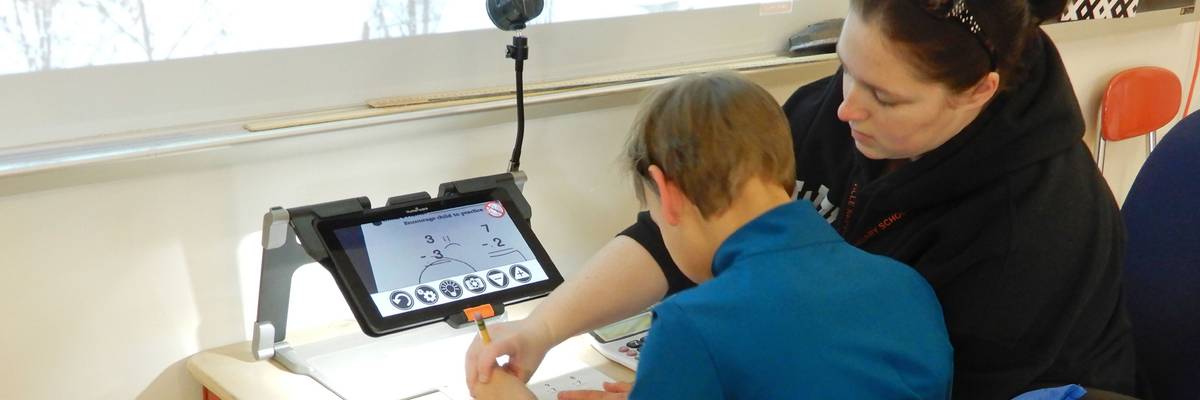
A classroom aide assists a special needs student using an electronic magnifier in Wellsville, New York.
Safeguarding the rights of people with disabilities should be a priority for both the scientific and educational communities, and they need to partner with disabled students to get the job done right.
Let’s face it, whether you are a parent or teacher, a school principal or college president, if you care about students with disabilities under your care, then logic dictates you should care about climate change and its impacts on the most vulnerable among us.
In 2025 alone, major climate tragedies, such as Hurricane Melissa’s destruction in Jamaica and Cuba, extreme heatwaves across Europe, and floods in Southeast Asia, demonstrated a new reality for today’s college and K-12 students: We are seeing more extreme weather, and the most vulnerable among us, along with the elderly, are college and K-12 students.
Consider the fact that nearly 240 million children globally manage life with a disability, making them more vulnerable to the impacts of climate change than the general population. They are among the most affected by sudden floods or mudslides; they cannot physically escape without help; they are most harmed by incapacitated roadways and shut-down transportation; and they are most vulnerable when it comes to diminished or defunded healthcare.
As a former public school teacher and a professor, I have witnessed firsthand the inadequacies of our disaster drills for students with disabilities. Some of the daunting questions that flashed through my mind during these drills were: Are school and university emergency shelters accessible to students in wheelchairs? Many communication systems and warning alerts depend on visual and auditory cues. What if a student is deaf and vision impaired?
The need for K-12 climate change education to be disability inclusive runs against the Trump administration’s attempts at dismantling special education.
As an author of two books on climate change and environmental justice education, when our policies and programs do not include disability access, I know we are failing to keep all children and students safe.
The need to provide accessible climate education is especially urgent in light of the recent 50th anniversary of the Individuals with Disabilities Education Act (IDEA). For five decades, IDEA has guaranteed every child in the United States a “Free and Appropriate Public Education.” Still, Congress’ promises remain largely unfulfilled, and schools struggle to fund services because they don’t receive adequate federal support.
However, in times of extreme weather, we must ask ourselves whether we are creating curriculum and safety plans that provide information needed to survive a sudden flood or severe heatwave. And we must consider whether our actions meet the letter of the law. A non-inclusive climate education is not just a curriculum gap; it is a violation of civil rights. We must treat students with disabilities as experts who can contribute to climate change action and activism, not just view them as people who need to be saved.
This means co-designing climate change studies with disabled students. A partnership. Co-designing (or redesigning) climate change curriculum offers teachers an excellent opportunity to tackle and overcome building design challenges. For example, students can design and engineer prototypes of multimodal emergency alert systems that can deliver warnings through sound, tactile vibration, and accessible text (such as large fonts or braille). Being intentional and thinking about accessibility throughout the design process benefits all students.
In addition, students can solve problems using a multidisciplinary approach across all subjects.
Students with disabilities can create and engineer prototypes of multimodal emergency alert systems that can deliver warnings through sound, tactile vibration, and accessible text, such as large fonts or braille—designs innovated via students’ life experiences and challenges. When working within the realm of visual color-coded maps meant to indicate levels of pollution or heat, students with eyesight challenges can create tactile, three-dimensional maps in clay or papier-mâché and attach braille labels. Other design solutions needed by disabled students during a climate event include supplying emergency electrical power for medical devices and refrigeration for certain medications, as well as access to emergency evacuation routes.
Furthermore, students with disabilities working on design and safety projects will be in a position to present their findings and projects to the city council, school board, and school PTA to advocate for increased accessibility at their school and in their community.
Researchers have also called on scientists to consider physical and mental ability when developing adaptations and responses to climate change. This provides students with an opportunity to glean from established scientific work to build their own solutions. Safeguarding the rights of people with disabilities should be a priority for both the scientific and educational communities, and they need to partner with disabled students to get the job done right.
The need for K-12 climate change education to be disability inclusive runs against the Trump administration’s attempts at dismantling special education. In fact, Trump’s administration has launched a war on disability, which has included removing the accessibility page and American Sign Language content from the White House website, removing interpreters from across multiple federal agencies, and openly using ableist slurs.
Urge your senators and representatives to support the IDEA Full Funding Act (S. 1277/H.R. 2598), co-sponsored by US Representative Jared Huffman, who represents California’s District 2.
The bill will ensure that Congress funds IDEA at the full 40%. And that means student designers will create a world accessible to everyone.
Dear Common Dreams reader, It’s been nearly 30 years since I co-founded Common Dreams with my late wife, Lina Newhouser. We had the radical notion that journalism should serve the public good, not corporate profits. It was clear to us from the outset what it would take to build such a project. No paid advertisements. No corporate sponsors. No millionaire publisher telling us what to think or do. Many people said we wouldn't last a year, but we proved those doubters wrong. Together with a tremendous team of journalists and dedicated staff, we built an independent media outlet free from the constraints of profits and corporate control. Our mission has always been simple: To inform. To inspire. To ignite change for the common good. Building Common Dreams was not easy. Our survival was never guaranteed. When you take on the most powerful forces—Wall Street greed, fossil fuel industry destruction, Big Tech lobbyists, and uber-rich oligarchs who have spent billions upon billions rigging the economy and democracy in their favor—the only bulwark you have is supporters who believe in your work. But here’s the urgent message from me today. It's never been this bad out there. And it's never been this hard to keep us going. At the very moment Common Dreams is most needed, the threats we face are intensifying. We need your support now more than ever. We don't accept corporate advertising and never will. We don't have a paywall because we don't think people should be blocked from critical news based on their ability to pay. Everything we do is funded by the donations of readers like you. When everyone does the little they can afford, we are strong. But if that support retreats or dries up, so do we. Will you donate now to make sure Common Dreams not only survives but thrives? —Craig Brown, Co-founder |
Let’s face it, whether you are a parent or teacher, a school principal or college president, if you care about students with disabilities under your care, then logic dictates you should care about climate change and its impacts on the most vulnerable among us.
In 2025 alone, major climate tragedies, such as Hurricane Melissa’s destruction in Jamaica and Cuba, extreme heatwaves across Europe, and floods in Southeast Asia, demonstrated a new reality for today’s college and K-12 students: We are seeing more extreme weather, and the most vulnerable among us, along with the elderly, are college and K-12 students.
Consider the fact that nearly 240 million children globally manage life with a disability, making them more vulnerable to the impacts of climate change than the general population. They are among the most affected by sudden floods or mudslides; they cannot physically escape without help; they are most harmed by incapacitated roadways and shut-down transportation; and they are most vulnerable when it comes to diminished or defunded healthcare.
As a former public school teacher and a professor, I have witnessed firsthand the inadequacies of our disaster drills for students with disabilities. Some of the daunting questions that flashed through my mind during these drills were: Are school and university emergency shelters accessible to students in wheelchairs? Many communication systems and warning alerts depend on visual and auditory cues. What if a student is deaf and vision impaired?
The need for K-12 climate change education to be disability inclusive runs against the Trump administration’s attempts at dismantling special education.
As an author of two books on climate change and environmental justice education, when our policies and programs do not include disability access, I know we are failing to keep all children and students safe.
The need to provide accessible climate education is especially urgent in light of the recent 50th anniversary of the Individuals with Disabilities Education Act (IDEA). For five decades, IDEA has guaranteed every child in the United States a “Free and Appropriate Public Education.” Still, Congress’ promises remain largely unfulfilled, and schools struggle to fund services because they don’t receive adequate federal support.
However, in times of extreme weather, we must ask ourselves whether we are creating curriculum and safety plans that provide information needed to survive a sudden flood or severe heatwave. And we must consider whether our actions meet the letter of the law. A non-inclusive climate education is not just a curriculum gap; it is a violation of civil rights. We must treat students with disabilities as experts who can contribute to climate change action and activism, not just view them as people who need to be saved.
This means co-designing climate change studies with disabled students. A partnership. Co-designing (or redesigning) climate change curriculum offers teachers an excellent opportunity to tackle and overcome building design challenges. For example, students can design and engineer prototypes of multimodal emergency alert systems that can deliver warnings through sound, tactile vibration, and accessible text (such as large fonts or braille). Being intentional and thinking about accessibility throughout the design process benefits all students.
In addition, students can solve problems using a multidisciplinary approach across all subjects.
Students with disabilities can create and engineer prototypes of multimodal emergency alert systems that can deliver warnings through sound, tactile vibration, and accessible text, such as large fonts or braille—designs innovated via students’ life experiences and challenges. When working within the realm of visual color-coded maps meant to indicate levels of pollution or heat, students with eyesight challenges can create tactile, three-dimensional maps in clay or papier-mâché and attach braille labels. Other design solutions needed by disabled students during a climate event include supplying emergency electrical power for medical devices and refrigeration for certain medications, as well as access to emergency evacuation routes.
Furthermore, students with disabilities working on design and safety projects will be in a position to present their findings and projects to the city council, school board, and school PTA to advocate for increased accessibility at their school and in their community.
Researchers have also called on scientists to consider physical and mental ability when developing adaptations and responses to climate change. This provides students with an opportunity to glean from established scientific work to build their own solutions. Safeguarding the rights of people with disabilities should be a priority for both the scientific and educational communities, and they need to partner with disabled students to get the job done right.
The need for K-12 climate change education to be disability inclusive runs against the Trump administration’s attempts at dismantling special education. In fact, Trump’s administration has launched a war on disability, which has included removing the accessibility page and American Sign Language content from the White House website, removing interpreters from across multiple federal agencies, and openly using ableist slurs.
Urge your senators and representatives to support the IDEA Full Funding Act (S. 1277/H.R. 2598), co-sponsored by US Representative Jared Huffman, who represents California’s District 2.
The bill will ensure that Congress funds IDEA at the full 40%. And that means student designers will create a world accessible to everyone.
Let’s face it, whether you are a parent or teacher, a school principal or college president, if you care about students with disabilities under your care, then logic dictates you should care about climate change and its impacts on the most vulnerable among us.
In 2025 alone, major climate tragedies, such as Hurricane Melissa’s destruction in Jamaica and Cuba, extreme heatwaves across Europe, and floods in Southeast Asia, demonstrated a new reality for today’s college and K-12 students: We are seeing more extreme weather, and the most vulnerable among us, along with the elderly, are college and K-12 students.
Consider the fact that nearly 240 million children globally manage life with a disability, making them more vulnerable to the impacts of climate change than the general population. They are among the most affected by sudden floods or mudslides; they cannot physically escape without help; they are most harmed by incapacitated roadways and shut-down transportation; and they are most vulnerable when it comes to diminished or defunded healthcare.
As a former public school teacher and a professor, I have witnessed firsthand the inadequacies of our disaster drills for students with disabilities. Some of the daunting questions that flashed through my mind during these drills were: Are school and university emergency shelters accessible to students in wheelchairs? Many communication systems and warning alerts depend on visual and auditory cues. What if a student is deaf and vision impaired?
The need for K-12 climate change education to be disability inclusive runs against the Trump administration’s attempts at dismantling special education.
As an author of two books on climate change and environmental justice education, when our policies and programs do not include disability access, I know we are failing to keep all children and students safe.
The need to provide accessible climate education is especially urgent in light of the recent 50th anniversary of the Individuals with Disabilities Education Act (IDEA). For five decades, IDEA has guaranteed every child in the United States a “Free and Appropriate Public Education.” Still, Congress’ promises remain largely unfulfilled, and schools struggle to fund services because they don’t receive adequate federal support.
However, in times of extreme weather, we must ask ourselves whether we are creating curriculum and safety plans that provide information needed to survive a sudden flood or severe heatwave. And we must consider whether our actions meet the letter of the law. A non-inclusive climate education is not just a curriculum gap; it is a violation of civil rights. We must treat students with disabilities as experts who can contribute to climate change action and activism, not just view them as people who need to be saved.
This means co-designing climate change studies with disabled students. A partnership. Co-designing (or redesigning) climate change curriculum offers teachers an excellent opportunity to tackle and overcome building design challenges. For example, students can design and engineer prototypes of multimodal emergency alert systems that can deliver warnings through sound, tactile vibration, and accessible text (such as large fonts or braille). Being intentional and thinking about accessibility throughout the design process benefits all students.
In addition, students can solve problems using a multidisciplinary approach across all subjects.
Students with disabilities can create and engineer prototypes of multimodal emergency alert systems that can deliver warnings through sound, tactile vibration, and accessible text, such as large fonts or braille—designs innovated via students’ life experiences and challenges. When working within the realm of visual color-coded maps meant to indicate levels of pollution or heat, students with eyesight challenges can create tactile, three-dimensional maps in clay or papier-mâché and attach braille labels. Other design solutions needed by disabled students during a climate event include supplying emergency electrical power for medical devices and refrigeration for certain medications, as well as access to emergency evacuation routes.
Furthermore, students with disabilities working on design and safety projects will be in a position to present their findings and projects to the city council, school board, and school PTA to advocate for increased accessibility at their school and in their community.
Researchers have also called on scientists to consider physical and mental ability when developing adaptations and responses to climate change. This provides students with an opportunity to glean from established scientific work to build their own solutions. Safeguarding the rights of people with disabilities should be a priority for both the scientific and educational communities, and they need to partner with disabled students to get the job done right.
The need for K-12 climate change education to be disability inclusive runs against the Trump administration’s attempts at dismantling special education. In fact, Trump’s administration has launched a war on disability, which has included removing the accessibility page and American Sign Language content from the White House website, removing interpreters from across multiple federal agencies, and openly using ableist slurs.
Urge your senators and representatives to support the IDEA Full Funding Act (S. 1277/H.R. 2598), co-sponsored by US Representative Jared Huffman, who represents California’s District 2.
The bill will ensure that Congress funds IDEA at the full 40%. And that means student designers will create a world accessible to everyone.