SUBSCRIBE TO OUR FREE NEWSLETTER
Daily news & progressive opinion—funded by the people, not the corporations—delivered straight to your inbox.
5
#000000
#FFFFFF
To donate by check, phone, or other method, see our More Ways to Give page.
Daily news & progressive opinion—funded by the people, not the corporations—delivered straight to your inbox.
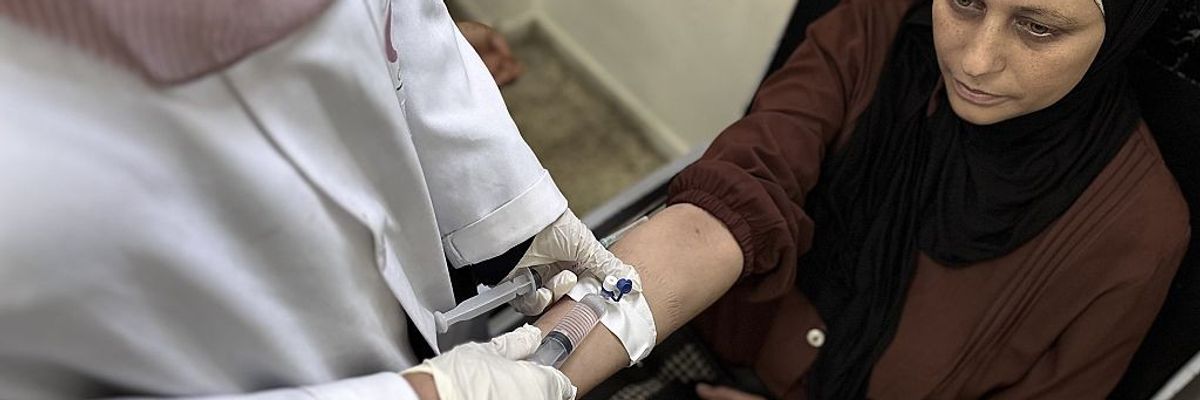
Cancer patients in the Gaza Strip are being treated with limited facilities at Nasser Hospital in Khan Yunis city, as the Turkish-Palestinian Friendship Hospital and Gaza-Europe Hospital are out of service due to Israeli attacks, on June 11, 2025 in Gaza.
Cancer and other noncommunicable diseases remain chronically underfunded in low- and middle-income countries. This neglect is not only unjust; it is destabilizing.
As the year draws to a close, I find myself thinking about what lingers after the headlines fade.
I am thinking about the corridors of a cancer conference in Tunisia, where doctors, nurses, scientists, students, and patients from across Africa gathered with a shared purpose: to reduce the burden of cancer in places too often overlooked. In conversation after conversation, I heard stories of ingenuity and quiet endurance; clinicians delivering chemotherapy with limited supplies, researchers building cancer registries on borrowed computers, patients selling what little they own to stay alive.
One young oncologist from Rwanda told me he is learning to speak differently with his patients about cancer. Not just about treatment protocols, but about fear, dignity, and hope. He explained how language itself can heal, how empathy can ease suffering even when resources are scarce. I called him the prophet—not because he predicted outcomes, but because he understood that healing begins with trust.
A breast cancer survivor from Gaza spoke of women forced to leave home in search of treatment, only to face drug shortages and fractured care across borders. Their struggle is not only against disease, but against politics and geography that interrupt therapy and shorten lives.
If the year ahead is to mean progress, it will depend on whether we choose to align wealth with wisdom and urgency with solidarity.
These stories stayed with me when I returned home; and when I read, almost casually, about tens of millions of dollars spent to influence a single political race in New York City. I could not stop doing the math. How many nurses could that money train? How many pathology labs could it equip? How many mothers could it help live long enough to watch their children grow?
We live in a moment when the science to dramatically reduce cancer and other noncommunicable diseases already exists. Prevention works. Diagnostics work. Treatment works. Yet survival remains a cruel lottery of birth. A child with leukemia in Boston, Heidelberg, or Tokyo has more than an 80% chance of survival. The same child in Kampala, Dhaka, Sana’a, or Gaza faces odds closer to 20%; not because science has failed, but because access has.
This inequity is not academic for me. I am living with stage IV cancer. My treatment is possible not because I am exceptional, but because of where I live. My ZIP code granted me specialists, hospitals, and medicines that millions of people around the world cannot access. In an era of breathtaking biomedical progress, this disparity is increasingly difficult to defend.
Meanwhile, vast sums continue to flow effortlessly toward political influence, luxury consumption, and fleeting spectacle; multimillion-dollar celebrations, couture collections, brief trips to the edge of space. Excess has always existed, and it always will. The question is not whether extravagance can be eliminated, but whether it must remain our highest expression of success.
History shows us another option. Coordinated global investment transformed the trajectory of HIV, tuberculosis, and malaria. Millions of lives were saved not because the science was perfect, but because resources were mobilized with urgency and moral clarity. When funding aligns with purpose, outcomes change—quickly and dramatically.
Yet cancer and other noncommunicable diseases, now responsible for most deaths worldwide, remain chronically underfunded in low- and middle-income countries. This neglect is not only unjust; it is destabilizing. Untreated cancer weakens families, strains health systems, and erodes trust in institutions. The consequences ripple far beyond individual patients.
As the year ends, it is worth asking what our spending reveals about our values. Conferences like the one I attended in Tunisia are not only scientific gatherings; they are moral ones. They confront us with the gap between what is possible and what we choose to prioritize.
We live in a world of abundance and absence, sometimes within the same news cycle. One story celebrates money deployed for influence; another recounts lives lost for lack of basic medicine. These are not separate realities. They are the result of collective choices.
As the new year begins, we will make choices—about budgets, priorities, and what we choose to celebrate. Those choices will determine who receives care and who waits, who lives and who is left behind. Science has already shown us what is possible. If the year ahead is to mean progress, it will depend on whether we choose to align wealth with wisdom and urgency with solidarity, deciding, at last, that saving lives deserves the same resolve we devote to influence, attention, and prestige.
Dear Common Dreams reader, It’s been nearly 30 years since I co-founded Common Dreams with my late wife, Lina Newhouser. We had the radical notion that journalism should serve the public good, not corporate profits. It was clear to us from the outset what it would take to build such a project. No paid advertisements. No corporate sponsors. No millionaire publisher telling us what to think or do. Many people said we wouldn't last a year, but we proved those doubters wrong. Together with a tremendous team of journalists and dedicated staff, we built an independent media outlet free from the constraints of profits and corporate control. Our mission has always been simple: To inform. To inspire. To ignite change for the common good. Building Common Dreams was not easy. Our survival was never guaranteed. When you take on the most powerful forces—Wall Street greed, fossil fuel industry destruction, Big Tech lobbyists, and uber-rich oligarchs who have spent billions upon billions rigging the economy and democracy in their favor—the only bulwark you have is supporters who believe in your work. But here’s the urgent message from me today. It's never been this bad out there. And it's never been this hard to keep us going. At the very moment Common Dreams is most needed, the threats we face are intensifying. We need your support now more than ever. We don't accept corporate advertising and never will. We don't have a paywall because we don't think people should be blocked from critical news based on their ability to pay. Everything we do is funded by the donations of readers like you. When everyone does the little they can afford, we are strong. But if that support retreats or dries up, so do we. Will you donate now to make sure Common Dreams not only survives but thrives? —Craig Brown, Co-founder |
As the year draws to a close, I find myself thinking about what lingers after the headlines fade.
I am thinking about the corridors of a cancer conference in Tunisia, where doctors, nurses, scientists, students, and patients from across Africa gathered with a shared purpose: to reduce the burden of cancer in places too often overlooked. In conversation after conversation, I heard stories of ingenuity and quiet endurance; clinicians delivering chemotherapy with limited supplies, researchers building cancer registries on borrowed computers, patients selling what little they own to stay alive.
One young oncologist from Rwanda told me he is learning to speak differently with his patients about cancer. Not just about treatment protocols, but about fear, dignity, and hope. He explained how language itself can heal, how empathy can ease suffering even when resources are scarce. I called him the prophet—not because he predicted outcomes, but because he understood that healing begins with trust.
A breast cancer survivor from Gaza spoke of women forced to leave home in search of treatment, only to face drug shortages and fractured care across borders. Their struggle is not only against disease, but against politics and geography that interrupt therapy and shorten lives.
If the year ahead is to mean progress, it will depend on whether we choose to align wealth with wisdom and urgency with solidarity.
These stories stayed with me when I returned home; and when I read, almost casually, about tens of millions of dollars spent to influence a single political race in New York City. I could not stop doing the math. How many nurses could that money train? How many pathology labs could it equip? How many mothers could it help live long enough to watch their children grow?
We live in a moment when the science to dramatically reduce cancer and other noncommunicable diseases already exists. Prevention works. Diagnostics work. Treatment works. Yet survival remains a cruel lottery of birth. A child with leukemia in Boston, Heidelberg, or Tokyo has more than an 80% chance of survival. The same child in Kampala, Dhaka, Sana’a, or Gaza faces odds closer to 20%; not because science has failed, but because access has.
This inequity is not academic for me. I am living with stage IV cancer. My treatment is possible not because I am exceptional, but because of where I live. My ZIP code granted me specialists, hospitals, and medicines that millions of people around the world cannot access. In an era of breathtaking biomedical progress, this disparity is increasingly difficult to defend.
Meanwhile, vast sums continue to flow effortlessly toward political influence, luxury consumption, and fleeting spectacle; multimillion-dollar celebrations, couture collections, brief trips to the edge of space. Excess has always existed, and it always will. The question is not whether extravagance can be eliminated, but whether it must remain our highest expression of success.
History shows us another option. Coordinated global investment transformed the trajectory of HIV, tuberculosis, and malaria. Millions of lives were saved not because the science was perfect, but because resources were mobilized with urgency and moral clarity. When funding aligns with purpose, outcomes change—quickly and dramatically.
Yet cancer and other noncommunicable diseases, now responsible for most deaths worldwide, remain chronically underfunded in low- and middle-income countries. This neglect is not only unjust; it is destabilizing. Untreated cancer weakens families, strains health systems, and erodes trust in institutions. The consequences ripple far beyond individual patients.
As the year ends, it is worth asking what our spending reveals about our values. Conferences like the one I attended in Tunisia are not only scientific gatherings; they are moral ones. They confront us with the gap between what is possible and what we choose to prioritize.
We live in a world of abundance and absence, sometimes within the same news cycle. One story celebrates money deployed for influence; another recounts lives lost for lack of basic medicine. These are not separate realities. They are the result of collective choices.
As the new year begins, we will make choices—about budgets, priorities, and what we choose to celebrate. Those choices will determine who receives care and who waits, who lives and who is left behind. Science has already shown us what is possible. If the year ahead is to mean progress, it will depend on whether we choose to align wealth with wisdom and urgency with solidarity, deciding, at last, that saving lives deserves the same resolve we devote to influence, attention, and prestige.
As the year draws to a close, I find myself thinking about what lingers after the headlines fade.
I am thinking about the corridors of a cancer conference in Tunisia, where doctors, nurses, scientists, students, and patients from across Africa gathered with a shared purpose: to reduce the burden of cancer in places too often overlooked. In conversation after conversation, I heard stories of ingenuity and quiet endurance; clinicians delivering chemotherapy with limited supplies, researchers building cancer registries on borrowed computers, patients selling what little they own to stay alive.
One young oncologist from Rwanda told me he is learning to speak differently with his patients about cancer. Not just about treatment protocols, but about fear, dignity, and hope. He explained how language itself can heal, how empathy can ease suffering even when resources are scarce. I called him the prophet—not because he predicted outcomes, but because he understood that healing begins with trust.
A breast cancer survivor from Gaza spoke of women forced to leave home in search of treatment, only to face drug shortages and fractured care across borders. Their struggle is not only against disease, but against politics and geography that interrupt therapy and shorten lives.
If the year ahead is to mean progress, it will depend on whether we choose to align wealth with wisdom and urgency with solidarity.
These stories stayed with me when I returned home; and when I read, almost casually, about tens of millions of dollars spent to influence a single political race in New York City. I could not stop doing the math. How many nurses could that money train? How many pathology labs could it equip? How many mothers could it help live long enough to watch their children grow?
We live in a moment when the science to dramatically reduce cancer and other noncommunicable diseases already exists. Prevention works. Diagnostics work. Treatment works. Yet survival remains a cruel lottery of birth. A child with leukemia in Boston, Heidelberg, or Tokyo has more than an 80% chance of survival. The same child in Kampala, Dhaka, Sana’a, or Gaza faces odds closer to 20%; not because science has failed, but because access has.
This inequity is not academic for me. I am living with stage IV cancer. My treatment is possible not because I am exceptional, but because of where I live. My ZIP code granted me specialists, hospitals, and medicines that millions of people around the world cannot access. In an era of breathtaking biomedical progress, this disparity is increasingly difficult to defend.
Meanwhile, vast sums continue to flow effortlessly toward political influence, luxury consumption, and fleeting spectacle; multimillion-dollar celebrations, couture collections, brief trips to the edge of space. Excess has always existed, and it always will. The question is not whether extravagance can be eliminated, but whether it must remain our highest expression of success.
History shows us another option. Coordinated global investment transformed the trajectory of HIV, tuberculosis, and malaria. Millions of lives were saved not because the science was perfect, but because resources were mobilized with urgency and moral clarity. When funding aligns with purpose, outcomes change—quickly and dramatically.
Yet cancer and other noncommunicable diseases, now responsible for most deaths worldwide, remain chronically underfunded in low- and middle-income countries. This neglect is not only unjust; it is destabilizing. Untreated cancer weakens families, strains health systems, and erodes trust in institutions. The consequences ripple far beyond individual patients.
As the year ends, it is worth asking what our spending reveals about our values. Conferences like the one I attended in Tunisia are not only scientific gatherings; they are moral ones. They confront us with the gap between what is possible and what we choose to prioritize.
We live in a world of abundance and absence, sometimes within the same news cycle. One story celebrates money deployed for influence; another recounts lives lost for lack of basic medicine. These are not separate realities. They are the result of collective choices.
As the new year begins, we will make choices—about budgets, priorities, and what we choose to celebrate. Those choices will determine who receives care and who waits, who lives and who is left behind. Science has already shown us what is possible. If the year ahead is to mean progress, it will depend on whether we choose to align wealth with wisdom and urgency with solidarity, deciding, at last, that saving lives deserves the same resolve we devote to influence, attention, and prestige.