5
#000000
#FFFFFF
To donate by check, phone, or other method, see our More Ways to Give page.
Daily news & progressive opinion—funded by the people, not the corporations—delivered straight to your inbox.
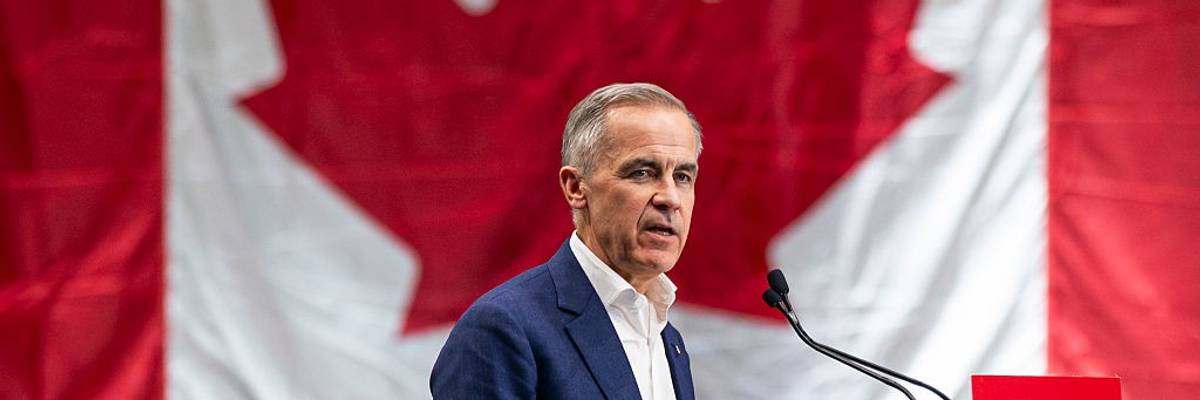
Prime Minister of Canada and Liberal Party Leader Mark Carney delivers a speech to supporters during a rally on April 23, 2025 in Surrey, Canada.
For those in Washington who assume the old alliances will endure regardless of how allies are treated, Canada's actions show the old order really is not coming back.
Canadian Prime Minister Mark Carney’s speech at the World Economic Forum on January 20 was not an exercise in pique. It was the clearest articulation yet of a strategic shift that has profound implications—not just for US-Canada relations, but for the entire structure of American alliances worldwide.
Carney told the Davos audience that “the old order is not coming back” and that the rules-based international system was always “partially false.” The strongest exempted themselves when convenient, trade rules were enforced asymmetrically, and Canada “placed the sign in the window” while avoiding the gaps between rhetoric and reality. That bargain, he declared, no longer works. Canada is now building what Carney called “strategic autonomy”—the capacity to feed itself, fuel itself, and defend itself without depending on the United States.
The speech codified what six months of frenetic diplomacy had already demonstrated. Since taking office, Carney has signed 12 trade and security agreements across four continents. Canada has joined the European Union’s €150 billion Security Action for Europe (SAFE) defense procurement program; the first non-European nation admitted. Recently, Carney announced a strategic partnership with Xi Jinping and opened Canadian markets to Chinese electric vehicles. Ottawa has committed to the largest military spending increase since World War II, deliberately structured to reduce reliance on American defense contractors.
This matters beyond North America because Canada was, until recently, the test case for deep integration with the United States. More than 75% of Canadian exports went south. Supply chains, especially in automotive and energy, were seamlessly continental. Defense was jointly managed through NORAD. If any country had conclusively answered the question of whether binding one’s self to American hegemony was safe, it was Canada.
When allies begin describing authoritarian rivals as more reliable than the United States, something fundamental has broken.
The answer, Ottawa has now concluded, is no. And that conclusion is being watched carefully in Brussels, Tokyo, Canberra, and Seoul.
The proximate cause is the Trump administration’s tariffs, threats to abandon the US-Mexico-Canada Agreement, and repeated suggestions that Canada should become the 51st US state. But Carney’s Davos speech made clear that the problem runs deeper than one administration. The issue is structural: American policy now swings so dramatically between presidencies that commitments made by one administration cannot be trusted to survive the next. For allies making decade-long investments in defense procurement, energy infrastructure, or trade relationships, this volatility is intolerable.
Carney borrowed a framework from Finnish President Alexander Stubb: “values-based realism.” Canada will remain committed to sovereignty, human rights, and international law in principle. However, Canada will be pragmatic about working with partners who do not share those values. This explains the China pivot. Beijing is not a trustworthy partner, and Canadians know this better than most after the arbitrary detention of the two Michaels—Michael Spavor and Michael Kovrig—in 2018 (and released in 2021). But China is predictable in ways that Washington no longer is. As Carney noted in Beijing, the relationship with China is now “more predictable” than the one with the United States.
That statement should alarm policymakers in Washington far more than any tariff retaliation. When allies begin describing authoritarian rivals as more reliable than the United States, something fundamental has broken.
The Canadian pivot also reveals the limits of geographical determinism. American analysts have long assumed that Canada has no real alternatives; that proximity and integration lock Ottawa into the US orbit regardless of policy. Carney is testing that assumption. The Trans Mountain pipeline now ships Canadian oil to Asia. Liquefied natural gas terminals are under construction for Pacific exports. The EU defense partnership opens European procurement to Canadian manufacturers.
Canada cannot replace American trade overnight, but it can build sufficient alternatives to survive without it. That is precisely what Carney has pledged: doubling non-US exports within 10 years.
For other US allies, the lesson is clear. If Canada, the most integrated, most proximate, most culturally similar American ally, has concluded that dependence on Washington is too risky, then no alliance is safe from reassessment. The Europeans are already drawing similar conclusions. The EU’s Mercosur deal and accelerated talks with Japan and South Korea reflect the same diversification logic. Even Australia, historically the most reliable US partner in the Indo-Pacific, is quietly exploring options.
None of this necessarily serves those allies’ long-term interests. China is not a benign alternative to American hegemony. The middle-power coalitions Carney envisions may lack the capacity to provide genuine security. And the economic costs of unwinding continental integration will be substantial. Canada’s gamble may yet prove to be a mistake.
But that is not the point. America’s closest ally has made a rational decision, based on observed evidence, that the United States can no longer be trusted, and is acting accordingly. Other allies are making similar calculations. The network of relationships that has amplified American power since 1945 is fraying, and American policy is what’s fraying it.
Carney closed his Davos speech with a line that deserves attention beyond Ottawa: “Nostalgia is not a strategy.” For those in Washington who assume the old alliances will endure regardless of how allies are treated, the warning applies with equal force. The old order really is not coming back. The question is what replaces it, and whether the United States will have any role in building it.
Dear Common Dreams reader, The U.S. is on a fast track to authoritarianism like nothing I've ever seen. Meanwhile, corporate news outlets are utterly capitulating to Trump, twisting their coverage to avoid drawing his ire while lining up to stuff cash in his pockets. That's why I believe that Common Dreams is doing the best and most consequential reporting that we've ever done. Our small but mighty team is a progressive reporting powerhouse, covering the news every day that the corporate media never will. Our mission has always been simple: To inform. To inspire. And to ignite change for the common good. Now here's the key piece that I want all our readers to understand: None of this would be possible without your financial support. That's not just some fundraising cliche. It's the absolute and literal truth. We don't accept corporate advertising and never will. We don't have a paywall because we don't think people should be blocked from critical news based on their ability to pay. Everything we do is funded by the donations of readers like you. Will you donate now to help power the nonprofit, independent reporting of Common Dreams? Thank you for being a vital member of our community. Together, we can keep independent journalism alive when it’s needed most. - Craig Brown, Co-founder |
Canadian Prime Minister Mark Carney’s speech at the World Economic Forum on January 20 was not an exercise in pique. It was the clearest articulation yet of a strategic shift that has profound implications—not just for US-Canada relations, but for the entire structure of American alliances worldwide.
Carney told the Davos audience that “the old order is not coming back” and that the rules-based international system was always “partially false.” The strongest exempted themselves when convenient, trade rules were enforced asymmetrically, and Canada “placed the sign in the window” while avoiding the gaps between rhetoric and reality. That bargain, he declared, no longer works. Canada is now building what Carney called “strategic autonomy”—the capacity to feed itself, fuel itself, and defend itself without depending on the United States.
The speech codified what six months of frenetic diplomacy had already demonstrated. Since taking office, Carney has signed 12 trade and security agreements across four continents. Canada has joined the European Union’s €150 billion Security Action for Europe (SAFE) defense procurement program; the first non-European nation admitted. Recently, Carney announced a strategic partnership with Xi Jinping and opened Canadian markets to Chinese electric vehicles. Ottawa has committed to the largest military spending increase since World War II, deliberately structured to reduce reliance on American defense contractors.
This matters beyond North America because Canada was, until recently, the test case for deep integration with the United States. More than 75% of Canadian exports went south. Supply chains, especially in automotive and energy, were seamlessly continental. Defense was jointly managed through NORAD. If any country had conclusively answered the question of whether binding one’s self to American hegemony was safe, it was Canada.
When allies begin describing authoritarian rivals as more reliable than the United States, something fundamental has broken.
The answer, Ottawa has now concluded, is no. And that conclusion is being watched carefully in Brussels, Tokyo, Canberra, and Seoul.
The proximate cause is the Trump administration’s tariffs, threats to abandon the US-Mexico-Canada Agreement, and repeated suggestions that Canada should become the 51st US state. But Carney’s Davos speech made clear that the problem runs deeper than one administration. The issue is structural: American policy now swings so dramatically between presidencies that commitments made by one administration cannot be trusted to survive the next. For allies making decade-long investments in defense procurement, energy infrastructure, or trade relationships, this volatility is intolerable.
Carney borrowed a framework from Finnish President Alexander Stubb: “values-based realism.” Canada will remain committed to sovereignty, human rights, and international law in principle. However, Canada will be pragmatic about working with partners who do not share those values. This explains the China pivot. Beijing is not a trustworthy partner, and Canadians know this better than most after the arbitrary detention of the two Michaels—Michael Spavor and Michael Kovrig—in 2018 (and released in 2021). But China is predictable in ways that Washington no longer is. As Carney noted in Beijing, the relationship with China is now “more predictable” than the one with the United States.
That statement should alarm policymakers in Washington far more than any tariff retaliation. When allies begin describing authoritarian rivals as more reliable than the United States, something fundamental has broken.
The Canadian pivot also reveals the limits of geographical determinism. American analysts have long assumed that Canada has no real alternatives; that proximity and integration lock Ottawa into the US orbit regardless of policy. Carney is testing that assumption. The Trans Mountain pipeline now ships Canadian oil to Asia. Liquefied natural gas terminals are under construction for Pacific exports. The EU defense partnership opens European procurement to Canadian manufacturers.
Canada cannot replace American trade overnight, but it can build sufficient alternatives to survive without it. That is precisely what Carney has pledged: doubling non-US exports within 10 years.
For other US allies, the lesson is clear. If Canada, the most integrated, most proximate, most culturally similar American ally, has concluded that dependence on Washington is too risky, then no alliance is safe from reassessment. The Europeans are already drawing similar conclusions. The EU’s Mercosur deal and accelerated talks with Japan and South Korea reflect the same diversification logic. Even Australia, historically the most reliable US partner in the Indo-Pacific, is quietly exploring options.
None of this necessarily serves those allies’ long-term interests. China is not a benign alternative to American hegemony. The middle-power coalitions Carney envisions may lack the capacity to provide genuine security. And the economic costs of unwinding continental integration will be substantial. Canada’s gamble may yet prove to be a mistake.
But that is not the point. America’s closest ally has made a rational decision, based on observed evidence, that the United States can no longer be trusted, and is acting accordingly. Other allies are making similar calculations. The network of relationships that has amplified American power since 1945 is fraying, and American policy is what’s fraying it.
Carney closed his Davos speech with a line that deserves attention beyond Ottawa: “Nostalgia is not a strategy.” For those in Washington who assume the old alliances will endure regardless of how allies are treated, the warning applies with equal force. The old order really is not coming back. The question is what replaces it, and whether the United States will have any role in building it.
Canadian Prime Minister Mark Carney’s speech at the World Economic Forum on January 20 was not an exercise in pique. It was the clearest articulation yet of a strategic shift that has profound implications—not just for US-Canada relations, but for the entire structure of American alliances worldwide.
Carney told the Davos audience that “the old order is not coming back” and that the rules-based international system was always “partially false.” The strongest exempted themselves when convenient, trade rules were enforced asymmetrically, and Canada “placed the sign in the window” while avoiding the gaps between rhetoric and reality. That bargain, he declared, no longer works. Canada is now building what Carney called “strategic autonomy”—the capacity to feed itself, fuel itself, and defend itself without depending on the United States.
The speech codified what six months of frenetic diplomacy had already demonstrated. Since taking office, Carney has signed 12 trade and security agreements across four continents. Canada has joined the European Union’s €150 billion Security Action for Europe (SAFE) defense procurement program; the first non-European nation admitted. Recently, Carney announced a strategic partnership with Xi Jinping and opened Canadian markets to Chinese electric vehicles. Ottawa has committed to the largest military spending increase since World War II, deliberately structured to reduce reliance on American defense contractors.
This matters beyond North America because Canada was, until recently, the test case for deep integration with the United States. More than 75% of Canadian exports went south. Supply chains, especially in automotive and energy, were seamlessly continental. Defense was jointly managed through NORAD. If any country had conclusively answered the question of whether binding one’s self to American hegemony was safe, it was Canada.
When allies begin describing authoritarian rivals as more reliable than the United States, something fundamental has broken.
The answer, Ottawa has now concluded, is no. And that conclusion is being watched carefully in Brussels, Tokyo, Canberra, and Seoul.
The proximate cause is the Trump administration’s tariffs, threats to abandon the US-Mexico-Canada Agreement, and repeated suggestions that Canada should become the 51st US state. But Carney’s Davos speech made clear that the problem runs deeper than one administration. The issue is structural: American policy now swings so dramatically between presidencies that commitments made by one administration cannot be trusted to survive the next. For allies making decade-long investments in defense procurement, energy infrastructure, or trade relationships, this volatility is intolerable.
Carney borrowed a framework from Finnish President Alexander Stubb: “values-based realism.” Canada will remain committed to sovereignty, human rights, and international law in principle. However, Canada will be pragmatic about working with partners who do not share those values. This explains the China pivot. Beijing is not a trustworthy partner, and Canadians know this better than most after the arbitrary detention of the two Michaels—Michael Spavor and Michael Kovrig—in 2018 (and released in 2021). But China is predictable in ways that Washington no longer is. As Carney noted in Beijing, the relationship with China is now “more predictable” than the one with the United States.
That statement should alarm policymakers in Washington far more than any tariff retaliation. When allies begin describing authoritarian rivals as more reliable than the United States, something fundamental has broken.
The Canadian pivot also reveals the limits of geographical determinism. American analysts have long assumed that Canada has no real alternatives; that proximity and integration lock Ottawa into the US orbit regardless of policy. Carney is testing that assumption. The Trans Mountain pipeline now ships Canadian oil to Asia. Liquefied natural gas terminals are under construction for Pacific exports. The EU defense partnership opens European procurement to Canadian manufacturers.
Canada cannot replace American trade overnight, but it can build sufficient alternatives to survive without it. That is precisely what Carney has pledged: doubling non-US exports within 10 years.
For other US allies, the lesson is clear. If Canada, the most integrated, most proximate, most culturally similar American ally, has concluded that dependence on Washington is too risky, then no alliance is safe from reassessment. The Europeans are already drawing similar conclusions. The EU’s Mercosur deal and accelerated talks with Japan and South Korea reflect the same diversification logic. Even Australia, historically the most reliable US partner in the Indo-Pacific, is quietly exploring options.
None of this necessarily serves those allies’ long-term interests. China is not a benign alternative to American hegemony. The middle-power coalitions Carney envisions may lack the capacity to provide genuine security. And the economic costs of unwinding continental integration will be substantial. Canada’s gamble may yet prove to be a mistake.
But that is not the point. America’s closest ally has made a rational decision, based on observed evidence, that the United States can no longer be trusted, and is acting accordingly. Other allies are making similar calculations. The network of relationships that has amplified American power since 1945 is fraying, and American policy is what’s fraying it.
Carney closed his Davos speech with a line that deserves attention beyond Ottawa: “Nostalgia is not a strategy.” For those in Washington who assume the old alliances will endure regardless of how allies are treated, the warning applies with equal force. The old order really is not coming back. The question is what replaces it, and whether the United States will have any role in building it.