SUBSCRIBE TO OUR FREE NEWSLETTER
Daily news & progressive opinion—funded by the people, not the corporations—delivered straight to your inbox.
5
#000000
#FFFFFF
To donate by check, phone, or other method, see our More Ways to Give page.
Daily news & progressive opinion—funded by the people, not the corporations—delivered straight to your inbox.
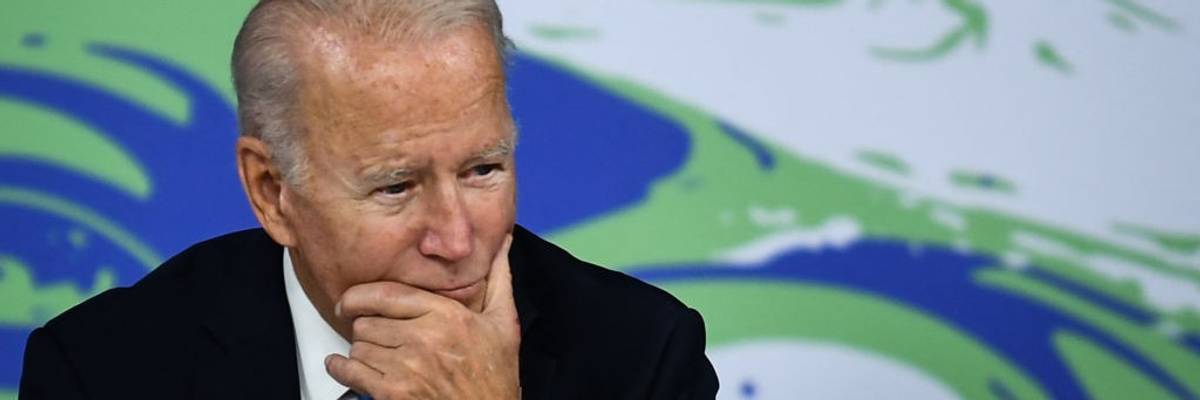
U.S. President Joe Biden reacts during a meeting on "the Build Back Better World (B3W)", as part of the World Leaders' Summit of the COP26 UN Climate Change Conference in Glasgow, Scotland, on November 2, 2021.
The hope and optimism for ocean protection at the beginning of the Biden administration has, in the end, turned to profound disappointment.
Among President Biden’s many laudable environmental accomplishments, one of his historic failures is that he declined to protect America’s ocean ecosystems. Despite the president’s professed goal to protect 30 percent of America’s oceans by 2030, he did virtually none of this. Perhaps he was planning on a second term (obviously a bad gamble), or perhaps he never really intended to do any of this.
Regardless, the hope and optimism for ocean protection at the beginning of the Biden administration has, in the end, turned to profound disappointment. On this issue, the administration prioritized local politics over science, need, and national interest.
At the start of his term, a group of marine scientists from across the nation submitted a joint Scientists’ Letter on Ocean Protection to President Biden, urging him to strongly protect 30% of America’s ocean ecosystems by 2030. The scientists’ ocean letter — signed by more than 90 university deans, department chairs, distinguished marine professors, agency and independent scientists (including legendary Dr. Jane Goodall) — told the president that America’s ocean ecosystems are in significant decline due to decades of over exploitation, climate change, acidification, and pollution.
History will not be kind to those government officials with the responsibility to address our ocean crisis, but stood by and did nothing.
Scientists warned the president that ocean ecosystems will have difficulty retaining functional integrity throughout the climate crisis this century, and that these ecosystems need the strongest protections the government can provide. As virtually all of America’s strongly protected federal waters to date are in the remote central Pacific, and none are on productive, intensively exploited continental shelves, the scientists urged President Biden to use executive authority under the Antiquities Act to establish Marine National Monuments in the Arctic Ocean, Bering Sea, Aleutian Islands, Gulf of Alaska, Gulf of Mexico, Gulf of Maine, Caribbean, and Pacific and Atlantic coasts. This isn’t rocket science, but simply adaptive, precautionary ecosystem management.
President Biden ignored the scientists’ plea.
Although he has so far designated seven cultural/historic monuments on land, Biden has still established no Marine National Monuments. While it is possible he may enact marine monuments in the final weeks of his term, indications are that this is unlikely.
Further, the Biden administration has designated only three small National Marine Sanctuaries: two in the Great Lakes and one small one off California. In early January, the administration is expected to announce, with great fanfare no doubt, its designation of a Marine Sanctuary overlaying the already strongly protected Papahanaumokuakea Marine National Monument (northwestern Hawaiian Islands), Coral Reef Reserve, and National Wildlife Refuge. To be clear, this sanctuary designation will not protect any new ocean area, but will simply further insulate existing protections from future administrative and legal challenges (e.g. at the Supreme Court). While this additional layer of protection is appropriate, it does not substitute for the critical need to strongly protect other more threatened marine ecosystems. And on this, the Biden administration simply failed.
The U.S. presently has seventeen National Marine Sanctuaries, five of those in just one state (California); and five Marine National Monuments, four in the remote central Pacific, and one small one in the northwest Atlantic. But other productive, and troubled marine ecosystems on continental shelves continue to be ignored, largely due to politics.
Alaska for instance—with more shoreline, continental shelf, marine mammals, seabirds, and fish than the rest of the U.S. combined, and one of the most over-exploited and climate stressed marine ecosystems in the world ocean—still has no national marine sanctuary or marine national monument, due to federal timidity in face of industry and political opposition. The federal government has essentially ceded ownership of Alaska’s vast federal offshore waters—over twice the size of the land area of the state—to parochial politics in Alaska.
Astonishingly, the U.S. is the only Arctic coastal nation that still has no permanently protected Arctic Ocean waters. Russia, Canada, Norway, and Greenland all have established permanent Arctic marine protected areas. But while presenting itself as an international leader in Arctic and ocean conservation, the U.S. has only established temporary administrative restrictions in its Arctic waters (oil & gas withdrawals and commercial fishery closures) that will almost certainly be rescinded in the Trump II administration, as most were in Trump I.
To remedy this, a group of Arctic Indigenous Peoples, conservationists, and marine scientists in Alaska proposed to President Biden that he designate an Arctic Ocean Marine National Monument, to protect the U.S. Arctic Ocean now in severe decline due to global warming and sea ice loss.
The Arctic Ocean Monument would encompass all U.S. federal waters (3-200 miles offshore) from the Northern Bering Sea north along the U.S./Russia maritime boundary, and east to the U.S./Canada maritime boundary (approx. 219,000 square miles), and would also include the Extended Continental Shelf seabed claims recently made by the U.S. in international Arctic waters north of the 200-mile limit (approx. 200,000 square miles). The Monument would permanently prohibit offshore oil & gas development, commercial fishing, and seabed mining; protect subsistence; enhance science; and would establish a co-management relationship between the federal government and Arctic coastal Tribes to manage this vast offshore ecosystem. As the region is the now-submerged ancient homeland for all Indigenous Peoples in the western hemisphere—Beringia—it is an inarguable candidate for monument designation under the Antiquities Act.
President Biden could have helped save our oceans with the simple stroke of his pen, but he refused.
Even though President Biden stated that: “What I really want to do... is conserve significant amounts of Alaskan sea and land forever,” he ignored the Arctic Ocean monument proposal.
This decade is likely our last best chance to secure strong protections for America’s offshore ecosystems, but now as the Biden administration has failed to do so, and Trump II will do none of this, we may have lost that last best chance.
Whenever faced with industry push-back or political pressure to ocean conservation measures, every federal administration, Democratic or Republican, simply refuses to act. This is a recipe for a disastrous future for our oceans. History will not be kind to those government officials with the responsibility to address our ocean crisis, but stood by and did nothing.
President Biden could have helped save our oceans with the simple stroke of his pen, but he refused.
The blame for further industrial damage and decline in America’s ocean ecosystems in the Trump II presidency will be shared by President Biden, as he had the authority, science, public support, and national interest obligation to prevent such, yet did nothing—an historic betrayal of the public trust.
Dear Common Dreams reader, It’s been nearly 30 years since I co-founded Common Dreams with my late wife, Lina Newhouser. We had the radical notion that journalism should serve the public good, not corporate profits. It was clear to us from the outset what it would take to build such a project. No paid advertisements. No corporate sponsors. No millionaire publisher telling us what to think or do. Many people said we wouldn't last a year, but we proved those doubters wrong. Together with a tremendous team of journalists and dedicated staff, we built an independent media outlet free from the constraints of profits and corporate control. Our mission has always been simple: To inform. To inspire. To ignite change for the common good. Building Common Dreams was not easy. Our survival was never guaranteed. When you take on the most powerful forces—Wall Street greed, fossil fuel industry destruction, Big Tech lobbyists, and uber-rich oligarchs who have spent billions upon billions rigging the economy and democracy in their favor—the only bulwark you have is supporters who believe in your work. But here’s the urgent message from me today. It's never been this bad out there. And it's never been this hard to keep us going. At the very moment Common Dreams is most needed, the threats we face are intensifying. We need your support now more than ever. We don't accept corporate advertising and never will. We don't have a paywall because we don't think people should be blocked from critical news based on their ability to pay. Everything we do is funded by the donations of readers like you. When everyone does the little they can afford, we are strong. But if that support retreats or dries up, so do we. Will you donate now to make sure Common Dreams not only survives but thrives? —Craig Brown, Co-founder |
Among President Biden’s many laudable environmental accomplishments, one of his historic failures is that he declined to protect America’s ocean ecosystems. Despite the president’s professed goal to protect 30 percent of America’s oceans by 2030, he did virtually none of this. Perhaps he was planning on a second term (obviously a bad gamble), or perhaps he never really intended to do any of this.
Regardless, the hope and optimism for ocean protection at the beginning of the Biden administration has, in the end, turned to profound disappointment. On this issue, the administration prioritized local politics over science, need, and national interest.
At the start of his term, a group of marine scientists from across the nation submitted a joint Scientists’ Letter on Ocean Protection to President Biden, urging him to strongly protect 30% of America’s ocean ecosystems by 2030. The scientists’ ocean letter — signed by more than 90 university deans, department chairs, distinguished marine professors, agency and independent scientists (including legendary Dr. Jane Goodall) — told the president that America’s ocean ecosystems are in significant decline due to decades of over exploitation, climate change, acidification, and pollution.
History will not be kind to those government officials with the responsibility to address our ocean crisis, but stood by and did nothing.
Scientists warned the president that ocean ecosystems will have difficulty retaining functional integrity throughout the climate crisis this century, and that these ecosystems need the strongest protections the government can provide. As virtually all of America’s strongly protected federal waters to date are in the remote central Pacific, and none are on productive, intensively exploited continental shelves, the scientists urged President Biden to use executive authority under the Antiquities Act to establish Marine National Monuments in the Arctic Ocean, Bering Sea, Aleutian Islands, Gulf of Alaska, Gulf of Mexico, Gulf of Maine, Caribbean, and Pacific and Atlantic coasts. This isn’t rocket science, but simply adaptive, precautionary ecosystem management.
President Biden ignored the scientists’ plea.
Although he has so far designated seven cultural/historic monuments on land, Biden has still established no Marine National Monuments. While it is possible he may enact marine monuments in the final weeks of his term, indications are that this is unlikely.
Further, the Biden administration has designated only three small National Marine Sanctuaries: two in the Great Lakes and one small one off California. In early January, the administration is expected to announce, with great fanfare no doubt, its designation of a Marine Sanctuary overlaying the already strongly protected Papahanaumokuakea Marine National Monument (northwestern Hawaiian Islands), Coral Reef Reserve, and National Wildlife Refuge. To be clear, this sanctuary designation will not protect any new ocean area, but will simply further insulate existing protections from future administrative and legal challenges (e.g. at the Supreme Court). While this additional layer of protection is appropriate, it does not substitute for the critical need to strongly protect other more threatened marine ecosystems. And on this, the Biden administration simply failed.
The U.S. presently has seventeen National Marine Sanctuaries, five of those in just one state (California); and five Marine National Monuments, four in the remote central Pacific, and one small one in the northwest Atlantic. But other productive, and troubled marine ecosystems on continental shelves continue to be ignored, largely due to politics.
Alaska for instance—with more shoreline, continental shelf, marine mammals, seabirds, and fish than the rest of the U.S. combined, and one of the most over-exploited and climate stressed marine ecosystems in the world ocean—still has no national marine sanctuary or marine national monument, due to federal timidity in face of industry and political opposition. The federal government has essentially ceded ownership of Alaska’s vast federal offshore waters—over twice the size of the land area of the state—to parochial politics in Alaska.
Astonishingly, the U.S. is the only Arctic coastal nation that still has no permanently protected Arctic Ocean waters. Russia, Canada, Norway, and Greenland all have established permanent Arctic marine protected areas. But while presenting itself as an international leader in Arctic and ocean conservation, the U.S. has only established temporary administrative restrictions in its Arctic waters (oil & gas withdrawals and commercial fishery closures) that will almost certainly be rescinded in the Trump II administration, as most were in Trump I.
To remedy this, a group of Arctic Indigenous Peoples, conservationists, and marine scientists in Alaska proposed to President Biden that he designate an Arctic Ocean Marine National Monument, to protect the U.S. Arctic Ocean now in severe decline due to global warming and sea ice loss.
The Arctic Ocean Monument would encompass all U.S. federal waters (3-200 miles offshore) from the Northern Bering Sea north along the U.S./Russia maritime boundary, and east to the U.S./Canada maritime boundary (approx. 219,000 square miles), and would also include the Extended Continental Shelf seabed claims recently made by the U.S. in international Arctic waters north of the 200-mile limit (approx. 200,000 square miles). The Monument would permanently prohibit offshore oil & gas development, commercial fishing, and seabed mining; protect subsistence; enhance science; and would establish a co-management relationship between the federal government and Arctic coastal Tribes to manage this vast offshore ecosystem. As the region is the now-submerged ancient homeland for all Indigenous Peoples in the western hemisphere—Beringia—it is an inarguable candidate for monument designation under the Antiquities Act.
President Biden could have helped save our oceans with the simple stroke of his pen, but he refused.
Even though President Biden stated that: “What I really want to do... is conserve significant amounts of Alaskan sea and land forever,” he ignored the Arctic Ocean monument proposal.
This decade is likely our last best chance to secure strong protections for America’s offshore ecosystems, but now as the Biden administration has failed to do so, and Trump II will do none of this, we may have lost that last best chance.
Whenever faced with industry push-back or political pressure to ocean conservation measures, every federal administration, Democratic or Republican, simply refuses to act. This is a recipe for a disastrous future for our oceans. History will not be kind to those government officials with the responsibility to address our ocean crisis, but stood by and did nothing.
President Biden could have helped save our oceans with the simple stroke of his pen, but he refused.
The blame for further industrial damage and decline in America’s ocean ecosystems in the Trump II presidency will be shared by President Biden, as he had the authority, science, public support, and national interest obligation to prevent such, yet did nothing—an historic betrayal of the public trust.
Among President Biden’s many laudable environmental accomplishments, one of his historic failures is that he declined to protect America’s ocean ecosystems. Despite the president’s professed goal to protect 30 percent of America’s oceans by 2030, he did virtually none of this. Perhaps he was planning on a second term (obviously a bad gamble), or perhaps he never really intended to do any of this.
Regardless, the hope and optimism for ocean protection at the beginning of the Biden administration has, in the end, turned to profound disappointment. On this issue, the administration prioritized local politics over science, need, and national interest.
At the start of his term, a group of marine scientists from across the nation submitted a joint Scientists’ Letter on Ocean Protection to President Biden, urging him to strongly protect 30% of America’s ocean ecosystems by 2030. The scientists’ ocean letter — signed by more than 90 university deans, department chairs, distinguished marine professors, agency and independent scientists (including legendary Dr. Jane Goodall) — told the president that America’s ocean ecosystems are in significant decline due to decades of over exploitation, climate change, acidification, and pollution.
History will not be kind to those government officials with the responsibility to address our ocean crisis, but stood by and did nothing.
Scientists warned the president that ocean ecosystems will have difficulty retaining functional integrity throughout the climate crisis this century, and that these ecosystems need the strongest protections the government can provide. As virtually all of America’s strongly protected federal waters to date are in the remote central Pacific, and none are on productive, intensively exploited continental shelves, the scientists urged President Biden to use executive authority under the Antiquities Act to establish Marine National Monuments in the Arctic Ocean, Bering Sea, Aleutian Islands, Gulf of Alaska, Gulf of Mexico, Gulf of Maine, Caribbean, and Pacific and Atlantic coasts. This isn’t rocket science, but simply adaptive, precautionary ecosystem management.
President Biden ignored the scientists’ plea.
Although he has so far designated seven cultural/historic monuments on land, Biden has still established no Marine National Monuments. While it is possible he may enact marine monuments in the final weeks of his term, indications are that this is unlikely.
Further, the Biden administration has designated only three small National Marine Sanctuaries: two in the Great Lakes and one small one off California. In early January, the administration is expected to announce, with great fanfare no doubt, its designation of a Marine Sanctuary overlaying the already strongly protected Papahanaumokuakea Marine National Monument (northwestern Hawaiian Islands), Coral Reef Reserve, and National Wildlife Refuge. To be clear, this sanctuary designation will not protect any new ocean area, but will simply further insulate existing protections from future administrative and legal challenges (e.g. at the Supreme Court). While this additional layer of protection is appropriate, it does not substitute for the critical need to strongly protect other more threatened marine ecosystems. And on this, the Biden administration simply failed.
The U.S. presently has seventeen National Marine Sanctuaries, five of those in just one state (California); and five Marine National Monuments, four in the remote central Pacific, and one small one in the northwest Atlantic. But other productive, and troubled marine ecosystems on continental shelves continue to be ignored, largely due to politics.
Alaska for instance—with more shoreline, continental shelf, marine mammals, seabirds, and fish than the rest of the U.S. combined, and one of the most over-exploited and climate stressed marine ecosystems in the world ocean—still has no national marine sanctuary or marine national monument, due to federal timidity in face of industry and political opposition. The federal government has essentially ceded ownership of Alaska’s vast federal offshore waters—over twice the size of the land area of the state—to parochial politics in Alaska.
Astonishingly, the U.S. is the only Arctic coastal nation that still has no permanently protected Arctic Ocean waters. Russia, Canada, Norway, and Greenland all have established permanent Arctic marine protected areas. But while presenting itself as an international leader in Arctic and ocean conservation, the U.S. has only established temporary administrative restrictions in its Arctic waters (oil & gas withdrawals and commercial fishery closures) that will almost certainly be rescinded in the Trump II administration, as most were in Trump I.
To remedy this, a group of Arctic Indigenous Peoples, conservationists, and marine scientists in Alaska proposed to President Biden that he designate an Arctic Ocean Marine National Monument, to protect the U.S. Arctic Ocean now in severe decline due to global warming and sea ice loss.
The Arctic Ocean Monument would encompass all U.S. federal waters (3-200 miles offshore) from the Northern Bering Sea north along the U.S./Russia maritime boundary, and east to the U.S./Canada maritime boundary (approx. 219,000 square miles), and would also include the Extended Continental Shelf seabed claims recently made by the U.S. in international Arctic waters north of the 200-mile limit (approx. 200,000 square miles). The Monument would permanently prohibit offshore oil & gas development, commercial fishing, and seabed mining; protect subsistence; enhance science; and would establish a co-management relationship between the federal government and Arctic coastal Tribes to manage this vast offshore ecosystem. As the region is the now-submerged ancient homeland for all Indigenous Peoples in the western hemisphere—Beringia—it is an inarguable candidate for monument designation under the Antiquities Act.
President Biden could have helped save our oceans with the simple stroke of his pen, but he refused.
Even though President Biden stated that: “What I really want to do... is conserve significant amounts of Alaskan sea and land forever,” he ignored the Arctic Ocean monument proposal.
This decade is likely our last best chance to secure strong protections for America’s offshore ecosystems, but now as the Biden administration has failed to do so, and Trump II will do none of this, we may have lost that last best chance.
Whenever faced with industry push-back or political pressure to ocean conservation measures, every federal administration, Democratic or Republican, simply refuses to act. This is a recipe for a disastrous future for our oceans. History will not be kind to those government officials with the responsibility to address our ocean crisis, but stood by and did nothing.
President Biden could have helped save our oceans with the simple stroke of his pen, but he refused.
The blame for further industrial damage and decline in America’s ocean ecosystems in the Trump II presidency will be shared by President Biden, as he had the authority, science, public support, and national interest obligation to prevent such, yet did nothing—an historic betrayal of the public trust.