SUBSCRIBE TO OUR FREE NEWSLETTER
Daily news & progressive opinion—funded by the people, not the corporations—delivered straight to your inbox.
5
#000000
#FFFFFF
To donate by check, phone, or other method, see our More Ways to Give page.


Daily news & progressive opinion—funded by the people, not the corporations—delivered straight to your inbox.

Tim Rusch, trusch@demos.org, (212) 389-1307
Alex Amend, aamend@demos.org, (212) 389-1411
Secretary Timothy Geithner will soon make a monumental decision: whether to allow the $4 trillion foreign exchange derivatives market to keep operating in the shadows, or adhere to Dodd-Frank rules for transparency, oversight and accountability.
At The American Prospect, Robert Kuttner writes on previously confidential data analyzed by the public-interest group Better Markets -- and made available by the Sanders Amendment -- showing that the Fed had to bail out the foreign exchange market with more than $2.9 trillion in lending in October 2008 alone and $5.4 trillion in the three months after the fall of Lehman Brothers. The Fed's peak injection of dollars on any one day occurred on Oct. 22, 2008, when it reached $823 billion, according to the Better Markets' analysis.
Despite this record, Sec. Geithner has signaled that he may not apply Dodd-Frank rules to foreign exchange swaps and forwards.
Such an exemption is opposed by a top member of Obama's economic team and many Hill Democrats. Additionally, the foreign exchange market has been in the news lately for numerous questionable practices, with major hedge funds like Blackrock and state pension funds arguing that they have been overcharged for foreign currency trades.
"In short, far from these derivatives markets working 'quite well,' as Geithner asserted, they required massive support by the world's central banks, and by the Federal Reserve in particular," Kuttner wrote. "Indeed, it was Geithner himself, in his former job as president of the New York Federal Reserve, who was responsible for the $5.4 trillion Fed rescue operation -- without which foreign-exchange markets would have collapsed."
"Yet Geithner's draft of what became the Dodd-Frank Act, sent by the Treasury to Congress in August 2009, excluded foreign-currency swaps from the derivatives reforms. The final House and Senate versions of the bill did cover foreign-currency derivatives, however. But as a result of extensive lobbying by Geithner and the financial industry, the final law contained a sleeper provision allowing an exemption if the Treasury secretary issues a finding that foreign-exchange derivatives should be exempted in the public interest."
Better Markets President Dennis Kelleher wrote, "The data refute the claim that the foreign-exchange markets performed well during the financial crisis and thus should be exempt from regulation."
To speak with either Robert Kuttner or Better Markets President Dennis Kelleher see contact information above.
Demos is a think tank that powers the movement for a just, inclusive, multiracial democracy. Through cutting-edge policy research, inspiring litigation, and deep relationships with grassroots organizations, Demos champions solutions that will create a democracy and economy rooted in racial equity.
"The 25th Amendment exists for a reason," US Rep. Yassamin Ansari said in response to the US president's threat to bomb Iran's power plants and bridges.
US President Donald Trump on Monday defended his threat to commit grave war crimes in Iran, telling reporters at the annual Easter Egg Roll at the White House—with children in the background—that bombing the country's bridges and power plants would be justified despite warnings of "catastrophic harm" to tens of millions of civilians.
Asked how it wouldn't be a war crime for the US military to launch a large-scale assault on Iran's civilian infrastructure, Trump pointed to Iranian security forces' recent killing of protesters and called Iranian leaders "animals."
"We have to stop them, and we can't let them have a nuclear weapon," the president continued. American intelligence agencies and international watchdogs have repeatedly assessed that Iran is not developing nuclear weapons.
Watch:
Reporter: How would it not be a war crime to strike Iran’s bridges and power plants?
Trump: They’re animals. pic.twitter.com/rWrj7oeTNx
— Clash Report (@clashreport) April 6, 2026
Brian Finucane, senior adviser to the US Program at the International Crisis Group, said in response to Trump's remarks that "prior crimes against the Iranian people do not excuse fresh war crimes against the Iranian people."
Trump also told reporters, absurdly, that "the time the Iranian people are most unhappy... is when those bombs stop." US-Israeli attacks, which began in late February, have killed around 2,000 people in Iran so far and destroyed or damaged tens of thousands of civilian structures, including apartment buildings, medical facilities, and universities.
Over the weekend, Trump set new deadline of Tuesday at 8 pm ET for the total reopening of the Strait of Hormuz. If Iran doesn't agree to his administration's terms, the US president said Sunday that he is "considering blowing everything up"—a threat of indiscriminate attacks that would violate international law and kill many civilians.
"The 25th Amendment exists for a reason," US Rep. Yassamin Ansari (D-Ariz.) wrote in response to Trump's Easter-morning threat. "The president of the United States is a deranged lunatic, and a national security threat to our country and the rest of the world."
The Wall Street Journal reported Monday that US military planners are "pulling out existing lists of potential targets to provide the president options if he decides to attack energy infrastructure" in Iran.
Amnesty International warned last month in response to earlier Trump threats that a major attack on Iranian energy infrastructure "would unleash catastrophic harm on millions."
“When power plants collapse, horrific consequences cascade instantly," said Erika Guevara-Rosas, Amnesty’s senior director of research, advocacy, policy, and campaigns. "Water pumping stations would stop functioning, clean water would become scarce, and preventable diseases would spread. Hospitals would lose electricity and fuel, forcing surgeries to be cancelled and life-support machines to shut down. Food production and distribution networks would collapse, deepening hunger and causing widespread food scarcity. Many businesses would also shut down with devastating economic consequences, including mass unemployment."
Jamal Abdi, president of the National Iranian American Council, said Monday that US lawmakers must investigate Trump's "targeting and threatening of civilian sites in Iran, including by utilizing all tools at Congress’ disposal including subpoena power to secure documentary evidence and testimony from relevant officials."
"Any actions that violate US and international law regarding the conduct of war must be thoroughly investigated and appropriate accountability pursued," said Abdi. "We cannot allow such brazen disregard for civilian life to be normalized."
First Lady Melania Trump, who accompanied the president to the White House Easter Egg Roll on Monday, defended the US-Israeli assault on Iran as a war for the "future" of Iran's children.
Melania Trump: All of this is happening for their future. They will be safe in the years to come.
Trump: We are fighting for the children who are in a war zone. pic.twitter.com/2GHTqA5nWM
— Acyn (@Acyn) April 6, 2026
The UN Children's Fund (UNICEF) said last week that at least 216 children have been killed by US-Israeli bombing in Iran, with many of the deaths caused by a US strike on an Iranian elementary school on the first day of the war.
“Children in the region are being exposed to horrific violence, while the very systems and services meant to keep them safe are coming under attack,” said UNICEF executive director Catherine Russell. “Urgent action is needed by all parties to conflict to protect the lives of civilians and uphold the rights of children."
"The American people understand that Donald Trump poses a direct threat to our Constitution and to the rule of law and must be impeached and removed from public office," said the head of Free Speech for People.
After just 14 months of President Donald Trump's return to the White House, polling released Monday found that a majority of likely US voters support impeaching him a historic third time—which one pollster called "an unprecedented result this early in a presidential term."
Lake Research Partners conducted the poll March 26-30 for Free Speech for People, a legal advocacy organization that has launched a campaign to "Impeach Trump. Again." As part of that effort, FSFP gathered more than 1 million supportive signatures ahead of the latest "No Kings" rallies and has publicly detailed over 25 grounds for impeachment.
First on that list is that "in Latin America, the Caribbean, and the Middle East, Trump is abusing his role as commander of the US military to commit atrocities that violate US and international law." The president notably spent the weekend threatening to commit more war crimes in Iran if it doesn't reopen the Strait of Hormuz to all ship traffic—which it only closed in response to the joint Israel-US attack on February 28.
Another key argument for impeachment on the FSFP list is that "Trump has militarized and weaponized federal law enforcement, particularly US Immigration and Customs Enforcement (ICE), to punish the opposition party, disrupt local communities, instill fear in the civilian population, and quell lawful political dissent."
Pollsters noted both of those grounds in their question, asking respondents: "Several members of Congress have recently come out in support of impeaching President Donald Trump for violating Americans' constitutional rights and the law, including actions by ICE in the US and the war he started with Iran. Do you support or oppose President Trump being impeached?"
Overall, 52% of all voters said they support impeachment, including 84% of Democrats, 55% of Independents, and even 14% of Republicans. Just 40% opposed, including 8% of Democrats, 34% of Independents, and 81% of Republicans.

"The result is quite striking," David Mermin of Lake Research Partners said in a call with reporters. "It's a clear majority. It's a solid majority. And it reaches across all demographics and across partisan lines as well."
The 800 respondents represented a variety of perspectives in terms of age, gender, racial identity, education, region, and partisanship. The margin of error is +/-3.5%.
Putting the finding in a historical context, Mermin noted that there were majorities in favor of impeachment in the mid-1970s, when then-President Richard Nixon was approaching impeachment and then resigned, well into his second term. Nearly a quarter-century later, during the proceeding that led to the impeachment of former President Bill Clinton, "most of that period, we did not see majorities in favor of impeaching him, even during that process," the pollster explained.
"For President Trump, in his first term, there were two impeachment proceedings against him, and in the first one, near the end of 2019... some of the polls disagreed, but there were some polls showing him slightly about 50% approval of impeachment," he continued. "And then the second proceeding that happened after the January 6th coup attempt, there was a clear majority... during those last few weeks of his term prior to his when he left office in January of 2021."
As with Clinton, the House of Representatives impeached Trump, but the Senate declined to convict him. Now, both chambers of Congress are narrowly controlled by Republicans who have demonstrated an unwillingness to stand up to the president—including by refusing to advance war powers resolutions challenging his various unauthorized military actions abroad.
Mermin said that "this appears to be the earliest in a presidential term that you've seen a majority of Americans in favor of impeachment."
FSFP co-founder and president John Bonifaz highlighted that the polling comes when there is not even an impeachment proceeding in the House.
Since Trump's return to office last year, Reps. Shri Thanedar (D-Mich.) and Al Green (D-Texas) have introduced articles of impeachment against him, though those efforts have not gone anywhere. However, in the lead-up to the November midterm elections, even Trump has acknowledged that Democrats winning congressional races could lead to him being impeached a third time.
"You gotta win the midterms, 'cause if we don't win the midterms... they'll find a reason to impeach me," Trump told Republicans in January. "I'll get impeached."
The new survey shows even higher figures for disapproval of Trump's job performance: 57% of all voters disapprove of the job Trump is doing, including 92% of Democrats, 56% of Independents, and 16% of Republicans.
Bonifaz said that "this poll confirms what we are seeing across the country: The American people understand that Donald Trump poses a direct threat to our Constitution and to the rule of law and must be impeached and removed from public office."
“There’s a new kind of brazenness in declaring an intent to commit unlawful attacks,” said a researcher for Human Rights Watch. “It appears impunity has emboldened the Israeli military."
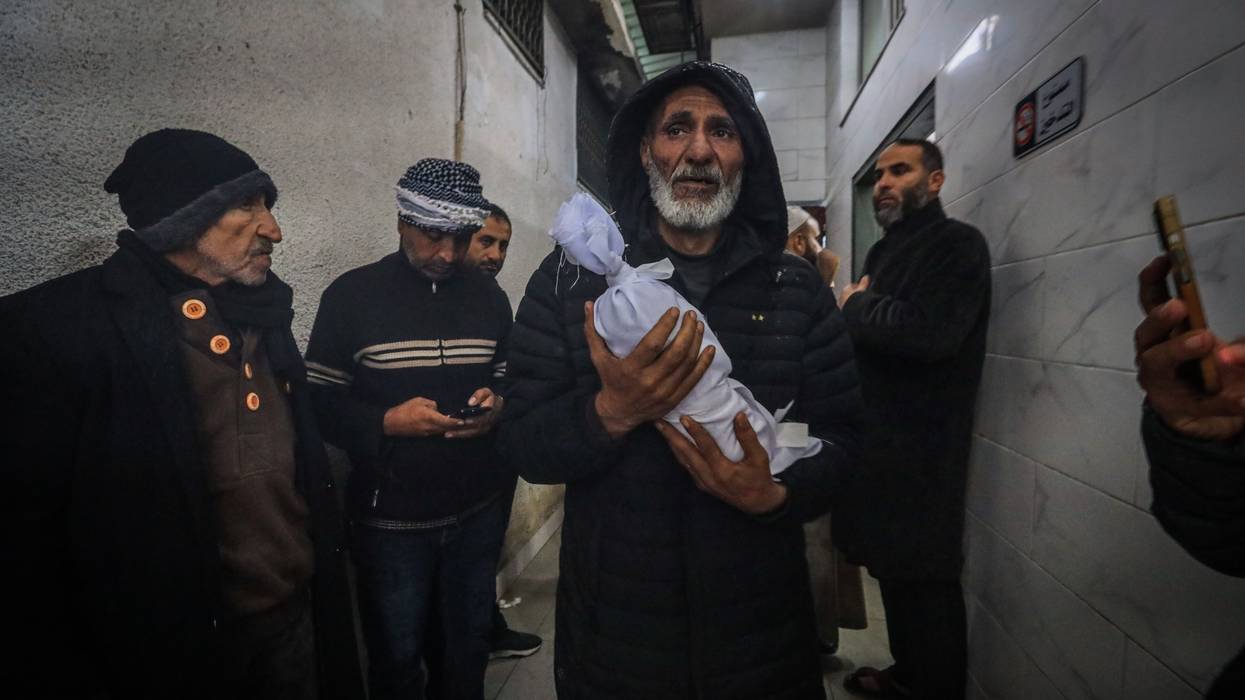
Doctors in Lebanon are warning that the Israeli military appears to be waging a campaign of deliberate destruction on their country's healthcare system.
In an interview with The Associated Press published Monday, Sidon-based surgeon Dr. Mohammed Ziara, who previously worked in Gaza City, said that he believes Israel is trying to inflict the same kind of damage on the Lebanese healthcare system that it inflicted in Gaza, when it regularly bombed hospitals and other healthcare facilities.
“I’ve lived this before,” Ziara told the AP, referring to Israel's attack on Gaza that has killed more than 70,000 Palestinians. "I cannot go back to Gaza now. But I can be here, in Lebanon."
The AP noted that Israel is justifying bombings of Lebanese hospitals by claiming that Hezbollah is using them as headquarters for storing weapons and plotting attacks. Israel made the same claims about Hamas militants being stationed in Gaza hospitals.
"Israel has increasingly targeted Lebanese first responders and medical centers, forcing several hospitals to evacuate," the AP reported.
Human Rights Watch researcher Ramzi Kaiss told the AP that, while Israel has launched attacks on Lebanon before, the country now seems even more willing to attack civilian infrastructure than in the past.
“There’s a new kind of brazenness in declaring an intent to commit unlawful attacks,” Kaiss explained. “It appears impunity has emboldened the Israeli military."
Human rights activists for the last several weeks have been trying to draw attention to Israel's attacks on Lebanese healthcare.
Kristine Beckerle, deputy regional director for the Middle East and North Africa at Amnesty International, said in March that Israel is using "the same deadly playbook it used in 2024 in Lebanon to kill dozens of health workers and devastate healthcare services."
Beckerle also slammed Israel's justifications for bombing healthcare infrastructure.
"Throwing out accusations claiming that healthcare facilities and ambulances are being used for military purposes without providing any evidence," Beckerle said, "does not justify treating hospitals, medical facilities or medical transport as battlefields or treating doctors and paramedics as targets. Under international humanitarian law parties to a conflict must ensure to distinguish between military objectives and civilian objects."
Kenneth Roth, former executive director of Human Rights Watch, recently flagged reports from Lebanese healthcare workers who "say Israeli bombing has deliberately targeted medical workers and facilities in southern Lebanon" in "a systematic effort to make the area unlivable."