

SUBSCRIBE TO OUR FREE NEWSLETTER
Daily news & progressive opinion—funded by the people, not the corporations—delivered straight to your inbox.
5
#000000
#FFFFFF
To donate by check, phone, or other method, see our More Ways to Give page.
Daily news & progressive opinion—funded by the people, not the corporations—delivered straight to your inbox.

Richard Charter, Defenders of Wildlife, 707-875-2345
Cat Lazaroff, Defenders of Wildlife, 202-772-3270
The following are statements from Defenders of Wildlife:
"In a catastrophe that imperils the entire Gulf Coast, offshore oil
drilling has again proven to be unreliable and unsafe. As officials
gamble with untested means to stop the flow, oil continues to gush into
the Gulf and move towards our beaches, coastal communities, wildlife
habitat and Gulf fisheries," said Richard Charter, Senior Policy
Advisor, Marine Programs. "Wildlife refuges and estuaries in Louisiana,
Mississippi, and possibly the coast of Florida, along with thousands of
migrating birds, sea turtles, whales and dolphins, river otters and
many other species lie potentially in the path of the spill. The extent
of the environmental and economic impacts of this spill have yet to be
seen, but clearly raise grave concerns for any expansion of drilling
off of our coasts in the future."
"Although we are encouraged by the White House announcement that no
new areas will be opened up to drilling until this spill has been fully
investigated, Shell has announced plans to move forward with drilling
in the Arctic, an area just as ecologically fragile as the Gulf, and
where cleanup technology doesn't even exist," said Jamie Rappaport
Clark, executive vice president of Defenders of Wildlife and former
director of the U.S. Fish and Wildlife Service. "It is time for
President Obama to reinstate the moratorium on all drilling off of U.S.
shores, ensuring that we can deal with the situation at hand without
opening another part of our country up to similar disaster. Hopefully
this catastrophe will be a wake-up call for Congress to pass
comprehensive climate change legislation that moves us beyond drilling
along our fragile coastline and towards a cleaner greener energy
future."
Since 2006, there have been 509 fires recorded on oil platforms in
the Gulf of Mexico, including nine major oil rig fires that have killed
at least two people and seriously injured 12, according to the U.S.
Mineral Management Services. Oil is estimated to be gushing from
underneath the rig at an estimated rate of at least 5,000 barrels a day.
Summary:
Defenders of Wildlife is the premier U.S.-based national conservation organization dedicated to the protection and restoration of imperiled species and their habitats in North America.
(917) 363-4149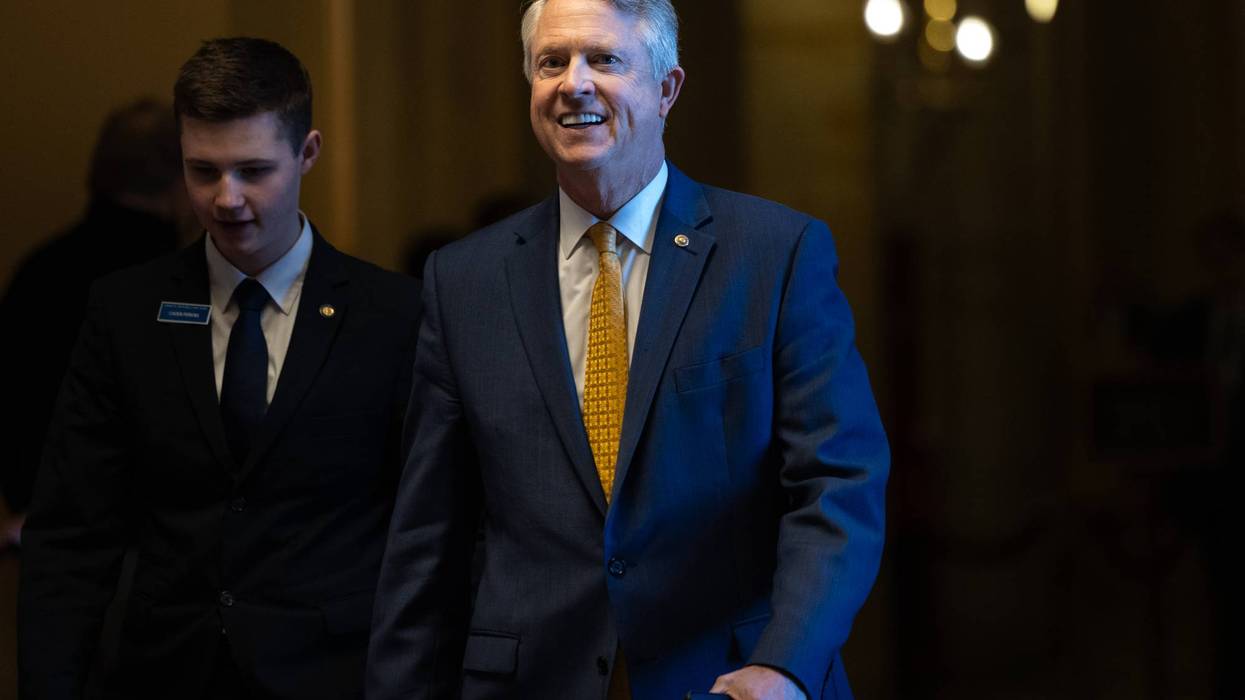
One foreign policy analyst said the senator was effectively admitting that “we’re literally committing crimes against humanity.”
A Republican US senator proudly declared that President Donald Trump's blockade of Iranian ports is "starving" Iranians on Wednesday, in yet another piece of counterevidence to the idea that the president's war there is meant to "liberate" the people.
"We have this embargo working, this blockade, and we're literally starving them," said Sen. Roger Marshall (R-Kan.) during an interview on Newsmax. "Both financially, and they can't feed themselves either, very long."
During the same interview, Marshall said Trump must “take everything into consideration” to finish the war against Iran and compared the decision Trump must make to "President [Harry] Truman’s decision on dropping the bomb, and D-Day for President [then-Gen. Dwight] Eisenhower.”
The comments came after Trump announced that he would extend a two-week ceasefire while continuing his naval blockade of Iranian ports, enacted as a counter to Iran's closure of the Strait of Hormuz, which has caused chaos and inflation across the global economy.
It was yet another 180-degree spin from Trump, who just days before had issued another genocidal threat to "blow up" the "whole country" of Iran, including civilian infrastructure, if it did not capitulate to his demands in a ceasefire agreement, which was roundly condemned by international organizations as a pledge to commit war crimes.
The Iranian population suffered tremendously under Trump's "maximum pressure sanctions" before the war, which fueled 58% food inflation year over year in September 2025.
The war launched by the US and Israel in February has only heightened the pain: Last month, Iran's inflation rate hit a record 72%, and the cost of its staple food basket soared to 134% compared with the previous year.
More than 750,000 jobs had been lost as of last week, and the United Nations Development Program predicted that Iran's economy could contract by as much as 10% as a result of the war. In just 40 days of war, the UNDP found that 3.5-4.1 million Iranians have fallen below the poverty line.
Trump's blockade of Iranian ports has tightened the noose even more, cutting off about 90% of the nation's maritime trade.
According to The Wall Street Journal, the blockade immediately affected nearly a million tons of grain and oilseeds. Prices for commodities like rice, which have already increased sevenfold in recent months, are expected to soar even further.
While Iran is much larger and more self-sufficient than Cuba, the blockade mirrors the economic warfare Trump has waged against the island in what he has said is an effort to force its leadership from power or outright "take" it for the US.
The blockade of fuel shipments to the island enacted through tariff threats has paralyzed its economy and resulted in rolling blackouts that have disrupted hospital care, agriculture, and every other facet of daily life for the Cuban people, drawing condemnation from United Nations human rights experts, who have called it a "serious violation of international law" and an act of "extreme unilateral economic coercion."
The Trump administration and its cheerleaders in Congress have not been shy about their goal for sanctions in Iran—to inflict suffering upon the people of Iran in hopes that they will rise up and overthrow their governmen. But Marshall's declaration that Trump was trying to "starve" Iran was seen by critics as an even more explicit endorsement of collective punishment than most.
Dylan Williams, the vice president for government affairs at the Center for International Policy, said it confirmed that Trump was pitching "genocide as a tactic in Iran."
In less than two months, at least 1,700 civilians have been killed, including more than 250 children, according to the US-based Human Rights Activist News Agency. More than 26,000 people have been injured, according to the Iranian Health Ministry.
The international affairs researcher Derek Davison wrote that by cheering a policy he said was "literally starving" Iran, Marshall was basically saying: "We're literally committing crimes against humanity. It's awesome."
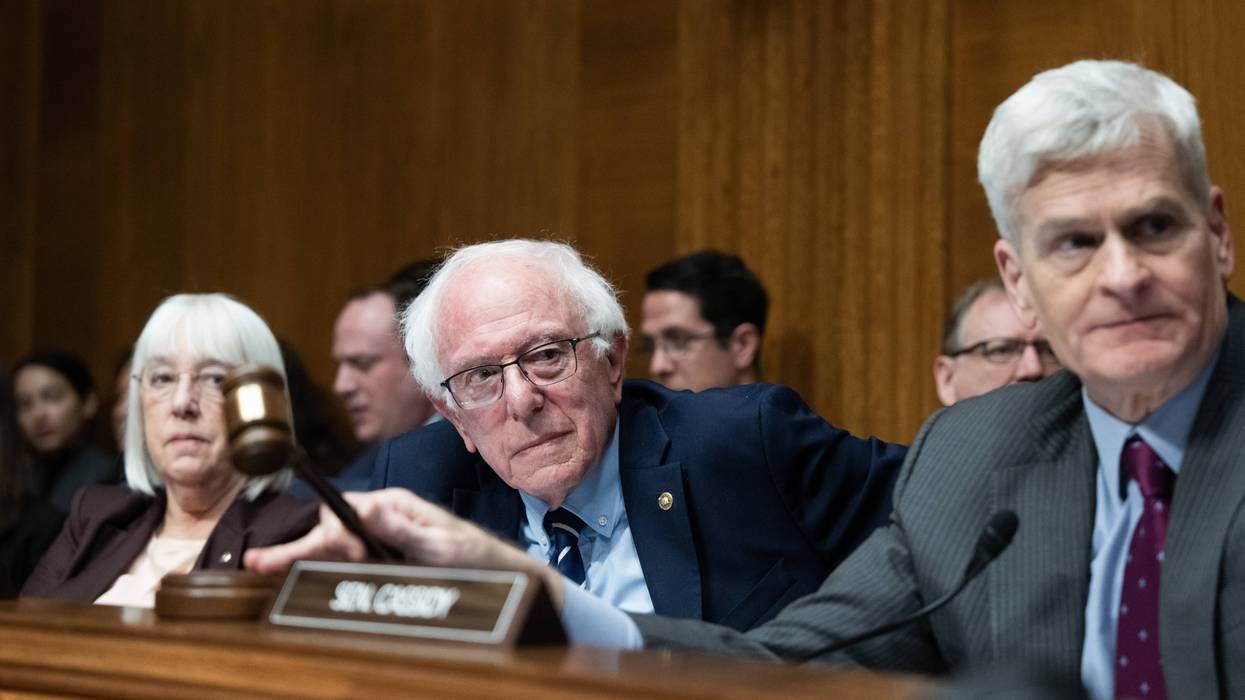
Sen. Bernie Sanders said the amendment blocked by the GOP "would prevent pharmaceutical companies from charging more for prescription drugs in the United States than they do in Canada, the UK, Germany, France, and Japan."
Senate Republicans voted in the early hours of Thursday morning to reject an amendment offered by Sen. Bernie Sanders that aimed to cut US prescription drug prices in half by mandating that Americans pay no more for medications than people in Canada and other wealthy nations.
Just two Republicans, Sens. Josh Hawley of Missouri and Dan Sullivan of Alaska, voted with every present Democrat in support of Sanders' (I-Vt.) proposed amendment to the GOP's emerging budget reconciliation package. Republicans plan to use the legislative vehicle to fund the Department of Homeland Security and its component agencies, principally Immigration and Customs Enforcement (ICE) and Customs and Border Protection (CBP).
The amendment vote put nearly every Senate Republican on the record against a policy supported by President Donald Trump. Last year, Trump signed an executive order directing federal health officials to "communicate most-favored-nation price targets to pharmaceutical manufacturers to bring prices for American patients in line with comparably developed nations."
But experts have noted that, without congressional action giving the federal government more power over drug pricing, pharmaceutical companies would not be required to comply with the proposed targets—rendering Trump's order effectively meaningless. Drug prices have continued to rise in the US despite Trump's order and his outlandish, mathematically impossible claims.
"If Trump is serious about making real change rather than just issuing a press release," Sanders said last year in response to Trump's executive order, "he will support legislation I will soon be introducing to make sure we pay no more for prescription drugs than people in other major countries. If Republicans and Democrats come together on this legislation, we can get it passed in a few weeks."
The Sanders-led amendment that Republicans blocked on Thursday called for reducing "the price of prescription drugs in the United States by more than 50% by adopting most-favored-nation drug pricing so that the American people pay no more for prescription drugs than Europeans or Canadians."
Research has shown that Americans pay at least twice as much on average for prescription drugs as people in other wealthy nations.
"This amendment is very simple," Sanders said during Senate debate on Thursday. "It would prevent pharmaceutical companies from charging more for prescription drugs in the United States than they do in Canada, the UK, Germany, France, and Japan.”
Last May, Sanders and several of his Democratic colleagues in the Senate introduced the Prescription Drug Price Relief Act, which would require federal health officials to "review brand-name drugs annually for excessive pricing and, if a drug is found to be priced excessively, to void any exclusivity granted to its sponsor."
"Under the bill, a price is considered excessive if the domestic average manufacturing price exceeds the median price for the drug in Canada, the United Kingdom, Germany, France, and Japan," according to a summary of the legislation. "If a price does not meet this criteria, or if pricing information is unavailable in at least three of these countries, the price is still considered excessive if it is higher than reasonable in light of specified factors, including development cost, revenue, and the size of the affected patient population."
"The US government is now one of, if not the most, corrupt governments on earth," said one critic.
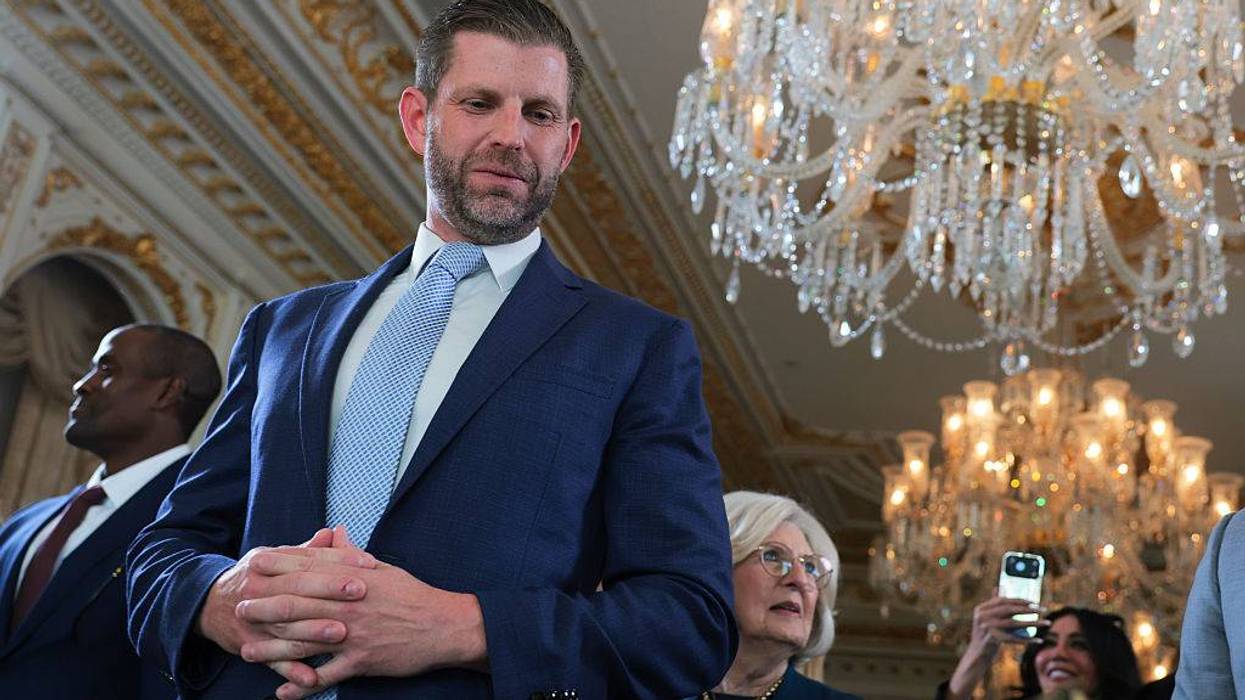
Critics reacted with disgust after Eric Trump went on Fox Business on Thursday morning to boast about Foundation Future Industries, a company where he serves as chief strategy adviser, scoring a multimillion-dollar deal from the US Department of Defense.
For the segment, Fox Business' Maria Bartiromo invited on both Eric Trump and Sankaet Pathak, co-founder and CEO of Foundation Future, a robotics firm that earlier this year won a $24 million Pentagon contract that will see its robots deployed in Ukraine, where they will be used to inspect and transport weapons.
Bartiromo asked the second-eldest son of President Donald Trump how he got involved with Foundation Future, and "what attracted" him to the enterprise.
Trump responded that he decided to get involved with robotics to help America "win" the race with China to build battle-ready robots, in the same way he purportedly helped the US "win" by being an early investor in cryptocurrency.
"We better be winning this race in the United States of America," he declared. "We're the greatest economy in the world... When you go up and you interact with these robots, and they fist bump you and they high five you, they follow your commands. You bring in AI economy, it's going to change industry, it's going to change military application, it's going to change hospitality. The uses are unlimited."
Eric Trump on his $24 million Pentagon contract for robots: "It's gonna change industry, military application, hospitality. The uses are unlimited and I think it's a very beautiful thing, but we must win that race." pic.twitter.com/JsfiB6Usbi
— Aaron Rupar (@atrupar) April 23, 2026
Eric Trump and his brother, Donald Trump Jr., for months have been investing in companies with the goal of scoring lucrative Pentagon deals.
The Wall Street Journal reported in March that the Trump brothers invested in a Florida-based drone company called Powerus that “is vying to meet fresh demand from the Pentagon” for drones that started when the Trump administration banned foreign-made drones and drone components from the US in December.
And in 2025, at least two companies backed by Trump Jr. received contracts collectively worth hundreds of millions of dollars from the DOD.
Given this history, critics were quick to hurl accusations of corruption at the Trumps for using their father's presidency to personally enrich themselves.
"The president's son, who was never involved in this industry before his father became president, should not be getting contracts from the Pentagon," declared Ron Filipkowski, editor-in-chief of MeidasTouch. "This is absurd corruption that Republicans in Congress will say nothing about and do no oversight."
Phillips O'Brien, professor of strategic studies at the University of St. Andrews, said the fact that the president's son is openly boasting about getting multimillion-dollar deals from his father's DOD shows "the US government is now one of, if not the most, corrupt governments on earth."
University of Michigan political scientist Donald Moynihan compared the Trump brothers to Uday and Qusay Hussein, the late sons of former Iraqi President Saddam Hussein, and argued that much of Trump's second administration appears to be running the US government like it's a family business.
"An underestimated rationale for Trump's massive ramp-ups in immigration/military spending," he wrote, "is to create a public slush fund for friends, families, donors."
National security attorney Bradley Moss, in a nod to possible future congressional investigations of the Trump family's corruption, advised Eric Trump to "preserve your records."