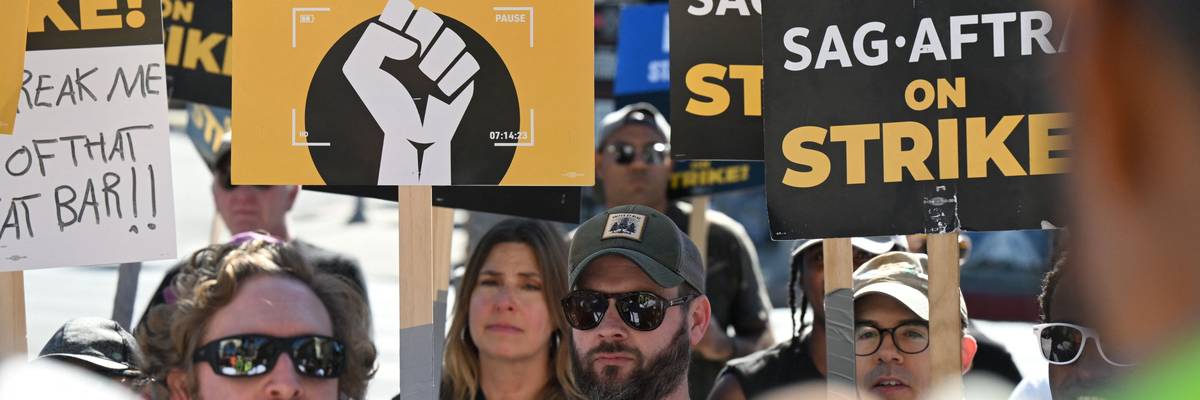
SAG-AFTRA members and supporters picket outside Paramount Studios during their strike against the Hollywood studios, in Los Angeles, California, on November 8, 2023.
Video Game Actors Strike for AI Protections
"The video game industry generates billions of dollars in profit annually," said one union leader. "The driving force behind that success is the creative people who design and create those games."
After nearly two years of negotiations with video game giants and no deal that would protect performers from artificial intelligence, unionized voice and motion capture actors who work in video game development announced Thursday that they will go on strike starting at 12:01 am on Friday, July 26.
The performers are represented by Screen Actors Guild-American Federation of Television and Radio Artists (SAG-AFTRA), which last year won a contract for TV and film actors that included "unprecedented provisions for consent and compensation that will protect members from the threat of AI," after the union went on strike for four months.
The union has been negotiating on behalf of video game actors with major production companies including Disney Character Voices Inc., Activision Productions Inc., and WB Games Inc., and has won concessions over wages and job safety—but "AI protections remain the sticking point," said SAG-AFTRA on Thursday as the impending strike was announced.
Unionized actors want protections that would stop video game companies from training AI to replicate actors' voices or likeness without their consent and without compensating them.
"The video game industry generates billions of dollars in profit annually," said Duncan Crabtree-Ireland, national executive director and chief negotiator for SAG-AFTRA. "The driving force behind that success is the creative people who design and create those games. That includes the SAG-AFTRA members who bring memorable and beloved game characters to life, and they deserve and demand the same fundamental protections as performers in film, television, streaming, and music: fair compensation and the right of informed consent for the AI use of their faces, voices, and bodies."
"Frankly, it's stunning that these video game studios haven't learned anything from the lessons of last year—that our members can and will stand up and demand fair and equitable treatment with respect to AI, and the public supports us in that," he added.
Sarah Elmaleh, negotiating committee chair for the union's interactive media agreement, said the negotiations have shown the companies "are not interested in fair, reasonable AI protections, but rather flagrant exploitation."
"We look forward to collaborating with teams on our interim and independent contracts, which provide AI transparency, consent, and compensation to all performers, and to continuing to negotiate in good faith with this bargaining group when they are ready to join us in the world we all deserve," said Elmaleh.
The unionized actors voted in favor of the strike authorization with a 98.32% yes vote, said SAG-AFTRA.
The strike was announced as more than 500 workers who help develop the popular World of Warcraft video game franchise voted to join the Communications Workers of America (CWA), with the games publisher, Blizzard Entertainment, recognizing the bargaining unit.
CWA noted that the workers' journey to union representation began with a walkout in 2021 at Activision Blizzard, which was later bought by Microsoft, over sexual harassment and discrimination.
"What we've accomplished at World of Warcraft is just the beginning," Eric Lanham, a World of Warcraft test analyst, said in a statement. "We know that when workers have a protected voice, it's a win-win for employee standards, the studio, and World of Warcraft fans looking for the best gaming experience."
We are at a crossroads
This country and this world are at a monumental crossroads. In a few short weeks, US voters will have an opportunity to beat back the forces of fascism and confront the billionaires who are rigging the economy, our media system, and our democracy, making it increasingly impossible for ordinary people to get by. We’re not just talking about the election. We’re talking about what must be done once these fascist elements are vanquished from power. We need a bolder set of solutions than what either major party has so far been willing to offer and a working-class movement ready to fight like hell for it. Trump didn't emerge from nowhere. The conditions that fueled MAGA authoritarianism were created by decades of radical neoliberal economic policies and a corrupt political system dominated by corporate interests. They slashed taxes on the super-rich, promising that the benefits would trickle down. They said giveaways to the corporate titans would make life more affordable for the rest of us. It was all bullshit. And when a bitter, betrayed populace searches for someone to blame, right-wing demagogues have little trouble finding scapegoats. People know when they're being lied to, but you won't hear any of this from the corporate media. Only independent journalism—powered and funded by people who believe in building a better world—can deliver truly trustworthy daily news. Our Fall Campaign is underway, and we need your help. To power our newsroom through the rest of the year, we need to raise $125,000 by midnight on October 31. So if you share our vision, please contribute whatever you can to sustain our work. |
After nearly two years of negotiations with video game giants and no deal that would protect performers from artificial intelligence, unionized voice and motion capture actors who work in video game development announced Thursday that they will go on strike starting at 12:01 am on Friday, July 26.
The performers are represented by Screen Actors Guild-American Federation of Television and Radio Artists (SAG-AFTRA), which last year won a contract for TV and film actors that included "unprecedented provisions for consent and compensation that will protect members from the threat of AI," after the union went on strike for four months.
The union has been negotiating on behalf of video game actors with major production companies including Disney Character Voices Inc., Activision Productions Inc., and WB Games Inc., and has won concessions over wages and job safety—but "AI protections remain the sticking point," said SAG-AFTRA on Thursday as the impending strike was announced.
Unionized actors want protections that would stop video game companies from training AI to replicate actors' voices or likeness without their consent and without compensating them.
"The video game industry generates billions of dollars in profit annually," said Duncan Crabtree-Ireland, national executive director and chief negotiator for SAG-AFTRA. "The driving force behind that success is the creative people who design and create those games. That includes the SAG-AFTRA members who bring memorable and beloved game characters to life, and they deserve and demand the same fundamental protections as performers in film, television, streaming, and music: fair compensation and the right of informed consent for the AI use of their faces, voices, and bodies."
"Frankly, it's stunning that these video game studios haven't learned anything from the lessons of last year—that our members can and will stand up and demand fair and equitable treatment with respect to AI, and the public supports us in that," he added.
Sarah Elmaleh, negotiating committee chair for the union's interactive media agreement, said the negotiations have shown the companies "are not interested in fair, reasonable AI protections, but rather flagrant exploitation."
"We look forward to collaborating with teams on our interim and independent contracts, which provide AI transparency, consent, and compensation to all performers, and to continuing to negotiate in good faith with this bargaining group when they are ready to join us in the world we all deserve," said Elmaleh.
The unionized actors voted in favor of the strike authorization with a 98.32% yes vote, said SAG-AFTRA.
The strike was announced as more than 500 workers who help develop the popular World of Warcraft video game franchise voted to join the Communications Workers of America (CWA), with the games publisher, Blizzard Entertainment, recognizing the bargaining unit.
CWA noted that the workers' journey to union representation began with a walkout in 2021 at Activision Blizzard, which was later bought by Microsoft, over sexual harassment and discrimination.
"What we've accomplished at World of Warcraft is just the beginning," Eric Lanham, a World of Warcraft test analyst, said in a statement. "We know that when workers have a protected voice, it's a win-win for employee standards, the studio, and World of Warcraft fans looking for the best gaming experience."
After nearly two years of negotiations with video game giants and no deal that would protect performers from artificial intelligence, unionized voice and motion capture actors who work in video game development announced Thursday that they will go on strike starting at 12:01 am on Friday, July 26.
The performers are represented by Screen Actors Guild-American Federation of Television and Radio Artists (SAG-AFTRA), which last year won a contract for TV and film actors that included "unprecedented provisions for consent and compensation that will protect members from the threat of AI," after the union went on strike for four months.
The union has been negotiating on behalf of video game actors with major production companies including Disney Character Voices Inc., Activision Productions Inc., and WB Games Inc., and has won concessions over wages and job safety—but "AI protections remain the sticking point," said SAG-AFTRA on Thursday as the impending strike was announced.
Unionized actors want protections that would stop video game companies from training AI to replicate actors' voices or likeness without their consent and without compensating them.
"The video game industry generates billions of dollars in profit annually," said Duncan Crabtree-Ireland, national executive director and chief negotiator for SAG-AFTRA. "The driving force behind that success is the creative people who design and create those games. That includes the SAG-AFTRA members who bring memorable and beloved game characters to life, and they deserve and demand the same fundamental protections as performers in film, television, streaming, and music: fair compensation and the right of informed consent for the AI use of their faces, voices, and bodies."
"Frankly, it's stunning that these video game studios haven't learned anything from the lessons of last year—that our members can and will stand up and demand fair and equitable treatment with respect to AI, and the public supports us in that," he added.
Sarah Elmaleh, negotiating committee chair for the union's interactive media agreement, said the negotiations have shown the companies "are not interested in fair, reasonable AI protections, but rather flagrant exploitation."
"We look forward to collaborating with teams on our interim and independent contracts, which provide AI transparency, consent, and compensation to all performers, and to continuing to negotiate in good faith with this bargaining group when they are ready to join us in the world we all deserve," said Elmaleh.
The unionized actors voted in favor of the strike authorization with a 98.32% yes vote, said SAG-AFTRA.
The strike was announced as more than 500 workers who help develop the popular World of Warcraft video game franchise voted to join the Communications Workers of America (CWA), with the games publisher, Blizzard Entertainment, recognizing the bargaining unit.
CWA noted that the workers' journey to union representation began with a walkout in 2021 at Activision Blizzard, which was later bought by Microsoft, over sexual harassment and discrimination.
"What we've accomplished at World of Warcraft is just the beginning," Eric Lanham, a World of Warcraft test analyst, said in a statement. "We know that when workers have a protected voice, it's a win-win for employee standards, the studio, and World of Warcraft fans looking for the best gaming experience."