SUBSCRIBE TO OUR FREE NEWSLETTER
Daily news & progressive opinion—funded by the people, not the corporations—delivered straight to your inbox.
5
#000000
#FFFFFF
To donate by check, phone, or other method, see our More Ways to Give page.
Daily news & progressive opinion—funded by the people, not the corporations—delivered straight to your inbox.
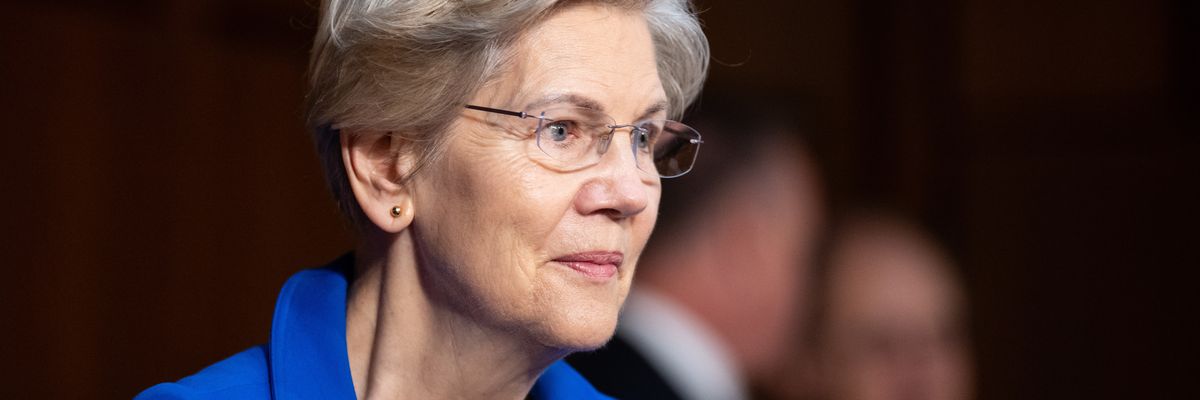
Sen. Elizabeth Warren (D-Mass.) arrives for a hearing in the Hart Senate Office Building in Washington, D.C. on April 9, 2024.
"The Supreme Court's overturning of Chevron undermines our government's ability to promote worker safety, ensure clean air and water, and protect consumers," said Sen. Elizabeth Warren.
In response to a U.S. Supreme Court ruling that Sen. Elizabeth Warren said exemplified corporations' effort to "hijack our government," the Massachusetts Democrat on Tuesday introduced legislation to effectively overturn the decision and return regulatory powers to federal agencies.
Warren led a group of senators in the Democratic caucus in introducing the Stop Corporate Capture Act (SCCA) less than a month after the high court ruled on Loper Bright Enterprises v. Raimondo and Relentless, Inc. v. Department of Commerce, overturning the "Chevron deference" precedent that had been recognized for four decades.
The legal rule required courts to defer to federal agencies' interpretation of a law if Congress had not passed legislation specifically addressing the issue, and permitted public servants in the federal government to craft regulations related to climate protections, workers' rights, and other crucial issues affecting millions of people in the United States.
The Loper Bright ruling last month, said Warren, made clear that "giant corporations are using far-right, unelected judges to... undermine the will of Congress."
"The Stop Corporate Capture Act will bring transparency and efficiency to the federal rulemaking process, and most importantly, will make sure corporate interest groups can't substitute their preferences for the judgment of Congress and the expert agencies," said the senator.
Specific actions the legislation would take include:
The bill has been endorsed by dozens of public interest groups including the Coalition for Sensible Safeguards (CSS), the Consumer Federation of America, the Institute for Agriculture and Trade Policy, and Earthjustice.
"The Loper Bright decision severely undermined the ability of expert federal agencies and Congress to address our most pressing environmental and health challenges, and instead, transferred an inordinate amount of power to judges who lack the profound understanding needed to craft federal regulations," said Raúl García, vice president of policy and legislation for Earthjustice. "This bill rightly remedies an egregious power grab from the U.S. Supreme Court while creating a more transparent and equitable federal rulemaking process. We thank senators for fighting to ensure that expert federal agencies have the power and mandate to protect the people who need these protections the most, not greedy corporations concerned more about their profits."
Rachel Weintraub, executive director of CSS, said the legislation is a "comprehensive blueprint for modernizing, improving, and strengthening the regulatory system to better protect the public."
"The bill would enhance our government's ability to deliver results for workers, consumers, public health, and our environment," said Weintraub. "And it would level the playing field so that ordinary people—not just big corporations—can weigh in on potential rules that affect them."
Earlier this month, CSS explained how the SCCA would save "our system of public protections," which the Republican Party and the right-wing policy agenda are out to "destroy."
U.S. Rep. Pramila Jayapal (D-Wash.), who introduced similar legislation in the House in March 2023, said the bill "couldn't be more critical after the extreme, conservative Supreme Court stripped the ability of governmental agencies to implement and enforce passed laws."
"Many Americans are taught in civics classes that Congress passes a law and that’s it, but the reality is that any major legislation enacted must also be implemented and enforced by the dedicated, nonpartisan experts at our public agencies to become a reality," said Jayapal. "Too often, this process is driven by corporate lobbyists and special interests who know exactly how to make these processes benefit their bottom lines at the cost of public interest... I am proud to lead this bill, which will level the playing field and ensure that laws passed for the people actually work for the people."
Dear Common Dreams reader, It’s been nearly 30 years since I co-founded Common Dreams with my late wife, Lina Newhouser. We had the radical notion that journalism should serve the public good, not corporate profits. It was clear to us from the outset what it would take to build such a project. No paid advertisements. No corporate sponsors. No millionaire publisher telling us what to think or do. Many people said we wouldn't last a year, but we proved those doubters wrong. Together with a tremendous team of journalists and dedicated staff, we built an independent media outlet free from the constraints of profits and corporate control. Our mission has always been simple: To inform. To inspire. To ignite change for the common good. Building Common Dreams was not easy. Our survival was never guaranteed. When you take on the most powerful forces—Wall Street greed, fossil fuel industry destruction, Big Tech lobbyists, and uber-rich oligarchs who have spent billions upon billions rigging the economy and democracy in their favor—the only bulwark you have is supporters who believe in your work. But here’s the urgent message from me today. It's never been this bad out there. And it's never been this hard to keep us going. At the very moment Common Dreams is most needed, the threats we face are intensifying. We need your support now more than ever. We don't accept corporate advertising and never will. We don't have a paywall because we don't think people should be blocked from critical news based on their ability to pay. Everything we do is funded by the donations of readers like you. When everyone does the little they can afford, we are strong. But if that support retreats or dries up, so do we. Will you donate now to make sure Common Dreams not only survives but thrives? —Craig Brown, Co-founder |
In response to a U.S. Supreme Court ruling that Sen. Elizabeth Warren said exemplified corporations' effort to "hijack our government," the Massachusetts Democrat on Tuesday introduced legislation to effectively overturn the decision and return regulatory powers to federal agencies.
Warren led a group of senators in the Democratic caucus in introducing the Stop Corporate Capture Act (SCCA) less than a month after the high court ruled on Loper Bright Enterprises v. Raimondo and Relentless, Inc. v. Department of Commerce, overturning the "Chevron deference" precedent that had been recognized for four decades.
The legal rule required courts to defer to federal agencies' interpretation of a law if Congress had not passed legislation specifically addressing the issue, and permitted public servants in the federal government to craft regulations related to climate protections, workers' rights, and other crucial issues affecting millions of people in the United States.
The Loper Bright ruling last month, said Warren, made clear that "giant corporations are using far-right, unelected judges to... undermine the will of Congress."
"The Stop Corporate Capture Act will bring transparency and efficiency to the federal rulemaking process, and most importantly, will make sure corporate interest groups can't substitute their preferences for the judgment of Congress and the expert agencies," said the senator.
Specific actions the legislation would take include:
The bill has been endorsed by dozens of public interest groups including the Coalition for Sensible Safeguards (CSS), the Consumer Federation of America, the Institute for Agriculture and Trade Policy, and Earthjustice.
"The Loper Bright decision severely undermined the ability of expert federal agencies and Congress to address our most pressing environmental and health challenges, and instead, transferred an inordinate amount of power to judges who lack the profound understanding needed to craft federal regulations," said Raúl García, vice president of policy and legislation for Earthjustice. "This bill rightly remedies an egregious power grab from the U.S. Supreme Court while creating a more transparent and equitable federal rulemaking process. We thank senators for fighting to ensure that expert federal agencies have the power and mandate to protect the people who need these protections the most, not greedy corporations concerned more about their profits."
Rachel Weintraub, executive director of CSS, said the legislation is a "comprehensive blueprint for modernizing, improving, and strengthening the regulatory system to better protect the public."
"The bill would enhance our government's ability to deliver results for workers, consumers, public health, and our environment," said Weintraub. "And it would level the playing field so that ordinary people—not just big corporations—can weigh in on potential rules that affect them."
Earlier this month, CSS explained how the SCCA would save "our system of public protections," which the Republican Party and the right-wing policy agenda are out to "destroy."
U.S. Rep. Pramila Jayapal (D-Wash.), who introduced similar legislation in the House in March 2023, said the bill "couldn't be more critical after the extreme, conservative Supreme Court stripped the ability of governmental agencies to implement and enforce passed laws."
"Many Americans are taught in civics classes that Congress passes a law and that’s it, but the reality is that any major legislation enacted must also be implemented and enforced by the dedicated, nonpartisan experts at our public agencies to become a reality," said Jayapal. "Too often, this process is driven by corporate lobbyists and special interests who know exactly how to make these processes benefit their bottom lines at the cost of public interest... I am proud to lead this bill, which will level the playing field and ensure that laws passed for the people actually work for the people."
In response to a U.S. Supreme Court ruling that Sen. Elizabeth Warren said exemplified corporations' effort to "hijack our government," the Massachusetts Democrat on Tuesday introduced legislation to effectively overturn the decision and return regulatory powers to federal agencies.
Warren led a group of senators in the Democratic caucus in introducing the Stop Corporate Capture Act (SCCA) less than a month after the high court ruled on Loper Bright Enterprises v. Raimondo and Relentless, Inc. v. Department of Commerce, overturning the "Chevron deference" precedent that had been recognized for four decades.
The legal rule required courts to defer to federal agencies' interpretation of a law if Congress had not passed legislation specifically addressing the issue, and permitted public servants in the federal government to craft regulations related to climate protections, workers' rights, and other crucial issues affecting millions of people in the United States.
The Loper Bright ruling last month, said Warren, made clear that "giant corporations are using far-right, unelected judges to... undermine the will of Congress."
"The Stop Corporate Capture Act will bring transparency and efficiency to the federal rulemaking process, and most importantly, will make sure corporate interest groups can't substitute their preferences for the judgment of Congress and the expert agencies," said the senator.
Specific actions the legislation would take include:
The bill has been endorsed by dozens of public interest groups including the Coalition for Sensible Safeguards (CSS), the Consumer Federation of America, the Institute for Agriculture and Trade Policy, and Earthjustice.
"The Loper Bright decision severely undermined the ability of expert federal agencies and Congress to address our most pressing environmental and health challenges, and instead, transferred an inordinate amount of power to judges who lack the profound understanding needed to craft federal regulations," said Raúl García, vice president of policy and legislation for Earthjustice. "This bill rightly remedies an egregious power grab from the U.S. Supreme Court while creating a more transparent and equitable federal rulemaking process. We thank senators for fighting to ensure that expert federal agencies have the power and mandate to protect the people who need these protections the most, not greedy corporations concerned more about their profits."
Rachel Weintraub, executive director of CSS, said the legislation is a "comprehensive blueprint for modernizing, improving, and strengthening the regulatory system to better protect the public."
"The bill would enhance our government's ability to deliver results for workers, consumers, public health, and our environment," said Weintraub. "And it would level the playing field so that ordinary people—not just big corporations—can weigh in on potential rules that affect them."
Earlier this month, CSS explained how the SCCA would save "our system of public protections," which the Republican Party and the right-wing policy agenda are out to "destroy."
U.S. Rep. Pramila Jayapal (D-Wash.), who introduced similar legislation in the House in March 2023, said the bill "couldn't be more critical after the extreme, conservative Supreme Court stripped the ability of governmental agencies to implement and enforce passed laws."
"Many Americans are taught in civics classes that Congress passes a law and that’s it, but the reality is that any major legislation enacted must also be implemented and enforced by the dedicated, nonpartisan experts at our public agencies to become a reality," said Jayapal. "Too often, this process is driven by corporate lobbyists and special interests who know exactly how to make these processes benefit their bottom lines at the cost of public interest... I am proud to lead this bill, which will level the playing field and ensure that laws passed for the people actually work for the people."