5
#000000
#FFFFFF
To donate by check, phone, or other method, see our More Ways to Give page.
Daily news & progressive opinion—funded by the people, not the corporations—delivered straight to your inbox.
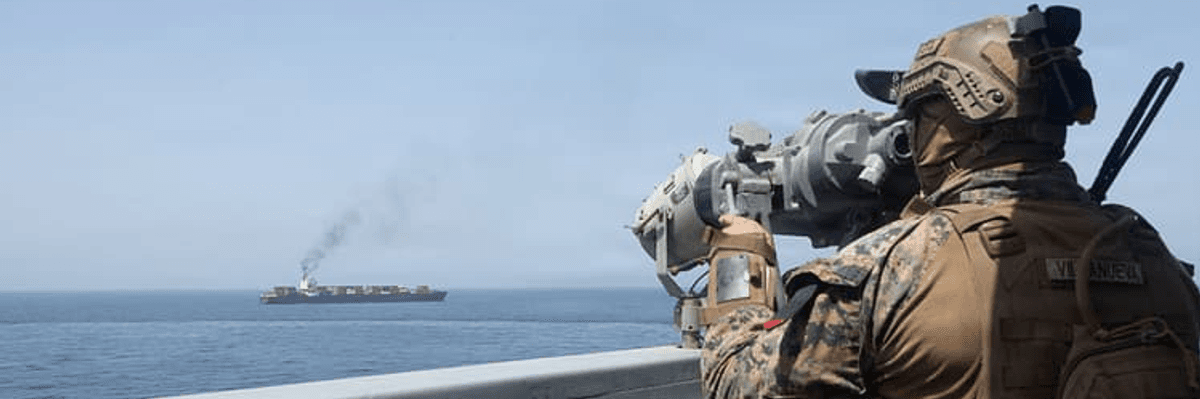
In this handout photo provided by US Central Command, US forces patrol the Arabian Sea near M/V Touska on April 20, 2026, after firing upon the Iranian-flagged vessel that the US accused of attempting to violate the US naval blockade of Iranian ports near the Strait of Hormuz.
"We took over the cargo. We took over the oil. It’s a very profitable business," said the American president, of seizing ships many thousands of miles away from US waters. No mention of what the war of choice against Iran is costing the US taxpayer.
President Donald Trump on Friday night openly bragged about the US military acting "like pirates" in the world's oceans as he described recent activities of the US Navy incapacitating vessels at sea and then taking their cargo.
"We took over the cargo. We took over the oil. It’s a very profitable business," Trump said with a smile as the friendly crowd at the Forum Club in Palm Beach, Florida, cheered him on.
"We're sort of like pirates, but we're not playing games," Trump added before calling the Iranian "bullies" who had to be confronted.
Trump on US Navy Seizing Ships:
It’s a very profitable business. We’re like pirates. pic.twitter.com/erWDQmJWnw
— Acyn (@Acyn) May 2, 2026
"The only good thing about Trump—only thing!—is that he sometimes says what we all know to be true," said journalist Mehdi Hassan, "but don’t expect an American president to say, admit, out loud."
In a social media post, the Iranian Embassy in New Zealand said: "No need to confess, President, the whole world already knows you. By the way, those who, with performative noise, constantly talk about 'international law' and 'freedom of navigation'… don’t want to condemn piracy now?"
"The only good thing about Trump—only thing!—is that he sometimes says what we all know to be true, but don’t expect an American president to say, admit, out loud."
While using the US military to seize the contents of ships may be profitable to somebody, it's not entirely clear who that might be.
So far, the estimate for what Trump's war of choice against Iran over the last two months has cost US taxpayers in the immediate term ranges from $25 billion, which is what the Pentagon itself said this week, to upwards of $100 billion. Over the long term, including the increased cost of gas and groceries due to the economic disruption and the care of veterans involved in the war, the costs of the war—which remains historically unpopular among the US public—could exceed $1 trillion.
Mark P. Nevitt, a retired US military lawyer and now an associate professor at Emory University School of Law, argues that the series of maritime blockades imposed by Trump on Iran has created a "legally surreal moment" in the ongoing conflict.
"The United States is simultaneously observing a ceasefire with Iran while enforcing a naval blockade—a belligerent wartime operation that has no legal basis in peacetime," explained Nevitt in a column for Justice Security on Friday. "Normally, the imposition of a naval blockade ends a ceasefire, because a blockade is itself a belligerent act."
While there are established legal frameworks for naval blockades during wartime, legal scholars have asserted from the outset of the war—when the US and Israel launched unprovoked bombings of Iran on Feb. 28—that the war itself is illegal under international law.
While the existence of the blockade, an overt act of war, means the US and Iran remain in active military conflict, Trump himself and the Pentagon made the untenable claim this week that because a tentative ceasefire is in place, the US is not engaged in war—thereby trying to sidestep a 60-day threshold under the War Powers Act of 1973 which mandates the president either get permission from Congress to continue the war or end military operations completely.
As Nevitt puts it, "the United States is neither fully at war nor fully at peace according to its own logic."
In his assessment, which makes distinctions between maritime law under normal circumstances versus laws of war and blockades during active military conflict, Nevitt said the Pentagon's position that it can enforce a total blockade of ships coming or going from Iranian ports by interdicting or boarding "sanctioned vessels of any flag state anywhere in the world is remarkably broad and lacks a sound legal basis in international law."
Dear Common Dreams reader, It’s been nearly 30 years since I co-founded Common Dreams with my late wife, Lina Newhouser. We had the radical notion that journalism should serve the public good, not corporate profits. It was clear to us from the outset what it would take to build such a project. No paid advertisements. No corporate sponsors. No millionaire publisher telling us what to think or do. Many people said we wouldn't last a year, but we proved those doubters wrong. Together with a tremendous team of journalists and dedicated staff, we built an independent media outlet free from the constraints of profits and corporate control. Our mission has always been simple: To inform. To inspire. To ignite change for the common good. Building Common Dreams was not easy. Our survival was never guaranteed. When you take on the most powerful forces—Wall Street greed, fossil fuel industry destruction, Big Tech lobbyists, and uber-rich oligarchs who have spent billions upon billions rigging the economy and democracy in their favor—the only bulwark you have is supporters who believe in your work. But here’s the urgent message from me today. It's never been this bad out there. And it's never been this hard to keep us going. At the very moment Common Dreams is most needed, the threats we face are intensifying. We need your support now more than ever. We don't accept corporate advertising and never will. We don't have a paywall because we don't think people should be blocked from critical news based on their ability to pay. Everything we do is funded by the donations of readers like you. When everyone does the little they can afford, we are strong. But if that support retreats or dries up, so do we. Will you donate now to make sure Common Dreams not only survives but thrives? —Craig Brown, Co-founder |
President Donald Trump on Friday night openly bragged about the US military acting "like pirates" in the world's oceans as he described recent activities of the US Navy incapacitating vessels at sea and then taking their cargo.
"We took over the cargo. We took over the oil. It’s a very profitable business," Trump said with a smile as the friendly crowd at the Forum Club in Palm Beach, Florida, cheered him on.
"We're sort of like pirates, but we're not playing games," Trump added before calling the Iranian "bullies" who had to be confronted.
Trump on US Navy Seizing Ships:
It’s a very profitable business. We’re like pirates. pic.twitter.com/erWDQmJWnw
— Acyn (@Acyn) May 2, 2026
"The only good thing about Trump—only thing!—is that he sometimes says what we all know to be true," said journalist Mehdi Hassan, "but don’t expect an American president to say, admit, out loud."
In a social media post, the Iranian Embassy in New Zealand said: "No need to confess, President, the whole world already knows you. By the way, those who, with performative noise, constantly talk about 'international law' and 'freedom of navigation'… don’t want to condemn piracy now?"
"The only good thing about Trump—only thing!—is that he sometimes says what we all know to be true, but don’t expect an American president to say, admit, out loud."
While using the US military to seize the contents of ships may be profitable to somebody, it's not entirely clear who that might be.
So far, the estimate for what Trump's war of choice against Iran over the last two months has cost US taxpayers in the immediate term ranges from $25 billion, which is what the Pentagon itself said this week, to upwards of $100 billion. Over the long term, including the increased cost of gas and groceries due to the economic disruption and the care of veterans involved in the war, the costs of the war—which remains historically unpopular among the US public—could exceed $1 trillion.
Mark P. Nevitt, a retired US military lawyer and now an associate professor at Emory University School of Law, argues that the series of maritime blockades imposed by Trump on Iran has created a "legally surreal moment" in the ongoing conflict.
"The United States is simultaneously observing a ceasefire with Iran while enforcing a naval blockade—a belligerent wartime operation that has no legal basis in peacetime," explained Nevitt in a column for Justice Security on Friday. "Normally, the imposition of a naval blockade ends a ceasefire, because a blockade is itself a belligerent act."
While there are established legal frameworks for naval blockades during wartime, legal scholars have asserted from the outset of the war—when the US and Israel launched unprovoked bombings of Iran on Feb. 28—that the war itself is illegal under international law.
While the existence of the blockade, an overt act of war, means the US and Iran remain in active military conflict, Trump himself and the Pentagon made the untenable claim this week that because a tentative ceasefire is in place, the US is not engaged in war—thereby trying to sidestep a 60-day threshold under the War Powers Act of 1973 which mandates the president either get permission from Congress to continue the war or end military operations completely.
As Nevitt puts it, "the United States is neither fully at war nor fully at peace according to its own logic."
In his assessment, which makes distinctions between maritime law under normal circumstances versus laws of war and blockades during active military conflict, Nevitt said the Pentagon's position that it can enforce a total blockade of ships coming or going from Iranian ports by interdicting or boarding "sanctioned vessels of any flag state anywhere in the world is remarkably broad and lacks a sound legal basis in international law."
President Donald Trump on Friday night openly bragged about the US military acting "like pirates" in the world's oceans as he described recent activities of the US Navy incapacitating vessels at sea and then taking their cargo.
"We took over the cargo. We took over the oil. It’s a very profitable business," Trump said with a smile as the friendly crowd at the Forum Club in Palm Beach, Florida, cheered him on.
"We're sort of like pirates, but we're not playing games," Trump added before calling the Iranian "bullies" who had to be confronted.
Trump on US Navy Seizing Ships:
It’s a very profitable business. We’re like pirates. pic.twitter.com/erWDQmJWnw
— Acyn (@Acyn) May 2, 2026
"The only good thing about Trump—only thing!—is that he sometimes says what we all know to be true," said journalist Mehdi Hassan, "but don’t expect an American president to say, admit, out loud."
In a social media post, the Iranian Embassy in New Zealand said: "No need to confess, President, the whole world already knows you. By the way, those who, with performative noise, constantly talk about 'international law' and 'freedom of navigation'… don’t want to condemn piracy now?"
"The only good thing about Trump—only thing!—is that he sometimes says what we all know to be true, but don’t expect an American president to say, admit, out loud."
While using the US military to seize the contents of ships may be profitable to somebody, it's not entirely clear who that might be.
So far, the estimate for what Trump's war of choice against Iran over the last two months has cost US taxpayers in the immediate term ranges from $25 billion, which is what the Pentagon itself said this week, to upwards of $100 billion. Over the long term, including the increased cost of gas and groceries due to the economic disruption and the care of veterans involved in the war, the costs of the war—which remains historically unpopular among the US public—could exceed $1 trillion.
Mark P. Nevitt, a retired US military lawyer and now an associate professor at Emory University School of Law, argues that the series of maritime blockades imposed by Trump on Iran has created a "legally surreal moment" in the ongoing conflict.
"The United States is simultaneously observing a ceasefire with Iran while enforcing a naval blockade—a belligerent wartime operation that has no legal basis in peacetime," explained Nevitt in a column for Justice Security on Friday. "Normally, the imposition of a naval blockade ends a ceasefire, because a blockade is itself a belligerent act."
While there are established legal frameworks for naval blockades during wartime, legal scholars have asserted from the outset of the war—when the US and Israel launched unprovoked bombings of Iran on Feb. 28—that the war itself is illegal under international law.
While the existence of the blockade, an overt act of war, means the US and Iran remain in active military conflict, Trump himself and the Pentagon made the untenable claim this week that because a tentative ceasefire is in place, the US is not engaged in war—thereby trying to sidestep a 60-day threshold under the War Powers Act of 1973 which mandates the president either get permission from Congress to continue the war or end military operations completely.
As Nevitt puts it, "the United States is neither fully at war nor fully at peace according to its own logic."
In his assessment, which makes distinctions between maritime law under normal circumstances versus laws of war and blockades during active military conflict, Nevitt said the Pentagon's position that it can enforce a total blockade of ships coming or going from Iranian ports by interdicting or boarding "sanctioned vessels of any flag state anywhere in the world is remarkably broad and lacks a sound legal basis in international law."