5
#000000
#FFFFFF
To donate by check, phone, or other method, see our More Ways to Give page.
Daily news & progressive opinion—funded by the people, not the corporations—delivered straight to your inbox.
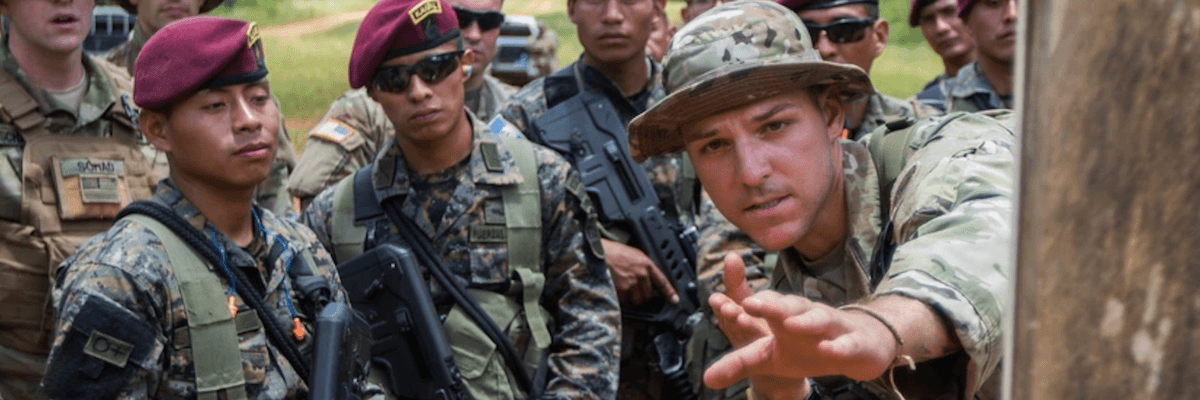
US and Guatemalan troops train together in Poptún, Guatemala on July 12, 2019.
While acknowledging a request for US support in fighting drug cartels, Guatemala's president on Thursday refuted reporting by The New York Times claiming his government "has agreed to carry out joint strikes with the United States military inside its territory"—action that would violate the country's Constitution.
Citing "three people familiar with the talks," the Times reported that "President Bernardo Arévalo of Guatemala agreed to both airstrikes and other military action in a call with [US] Defense Secretary Pete Hegseth... with operations to start as early as next month."
However, Arévalo's office pushed back in a statement stressing that “there is no agreement authorizing foreign military operations by any country in national territory."
The presidential statement said that Guatemalan Defense Minister Henry Sáenz wrote to Hegseth "to request US cooperation in operations led by Guatemalan security forces against narco-trafficking organizations as part of a strategy launched in 2024."
"This request falls within the framework of existing bilateral agreements on the matter, and adheres to constitutional provisions and laws regarding cooperation agreements on civil and military security," the office added.
Arévalo's office stressed that Guatemala's Constitution stipulates that foreign military forces can only be deployed in the country if authorized by a two-thirds vote of the national Legislature.
A source from Arévalo's government told El País Thursday on condition of anonymity that the Trump administration has been exerting "great pressure" for two months.
“What they offered us is to select one or two places to bomb and televise everything," the source said. "But we have been clear that this is not going to happen. It cannot operate a US military force in the country, simply because it is unconstitutional."
Arévalo's office said it is seeking US assistance in training, strategic and tactical support, and intelligence sharing, pointing to recent actions against drug trafficking, including the capture of an arsenal in Las Cruces, Petén, the seizure of a narcotics laboratory in Ayutla, San Marcos, and the capture of numerous suspected narco-traffickers.
Asked during a Thursday press conference about the possibility of joint combat operations like those reportedly carried out by US and Ecuadorian forces in the South American nation, Arévalo claimed unfamiliarity with the details of the agreement between those two countries.
Progressive US lawmakers are demanding answers about “reports of serious human rights violations and the bombing of what appear to have been civilian facilities" in Ecuador, including a "dairy and cattle farm with no known links to armed groups or drug trafficking" where unarmed civilians were allegedly tortured.
Arévalo brushed off a suggestion that his request for US cooperation could open the door to human rights violations in Guatemala, telling reporters that "the best defense against any violation of human rights is our respect and commitment to the laws of the republic and to current legislation."
While Guatemala does suffer from serious narco-trafficking issues, many Guatemalans are wary of US intervention, given past meddling including the 1954 CIA-orchestrated overthrow of reformist President Jacobo Árbenz, which was followed by decades of right-wing repression, civil war, and a US-backed genocide against Indigenous Mayan peoples during which around 200,000 people were killed.
In March, the Trump administration lifted longstanding restrictions on arms transfers to Guatemala.
“Now, our soldiers are going to have access to modern technology, radars, night viewfinders," Sáenz told La Hora on Friday.
The defense minister said he discussed closer counter-narcotics cooperation with the United States during the “Shield of the Americas” summit, during which senior officials from over a dozen nations—most of them ruled by right-wing governments—gathered at President Donald Trump's golf resort near Miami.
In addition to Guatemala, the Trump administration has been trying to pressure other Latin American nations into launching joint military operations against narco-traffickers. President Claudia Sheinbaum of Mexico has vehemently rejected US requests, even as President Donald Trump has threatened "to do something" about cartels in her country.
“The epicenter of cartel violence is not Mexico, it’s the United States,” Sheinbaum defiantly declared in March. “The cartels are fueled by the United States’ demand for drugs and armed with US weapons, and thanks to the United States, they are able to orchestrate enormous bloodshed and chaos throughout Latin America.”
In January, Trump ordered the bombing and invasion of Venezuela, whose president, Nicolás Maduro, was abducted to the United States on dubious "narco-terrorism" allegations that were then significantly walked back.
Trump has also threatened to attack Colombia, Panama, and Cuba, whose people are bracing for what many observers fear is an impending US war. If Trump does order military action against Cuba, it would be the 12th country he's attacked during the course of his two White House terms. Trump also ordered the ongoing bombing campaign targeting boats his administration claims—without providing evidence—were smuggling drugs in the Caribbean Sea and Pacific Ocean. Around 200 people have been killed by the US strikes.
As Nick Turse of The Intercept reported Wednesday:
Trump has turned the Western Hemisphere into a war zone as part of what he and others have called the Donroe Doctrine. This bastardization of the 1823 Monroe Doctrine has been used to justify strikes on civilian boats in the Caribbean Sea and Pacific Ocean; an attack on Venezuela and the abduction of its president; CIA operations in Mexico; joint counter-cartel operations in Ecuador dubbed “Operation Total Extermination”; and increased military and intelligence operations elsewhere in Latin America.
Experts contend that, like the boat strikes, any airstrikes carried out against drug cartels would likely constitute illegal acts of murder, even if conducted with the permission of governments in targeted countries.
“As with the boat strikes, depending on the facts, further attacks could amount to premeditated killings outside of armed conflict, which some of us lawyers would refer to as murder,” former US State Department lawyer Brian Finucane told The New York Times on Thursday.
“Congress never authorized any of these strikes," he added. "So US personnel who participate in these actions could face consequences down the road, after the Trump administration.”
Dear Common Dreams reader, It’s been nearly 30 years since I co-founded Common Dreams with my late wife, Lina Newhouser. We had the radical notion that journalism should serve the public good, not corporate profits. It was clear to us from the outset what it would take to build such a project. No paid advertisements. No corporate sponsors. No millionaire publisher telling us what to think or do. Many people said we wouldn't last a year, but we proved those doubters wrong. Together with a tremendous team of journalists and dedicated staff, we built an independent media outlet free from the constraints of profits and corporate control. Our mission has always been simple: To inform. To inspire. To ignite change for the common good. Building Common Dreams was not easy. Our survival was never guaranteed. When you take on the most powerful forces—Wall Street greed, fossil fuel industry destruction, Big Tech lobbyists, and uber-rich oligarchs who have spent billions upon billions rigging the economy and democracy in their favor—the only bulwark you have is supporters who believe in your work. But here’s the urgent message from me today. It's never been this bad out there. And it's never been this hard to keep us going. At the very moment Common Dreams is most needed, the threats we face are intensifying. We need your support now more than ever. We don't accept corporate advertising and never will. We don't have a paywall because we don't think people should be blocked from critical news based on their ability to pay. Everything we do is funded by the donations of readers like you. When everyone does the little they can afford, we are strong. But if that support retreats or dries up, so do we. Will you donate now to make sure Common Dreams not only survives but thrives? —Craig Brown, Co-founder |
While acknowledging a request for US support in fighting drug cartels, Guatemala's president on Thursday refuted reporting by The New York Times claiming his government "has agreed to carry out joint strikes with the United States military inside its territory"—action that would violate the country's Constitution.
Citing "three people familiar with the talks," the Times reported that "President Bernardo Arévalo of Guatemala agreed to both airstrikes and other military action in a call with [US] Defense Secretary Pete Hegseth... with operations to start as early as next month."
However, Arévalo's office pushed back in a statement stressing that “there is no agreement authorizing foreign military operations by any country in national territory."
The presidential statement said that Guatemalan Defense Minister Henry Sáenz wrote to Hegseth "to request US cooperation in operations led by Guatemalan security forces against narco-trafficking organizations as part of a strategy launched in 2024."
"This request falls within the framework of existing bilateral agreements on the matter, and adheres to constitutional provisions and laws regarding cooperation agreements on civil and military security," the office added.
Arévalo's office stressed that Guatemala's Constitution stipulates that foreign military forces can only be deployed in the country if authorized by a two-thirds vote of the national Legislature.
A source from Arévalo's government told El País Thursday on condition of anonymity that the Trump administration has been exerting "great pressure" for two months.
“What they offered us is to select one or two places to bomb and televise everything," the source said. "But we have been clear that this is not going to happen. It cannot operate a US military force in the country, simply because it is unconstitutional."
Arévalo's office said it is seeking US assistance in training, strategic and tactical support, and intelligence sharing, pointing to recent actions against drug trafficking, including the capture of an arsenal in Las Cruces, Petén, the seizure of a narcotics laboratory in Ayutla, San Marcos, and the capture of numerous suspected narco-traffickers.
Asked during a Thursday press conference about the possibility of joint combat operations like those reportedly carried out by US and Ecuadorian forces in the South American nation, Arévalo claimed unfamiliarity with the details of the agreement between those two countries.
Progressive US lawmakers are demanding answers about “reports of serious human rights violations and the bombing of what appear to have been civilian facilities" in Ecuador, including a "dairy and cattle farm with no known links to armed groups or drug trafficking" where unarmed civilians were allegedly tortured.
Arévalo brushed off a suggestion that his request for US cooperation could open the door to human rights violations in Guatemala, telling reporters that "the best defense against any violation of human rights is our respect and commitment to the laws of the republic and to current legislation."
While Guatemala does suffer from serious narco-trafficking issues, many Guatemalans are wary of US intervention, given past meddling including the 1954 CIA-orchestrated overthrow of reformist President Jacobo Árbenz, which was followed by decades of right-wing repression, civil war, and a US-backed genocide against Indigenous Mayan peoples during which around 200,000 people were killed.
In March, the Trump administration lifted longstanding restrictions on arms transfers to Guatemala.
“Now, our soldiers are going to have access to modern technology, radars, night viewfinders," Sáenz told La Hora on Friday.
The defense minister said he discussed closer counter-narcotics cooperation with the United States during the “Shield of the Americas” summit, during which senior officials from over a dozen nations—most of them ruled by right-wing governments—gathered at President Donald Trump's golf resort near Miami.
In addition to Guatemala, the Trump administration has been trying to pressure other Latin American nations into launching joint military operations against narco-traffickers. President Claudia Sheinbaum of Mexico has vehemently rejected US requests, even as President Donald Trump has threatened "to do something" about cartels in her country.
“The epicenter of cartel violence is not Mexico, it’s the United States,” Sheinbaum defiantly declared in March. “The cartels are fueled by the United States’ demand for drugs and armed with US weapons, and thanks to the United States, they are able to orchestrate enormous bloodshed and chaos throughout Latin America.”
In January, Trump ordered the bombing and invasion of Venezuela, whose president, Nicolás Maduro, was abducted to the United States on dubious "narco-terrorism" allegations that were then significantly walked back.
Trump has also threatened to attack Colombia, Panama, and Cuba, whose people are bracing for what many observers fear is an impending US war. If Trump does order military action against Cuba, it would be the 12th country he's attacked during the course of his two White House terms. Trump also ordered the ongoing bombing campaign targeting boats his administration claims—without providing evidence—were smuggling drugs in the Caribbean Sea and Pacific Ocean. Around 200 people have been killed by the US strikes.
As Nick Turse of The Intercept reported Wednesday:
Trump has turned the Western Hemisphere into a war zone as part of what he and others have called the Donroe Doctrine. This bastardization of the 1823 Monroe Doctrine has been used to justify strikes on civilian boats in the Caribbean Sea and Pacific Ocean; an attack on Venezuela and the abduction of its president; CIA operations in Mexico; joint counter-cartel operations in Ecuador dubbed “Operation Total Extermination”; and increased military and intelligence operations elsewhere in Latin America.
Experts contend that, like the boat strikes, any airstrikes carried out against drug cartels would likely constitute illegal acts of murder, even if conducted with the permission of governments in targeted countries.
“As with the boat strikes, depending on the facts, further attacks could amount to premeditated killings outside of armed conflict, which some of us lawyers would refer to as murder,” former US State Department lawyer Brian Finucane told The New York Times on Thursday.
“Congress never authorized any of these strikes," he added. "So US personnel who participate in these actions could face consequences down the road, after the Trump administration.”
While acknowledging a request for US support in fighting drug cartels, Guatemala's president on Thursday refuted reporting by The New York Times claiming his government "has agreed to carry out joint strikes with the United States military inside its territory"—action that would violate the country's Constitution.
Citing "three people familiar with the talks," the Times reported that "President Bernardo Arévalo of Guatemala agreed to both airstrikes and other military action in a call with [US] Defense Secretary Pete Hegseth... with operations to start as early as next month."
However, Arévalo's office pushed back in a statement stressing that “there is no agreement authorizing foreign military operations by any country in national territory."
The presidential statement said that Guatemalan Defense Minister Henry Sáenz wrote to Hegseth "to request US cooperation in operations led by Guatemalan security forces against narco-trafficking organizations as part of a strategy launched in 2024."
"This request falls within the framework of existing bilateral agreements on the matter, and adheres to constitutional provisions and laws regarding cooperation agreements on civil and military security," the office added.
Arévalo's office stressed that Guatemala's Constitution stipulates that foreign military forces can only be deployed in the country if authorized by a two-thirds vote of the national Legislature.
A source from Arévalo's government told El País Thursday on condition of anonymity that the Trump administration has been exerting "great pressure" for two months.
“What they offered us is to select one or two places to bomb and televise everything," the source said. "But we have been clear that this is not going to happen. It cannot operate a US military force in the country, simply because it is unconstitutional."
Arévalo's office said it is seeking US assistance in training, strategic and tactical support, and intelligence sharing, pointing to recent actions against drug trafficking, including the capture of an arsenal in Las Cruces, Petén, the seizure of a narcotics laboratory in Ayutla, San Marcos, and the capture of numerous suspected narco-traffickers.
Asked during a Thursday press conference about the possibility of joint combat operations like those reportedly carried out by US and Ecuadorian forces in the South American nation, Arévalo claimed unfamiliarity with the details of the agreement between those two countries.
Progressive US lawmakers are demanding answers about “reports of serious human rights violations and the bombing of what appear to have been civilian facilities" in Ecuador, including a "dairy and cattle farm with no known links to armed groups or drug trafficking" where unarmed civilians were allegedly tortured.
Arévalo brushed off a suggestion that his request for US cooperation could open the door to human rights violations in Guatemala, telling reporters that "the best defense against any violation of human rights is our respect and commitment to the laws of the republic and to current legislation."
While Guatemala does suffer from serious narco-trafficking issues, many Guatemalans are wary of US intervention, given past meddling including the 1954 CIA-orchestrated overthrow of reformist President Jacobo Árbenz, which was followed by decades of right-wing repression, civil war, and a US-backed genocide against Indigenous Mayan peoples during which around 200,000 people were killed.
In March, the Trump administration lifted longstanding restrictions on arms transfers to Guatemala.
“Now, our soldiers are going to have access to modern technology, radars, night viewfinders," Sáenz told La Hora on Friday.
The defense minister said he discussed closer counter-narcotics cooperation with the United States during the “Shield of the Americas” summit, during which senior officials from over a dozen nations—most of them ruled by right-wing governments—gathered at President Donald Trump's golf resort near Miami.
In addition to Guatemala, the Trump administration has been trying to pressure other Latin American nations into launching joint military operations against narco-traffickers. President Claudia Sheinbaum of Mexico has vehemently rejected US requests, even as President Donald Trump has threatened "to do something" about cartels in her country.
“The epicenter of cartel violence is not Mexico, it’s the United States,” Sheinbaum defiantly declared in March. “The cartels are fueled by the United States’ demand for drugs and armed with US weapons, and thanks to the United States, they are able to orchestrate enormous bloodshed and chaos throughout Latin America.”
In January, Trump ordered the bombing and invasion of Venezuela, whose president, Nicolás Maduro, was abducted to the United States on dubious "narco-terrorism" allegations that were then significantly walked back.
Trump has also threatened to attack Colombia, Panama, and Cuba, whose people are bracing for what many observers fear is an impending US war. If Trump does order military action against Cuba, it would be the 12th country he's attacked during the course of his two White House terms. Trump also ordered the ongoing bombing campaign targeting boats his administration claims—without providing evidence—were smuggling drugs in the Caribbean Sea and Pacific Ocean. Around 200 people have been killed by the US strikes.
As Nick Turse of The Intercept reported Wednesday:
Trump has turned the Western Hemisphere into a war zone as part of what he and others have called the Donroe Doctrine. This bastardization of the 1823 Monroe Doctrine has been used to justify strikes on civilian boats in the Caribbean Sea and Pacific Ocean; an attack on Venezuela and the abduction of its president; CIA operations in Mexico; joint counter-cartel operations in Ecuador dubbed “Operation Total Extermination”; and increased military and intelligence operations elsewhere in Latin America.
Experts contend that, like the boat strikes, any airstrikes carried out against drug cartels would likely constitute illegal acts of murder, even if conducted with the permission of governments in targeted countries.
“As with the boat strikes, depending on the facts, further attacks could amount to premeditated killings outside of armed conflict, which some of us lawyers would refer to as murder,” former US State Department lawyer Brian Finucane told The New York Times on Thursday.
“Congress never authorized any of these strikes," he added. "So US personnel who participate in these actions could face consequences down the road, after the Trump administration.”