SUBSCRIBE TO OUR FREE NEWSLETTER
Daily news & progressive opinion—funded by the people, not the corporations—delivered straight to your inbox.
5
#000000
#FFFFFF
To donate by check, phone, or other method, see our More Ways to Give page.
Daily news & progressive opinion—funded by the people, not the corporations—delivered straight to your inbox.
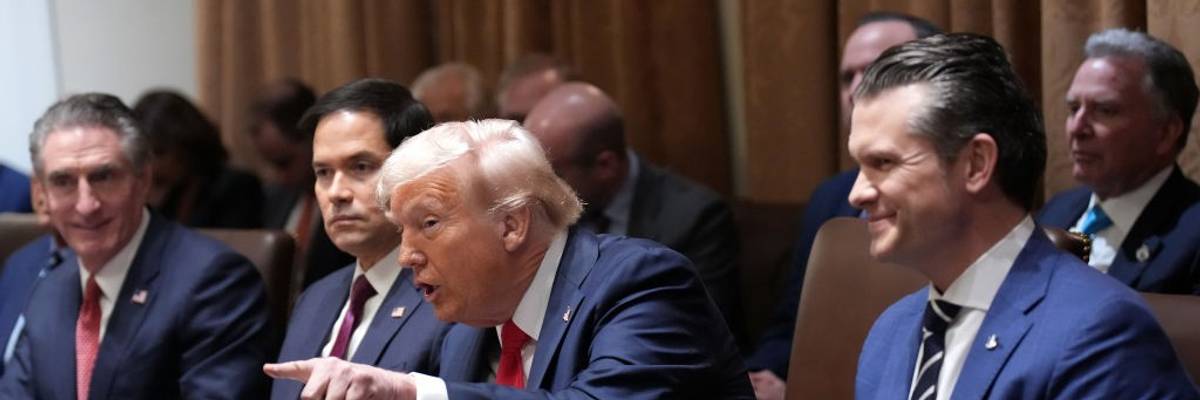
USPresident Donald Trump delivers remarks during a Cabinet meeting at the White House on February 26, 2025 in Washington, DC.
"US military interventions of the 20th century brought dictatorships, disappearances, and decades of trauma to our nations," the Latin American leaders emphasized.
Dozens of political leaders throughout Latin America are condemning US President Donald Trump's boat-bombing spree, which began in the Caribbean last month but has since spread to the Pacific Ocean.
In a letter posted by Progressive International on its X account, the Latin American leaders from across the region said that Trump's campaign of extrajudicial killings of purported drug traffickers is threatening peace and stability in Latin America, and is likely a pretext for further military intervention in the region.
"The Trump administration is escalating a dangerous military buildup off the coast of Venezuela, deploying naval forces in the Caribbean in preparation for potential armed intervention," they wrote. "The pretext is familiar. President Trump justifies intervention in Venezuela as a means to combat 'cartels,' celebrating lethal strikes against fishermen accused of carrying drugs."
The lawmakers then linked the Trump administration's current militarism to past US actions that had destabilized their nations.
"We have lived this nightmare before," they emphasized. "US military interventions of the 20th century brought dictatorships, disappearances, and decades of trauma to our nations. We know the terrible cost of allowing foreign powers to wage war on our continent. We cannot—we will not—allow history to repeat itself."
They called upon "all organized political forces across Latin America and the Caribbean" to unite in the name of preventing another "catastrophe" from occurring.
"Across our political contexts, we share a common cause: the sovereignty of our nations and the security of our peoples," they concluded. "We must stand together now."
The US military has carried out at least nine attacks on boats in the Caribbean and in the Pacific Ocean over the past seven weeks, killing at least 37 people so far. Although the administration has claimed that these boats were engaged in illegal drug smuggling, it has provided no evidence to justify this claim—and both Trump and Vice President have jokingly said it would be dangerous "to even go fishing" in the Caribbean, suggesting civilians could be killed in the strikes
Colombian President Gustavo Petro this past weekend said that the Trump administration had “committed a murder” after one of its boat attacks killed a Colombian citizen named Alejandro Carranza, who had been out on a fishing trip when the US military attacked his boat.
The Trump administration's boat strikes have been condemned not only by leaders in Latin America, but also by multiple US-based legal experts who have accused the administration of going on an extrajudicial murder spree. Experts have noted that the US has long approached drug trafficking as a criminal offense—not an act of war to be responded to with military force.
The Center for Economic and Policy Research (CEPR), a US-based think tank, announced on Thursday that it was launching a new project aimed at tracking "US militarism, aggression, and intervention in Latin America and the Caribbean," including "US strikes on boats, threats against Venezuela and Colombia, and other aspects of US interventionism in the region under the second Trump administration."
Alexander Main, CEPR's director of international policy, said that the Trump administration's recent actions across Latin America represent "a dangerous new escalation with an open disregard for international law and agreements" that could have "profound implications beyond the region."
Dear Common Dreams reader, It’s been nearly 30 years since I co-founded Common Dreams with my late wife, Lina Newhouser. We had the radical notion that journalism should serve the public good, not corporate profits. It was clear to us from the outset what it would take to build such a project. No paid advertisements. No corporate sponsors. No millionaire publisher telling us what to think or do. Many people said we wouldn't last a year, but we proved those doubters wrong. Together with a tremendous team of journalists and dedicated staff, we built an independent media outlet free from the constraints of profits and corporate control. Our mission has always been simple: To inform. To inspire. To ignite change for the common good. Building Common Dreams was not easy. Our survival was never guaranteed. When you take on the most powerful forces—Wall Street greed, fossil fuel industry destruction, Big Tech lobbyists, and uber-rich oligarchs who have spent billions upon billions rigging the economy and democracy in their favor—the only bulwark you have is supporters who believe in your work. But here’s the urgent message from me today. It's never been this bad out there. And it's never been this hard to keep us going. At the very moment Common Dreams is most needed, the threats we face are intensifying. We need your support now more than ever. We don't accept corporate advertising and never will. We don't have a paywall because we don't think people should be blocked from critical news based on their ability to pay. Everything we do is funded by the donations of readers like you. When everyone does the little they can afford, we are strong. But if that support retreats or dries up, so do we. Will you donate now to make sure Common Dreams not only survives but thrives? —Craig Brown, Co-founder |
Dozens of political leaders throughout Latin America are condemning US President Donald Trump's boat-bombing spree, which began in the Caribbean last month but has since spread to the Pacific Ocean.
In a letter posted by Progressive International on its X account, the Latin American leaders from across the region said that Trump's campaign of extrajudicial killings of purported drug traffickers is threatening peace and stability in Latin America, and is likely a pretext for further military intervention in the region.
"The Trump administration is escalating a dangerous military buildup off the coast of Venezuela, deploying naval forces in the Caribbean in preparation for potential armed intervention," they wrote. "The pretext is familiar. President Trump justifies intervention in Venezuela as a means to combat 'cartels,' celebrating lethal strikes against fishermen accused of carrying drugs."
The lawmakers then linked the Trump administration's current militarism to past US actions that had destabilized their nations.
"We have lived this nightmare before," they emphasized. "US military interventions of the 20th century brought dictatorships, disappearances, and decades of trauma to our nations. We know the terrible cost of allowing foreign powers to wage war on our continent. We cannot—we will not—allow history to repeat itself."
They called upon "all organized political forces across Latin America and the Caribbean" to unite in the name of preventing another "catastrophe" from occurring.
"Across our political contexts, we share a common cause: the sovereignty of our nations and the security of our peoples," they concluded. "We must stand together now."
The US military has carried out at least nine attacks on boats in the Caribbean and in the Pacific Ocean over the past seven weeks, killing at least 37 people so far. Although the administration has claimed that these boats were engaged in illegal drug smuggling, it has provided no evidence to justify this claim—and both Trump and Vice President have jokingly said it would be dangerous "to even go fishing" in the Caribbean, suggesting civilians could be killed in the strikes
Colombian President Gustavo Petro this past weekend said that the Trump administration had “committed a murder” after one of its boat attacks killed a Colombian citizen named Alejandro Carranza, who had been out on a fishing trip when the US military attacked his boat.
The Trump administration's boat strikes have been condemned not only by leaders in Latin America, but also by multiple US-based legal experts who have accused the administration of going on an extrajudicial murder spree. Experts have noted that the US has long approached drug trafficking as a criminal offense—not an act of war to be responded to with military force.
The Center for Economic and Policy Research (CEPR), a US-based think tank, announced on Thursday that it was launching a new project aimed at tracking "US militarism, aggression, and intervention in Latin America and the Caribbean," including "US strikes on boats, threats against Venezuela and Colombia, and other aspects of US interventionism in the region under the second Trump administration."
Alexander Main, CEPR's director of international policy, said that the Trump administration's recent actions across Latin America represent "a dangerous new escalation with an open disregard for international law and agreements" that could have "profound implications beyond the region."
Dozens of political leaders throughout Latin America are condemning US President Donald Trump's boat-bombing spree, which began in the Caribbean last month but has since spread to the Pacific Ocean.
In a letter posted by Progressive International on its X account, the Latin American leaders from across the region said that Trump's campaign of extrajudicial killings of purported drug traffickers is threatening peace and stability in Latin America, and is likely a pretext for further military intervention in the region.
"The Trump administration is escalating a dangerous military buildup off the coast of Venezuela, deploying naval forces in the Caribbean in preparation for potential armed intervention," they wrote. "The pretext is familiar. President Trump justifies intervention in Venezuela as a means to combat 'cartels,' celebrating lethal strikes against fishermen accused of carrying drugs."
The lawmakers then linked the Trump administration's current militarism to past US actions that had destabilized their nations.
"We have lived this nightmare before," they emphasized. "US military interventions of the 20th century brought dictatorships, disappearances, and decades of trauma to our nations. We know the terrible cost of allowing foreign powers to wage war on our continent. We cannot—we will not—allow history to repeat itself."
They called upon "all organized political forces across Latin America and the Caribbean" to unite in the name of preventing another "catastrophe" from occurring.
"Across our political contexts, we share a common cause: the sovereignty of our nations and the security of our peoples," they concluded. "We must stand together now."
The US military has carried out at least nine attacks on boats in the Caribbean and in the Pacific Ocean over the past seven weeks, killing at least 37 people so far. Although the administration has claimed that these boats were engaged in illegal drug smuggling, it has provided no evidence to justify this claim—and both Trump and Vice President have jokingly said it would be dangerous "to even go fishing" in the Caribbean, suggesting civilians could be killed in the strikes
Colombian President Gustavo Petro this past weekend said that the Trump administration had “committed a murder” after one of its boat attacks killed a Colombian citizen named Alejandro Carranza, who had been out on a fishing trip when the US military attacked his boat.
The Trump administration's boat strikes have been condemned not only by leaders in Latin America, but also by multiple US-based legal experts who have accused the administration of going on an extrajudicial murder spree. Experts have noted that the US has long approached drug trafficking as a criminal offense—not an act of war to be responded to with military force.
The Center for Economic and Policy Research (CEPR), a US-based think tank, announced on Thursday that it was launching a new project aimed at tracking "US militarism, aggression, and intervention in Latin America and the Caribbean," including "US strikes on boats, threats against Venezuela and Colombia, and other aspects of US interventionism in the region under the second Trump administration."
Alexander Main, CEPR's director of international policy, said that the Trump administration's recent actions across Latin America represent "a dangerous new escalation with an open disregard for international law and agreements" that could have "profound implications beyond the region."