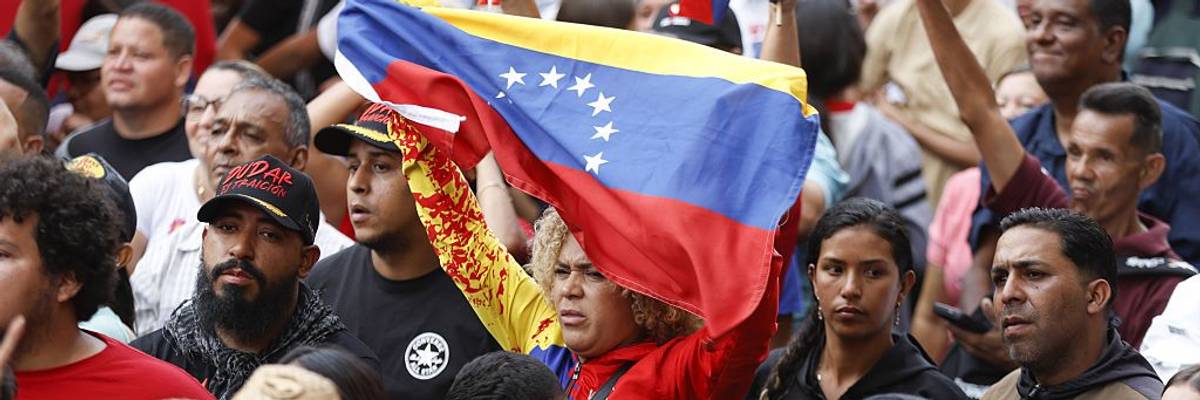
Supporters of Venezuelan President Nicolas Maduro participate in a rally to swear in Bolivarian community commanders in Caracas on December 1, 2025.
Top Brazilian Official Warns Trump of 'Vietnam-Style' Regional Conflict If He Attacks Venezuela
"The last thing we want is for South America to become a war zone," said Celso Amorim, chief foreign policy adviser to Brazilian President Luiz Inácio Lula da Silva.
A top Brazilian official is warning President Donald Trump that a US military attack on Venezuela could easily spiral out of control into a "Vietnam-style" regional conflict.
Celso Amorim, chief foreign policy adviser to Brazilian President Luiz Inácio Lula da Silva, said in an interview published on Monday by the Guardian that a US military strike on Venezuela would inevitably draw nations throughout Latin America into an armed conflict that would be difficult to contain.
"The last thing we want is for South America to become a war zone—and a war zone that would inevitably not just be a war between the US and Venezuela," he said. "It would end up having global involvement and this would be really unfortunate."
Amorim added that "if there was an invasion, a real invasion [of Venezuela]... I think undoubtedly you would see something similar to Vietnam—on what scale it’s impossible to say."
While acknowledging that Venezuelan President Nicolás Maduro is disliked by many other South American leaders, Amorim predicted that even some of Maduro's adversaries would rally to his side in the face of destabilizing military actions by the US government.
He also predicted that anti-US sentiment would surge throughout the continent in the event of an invasion, as there is still major resentment toward the US for backing right-wing military coups during the Cold War in Chile, Brazil, and other nations.
"I know South America," he emphasized. "Our whole continent exists because of resistance against foreign invaders."
The Trump administration in recent weeks has signaled that it plans to launch attacks against purported drug traffickers inside Venezuela, even though reports from the US government and the United Nations have not identified Venezuela as a significant source of drugs that enter the United States.
The administration has also accused Maduro of leading an international drug trafficking organization called the Cartel de los Soles, despite many experts saying that they have seen no evidence that such an organization formally exists.
Trump late last month further escalated tensions with Venezuela when he declared that airspace over the nation was "closed in its entirety," even though he lacks any legal authority to enforce such a decree.
The Washington Post reported on Monday that Maduro is remaining defiant in the face of US pressure, as he is refusing to go into exile despite the threat of an attack on his country.
According to the Post's sources, Maduro's inner circle of allies "shows no signs of imminent collapse," even as he has limited his public appearances and beefed up his personal security amid fears that he could be the target of an assassination attempt.
We are at a crossroads
This country and this world are at a monumental crossroads. In a few short weeks, US voters will have an opportunity to beat back the forces of fascism and confront the billionaires who are rigging the economy, our media system, and our democracy, making it increasingly impossible for ordinary people to get by. We’re not just talking about the election. We’re talking about what must be done once these fascist elements are vanquished from power. We need a bolder set of solutions than what either major party has so far been willing to offer and a working-class movement ready to fight like hell for it. Trump didn't emerge from nowhere. The conditions that fueled MAGA authoritarianism were created by decades of radical neoliberal economic policies and a corrupt political system dominated by corporate interests. They slashed taxes on the super-rich, promising that the benefits would trickle down. They said giveaways to the corporate titans would make life more affordable for the rest of us. It was all bullshit. And when a bitter, betrayed populace searches for someone to blame, right-wing demagogues have little trouble finding scapegoats. People know when they're being lied to, but you won't hear any of this from the corporate media. Only independent journalism—powered and funded by people who believe in building a better world—can deliver truly trustworthy daily news. Our Fall Campaign is underway, and we need your help. To power our newsroom through the rest of the year, we need to raise $125,000 by midnight on October 31. So if you share our vision, please contribute whatever you can to sustain our work. |
A top Brazilian official is warning President Donald Trump that a US military attack on Venezuela could easily spiral out of control into a "Vietnam-style" regional conflict.
Celso Amorim, chief foreign policy adviser to Brazilian President Luiz Inácio Lula da Silva, said in an interview published on Monday by the Guardian that a US military strike on Venezuela would inevitably draw nations throughout Latin America into an armed conflict that would be difficult to contain.
"The last thing we want is for South America to become a war zone—and a war zone that would inevitably not just be a war between the US and Venezuela," he said. "It would end up having global involvement and this would be really unfortunate."
Amorim added that "if there was an invasion, a real invasion [of Venezuela]... I think undoubtedly you would see something similar to Vietnam—on what scale it’s impossible to say."
While acknowledging that Venezuelan President Nicolás Maduro is disliked by many other South American leaders, Amorim predicted that even some of Maduro's adversaries would rally to his side in the face of destabilizing military actions by the US government.
He also predicted that anti-US sentiment would surge throughout the continent in the event of an invasion, as there is still major resentment toward the US for backing right-wing military coups during the Cold War in Chile, Brazil, and other nations.
"I know South America," he emphasized. "Our whole continent exists because of resistance against foreign invaders."
The Trump administration in recent weeks has signaled that it plans to launch attacks against purported drug traffickers inside Venezuela, even though reports from the US government and the United Nations have not identified Venezuela as a significant source of drugs that enter the United States.
The administration has also accused Maduro of leading an international drug trafficking organization called the Cartel de los Soles, despite many experts saying that they have seen no evidence that such an organization formally exists.
Trump late last month further escalated tensions with Venezuela when he declared that airspace over the nation was "closed in its entirety," even though he lacks any legal authority to enforce such a decree.
The Washington Post reported on Monday that Maduro is remaining defiant in the face of US pressure, as he is refusing to go into exile despite the threat of an attack on his country.
According to the Post's sources, Maduro's inner circle of allies "shows no signs of imminent collapse," even as he has limited his public appearances and beefed up his personal security amid fears that he could be the target of an assassination attempt.
- The US People Don't Want a War on Venezuela ›
- Maduro Says US Pointing '1,200 Missiles' at Venezuela After Trump Sends More Warships ›
- Trump's Threat to Invade Venezuela Is Indeed About Drugs–Oil, That Is ›
A top Brazilian official is warning President Donald Trump that a US military attack on Venezuela could easily spiral out of control into a "Vietnam-style" regional conflict.
Celso Amorim, chief foreign policy adviser to Brazilian President Luiz Inácio Lula da Silva, said in an interview published on Monday by the Guardian that a US military strike on Venezuela would inevitably draw nations throughout Latin America into an armed conflict that would be difficult to contain.
"The last thing we want is for South America to become a war zone—and a war zone that would inevitably not just be a war between the US and Venezuela," he said. "It would end up having global involvement and this would be really unfortunate."
Amorim added that "if there was an invasion, a real invasion [of Venezuela]... I think undoubtedly you would see something similar to Vietnam—on what scale it’s impossible to say."
While acknowledging that Venezuelan President Nicolás Maduro is disliked by many other South American leaders, Amorim predicted that even some of Maduro's adversaries would rally to his side in the face of destabilizing military actions by the US government.
He also predicted that anti-US sentiment would surge throughout the continent in the event of an invasion, as there is still major resentment toward the US for backing right-wing military coups during the Cold War in Chile, Brazil, and other nations.
"I know South America," he emphasized. "Our whole continent exists because of resistance against foreign invaders."
The Trump administration in recent weeks has signaled that it plans to launch attacks against purported drug traffickers inside Venezuela, even though reports from the US government and the United Nations have not identified Venezuela as a significant source of drugs that enter the United States.
The administration has also accused Maduro of leading an international drug trafficking organization called the Cartel de los Soles, despite many experts saying that they have seen no evidence that such an organization formally exists.
Trump late last month further escalated tensions with Venezuela when he declared that airspace over the nation was "closed in its entirety," even though he lacks any legal authority to enforce such a decree.
The Washington Post reported on Monday that Maduro is remaining defiant in the face of US pressure, as he is refusing to go into exile despite the threat of an attack on his country.
According to the Post's sources, Maduro's inner circle of allies "shows no signs of imminent collapse," even as he has limited his public appearances and beefed up his personal security amid fears that he could be the target of an assassination attempt.
- The US People Don't Want a War on Venezuela ›
- Maduro Says US Pointing '1,200 Missiles' at Venezuela After Trump Sends More Warships ›
- Trump's Threat to Invade Venezuela Is Indeed About Drugs–Oil, That Is ›