SUBSCRIBE TO OUR FREE NEWSLETTER
Daily news & progressive opinion—funded by the people, not the corporations—delivered straight to your inbox.
5
#000000
#FFFFFF
To donate by check, phone, or other method, see our More Ways to Give page.
Daily news & progressive opinion—funded by the people, not the corporations—delivered straight to your inbox.
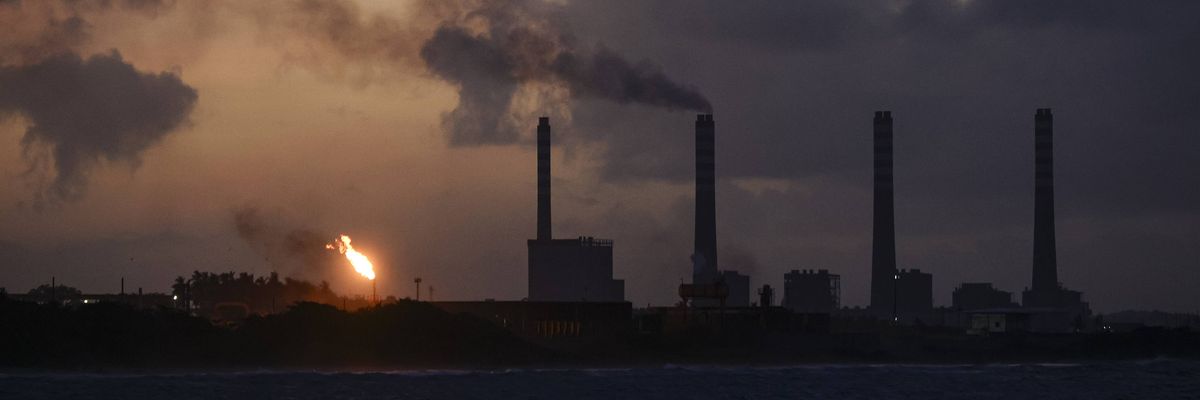
General view of 'El Palito' refinery building at dusk during a walk around the outskirts of 'El Palito' refinery on December 18, 2025, in Puerto Cabello, Venezuela.
"When government actions tied to foreign resources are preceded and followed by closed-door meetings with the world’s largest oil companies, transparency is not optional—it is essential."
A legal watchdog group is demanding information about the extent to which the Trump administration planned its attack on Venezuela last weekend with American oil companies, which are expected to profit royally from the takeover of the South American nation's oil reserves.
The group Democracy Forward filed a series of Freedom of Information Act (FOIA) requests on Monday seeking records and information about the role of US oil companies in the planning of the attack, which killed an estimated 75 people and led to the US military's abduction of Venezuelan President Nicolas Maduro and his wife.
President Donald Trump did not inform Congress of the operation, which is required under the War Powers Act of 1973, but he told reporters on Sunday that he'd tipped off oil company executives both "before and after" the strike.
According to reporting by the Wall Street Journal, he informed executives roughly a month before the strike to "get ready" because big changes were coming to the country, which had long held state control over the largest oil reserves in the world.
Since toppling Maduro, in an operation that international law experts have widely described as illegal, Trump has said his goal is to "get the oil flowing" to American oil companies to start "taking a tremendous amount of wealth out of the ground.”
On Tuesday, Trump said Venezuela's interim leaders—who he's threatened with more attacks if they don't do what he says—have agreed to hand over 30-50 million barrels of oil to be sold by the US, which will control how the profits are dispersed.
Trump and several members of his Cabinet, including Energy Secretary Chris Wright and Interior Secretary Doug Burgum, are expected to meet with oil executives on Friday at the White House to discuss "security guarantees" for their new spoils.
Democracy Forward has requested information about communications between senior officials at the US departments of Energy and the Interior and executives at top oil companies, including Chevron, ExxonMobil, and ConocoPhillips, prior to the attack. This includes emails, attachments, and calendar invitations exchanged since December 2025.
The group has said it will seek to determine whether these companies were given "privileged access or influence" over the administration's policy toward Venezuela.
“The president couldn’t find time to brief members of Congress before kidnapping a foreign head of state, but appears to have prioritized discussions with Big Oil. When government actions tied to foreign resources are preceded and followed by closed-door meetings with the world’s largest oil companies, transparency is not optional—it is essential,” said Skye Perryman, the president and CEO of Democracy Forward. “The public deserves to know what interests are shaping decisions that have enormous consequences for global energy markets and democratic accountability.”
FOIA, which was passed in 1967, allows members of the public to request records from any federal agency. However, agencies have broad discretion to deny FOIA requests, including in cases involving national security or interagency communications.
Dear Common Dreams reader, It’s been nearly 30 years since I co-founded Common Dreams with my late wife, Lina Newhouser. We had the radical notion that journalism should serve the public good, not corporate profits. It was clear to us from the outset what it would take to build such a project. No paid advertisements. No corporate sponsors. No millionaire publisher telling us what to think or do. Many people said we wouldn't last a year, but we proved those doubters wrong. Together with a tremendous team of journalists and dedicated staff, we built an independent media outlet free from the constraints of profits and corporate control. Our mission has always been simple: To inform. To inspire. To ignite change for the common good. Building Common Dreams was not easy. Our survival was never guaranteed. When you take on the most powerful forces—Wall Street greed, fossil fuel industry destruction, Big Tech lobbyists, and uber-rich oligarchs who have spent billions upon billions rigging the economy and democracy in their favor—the only bulwark you have is supporters who believe in your work. But here’s the urgent message from me today. It's never been this bad out there. And it's never been this hard to keep us going. At the very moment Common Dreams is most needed, the threats we face are intensifying. We need your support now more than ever. We don't accept corporate advertising and never will. We don't have a paywall because we don't think people should be blocked from critical news based on their ability to pay. Everything we do is funded by the donations of readers like you. When everyone does the little they can afford, we are strong. But if that support retreats or dries up, so do we. Will you donate now to make sure Common Dreams not only survives but thrives? —Craig Brown, Co-founder |
A legal watchdog group is demanding information about the extent to which the Trump administration planned its attack on Venezuela last weekend with American oil companies, which are expected to profit royally from the takeover of the South American nation's oil reserves.
The group Democracy Forward filed a series of Freedom of Information Act (FOIA) requests on Monday seeking records and information about the role of US oil companies in the planning of the attack, which killed an estimated 75 people and led to the US military's abduction of Venezuelan President Nicolas Maduro and his wife.
President Donald Trump did not inform Congress of the operation, which is required under the War Powers Act of 1973, but he told reporters on Sunday that he'd tipped off oil company executives both "before and after" the strike.
According to reporting by the Wall Street Journal, he informed executives roughly a month before the strike to "get ready" because big changes were coming to the country, which had long held state control over the largest oil reserves in the world.
Since toppling Maduro, in an operation that international law experts have widely described as illegal, Trump has said his goal is to "get the oil flowing" to American oil companies to start "taking a tremendous amount of wealth out of the ground.”
On Tuesday, Trump said Venezuela's interim leaders—who he's threatened with more attacks if they don't do what he says—have agreed to hand over 30-50 million barrels of oil to be sold by the US, which will control how the profits are dispersed.
Trump and several members of his Cabinet, including Energy Secretary Chris Wright and Interior Secretary Doug Burgum, are expected to meet with oil executives on Friday at the White House to discuss "security guarantees" for their new spoils.
Democracy Forward has requested information about communications between senior officials at the US departments of Energy and the Interior and executives at top oil companies, including Chevron, ExxonMobil, and ConocoPhillips, prior to the attack. This includes emails, attachments, and calendar invitations exchanged since December 2025.
The group has said it will seek to determine whether these companies were given "privileged access or influence" over the administration's policy toward Venezuela.
“The president couldn’t find time to brief members of Congress before kidnapping a foreign head of state, but appears to have prioritized discussions with Big Oil. When government actions tied to foreign resources are preceded and followed by closed-door meetings with the world’s largest oil companies, transparency is not optional—it is essential,” said Skye Perryman, the president and CEO of Democracy Forward. “The public deserves to know what interests are shaping decisions that have enormous consequences for global energy markets and democratic accountability.”
FOIA, which was passed in 1967, allows members of the public to request records from any federal agency. However, agencies have broad discretion to deny FOIA requests, including in cases involving national security or interagency communications.
A legal watchdog group is demanding information about the extent to which the Trump administration planned its attack on Venezuela last weekend with American oil companies, which are expected to profit royally from the takeover of the South American nation's oil reserves.
The group Democracy Forward filed a series of Freedom of Information Act (FOIA) requests on Monday seeking records and information about the role of US oil companies in the planning of the attack, which killed an estimated 75 people and led to the US military's abduction of Venezuelan President Nicolas Maduro and his wife.
President Donald Trump did not inform Congress of the operation, which is required under the War Powers Act of 1973, but he told reporters on Sunday that he'd tipped off oil company executives both "before and after" the strike.
According to reporting by the Wall Street Journal, he informed executives roughly a month before the strike to "get ready" because big changes were coming to the country, which had long held state control over the largest oil reserves in the world.
Since toppling Maduro, in an operation that international law experts have widely described as illegal, Trump has said his goal is to "get the oil flowing" to American oil companies to start "taking a tremendous amount of wealth out of the ground.”
On Tuesday, Trump said Venezuela's interim leaders—who he's threatened with more attacks if they don't do what he says—have agreed to hand over 30-50 million barrels of oil to be sold by the US, which will control how the profits are dispersed.
Trump and several members of his Cabinet, including Energy Secretary Chris Wright and Interior Secretary Doug Burgum, are expected to meet with oil executives on Friday at the White House to discuss "security guarantees" for their new spoils.
Democracy Forward has requested information about communications between senior officials at the US departments of Energy and the Interior and executives at top oil companies, including Chevron, ExxonMobil, and ConocoPhillips, prior to the attack. This includes emails, attachments, and calendar invitations exchanged since December 2025.
The group has said it will seek to determine whether these companies were given "privileged access or influence" over the administration's policy toward Venezuela.
“The president couldn’t find time to brief members of Congress before kidnapping a foreign head of state, but appears to have prioritized discussions with Big Oil. When government actions tied to foreign resources are preceded and followed by closed-door meetings with the world’s largest oil companies, transparency is not optional—it is essential,” said Skye Perryman, the president and CEO of Democracy Forward. “The public deserves to know what interests are shaping decisions that have enormous consequences for global energy markets and democratic accountability.”
FOIA, which was passed in 1967, allows members of the public to request records from any federal agency. However, agencies have broad discretion to deny FOIA requests, including in cases involving national security or interagency communications.